



On this pageWhat a Fireplace Repair Actually Costs, Start to Finish8 sections+7
- What a Fireplace Repair Actually Costs, Start to Finish
- Fireplace Repair Cost by Type of Repair
- Which Repairs Cannot Wait, and Which Usually Can
- Why the Same Repair Gets Quoted at Wildly Different Prices
- How to Read a Fireplace Repair Estimate Without Getting Taken
- When Repair Stops Making Sense and Replacement Starts
- The Inspection That Comes Before the Estimate
- How VIO Helps With Your Fireplace Repair Cost
Quick answer
Fireplace repair cost varies widely because the work does. Small gas parts such as a thermocouple, an igniter, or a pilot assembly sit at the bottom of the scale. Firebox mortar, refractory panels, and crown work sit in the middle. Relining a flue sits at the top. Published averages disagree because they mix short gas service calls with structural masonry, so judge the price by the part that actually failed.
The igniter clicks. Click, click, click. Nothing catches.
It is the first properly cold Saturday of the season, the house is chilly, and the fireplace that worked fine last March has decided it is done. So you do what everyone does. You pull out your phone and type in some version of fireplace repair cost, and four pages of tables come back at you.
Here is the problem with those tables. They will give you a number for a thermocouple. They will not tell you whether you can keep using the fireplace tonight, or why the company that came out quoted several times what the table said, or what a fair estimate looks like printed on paper and sitting on your kitchen counter.
Two homeowners can have the same crack in the same spot and get wildly different quotes. The reason usually has little to do with the crack. We will get to that.
This page tells you where each repair sits on the price scale, which is what you actually need in order to plan. Then it gives you the part nobody else does: which repairs can reasonably wait, which ones mean you stop lighting fires today, and how to read the estimate you are holding.
What a Fireplace Repair Actually Costs, Start to Finish
The honest band is wide, and that is not evasion. It is the shape of the trade.
At the bottom sit small gas parts: a sensor, an igniter, a pilot assembly. These are short visits with an inexpensive component at the center. At the top sits relining a flue, which is a full day of work, material by the foot, and a crew on a roof.
Everything else falls somewhere between those two poles, and where your problem lands depends less on the symptom than on what has to happen to reach it.
Why Published Averages Disagree
Pull up three cost guides and you get three different averages. They are counting different things.
A short gas service call and a masonry rebuild both get filed under "fireplace repair." Average those two together and you get a figure that describes nobody's actual house.
So think in tiers, not averages. The average fireplace repair cost is a statistic about the internet, not about your fireplace.
What You Are Really Paying For on a Service Call
The part is rarely the biggest line on the invoice, and this surprises people.
A thermocouple, the physical object, is a small piece of hardware you can find on a shelf. The installed repair is quoted at a multiple of that.
What fills the gap is the trip, the diagnostic time, and the fact that gas controls are not something a homeowner should be opening. The visit costs the company the same whether the fix takes ten minutes or ninety.
Good to know: When a quote looks high next to the shelf price of the part, that is usually normal rather than predatory. You are buying a trained person's time, not a piece of copper tubing. What should raise your eyebrow is a quote with no itemization at all, which we cover further down.
Fireplace Repair Cost by Type of Repair
Here is the map. Rather than numbers that go stale and vary by region anyway, this table places each repair on the scale relative to the others, which is the thing you can actually use when a quote arrives.
| Repair or part | Where it sits on the scale | Telltale symptom |
|---|---|---|
| Thermocouple or thermopile | Lowest tier | Pilot lights, then dies when you release the knob |
| Gas igniter | Lowest tier | Clicks and clicks, nothing catches |
| Pilot assembly | Low tier | Corroded pilot, replaced as one unit |
| Fireplace glass | Low tier | Cracked, chipped, or permanently hazed |
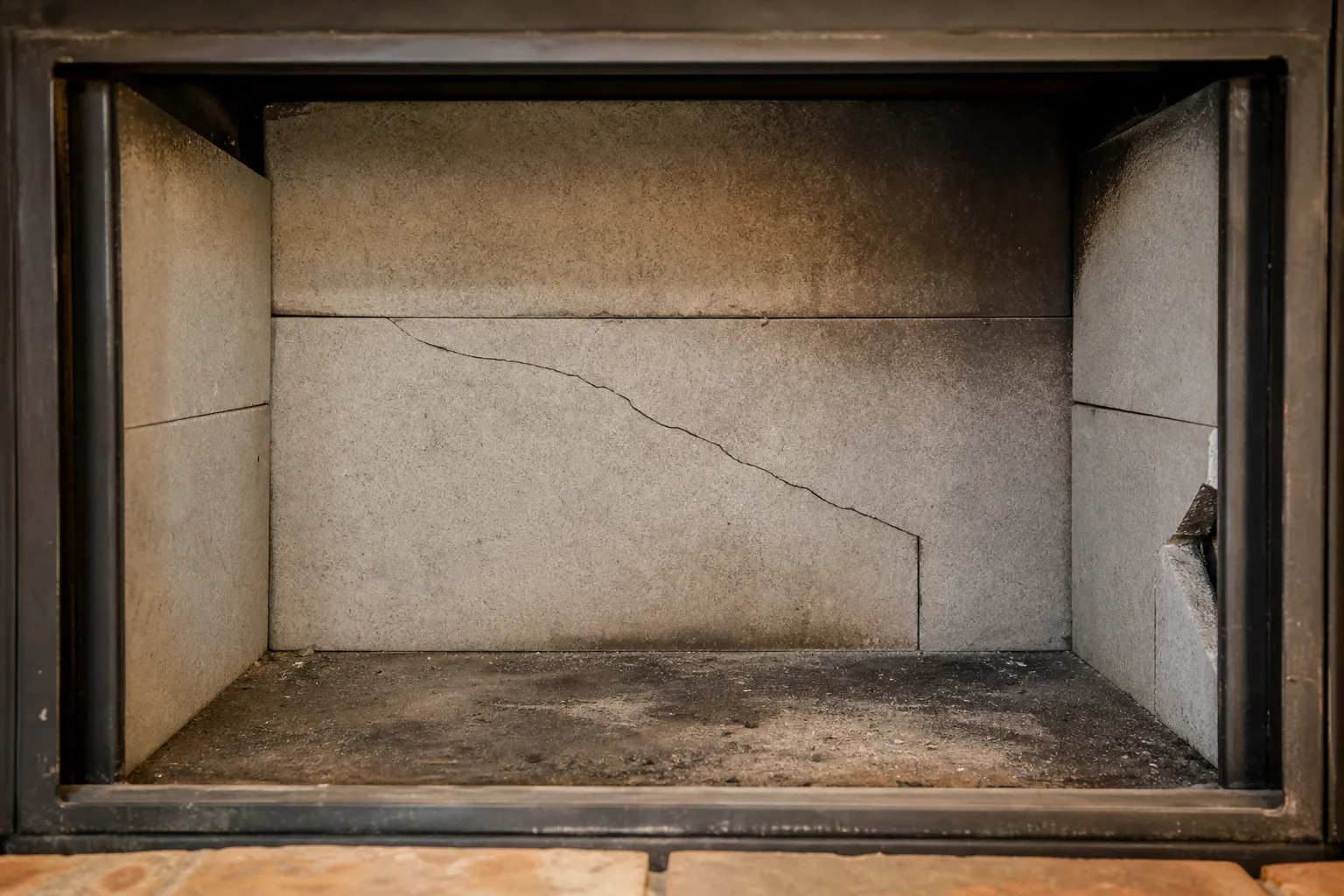
| Refractory panel | Low tier | Cracked gray liner panel in a prefab firebox |
| Gas valve repair | Low to middle | No gas flow, or a valve that will not hold |
| Firebox mortar repair | Middle tier | Open gaps between the firebricks |
| Metal firebox, hearth, or mantel | Middle, wide swing | Varies entirely with material and damage |
| Repointing the stack | Middle to high | Failed exterior joints, priced by the square foot |
| Chimney crown repair | Middle to high | Cracked slab on top; sealing alone sits far lower |
| Firebox replacement | High tier | Damage past the point of patching |
| Fireplace surround | High, wide swing | The visible face around the opening; material drives it |
| Flue liner replacement | Highest tier | Cracked tiles, priced by height and material |
By fuel, the pattern holds roughly like this: electric units are the least expensive to fix, gas sits in the middle with the widest spread, and wood burning masonry reaches the highest ceilings because its failures are structural.
Fireplace Repair Cost for Gas Fireplaces
Gas units concentrate their failure points in a small area: the pilot, the sensors sitting in its flame, and the valve they report to. That is good news, because it is a short list to work through.
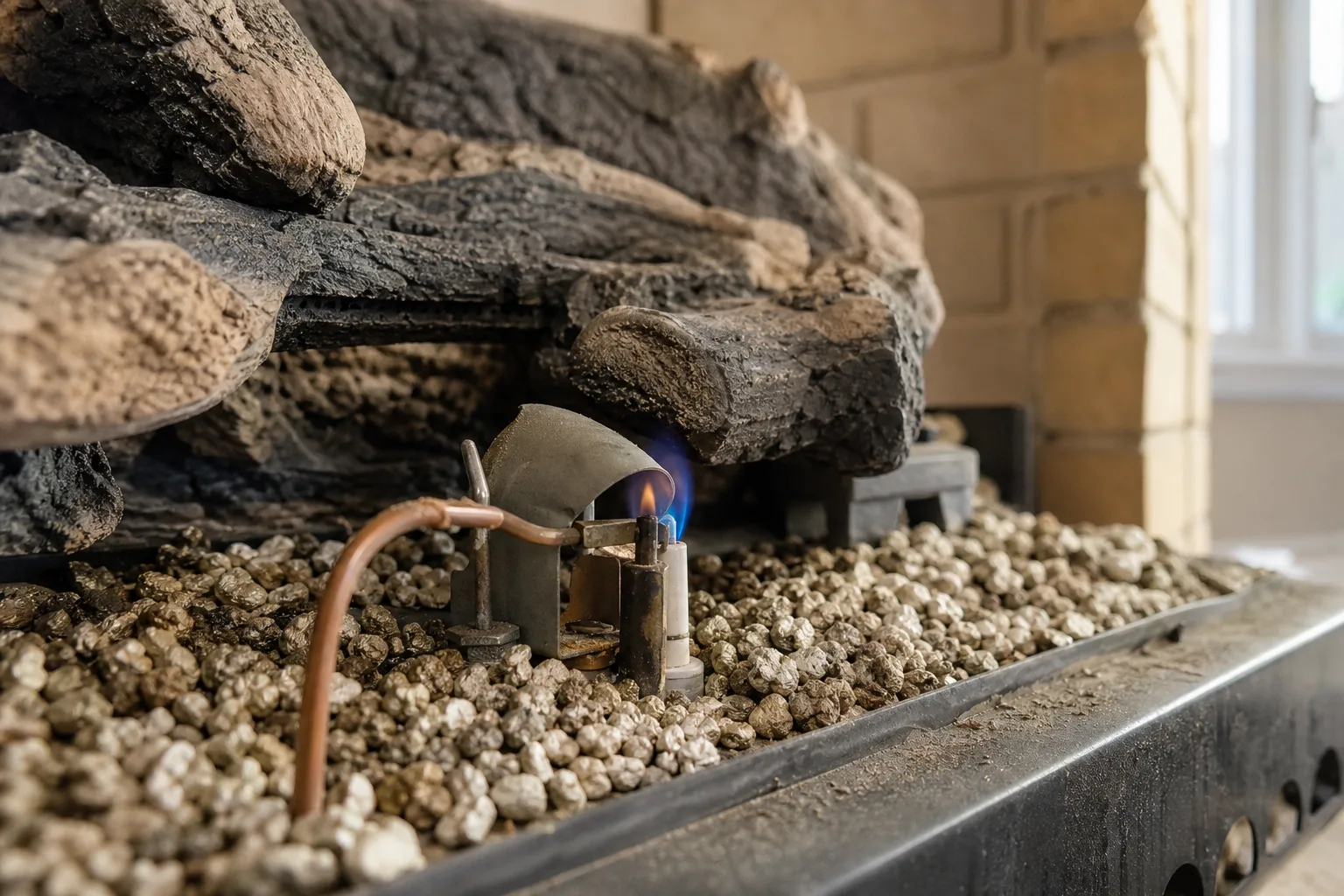
A pilot that will not stay lit is a familiar complaint in this trade. Here is why it happens. The pilot flame heats the tip of the thermocouple, two dissimilar metals joined at that tip generate a tiny DC voltage, typically twenty to thirty millivolts, and that current runs down a copper tube to an electromagnet in the gas valve. The magnet holds the valve open. When the thermocouple weakens with age, the magnet lets go and the pilot drops the moment you release the knob.
Small part, short visit. It is the cheapest real outcome on this list.
The expensive end is the valve and the sealed combustion components. Those are not homeowner territory under any circumstances.
One more thing worth knowing: on a direct vent unit the glass sits against a flat black gasket rope and forms part of the sealed combustion system, so a failed gasket is a real repair, not a cosmetic one.
From the field: A symptom worth recognizing on a gas unit is the pilot that lights and then drops the instant you let go of the knob. It sounds alarming to a homeowner. It generally sits at the inexpensive end of everything on this page.
Fireplace Repair Cost for Wood Burning and Masonry Fireplaces
Masonry is a different animal. Much of it wears slowly, over years, and then one inspection reveals it all at once. It can also fail in a single afternoon: a chimney fire, a severe storm, a lightning strike, an earthquake, or work done on the roof can damage a stack immediately, which is exactly why NFPA 211 calls for a Level 2 inspection after any of those.
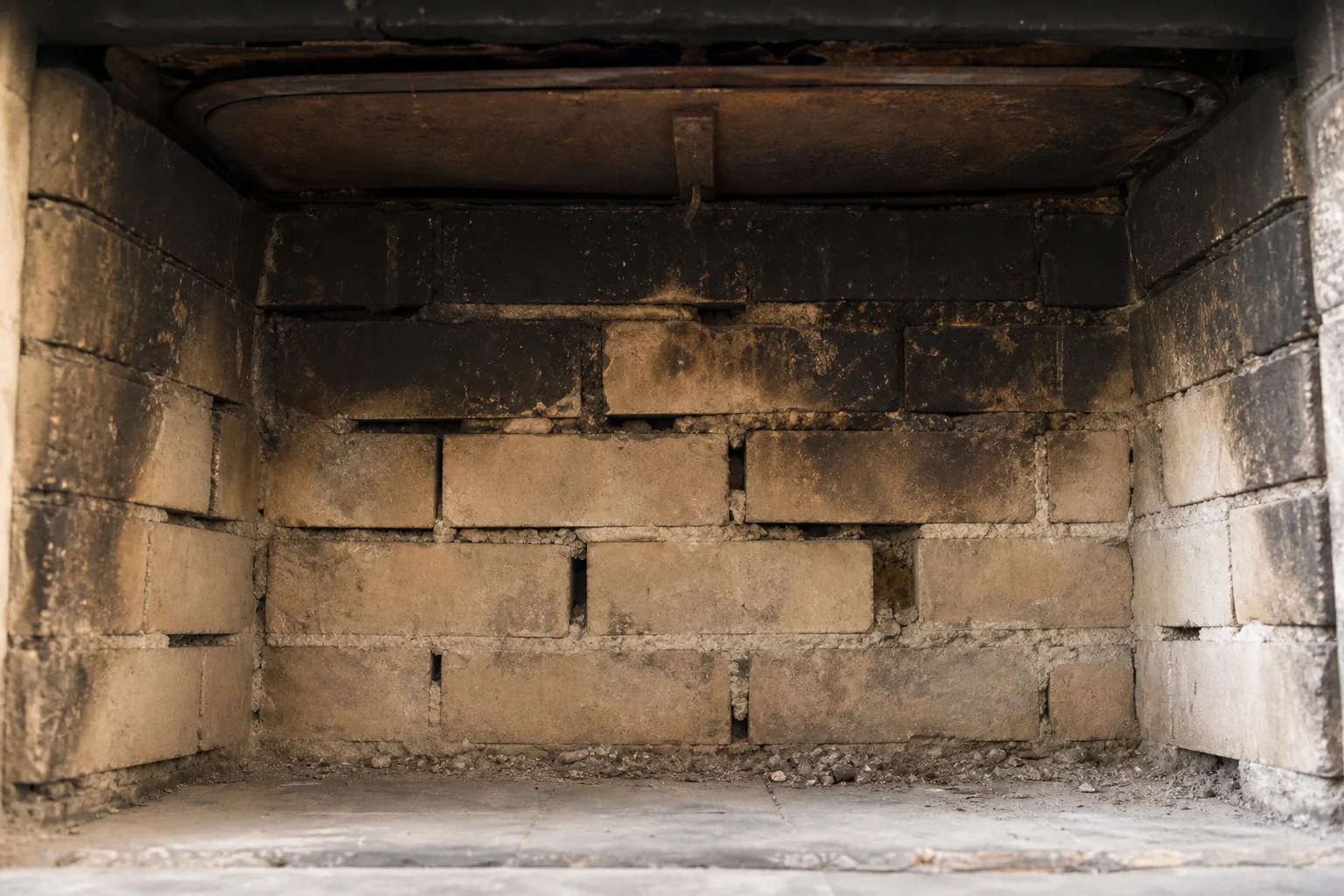
Inside the firebox, the damage you can see yourself is missing mortar between the firebricks. Take a flashlight and look at the joints. If you can push a finger into a gap, the joints have failed and heat is reaching what sits behind them.
Above that, the damper: cast iron plate and frame at the throat, rusted orange brown after decades of moisture, with flakes sitting on the smoke shelf below. Stuck is a cheap problem. Rusted into pieces is not.
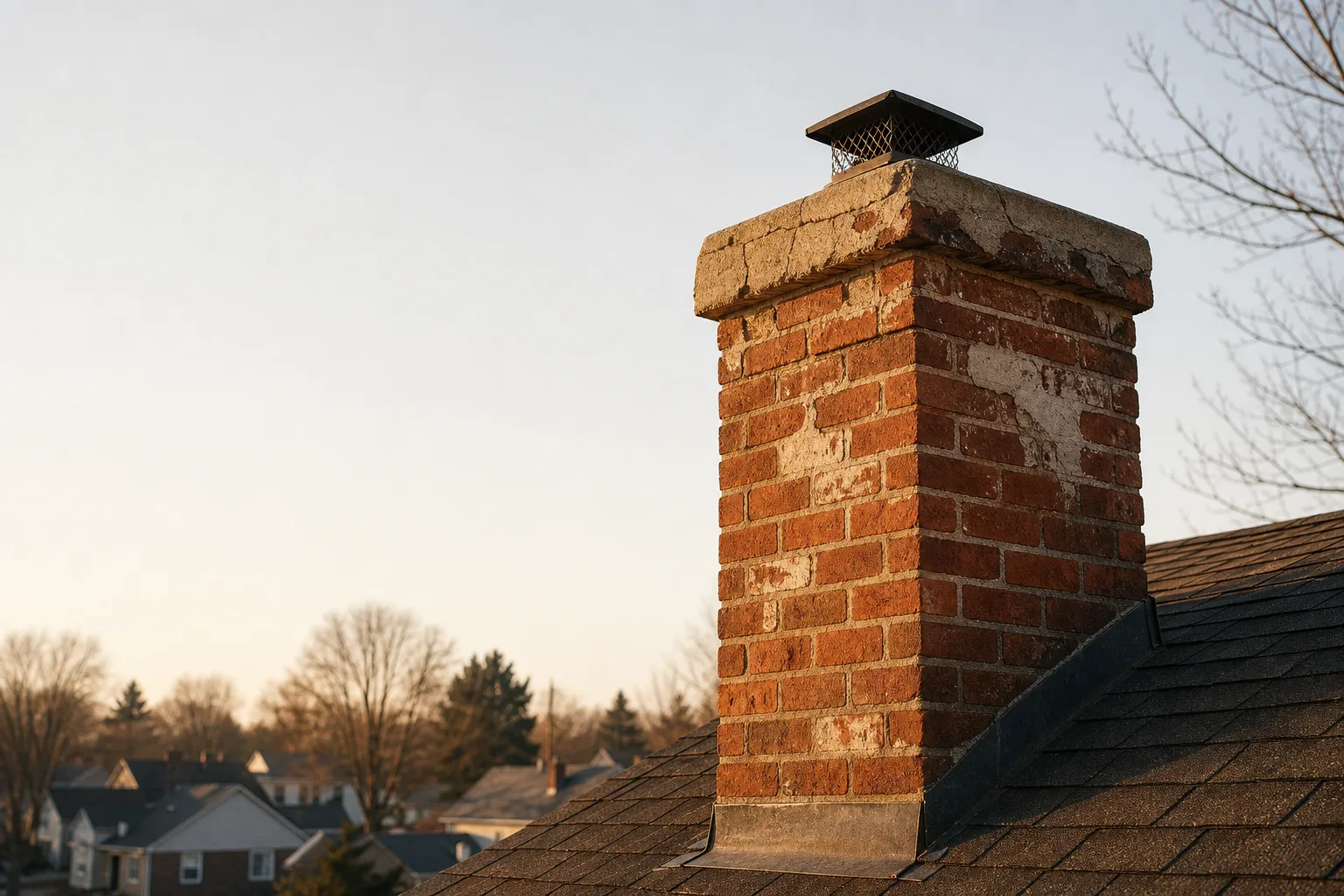
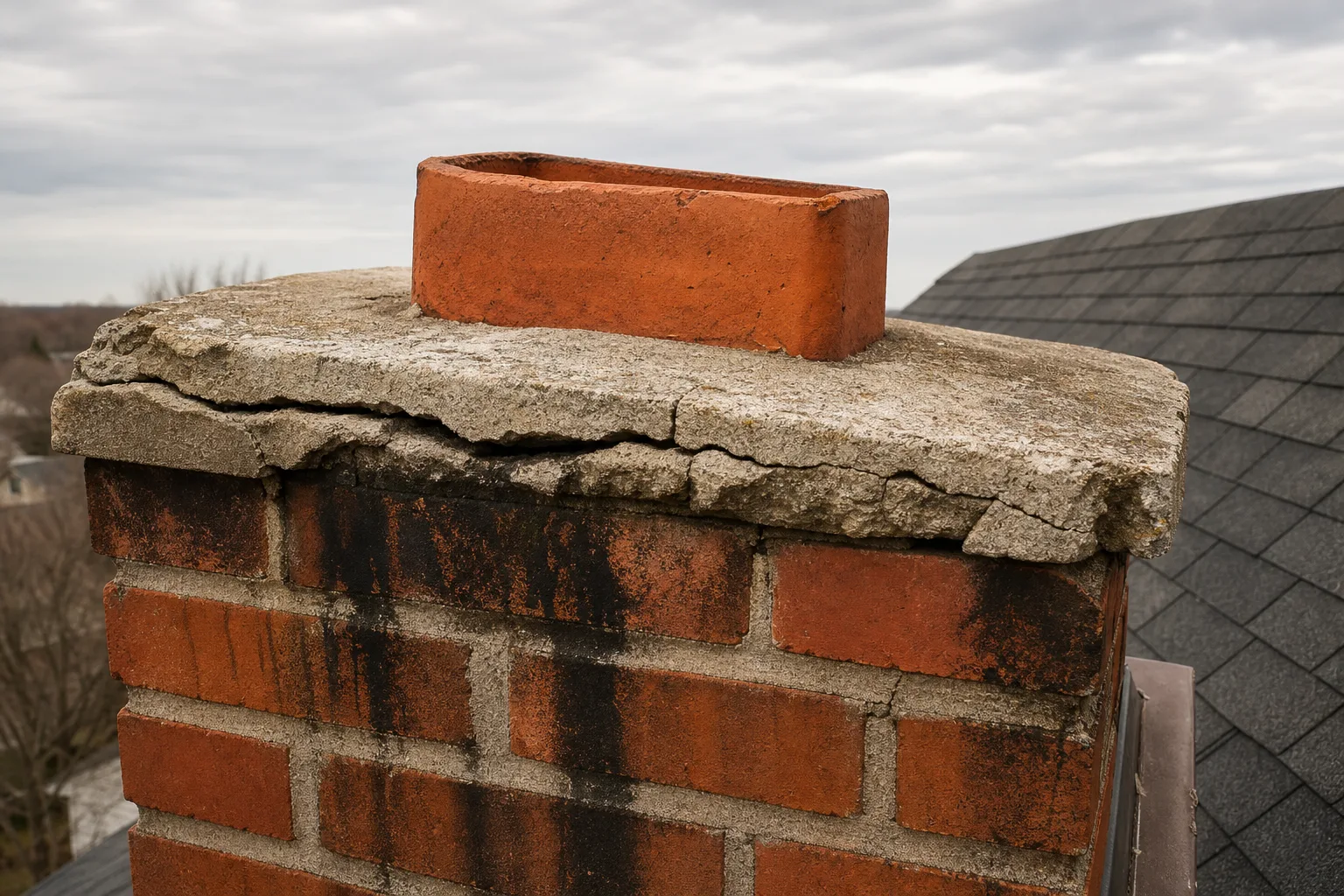
On the roof, the crown is the concrete slab that sheds water off the top of the stack. When it cracks, water goes straight into the masonry, and the dark stain spreading down the brick underneath is the tell. Crown work is among the highest value repairs on this whole list, because it stops what causes the other repairs.
The flue liner sits at the top of the price scale. Cracked clay tiles mean combustion gases can reach the framing around the chimney, and that is not a repair you negotiate down.
Prefab Fireboxes and Refractory Panels
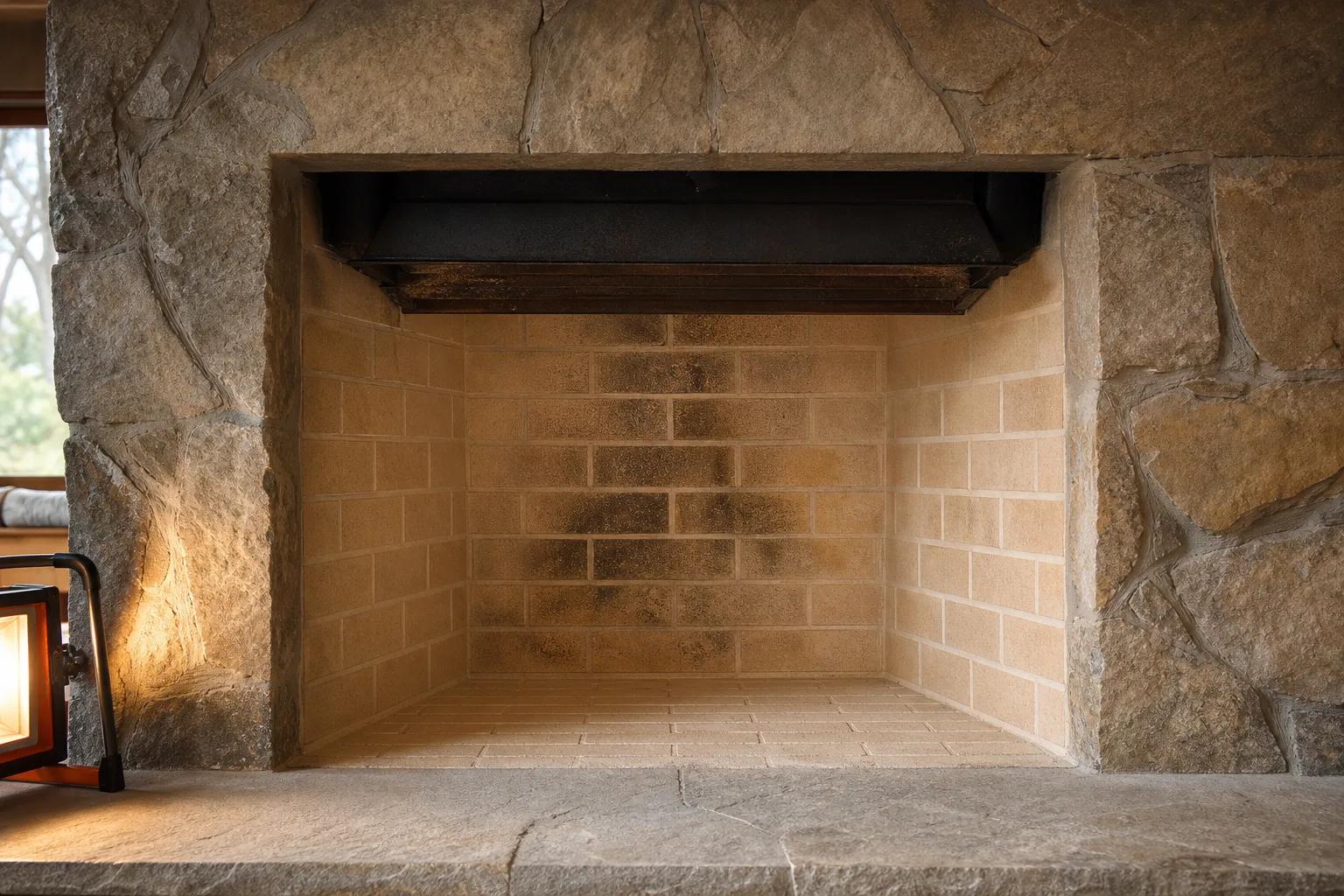
If your fireplace is a metal box with light gray flat panels lining the back and sides, you have a prefab, also called a zero clearance unit. Those flat gray liners are fireplace refractory panels, and they crack.
There is an actual threshold here, which is unusual and useful. The Chimney Safety Institute of America's guidance: replace a panel once a nickel fits edgewise into a crack, or once the surface has abraded more than a quarter inch deep. A common working rule is that a crack narrower than about a sixteenth of an inch, one a dime will not fit into, may be repairable.
Multiple cracks, full depth cracks, or any crack near the smoke chamber opening call for a professional look before anyone patches anything.
Behind those panels is sheet steel. Once a panel stops shielding that steel from flame, the conversation can shift from a panel to the whole firebox, which is a long way up the scale.
Which Repairs Cannot Wait, and Which Usually Can
Not one page in the top results for fireplace repair cost will tell you this, and it is the most useful thing here. Price is only half the decision. The other half is time.
Some of what a sweep finds is a genuine emergency. Some of it is ordinary scheduled work. Confusing the two is how people either panic or shrug off something that matters.
Stop using the fireplace now if any of these are true:
- You smell gas, at any strength, at any time. Leave, then call the gas utility first, not a repair company.
- A carbon monoxide alarm has sounded, or someone in the house gets headaches, nausea, or dizziness that clears up when they leave.
- The firebox is cracked through, or you can see daylight, framing, or the metal shell behind a failed panel or joint.
- You have had a chimney fire, even a small one you thought you got away with, and nobody has inspected the flue since.
- Smoke rolls back into the room instead of drawing up, and it did not used to. A draft problem that appeared out of nowhere is a different thing from one you have always had, which a fireplace smoke guard sometimes addresses.
- You can see cracked or displaced flue tiles, or a liner that has separated.
- The damper will not open at all.
These are often handled as scheduled work rather than emergencies, though only an inspection of your specific system can settle it:
- Failed mortar joints in the firebox, where the material behind them still appears sound.
- A hairline crack in a refractory panel that a dime will not fit into, subject to the manufacturer's own guidance for that unit.
- A cracked chimney crown with no water coming inside. Get it done before the freeze and thaw cycles, though. Water sitting in masonry through a winter is what turns a small job into a large one.
- Hazed or chipped glass on a gas unit, assuming the seal is intact and the manufacturer permits continued use.
- A rusted chimney chase cover holding standing water. Not this week's crisis. Do not let it go two more years either.
- Cosmetic spalling on the exterior brick face, where flakes have popped off and left pale patches behind.
Safety note: One question sorts most of these: can combustion products reach something they should not, meaning your living space or the wood framing around the chimney? It is not the only test, though. A gas odor, a carbon monoxide alarm, or anything your appliance manufacturer flags means stop regardless of what else looks fine. When you cannot tell which list your problem belongs on, treat it as the first list until somebody who can actually see up the flue tells you otherwise.
Not sure whether what you are seeing can wait? Tell us what your fireplace is doing and we will match you with an independent chimney company in your area that handles this exact repair. We ask every company in the network to put its estimate in writing before any work starts, and you should insist on exactly that. Call (513) 655-6702, or request service and we will take it from there.
Why the Same Repair Gets Quoted at Wildly Different Prices
Time to pay off the promise from the top of the page. Two homeowners, two nearly identical cracks, two quotes that do not resemble each other. Here is what actually drives that spread, and almost none of it is greed.
Access, Height, and How Much Has to Come Apart
A one story ranch with a stack you can reach off a ladder is a different job from a three story house where the same repair needs staging, a roof jack, and two people instead of one. Roof pitch changes it again. So does whether a truck can park within a hose length of the chimney.
Then there is the part nobody sees in the photos: how much has to come apart before anyone can even look at the damage. A firebox repair a technician can reach through the opening is one number. The same repair with a stone surround in the way is another.
Masonry Versus Prefab
These are two completely different products that look similar from the couch.
A masonry fireplace is built in place from brick and refractory mortar, and nearly anything in it can be rebuilt piece by piece. Labor heavy, materials cheap.
A prefab is a manufactured metal appliance with a model number on a tag. Its parts either still exist or they do not. When a unit was discontinued years ago, the repair you wanted may be off the table and the conversation turns to replacing the firebox. That is why one symptom can land in a completely different tier at one house than at another, and the fireplace repair cost you read online will not have warned you.
Code Triggers That Change the Scope
This is the invisible one. Some repairs drag other work along behind them.
Relining a flue, changing the appliance, or converting a wood fireplace to gas can trigger requirements that were not in force when the fireplace was built, and bringing the system into compliance can mean work you were not expecting. Many jurisdictions require permits and inspections for work in this category, so ask about it early rather than late.
A company that scopes all of that in looks expensive next to one that prices only the visible repair. The second quote is not cheaper. It is incomplete.
Myth vs. fact: Myth, a higher quote means they are padding it. Fact, in this trade the higher quote is often the one where somebody actually got on the roof, looked into the flue, and scoped the whole failure instead of the symptom. The way to tell them apart is not the total. It is the itemization.
How to Read a Fireplace Repair Estimate Without Getting Taken
If you are reading this with a piece of paper in your hand, this section is yours.
A real estimate is specific. It names the part or the assembly, separates labor from materials, states the diagnostic fee and whether it is credited toward the work, and marks what is included versus what is a contingency.
A quote that gives you a total and nothing else is not an estimate. It is a number.
Ask for the breakdown, and watch how the company reacts to being asked. That reaction tells you more than the total did.
Some fair questions to put to whoever quoted you:
- Which of these line items are required by code, and which are your recommendation?
- What did you actually see, and can you show me a photo or video of it?
- Was this a Level 1 or a Level 2 inspection, and what did the scan of the flue show?
- If you open it up and find more damage, how does the price change, and do I approve that before you keep going?
- Is any of this something that can safely wait, and if so, for how long?
"We will know more when we open it up" is legitimate in this trade, because masonry hides its damage until you disturb it. It becomes a red flag only when it arrives without a ceiling on the number and an approval step.
Pro tip: Ask which line items are code driven and which are recommended. Any company worth hiring answers that instantly and without getting defensive. One that treats the question as an insult has told you something useful for free.
The simplest protection of all: get a second estimate on anything beyond a minor part swap. Not because the first company is dishonest, but because two independent scopes of the same fireplace show you exactly where the real uncertainty sits.
When Repair Stops Making Sense and Replacement Starts
At some point the arithmetic turns over.
For a prefab unit, the flip comes when the firebox itself is compromised rather than just its panels. Let flame touch the steel shell for a couple of seasons and you can end up paying for panels and then paying for the box anyway.
For masonry, the flip tends to arrive at the liner. Relining is the top of the scale, and when a stack also needs repointing and a new crown on top of that, the combined fireplace repair cost starts to approach the territory of a fireplace remodel budget, which becomes a reasonable conversation to have.
No clean rule of thumb exists here, and anyone offering one as a percentage is guessing. What exists is an inspection report, with photos, telling you what is sound.
A useful question to ask yourself is how long you plan to own the house. A crown and a repoint address the structure itself. A patch on a discontinued prefab addresses the symptom and leaves the underlying unit where it was.
Good to know: An inspection is the cheapest way to find out which side of this line you are on. It is a small fraction of the repairs it keeps you from guessing about, and it is the one expense on this page that is almost never wasted.
The Inspection That Comes Before the Estimate
You cannot price what nobody has looked at. That is why an honest company puts a camera up the flue instead of quoting off a photo you texted.
Inspections come in three levels. Level 1 is the routine annual look at readily accessible parts. Level 2 adds video scanning of the flue and smoke chamber plus accessible attic, crawl space, and basement areas. Level 3 means opening up parts of the structure, and it is reserved for suspected serious hazards.
Level 2 is not optional in five situations. Under NFPA 211 it is required at the sale or transfer of the property, when the system changes (a new appliance, a fuel change, a relining, a change in flue shape or material), after a malfunction, after a chimney fire, and after an external event that could have damaged the chimney, such as a severe storm, an earthquake, a lightning strike, or a building fire.
Worth memorizing if you are buying or selling. A home inspector's general look at the fireplace is not a Level 2, and plenty of people find that out after closing.
The practical effect on your fireplace repair cost is straightforward. An estimate written from a Level 2 scan is a scope. An estimate written from a glance through the firebox opening is a guess that will be revised.
Pro tip: Get the inspection report, with the video stills, in your hand before you compare quotes. Then every company is bidding on the same defined problem, and the comparison finally means something.
Annual inspection is the standard recommendation for a reason, and it pairs with knowing how often you should clean your chimney. Together they are how small maintenance happens instead of a rebuild. Inspection pricing varies by region and level, so ask locally rather than trusting a national figure.
How VIO Helps With Your Fireplace Repair Cost
Plainly, because the internet is full of pages that blur this: VIO CHIMNEY is a referral service. We do not sweep chimneys, replace refractory panels, or put liners in. We connect homeowners with independent local chimney and fireplace companies that handle this exact work.
For the situation you are in right now, it looks like this. You request service and tell us what the fireplace is doing, or what a report said, or what your quote says. We match you with an independent company in your area that does that repair, and you deal with that company directly.
We ask every company in the network to put its estimate in writing before any work starts, and you should insist on exactly that. Written, itemized, diagnostic fee spelled out, approval step if the scope grows. Hold anyone to it, including a company you found somewhere else.
If you are trying to sanity check a fireplace repair cost you have already been quoted, a second independent scope is the fastest way to do it, and a phone call is how it starts.
Already have a quote and it does not sit right? Get a second one. VIO CHIMNEY is a referral service that connects you with independent local chimney and fireplace companies. Describe the problem and we will point you to a company that does this work. Call (513) 655-6702.
Your fireplace repair cost comes down to two questions no table can answer: what specifically failed, and whether it can wait. Get a real look up the flue, get the scope in writing, and the number stops being frightening and starts being a decision you are making with your eyes open.
Symptom checker
What is your chimney doing?
Tap the closest match for an honest first answer.