



On this pageLeaning Chimney Repair Starts With One Question: Is It Still Moving?7 sections+6
- Leaning Chimney Repair Starts With One Question: Is It Still Moving?
- Why Chimneys Lean: Five Mechanisms, Four Different Repairs
- The Four Leaning Chimney Repair Paths, Side by Side
- What Nobody Tells You: The Flue Inside a Chimney That Moved
- How Leaning Chimney Repair Is Priced
- How to Read a Leaning Chimney Repair Estimate
- How VIO Helps With Leaning Chimney Repair
Quick answer
Leaning chimney repair means stabilizing whatever moved the stack, not patching the brick, because masonry does not lean back on its own. There are four real paths: underpinning with steel piers, rebuilding above the roofline, a full rebuild from the footing, or removal. The flue needs its own evaluation, since a chimney can be pulled back to plumb and still have cracked clay tiles inside it.
You noticed it the way most people do. Standing off to the side of the house, phone in hand, looking up at a gap between the brick and the siding that was not there last year. Leaning chimney repair is what you typed, and you are probably already holding a number somebody said out loud in your driveway.
Here is what matters before any of that. Masonry does not lean back. Whatever moved that stack is still acting on it, and the real question is not whether it moved but whether it is moving right now.
There is also a second question sitting underneath this one, and most of the pages you are about to read skip it. I will get to it. It is the reason a chimney can be pulled back to dead plumb and still be unsafe to light.
Leaning Chimney Repair Starts With One Question: Is It Still Moving?
A stack that settled in 1974 and stopped is a different repair, at a very different price, from a stack that moved half an inch since spring. Every contractor who walks up to your house will want to know which one you have, and almost nobody tells you that you can start answering it yourself, tonight, for free.
How to measure the lean in about ninety seconds
Stand at the corner of the house and sight along the wall. The stack should read parallel to the siding.
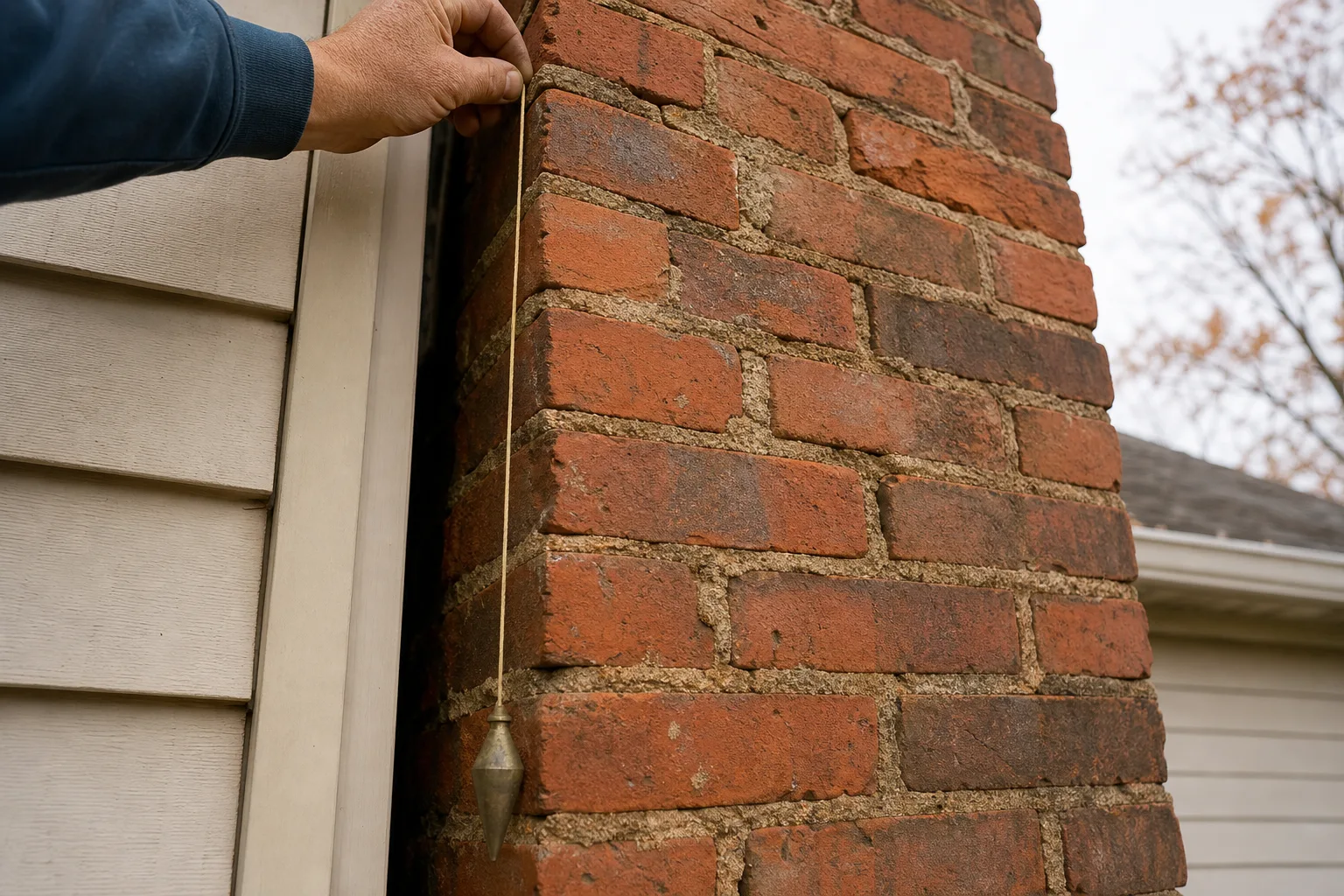
Then get something actually vertical against it. A plumb bob on a string works, and so does a four foot level held upright against the brick. A common inspection rule of thumb treats roughly half an inch out of plumb over four feet as a measurable structural lean rather than an optical illusion. Longer reads truer, so a dropped plumb line beats a short level.
Now measure the gap where the chimney meets the house, once at the bottom and once as high as you can safely reach. A gap that is even top to bottom means the whole stack moved. A gap that widens as it rises means the top is walking away while the base stays put, and those are not the same problem.
The pencil mark, and why the date matters more than the measurement
Pro tip: Draw a pencil line across the gap at its widest visible point and write today's date next to it on the brick. Photograph it. Check again in three or four weeks. That mark costs you ninety seconds and tells a structural contractor more about scope and price than any measurement you take today.
Movement over weeks is an active problem. Movement that stopped decades ago is a maintenance problem wearing a scary costume. Those two call for different scopes of work, and no photograph of a gap tells you which one you have. Only time can.
Clay soil complicates this usefully. It swells when wet and shrinks when dry, so a stack on that ground measures differently in April than in September. If your mark moves and then moves back, that is information too.
What to do tonight, before anybody comes out
- Keep people and cars out from under the stack, and off the roof around it, until somebody qualified has looked.
- Stop using the fireplace. A chimney that has moved has very likely broken something inside it, and you cannot see that from the firebox.
- Measure the gap at the base and near the top. Write both numbers down.
- Mark the gap in pencil and date it.
- Photograph all four faces, the flashing where the stack passes the roof, and the ground at its base.
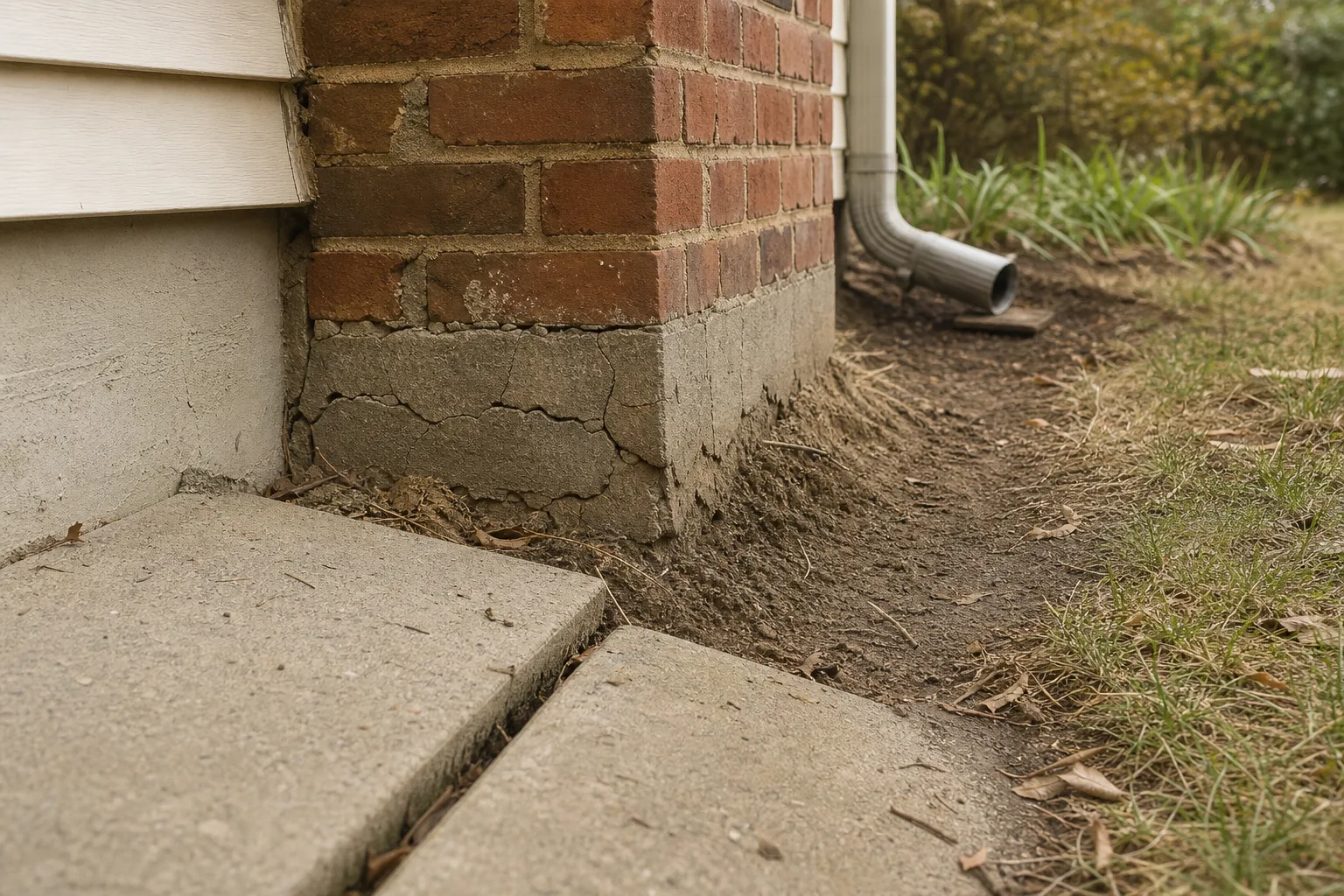
- Look for company: cracked parging at the base, a settled walkway slab, stepped cracks in the nearby foundation, cracks in the firebox.
Safety note: A leaning chimney is a falling hazard as well as a repair, and that alone is reason enough to keep the area clear. Nobody can tell you when or whether a given stack will come down, and anyone who hands you a date is selling.
Those photographs are worth more than you think. A contractor who can see which way the stack is going, and whether the joints open on one face only, arrives with half the diagnosis done.
Why Chimneys Lean: Five Mechanisms, Four Different Repairs
The internet collapses all of this into "foundation problems," which is true enough to be useless. There are five distinct mechanisms, they leave different fingerprints, and they do not get the same fix.
A footing that settled, or never was big enough
A masonry chimney is enormously heavy for its footprint, and on older houses it often sits on a footing that would not pass an inspection today. When that footing settles unevenly, the whole stack tilts with it, base and all.
The tell is a lean that runs the full height with a gap roughly even from bottom to top. Poor drainage is usually somewhere in the story, which is why a downspout emptying beside the chimney base is worth photographing.
Soil that moves with the season
Expansive clay swells when saturated and shrinks when it dries. A footing sitting in that soil rides the cycle, and the stack can measure out of plumb differently between a wet spring and a dry August.
This one is sneaky, because it can look like it is getting better. It is not. It is breathing, and every cycle works the joints a little further apart.
The stack that leans toward the house, not away from it
Here is a mechanism almost nobody writing about this mentions, and it changes the answer completely.
On many houses, the part of the chimney above the roofline does not carry down to a footing at all. Its wall bears directly on the roof decking. Masonry contractors who work on this describe what follows: sustained load wears the wood, rafters and decking under those bricks, the wall sags, and the chimney leans in toward the house.
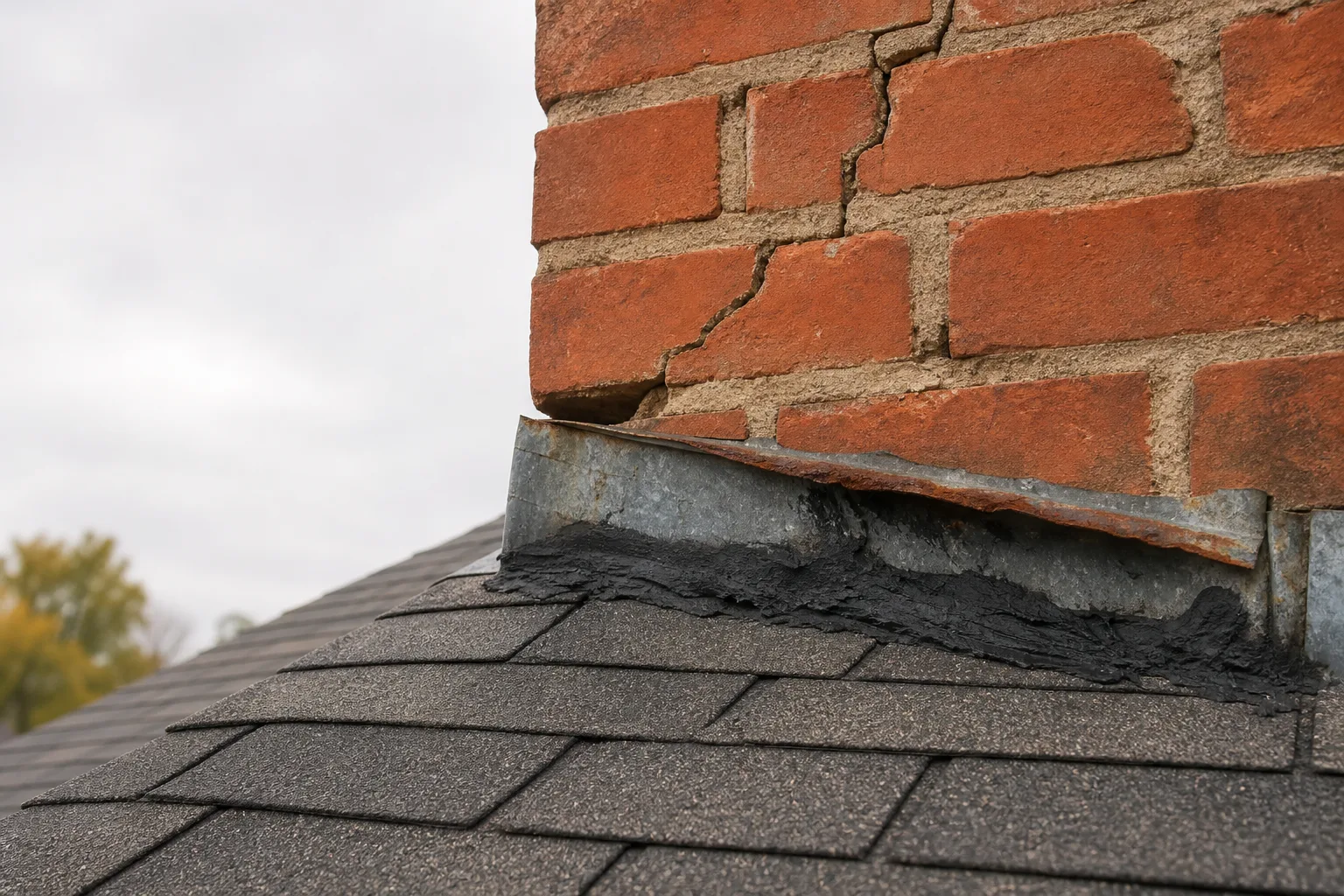
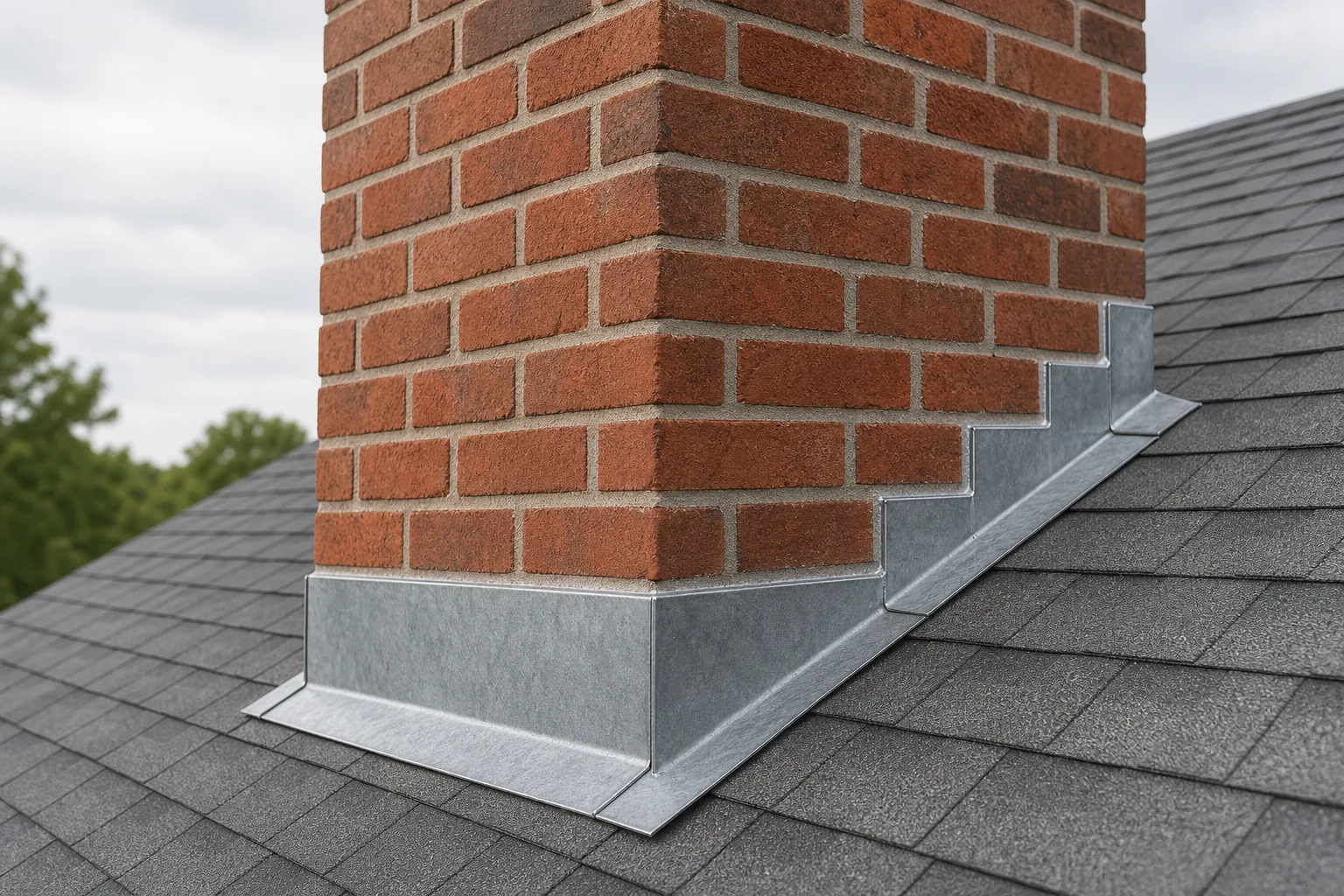
The direction is the clue. A stack tipping away from the wall is usually a ground problem. A stack tipping into it, flashing crushed on the uphill side instead of stretched open, may be a framing problem sitting eighteen feet above the footing.
From the field: The direction of the lean is the detail people walk straight past. They see that the chimney is crooked and stop looking. Which way it is crooked is the difference between a conversation about piers and a conversation about rafters.
The repair there is carpentry and bracing, not underpinning. Steel piers under a footing do nothing for decking crushed under a brick wall two stories up.
Failed ties and washed-out mortar joints
An exterior chimney is tied into the framing of the house. Those connections corrode, the mortar around them fails, and the top of the stack pulls away while the base stays exactly where it was.
Joints that have washed out also let courses shift against each other. The fingerprint is a stepped crack running diagonally up one face, following the mortar in a staircase, joints recessed and sandy where you can reach them.
Water is the accelerant behind both. Saturated masonry freezing and thawing through a winter opens joints and pops the faces off brick, which is that pale rough crater low on the weather side of old stacks.
Myth vs. fact: The myth is that you can strap or brace a leaning stack back to the house and be done. The fact, and this is one of the few things every source agrees on, is that patching and strapping are not a repair. The cause sits below or behind what you are strapping, and it keeps working.
The Four Leaning Chimney Repair Paths, Side by Side
Every page ranking for leaning chimney repair sells exactly one of these four. That is not dishonesty, it is just what each company does. It does mean you will not find them side by side anywhere you are likely to look.
Read the last column twice. Knowing what a repair does not fix is how you avoid paying for good work on the wrong problem.
| Repair path | What happens | When it is right | How it is usually priced | What it does NOT fix |
|---|---|---|---|---|
| Underpinning with piers | Steel piers driven to load bearing soil or bedrock, brackets under the footing, a jack lifts the stack toward plumb | The footing settled and the lean runs full height | Per pier, plus an overage rate for depth beyond what was assumed | Cracked flue tiles, failed joints, anything above the roofline |
| Rebuild above the roofline | The stack comes down to the roof and goes back up, usually with new flashing and crown | Movement sits in the exposed section, base is sound | By the linear foot of stack rebuilt, plus access and rigging | A settling footing, which will tilt the new brick too |
| Full rebuild from the footing | Everything comes down and goes back up, footing included | Masonry failing through its height, or movement continued after earlier work | As a whole project, and it is the largest of the four | Nothing, but it is the answer people reach for too early |
| Take it down instead | Stack removed to the roofline or entirely, roof patched, appliance revented | The fireplace is unused and the repair math stops making sense | By height, access, and what has to be revented | Selling the house as having a working fireplace |
Underpinning with piers
There are two families. Push piers, also called resistance piers, are driven straight down to bedrock and are the common choice where rock is shallow, generally under about forty feet. Helical piers screw down and rely on load bearing soil instead, and can extend a hundred feet or more where rock is too deep to reach.
Which one is right is a soil question, not a preference. Published sources contradict each other here, some arguing helical piers are less supportive because they never touch rock, others arguing helical is the only workable choice in deep bedrock regions. Both are right about their own ground. Neither can tell you about yours.
Rebuilding above the roofline
If the movement lives in the exposed section and the base is genuinely sound, rebuilding from the roof up is proportional. It is also the repair most vulnerable to a wrong diagnosis: rebuild the top of a stack whose footing is still settling and you have bought a few good years and a bill you will pay again.
A full rebuild from the footing
Sometimes the honest answer, and also the one recommended early and often, because it is unambiguous and it is large. If somebody proposes it on the first visit, ask what rules out the other three.
Taking it down instead
Nobody on page one wants to mention this, and it deserves a seat at the table. If the fireplace has not been lit in fifteen years and the furnace vents elsewhere, removing the stack to the roofline is a legitimate outcome. Think about resale first, because only you know your street.
Not sure which of these four your chimney needs?
That is the one question this page cannot answer from here. It takes someone on a ladder with a plumb line and a look at the footing. Tell us what you are seeing and we will match you with a local company that does this work.
Request service. Call (513) 655-6702.
What Nobody Tells You: The Flue Inside a Chimney That Moved
Here is the loop I opened at the top. Most of the pages ranking for this search are foundation repair companies. They are good at what they do, and almost none of them mention the flue, because the flue is not their trade.
Why a chimney can be pulled back to plumb and still be unsafe to light
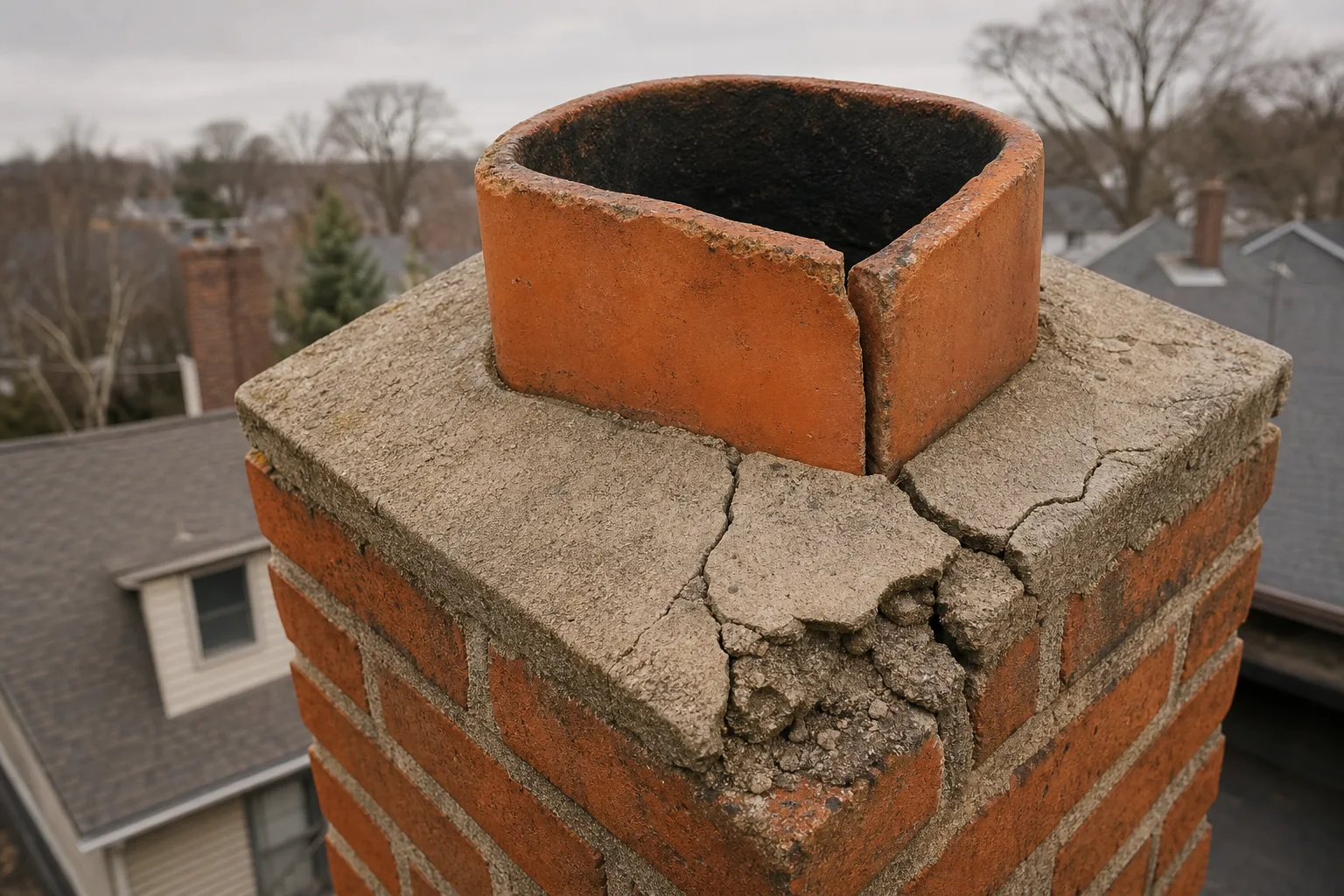
Inside a masonry chimney is a liner, and on most older American houses that liner is a stack of terracotta clay tiles mortared end to end. Clay tile is strong in compression and unforgiving about movement.
When the masonry around it shifts, the clay tiles shift too. They crack. They slide out of alignment. Gaps open in the smoke chamber, that upside down funnel of corbelled brick above the firebox.
Now picture the repair. Piers go in, the jack comes up, the stack returns to vertical. From the street it is fixed. From the firebox it looks exactly as it always did, because you cannot see a displaced tile twelve feet up a dark flue by leaning in with a flashlight.
That is the sentence worth carrying out of this article. A chimney can be perfectly plumb and still be a fire and carbon monoxide risk, and the work that made it plumb is not the work that finds out.
Where NFPA 211 puts a Level 2 inspection
NFPA 211 defines the three levels of chimney inspection. A Level 2 includes a video scan of the flue interior top to bottom, plus accessible structural areas like the attic and crawl space, liner integrity, and clearances to combustibles.
It is required, not suggested, in a specific list of situations: at the sale or transfer of a property, when the system changes (different fuel, different appliance, a change to the flue's shape or material), after a malfunction, after an external event that could have damaged the chimney, and after a chimney fire. A stack that moved far enough for you to see it from the yard is an external event by any reasonable reading.
Good to know: That sale and transfer trigger catches a lot of people searching this exact term. If a lean turned up in a buyer's inspection report, the Level 2 is not an upsell. It is the standard, and the report reaches the buyer either way, so you may as well know what it says first.
So your repair has two scopes. The structural scope brings the chimney back to plumb and stops the movement. The chimney scope finds out what the movement did inside. Sometimes one company does both, frequently they do not, and that is worth knowing before you sign anything.
How Leaning Chimney Repair Is Priced
I am not going to hand you a number, because a number from an article is worse than no number at all on a repair this variable. What I can give you is the shape of the bill, which is more useful when somebody hands you a quote and you have to judge it.
Piers and underpinning
Pier work is priced per pier. Ask how many the design calls for and why, because that count is the whole estimate.
Then watch the depth clause. Contractors commonly quote a flat price per pier to an assumed depth, then charge an overage rate per foot beyond it. If the soil turns out deeper than the assumption, that is where the number grows, and it is the single most common surprise on this kind of job.
Masonry, tuckpointing and rebuild work
Rebuilding above the roofline is usually priced by the linear foot of stack, plus whatever access and rigging the height demands. A tall stack behind a deck is a different job from a short one you can park a truck beside.
Tuckpointing is priced by area, and published guidance on it varies widely enough that I would not trust any single figure. Get it priced on your own wall.
Compare it against what other chimney and fireplace repairs run if you want a frame, but treat leaning chimney repair as its own animal, because the structural work underneath has no equivalent in ordinary chimney maintenance.
What changes the leaning chimney repair price on your house
- Whether the movement is active. The pencil mark question, and the largest single swing on the estimate.
- How deep the piers must go. Bedrock at fifteen feet and bedrock at seventy feet are different projects.
- Access. A stack you can bring equipment to is cheaper than one behind a deck.
- Height above the roofline. Rebuild pricing is per linear foot, and rigging is not free.
- What the flue needs. The line people forget to budget for, and relining a damaged flue is a project of its own.
- Whether the original footing was adequate. Sometimes the honest fix includes a new one.
How to Read a Leaning Chimney Repair Estimate
This is the part worth screenshotting. Whoever comes out, and whether or not we are the ones who sent them, a leaning chimney repair estimate should contain all eight of these.
- The lean, measured and written down. A number, not "it's leaning pretty bad." You have your own measurement now, so you can compare.
- The cause named, not only the symptom. "Chimney is out of plumb" is a symptom. "Footing has settled on the north side" is a cause.
- The footing condition documented, or an explanation of why nobody could get to it.
- Which of the four paths, and why the other three were ruled out.
- The flue evaluated and priced on its own line. Separate scope, separate trade, separate number.
- What happens if the piers go deeper than quoted. Get the per foot overage in writing first.
- Warranty terms spelled out. One published source calls lifetime coverage typical in this category. Typical is not universal. Read what yours says, including whether it transfers to a buyer.
- Who pulls the permit. Structural work on a chimney usually needs one, and "we don't usually bother" is an answer that tells you something.
Pro tip: Bring this list to the visit on paper and ask for the flue on its own line. A contractor who prices the structural work and the chimney work separately understands there are two problems here. One who waves off the flue question is telling you something too.
Get more than one estimate. Not because anyone is cheating you, but because on a repair with four legitimate answers, a second opinion from another chimney specialist is how you learn which one you have.
How VIO Helps With Leaning Chimney Repair
VIO CHIMNEY is a referral network. We do not do the work and we do not set the price. What we do is match you with an independent local company that handles leaning chimney repair, based on where you are and what you are describing.
For this problem that matters more than usual. The structural scope and the chimney scope are two different trades, and the company that is excellent at one is not automatically the one you want for the other. Part of matching you well is knowing which of the two you need first.
We ask every company in the network to put its estimate in writing before any work starts, and you should insist on exactly that. Ask for the lean measured, the cause named, the four paths addressed, and the flue on its own line.
So tell us what you are seeing and we will take it from there. Nothing on this page is a diagnosis, because a leaning chimney repair scope genuinely cannot be set from the ground, from a photograph, or from an article. It can be set from somebody on a ladder with a plumb line, a look at the footing, and a camera down the flue.
Get a leaning chimney repair estimate you can actually compare.
Send the photos and the gap measurement. We will connect you with an independent local company, and you bring the checklist from this page to the visit.
Request service. Call (513) 655-6702.
Go make the pencil mark tonight. Whatever you decide after that, you will be deciding it with information instead of with a number somebody said in your driveway.
Symptom checker
What is your chimney doing?
Tap the closest match for an honest first answer.