



On this pageWhat a Metal Chimney Cover Actually Is7 sections+6
- What a Metal Chimney Cover Actually Is
- Which Metal Chimney Cover Is on Your House
- What a Failing Metal Chimney Cover Looks Like
- Choosing the Metal: Galvanized, Stainless, or Copper
- What Separates a Well-Built Cover From a Bad One
- Measuring a Metal Chimney Cover, and Who Should Go Up There
- How VIO Helps With a Metal Chimney Cover
Quick answer
A metal chimney cover is one of two different parts. A chimney cap sits over the flue opening on a masonry chimney. A chase cover is the metal pan spanning the top of a prefabricated chimney's framed, sided enclosure. Masonry chimneys take a cap; prefab chimneys need both a cap and a chase cover, and the two fail independently. Which one you have decides what to measure and what to replace.
If you have been staring at the top of your chimney wondering what that rusty metal thing is called, you are in a very large club. The phrase most people reach for is metal chimney cover, and it is a perfectly sensible description of what they are looking at. It is also, unhelpfully, the name of two completely different parts.
That matters more than it sounds like it should. One of those parts belongs on a brick chimney and the other belongs on a chimney that only looks like one. They are measured differently, they fail differently, and buying the wrong one is a weekend you do not get back. So before anything else, we are going to figure out which metal chimney cover is on your house.
Then we will read what yours is telling you, because a cover that is streaking rust down your siding is not being cosmetic about it.
What a Metal Chimney Cover Actually Is
A chimney needs something over its opening. Without it, the flue is an open pipe pointed at the sky, and everything that falls out of the sky goes down it.
What that something is depends on how your chimney was built. There are two answers, and the trade has a word for each.
The chimney cap: the lid over the flue
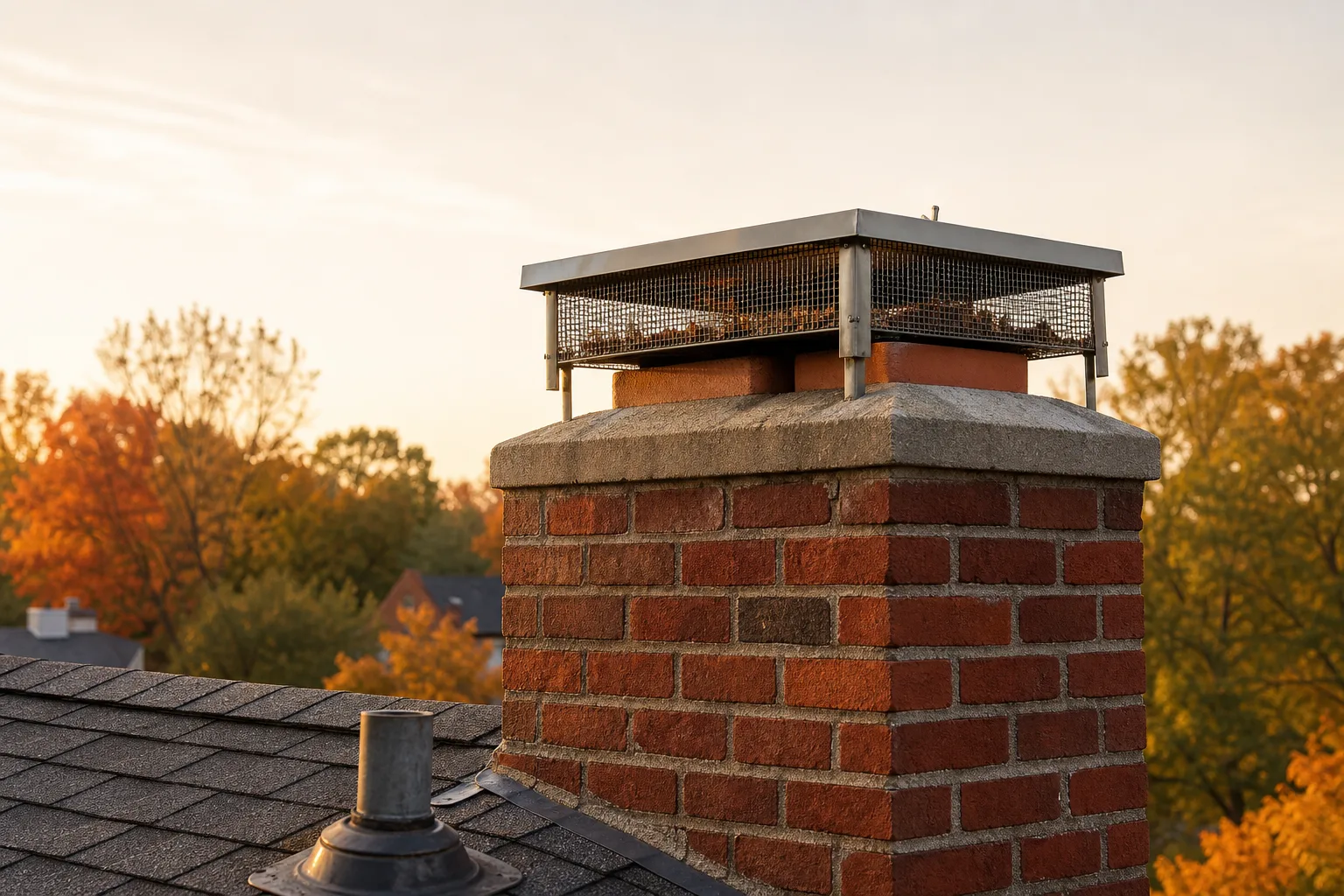
A chimney cap sits at the very top, directly over the flue opening: a metal lid held a few inches up, usually on a cage of mesh that wraps the sides.
Its job is to keep rain, snow, leaves, and animals out of the flue, and to shelter the opening from wind that would push smoke back down at you. On a masonry chimney, this is the only metal part up there.
Caps come in a few shapes. A single-flue cap clamps onto one protruding clay flue tile. A multi-flue or full-top cap spans the whole chimney top on legs at the corners, which is what you want when there are two or three tiles up there.
The chase cover: the pan over a prefab chimney
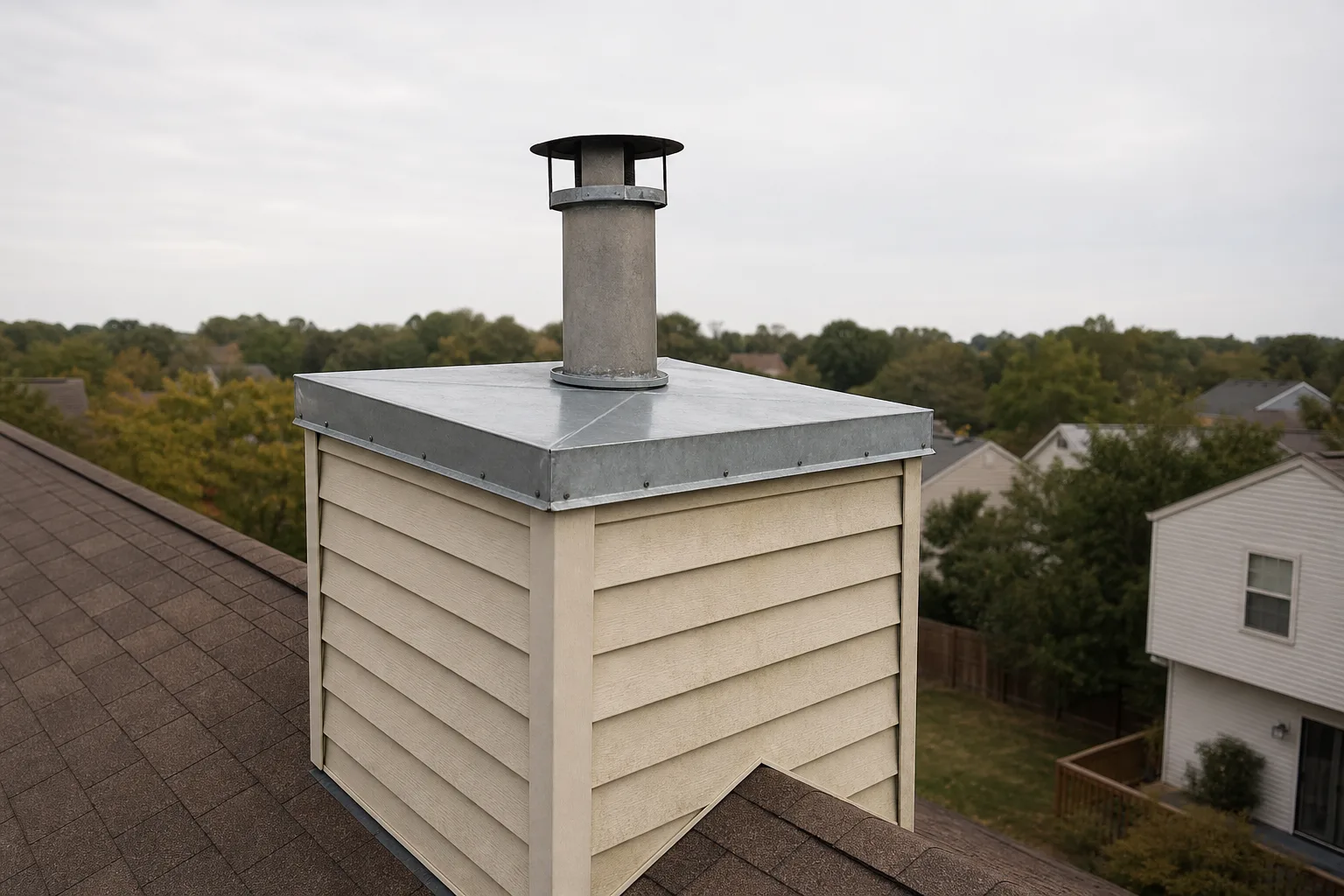
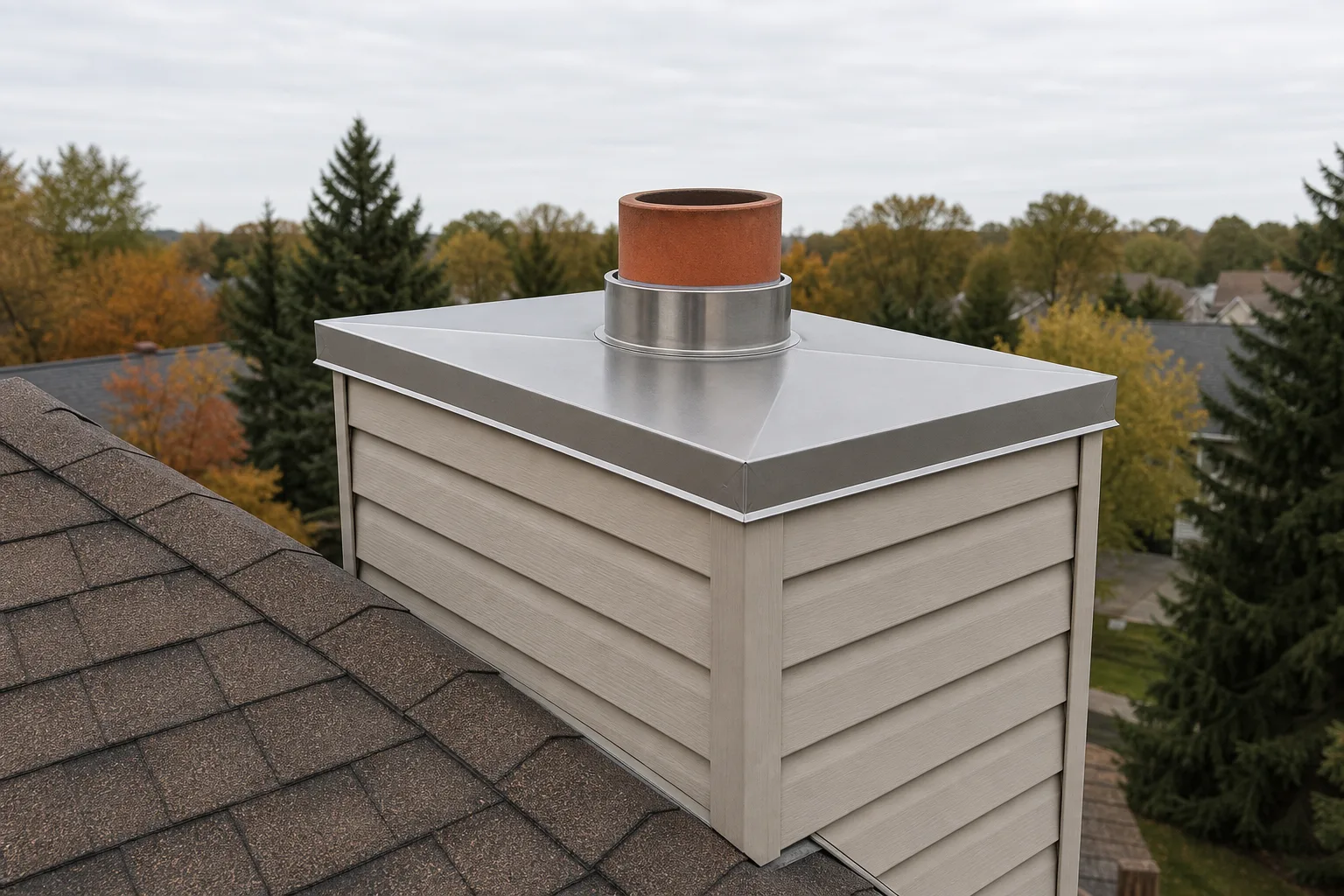
Now the other one. A chase cover is a flat or slightly pitched sheet metal pan that spans the entire top of a prefabricated chimney's framed enclosure.
Prefab chimneys, also called factory-built, are not stacks of brick. They are a metal flue pipe running up through a framed wooden box clad in whatever siding the rest of the house wears. The chase cover is the lid on that box.
Its first job is not the flue at all. It is keeping water out of the wooden structure underneath, which is why a failing one does its damage quietly, inside the chase, where nobody looks.
The other names you will hear
A chase cover also goes by top pan, chase pan, and top flashing. All four mean the same piece of metal, so a quote for a "top pan replacement" is a chase cover.
A shroud is the decorative version: an outer housing, often copper or shaped stainless, that dresses up the top instead of just capping it.
And one word that is not metal at all. A chimney crown is the sloped concrete slab across the top of a masonry chimney, with the flue tiles coming up through it. People call it a cover, but it is poured concrete, and it is repaired rather than replaced.
Good to know: A masonry chimney does not have a chase cover and never did. The concrete crown already does that job, built in. On masonry, the metal part you are looking at is the cap.
Which Metal Chimney Cover Is on Your House
Here is the identification, and it takes about two minutes from the ground.
If your chimney is brick or stone
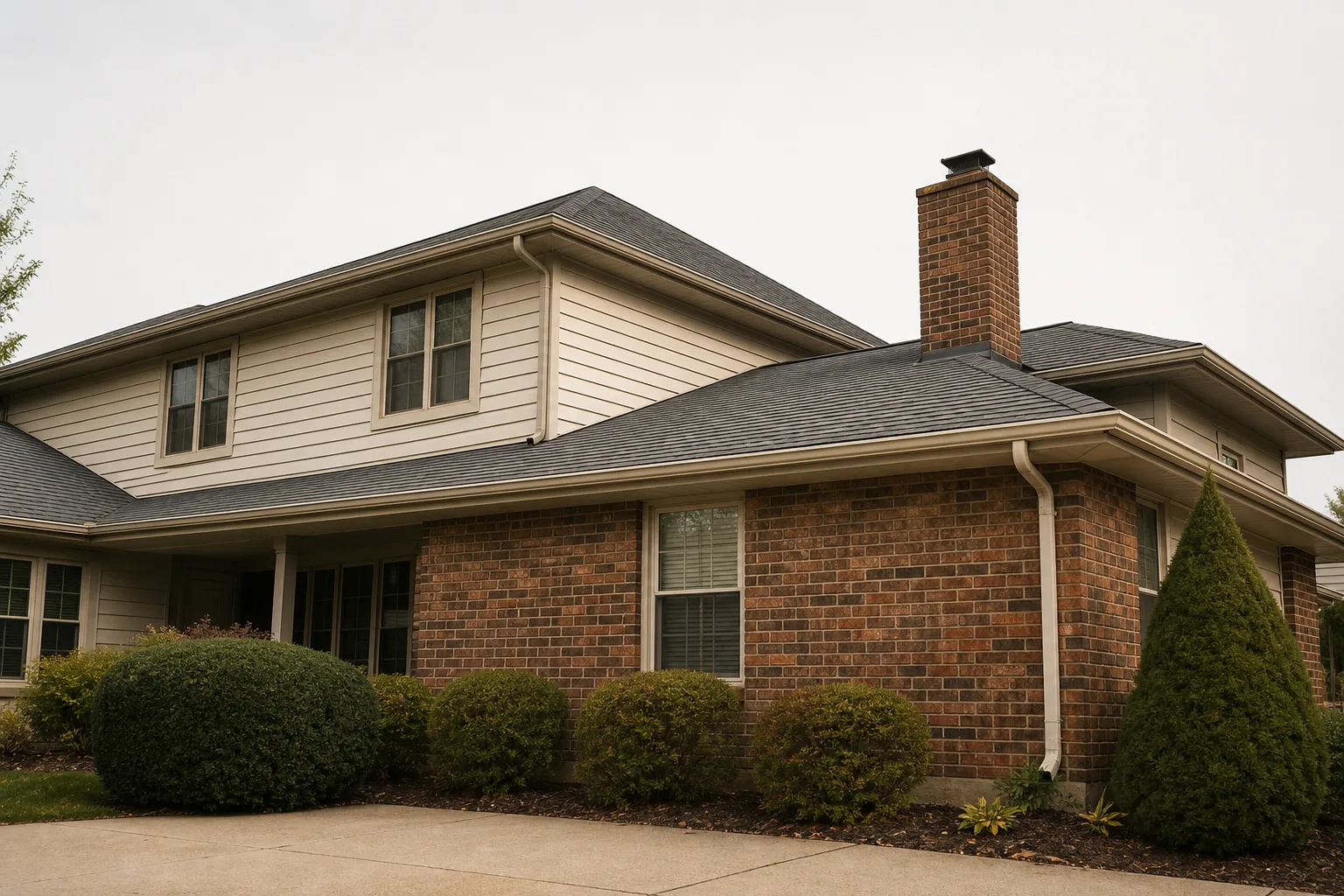
Look at the structure itself. If it is brick, block, or stone all the way up, you have a masonry chimney and you are looking at a cap.
You can usually confirm it by the flue tiles. Many masonry chimneys have clay liner tiles that stick up a few inches past the concrete crown, and clay reads terracotta orange even from the driveway. Other liner types exist and some older stacks are unlined, so treat visible tile as a helpful sign rather than a rule.
Either way, the cap sits over the opening and there is no wide flat pan across the top, because there is nothing for one to sit on.
If your chimney is a sided box
If the chimney wears the same vinyl, fiber cement, or cedar siding as the rest of the house, it is a chase: a wood frame with siding on it, and the thing on top is a chase cover.
The giveaway is the middle of the pan. A chase cover has a round collar punched in it with the metal flue pipe coming up through, usually finished with a small cap on the pipe. Masonry shows tile or masonry at the opening; prefab shows a steel pipe.
The second giveaway is the edge, which turns down over the top few inches of siding like a shoebox lid. You can see that skirt from the ground.
The two-minute check from the driveway
Walk out far enough to see the whole chimney against the sky, and work down this order.
- What is the chimney made of, masonry or siding?
- What is coming out of the top, clay tile or steel pipe?
- Is there a flat pan spanning the whole top, or a small lid over the opening?
- Is the metal dull gray, mottled white, or orange?
- Is anything streaking down the brick or the siding underneath it?
That is enough to name your part and know whether it is in trouble. A phone camera at full zoom does the rest.
Why a prefab chimney needs both parts
This is the most useful thing on this page, and almost nobody says it out loud, because the companies writing about it each sell one part.
A prefab chimney needs a chase cover and a cap, and they fail independently. The chase cover keeps water out of the wooden box; the cap keeps water out of the flue.
Replace the chase cover and leave a missing cap, and rain goes straight down the pipe into the firebox. Put a new cap on the pipe while the pan around it is rusted through, and water soaks framing you cannot see.
A new cap over a rotted pan is money spent on the wrong half. Check both, always.
What a Failing Metal Chimney Cover Looks Like
A metal chimney cover rarely announces itself with a dramatic failure. It tells you quietly, in four or five ways, and all of them are readable from outside the house, though it takes a chimney safety inspection to confirm what the cover has already let in.
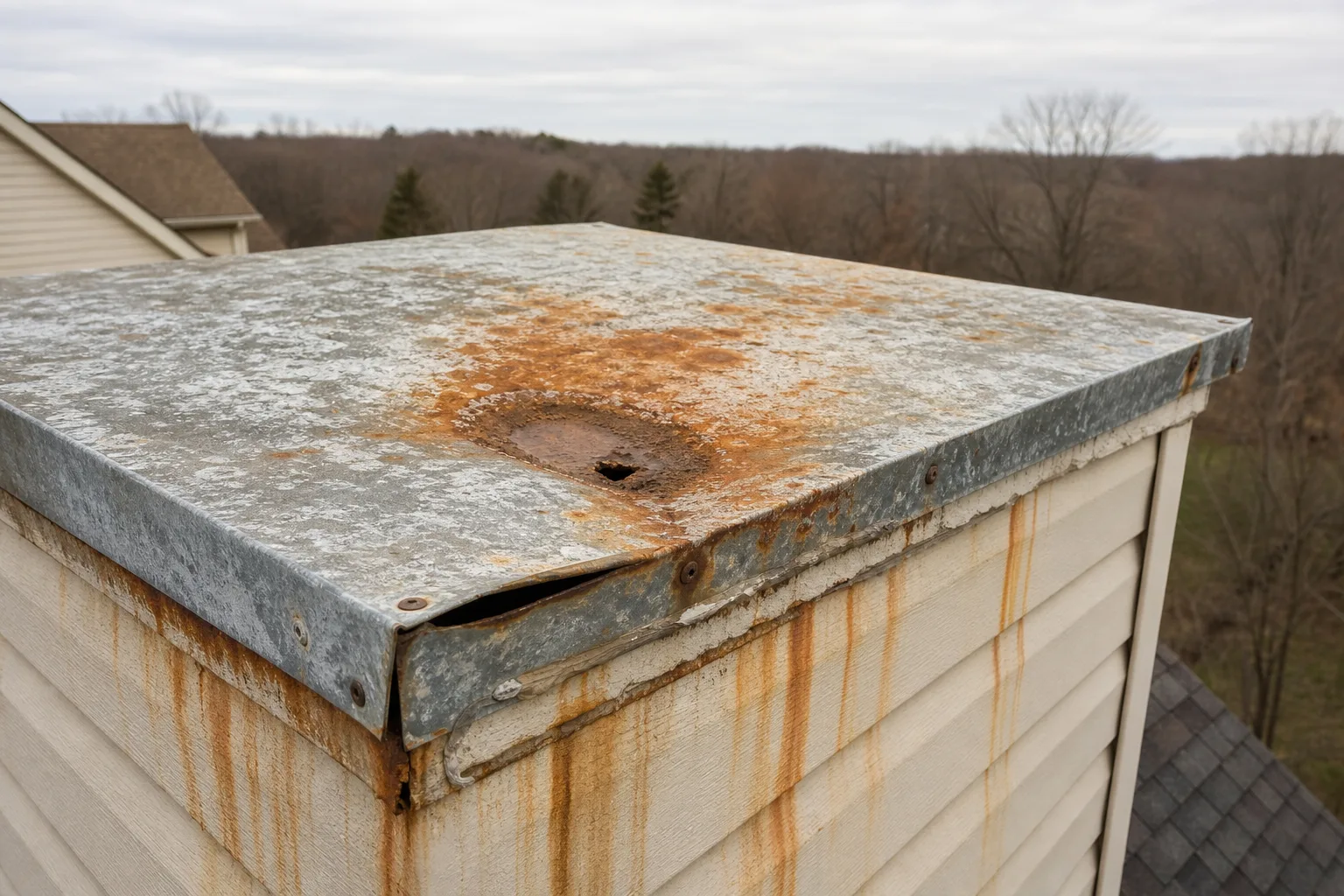
The rust streak down the siding
If there are orange brown streaks running down your siding or brick below the top of the chimney, stop looking for a siding problem. You do not have one.
Rain hits a corroded galvanized or aluminum cover, picks up rust, runs off the edge, and paints it down the wall. The streak is a report from the metal above it. It means the galvanized coating has given up and the steel underneath is going.
Chimney companies treat visible rust streaking on the cover and the chase as a sign the cover is at the end of its service life. By the time rust is traveling, it has usually found a low spot to go through.
From the field: Look at the center of a flat pan rather than the corners. A dried ring of silt in the middle is a record of water that sat there and evaporated, over and over. That low spot is where the metal goes through first, while the corners still look fine.
Water where water should not be
The inside symptoms are less obvious than the rust, and people misread them constantly.
Water dripping into the firebox after a storm, staining on the ceiling beside the chimney, crumbling mortar at the top, or a damp smell near the hearth that gets stronger after rain: all of these can be the cover. A flue that stays wet produces a sour, ashy odor that plenty of people chase around the living room for a season before anyone looks at the top of the chimney.
Scratching, chirping, and nesting debris
An uncapped flue is a sheltered vertical cavity with a warm house at the bottom, and birds, squirrels, and raccoons moving into the flue all find that appealing.
Scratching or chirping in the chimney, or twigs and leaf litter in the firebox, means the mesh on your cap is damaged or the cap is gone. The animal problem is a cover problem wearing a disguise.
Autumn makes it worse: leaves pile onto a screenless flue while the nesting season's leftovers are still in there.
Smoke rolling back on a windy day
If the fireplace draws fine on calm evenings and pushes smoke into the room when it is gusty, wind is getting down your flue.
A cap shelters the opening, and wind directional caps are built for chimneys sitting low relative to the roof. Nothing up there is genuinely windproof, though, and draft has other causes, so treat a damaged cap as a suspect, not a verdict.
Choosing the Metal: Galvanized, Stainless, or Copper
A metal chimney cover gets fabricated in galvanized steel, stainless steel (usually type 304), copper, zinc, and powder coated stainless. The choice is less about looks than about whether you want to think about this part again.
One thing worth knowing before you compare anything: the cover the builder put on a prefab chimney is typically galvanized, which is the least durable of the options on the list.
| Material | How it holds up | What it looks like over time | Choose this if |
|---|---|---|---|
| Galvanized steel | The shortest lived option. The zinc coating sacrifices itself, then the steel corrodes. Freeze and thaw punishes it hardest. | Dull silver when new, mottled white gray, then orange and streaking. | You are replacing like for like on a budget and you accept you will revisit it. |
| Stainless steel (304) | Resists corrosion far better than galvanized. The standard upgrade here, commonly sold with a limited lifetime warranty. | Even dull gray. It does not stay shiny, and that is normal. | You do not want to go back up on that roof, or you live with freeze and thaw. |
| Copper | The most corrosion resistant of the common choices, also sold with limited lifetime warranties. | Bright, then brown, then a green patina that many people buy it for. | The chimney is visible from the street and you want it to look deliberate. |
| Powder coated stainless | Stainless underneath, color on top. The coating is cosmetic and can chip. | Holds color, shows wear at edges and fasteners. | You need it to match black trim or a dark roof. |
Exactly how many years any of these lasts is not a number anyone should hand you. Sellers give wildly different figures for galvanized, and the honest reading is that climate, fabrication quality, and whether the pan sheds water decide the outcome.
Myth vs. fact: The myth is that stainless is just the upsell. The fact is that galvanized and stainless corrode on different timelines, which is why stainless and copper are the ones commonly sold with limited lifetime warranties. Also true: nobody can promise you a service life, and a seller quoting decades is describing marketing, not metallurgy.
What Separates a Well-Built Cover From a Bad One
Material is half the decision. The other half is fabrication, and this is where you stop being a shopper and start being a competent buyer.
The cross break, and why a flat pan is a defect
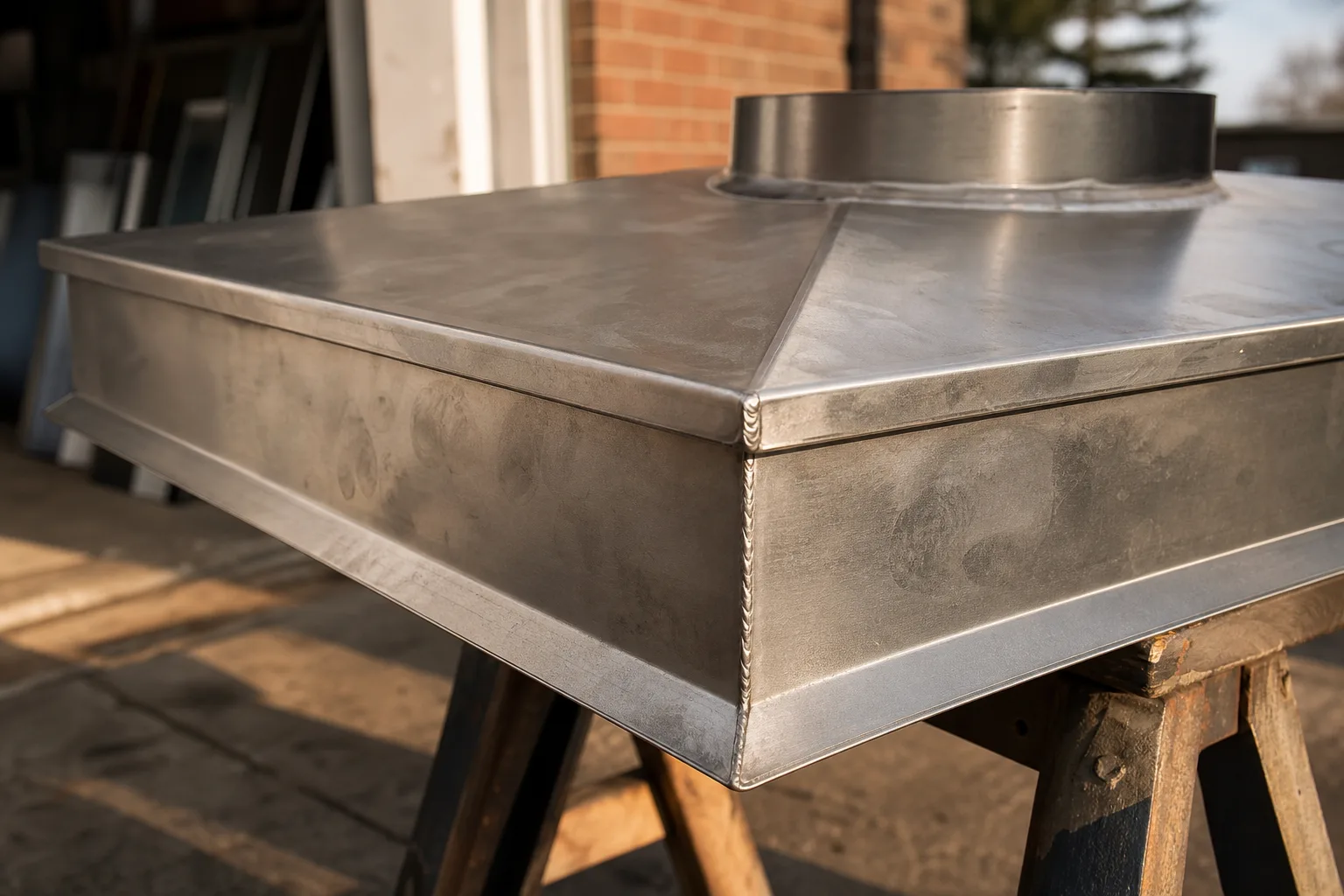
A good chase cover has a cross break: a diagonal crease, sometimes called an X bend, pressed corner to corner so the surface is never flat. Water runs to the edges instead of sitting in the middle.
A dead flat pan ponds. Silt collects, ice forms on top in winter, and the low point becomes the failure point. A flat pan with no cross break was a defect the day it was installed. It did not wear out, it was built wrong.
Drip edge and skirt
The cover's edge should flare outward into a drip edge, commonly about half an inch, so runoff is thrown clear of the siding or brick instead of curling back underneath.
The skirt is the part that turns down over the sides of the chase, commonly around three inches. Too shallow and wind driven rain gets behind it.
Welded corners and the flue collar
Corners should be fully welded and watertight, not folded and caulked. Caulk is a maintenance item pretending to be a seal.
The flue collar is the raised ring around the pipe opening, commonly two to three inches tall, sealed with high temperature silicone where the pipe passes through. That collar is the other common leak point besides the ponding low spot.
Pro tip: You can judge most of this from a single photo. Look for the diagonal crease, a lip standing clear of the siding, and corners with a weld bead instead of a smear of sealant. A flat sheet with caulked corners is the cheap version regardless of what the invoice says.
Gauge, in plain language
Gauge is thickness, and the number runs backwards: smaller means thicker. Chase covers are commonly fabricated in 24, 22, and 20 gauge, with 24 treated as the minimum worth buying and 22 or 20 available as heavier upgrades.
Thicker metal holds the cross break and resists denting from hail and from someone's boot. On a large span it is the upgrade that does something.
Mesh, spark arrestors, and what the code actually says
The mesh cage on a cap does two jobs: it keeps animals out and it catches embers on the way up. Where that screening serves as a spark arrestor, the residential code is specific about it.
You will find chimney companies claiming a cap is required by international building code. That is not what the code says. It describes what a spark arrestor must be where one is installed or required, and whether one is required is set by your local jurisdiction, with wildfire areas like much of California mandating them.
Safety note: Where a spark arrestor is installed or required, the residential code (IRC R1003.9.2, unchanged in substance from 2015 through 2024) sets the mesh so it will not pass a half inch sphere and will not block a three eighths inch sphere, requires net free area of at least four times the flue outlet, requires heat and corrosion resistance equivalent to 19 gauge galvanized or 24 gauge stainless, and requires the arrestor to be accessible and removable so the flue can still be cleaned. Separately, NFPA 211 requires a Level 2 inspection at sale or transfer of the property, on a change to the system, on a malfunction, after a chimney fire, and after an external event such as a storm or earthquake.
Measuring a Metal Chimney Cover, and Who Should Go Up There
No metal chimney cover is one size fits all. The big suppliers rank their measuring forms for a reason: dimensions are the real gatekeeper, not selection.
What has to be measured for a metal chimney cover
Before anyone can order the right part, every line here needs an answer:
- Which part you are replacing: cap, chase cover, or both
- For a chase cover: the outside length and width of the chase top, measured at the widest point of the siding
- For a cap: the outside dimensions of the flue tile, or the full outside dimensions of the crown for a full top cap
- How deep the skirt needs to be to clear the siding and its trim
- The flue pipe diameter
- Where the collar sits: centered, or offset, and by how much
- How many flues there are
- Roof pitch, height, and how the roof is reached
Stock sizes versus custom fabrication
Standard sizes exist and are worth checking first. Single flue stainless caps are sold in fixed squares, and suppliers stock common chase cover dimensions.
Custom is normal here, not exotic. Every major supplier fabricates to measurement, because no two chases were framed quite the same.
The part is simple, the roof is the hazard
Retail listings say easy to install, and for a stock single flue cap on a walkable roof you can safely reach, that is close to true.
A chase cover is a different thing. It is a large sheet of metal that has to be carried up a ladder, set over a pipe, then fastened and sealed while you balance next to it. On a steep or tall roof, in wind, that is not a homeowner job, and handing it off is exactly what a chimney cap installer does.
Safety note: The part is simple and the roof is the hazard. Falls from residential roofs are the serious risk in this project, not the metal. If you are not steady on a ladder, that alone is reason enough to have someone else take the measurements.
Not sure what to measure, or not keen on the roof? Tell us what you can see from the ground and we will line up a local chimney company to get up there, measure the cover properly, and tell you which of the two parts actually needs replacing. Request service, or call (513) 655-6702.
How VIO Helps With a Metal Chimney Cover
VIO is a referral service, so let us be plain about who does what. You describe what you are seeing, we match you with an independent local chimney company that works on your type of chimney, and that company does the work. We do not have crews of our own.
For this problem, the two hard parts of a metal chimney cover job are establishing which part is actually failing and getting accurate dimensions off a roof you should not be standing on. Both of those take someone on the roof with a tape measure, which is the argument for having the company that comes out do it, and for asking them for photographs you can look at yourself.
We ask every company in our network to put its estimate in writing before any work starts, and you should insist on exactly that. Ask which part they are quoting, what material and gauge, whether the cover is cross broken with a drip edge, whether the corners are welded, and whether a cap is included. Those questions tell you quickly whether you are talking to a fabricator or a reseller.
If your metal chimney cover is streaking rust down the siding, missing entirely, or holding a puddle you can see in a photo, it is worth a look from someone local before the next stretch of wet weather.
Get your metal chimney cover looked at by someone local. VIO matches you with an independent chimney company in your area. Describe what you are seeing, the rust streak, the water, the missing lid, and we will connect you with a company that handles covers on your type of chimney. Request service, or call (513) 655-6702.
Symptom checker
What is your chimney doing?
Tap the closest match for an honest first answer.