



On this pageWhat a Wood Stove Blower Actually Does7 sections+6
- What a Wood Stove Blower Actually Does
- What the Blower Changes, and What It Does Not
- Built-In Blower or Add-On Kit: Can You Retrofit?
- Choosing a Wood Stove With a Blower: What Actually Matters
- The Part Nobody Shops For: Your Chimney and Venting
- Living With It: Noise, Dust, and the First Season
- How VIO Helps With a Wood Stove With Blower Installation
Quick answer
A wood stove with blower uses an electric fan to pull room air through a jacket around the firebox and return it warmed. It does not increase heat output, which is set by the fuel and the appliance itself. What it improves is how far and how evenly that heat travels through the house. Because it runs on household power, the fan stops during an outage while the stove keeps burning.
Somewhere between deciding to heat with wood and actually buying the stove, almost everyone hits the same small fork in the road. Two versions of the same model sit next to each other, one costs more, and the difference is a fan bolted to the back. A wood stove with blower promises to push warmth into the rest of the house instead of cooking the one room it stands in, and the product pages lean on that promise hard.
Here is the part those pages leave out. The blower is real, it does something worth paying for, and it is still not the component that decides whether this stove heats your house. Something else decides that, and it is not even the stove.
Let's take the fan apart first, then get to the thing that actually matters.
What a Wood Stove Blower Actually Does
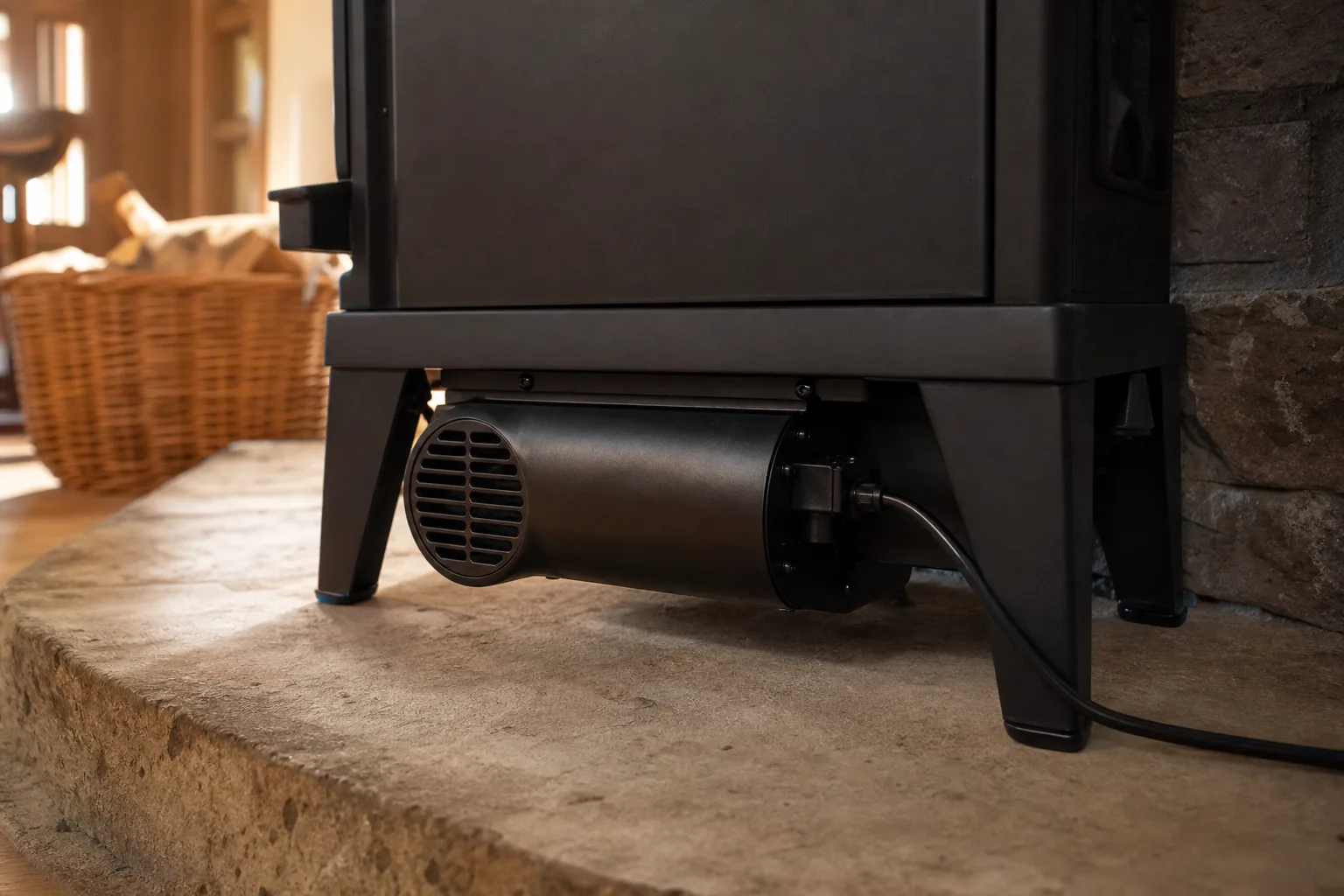
A blower is an electric fan assembly, usually a squirrel cage unit, mounted low on the back or underneath the stove body. It plugs into a standard wall outlet. That is the whole apparatus, and its simplicity is worth holding onto, because marketing language works hard to make it sound like more.
The path the air takes
Most stoves built to accept a blower are not just a steel box. They have a second shell, a jacket, wrapped around part of the firebox with a gap between the layers. The fan pulls cool air off the floor and pushes it up through that gap, where it runs along the outside of the screaming hot firebox wall before exiting back into the room.
Air moving fast across hot metal picks up heat far more efficiently than air drifting past it. That is the entire mechanism. The fan never touches the fire and has nothing to do with combustion.
This is also why the jacket matters more than the fan. A stove built without that second shell has nowhere for the air to travel, so bolting a fan to the back just blows room air at a hot surface. Better than nothing, but a different and much weaker thing. The same jacket and fan arrangement is what makes wood fireplace inserts work the way they do, which is why blower questions come up in both conversations.
The switch that turns it on without you
Most factory blowers run off a thermodisc, sometimes called a snap switch, clipped to the stove body. It closes a circuit at a set temperature and opens it when things cool. Many models add a manual mode and speed control, so check yours.
So the sequence goes: you light the fire, nothing happens for twenty minutes or more, then the fan comes on by itself. Hours later, after the fire has burned down, it shuts off on its own.
A new owner lights the first fire, hears nothing, and assumes the blower is defective. It is waiting for the steel to reach temperature, because a fan across a cold firebox just pushes cold air around the living room.
Good to know: The thermodisc is doing you a favor by being slow. A fan that spun up the instant you flipped a switch would just move unheated air. The same logic runs in reverse at the end of the night, pulling residual warmth out of the steel long after the flames are gone.
Blower vs. stove-top fan, which are not the same part
These two get conflated constantly. A blower is what we have been describing: electric, plugged in, integrated with the stove. A stove-top fan is the small thermoelectric unit you set on the flat top; it generates its own trickle of electricity from the stove's heat to spin a little propeller. No outlet, no wiring, genuinely clever, but in air moved they are in different weight classes. If you have no outlet, it is a reasonable consolation, not a blower's replacement.
What the Blower Changes, and What It Does Not
Moving heat is not making heat
A fan cannot add energy to a fire. The heat in your house comes from wood burning, and the amount of it is set by the wood, the air supply, and the stove's efficiency. The blower changes none of those three.
What it changes is where the heat goes and how fast it leaves the stove. Without a fan, a stove heats mostly by radiation, throwing warmth in straight lines at whatever it can see. That produces the classic wood stove experience: too warm within fifteen feet of the appliance, noticeably cooler at the far wall, with the next room barely participating.
Add the fan and you convert more of that output into moving air. The near field gets less brutally hot, the far corners get warmer, and air in motion has a chance of reaching a doorway and going somewhere. On an open floor plan the difference is substantial. Through a hallway and around two corners, much less so, because a blower is not a duct system and it cannot steer.
Same heat, distributed better. If your complaint is "the living room is an oven and the kitchen is cold," a wood stove with blower addresses that directly. If your complaint is "this stove cannot keep up with the house," the fan is not your answer; look first at sizing, fuel moisture, and draft.
Myth vs. fact: Myth: a blower increases a stove's heat output. Fact: it increases heat transfer and circulation, not output. The BTUs come from the fuel. Retail copy sometimes attaches impressive sounding percentages to blower upgrades, but those figures describe distribution under whatever conditions the seller measured, not a fire producing more energy. Buy the fan for reach and evenness. Buy the right size stove for capacity.
The night the fan does nothing
Now the part no stove listing puts in bold: the power goes out. The furnace is dead, the lights are off, and you go light the stove, because this is exactly the scenario you had in mind when you decided to burn wood.
The stove works beautifully; it does not care about the grid. The fan on the back of it is a dead lump of metal, because it plugs into a wall with nothing behind it.
The stove reverts to radiant heat, and you will be warm in that room. But the even circulation you paid extra for stops during the one event where you most wanted it.
None of this argues against the blower; it argues for knowing what you own. If wood heat is your outage plan, size the stove so the room is livable on radiation alone, and treat the fan as comfort rather than insurance. A generator can run a blower easily, the draw is small; decide on purpose instead of finding out in the dark.
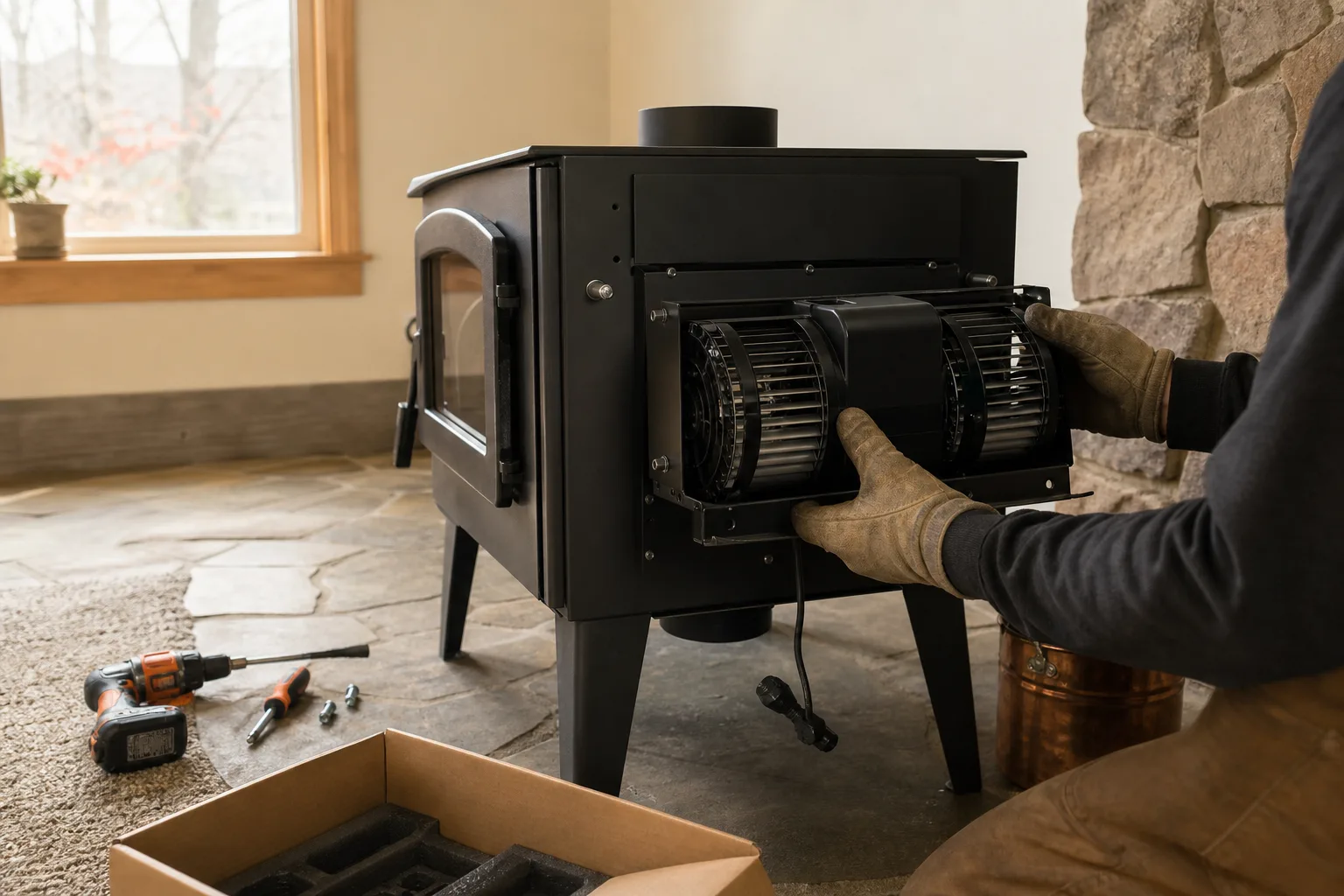
Built-In Blower or Add-On Kit: Can You Retrofit?
Short answer: sometimes, and the difference between the two paths is bigger than the retailers make it sound.
Blowers designed into the stove
Manufacturers sell blower kits built for specific models. They mount to brackets already welded on the stove, connect to a thermodisc positioned where the engineers wanted it, and blow into the convection jacket the stove was built with. Wiring routes are planned, clearances account for the assembly, and the instructions are written for your exact appliance.
If your stove has an optional blower listed by its own manufacturer, that is the one to buy. On many models the kit is designed to be fitted later, so buying the stove now and the fan in a year is a perfectly reasonable plan.
Universal kits, and where they stop
Then there are the universal kits, widely sold, often magnetic, advertised as fitting nearly anything.
Some are decent hardware. A magnetic mount fan will move some air past hot steel and you will feel it. What it cannot do is manufacture a convection jacket. If the stove was built as a single wall firebox, there is no channel for the fan to feed, and no accessory changes the stove's architecture. You get surface air movement, a real if modest improvement, not the performance of an integrated system.
The second issue matters more. A magnetically mounted accessory is not part of the stove's listing. Clearances to combustibles and the tested configuration were established with the appliance as certified. Anything you attach that alters airflow or sits inside a clearance zone deserves a look at the manual first, and if the manual is silent, the manufacturer is the one to ask.
From the field: The most useful question to ask about a blower is not how many CFM it moves. It is whether the stove has a jacket for the air to travel through. That single structural fact separates stoves where a fan transforms the experience from stoves where it politely improves it, and you can often answer it just by looking at whether the stove has a visible second skin or an air gap along its back and sides.
How to tell what your stove will take
Find the model number, usually on a metal data plate on the back or under the ash lip, and go to the manufacturer's page for that model. You are looking for three things: whether an optional blower is listed, whether the body has a convection jacket, and whether there is a mounting provision and thermodisc location.
If the stove is old, unlisted, or you cannot identify it at all, that matters for reasons well beyond the fan. An unidentifiable appliance has no documented clearances, and that question outranks the blower question by a wide margin.
Choosing a Wood Stove With a Blower: What Actually Matters
Assume you are comparing a few models. Here is what is worth weighting and what is mostly noise.
| What to look at | What it actually tells you | The question to ask |
|---|---|---|
| Convection jacket | Whether the fan has a designed path, which matters more than the fan's specs | Jacketed stove, or single wall firebox with a fan attached? |
| CFM rating | Air volume moved, useful across similar stoves, meaningless across different architectures | Measured on this stove, or the bare fan's rating? |
| Square footage claim | A marketing figure from ideal conditions, not a promise about your floor plan | Based on what ceiling height, climate, and layout? |
| EPA certification | Whether the appliance meets current emissions standards | Certified to the current standard? |
| Speed control | Whether you can run it low on a mild night, which decides how you tolerate the noise | Variable speed or fixed? |
| Blower availability later | Whether you can defer the purchase | Sold separately for this exact model? |
CFM and square footage claims
Treat coverage numbers as a rough class indicator and nothing more. Ratings are not standardized between manufacturers, and the figure assumes an open plan, average ceilings, and a climate that may not be yours. A tight new build and a drafty farmhouse of identical square footage are not the same heating problem.
EPA certification
New wood stoves sold in the US generally must meet EPA emissions requirements; confirm the specific model's certification, especially with a used stove or an online deal that seems oddly cheap. Certification affects what you are permitted to install in many jurisdictions, and an inspector or your insurer may ask about it. It has nothing to do with the blower, but it belongs on the same checklist.
Noise and speed control
A blower makes noise. Anyone who says otherwise is selling one. On low, most are a soft hum you stop noticing. On high you notice, and in a quiet room with the television down, quite a bit.
Variable speed decides how you feel about this in year three. A fixed speed blower gives one answer to every evening. A variable one lets you run it barely on during a mild night and open it up when it is genuinely cold. Between two otherwise similar stoves, that is worth more than a modest difference in CFM.
The outlet nobody plans for
Here is the detail that surprises people, and it is embarrassingly practical.
You will choose the stove's location based on clearances, hearth pad geometry, and where the flue can reasonably go. Those constraints often land it in a corner, or against an interior wall, or somewhere that was never wired with an appliance in mind. Then the blower arrives with a power cord that needs a receptacle within reach.
The fixes are all fine and none are free: an electrician adds a receptacle, or you live with a cord running somewhere you would rather it did not. Work it out on paper, while the stove location is still a pencil mark.
Pro tip: Before you finalize where the stove goes, stand in that spot and look for an outlet. If the nearest one is across the room or behind where the hearth pad will sit, add an electrician to your plan now rather than after the installation. It is a small line item when it is scheduled and an annoying one when it is a surprise.
The Part Nobody Shops For: Your Chimney and Venting
Everything so far has been about the appliance. Now the part that determines whether any of it happens.
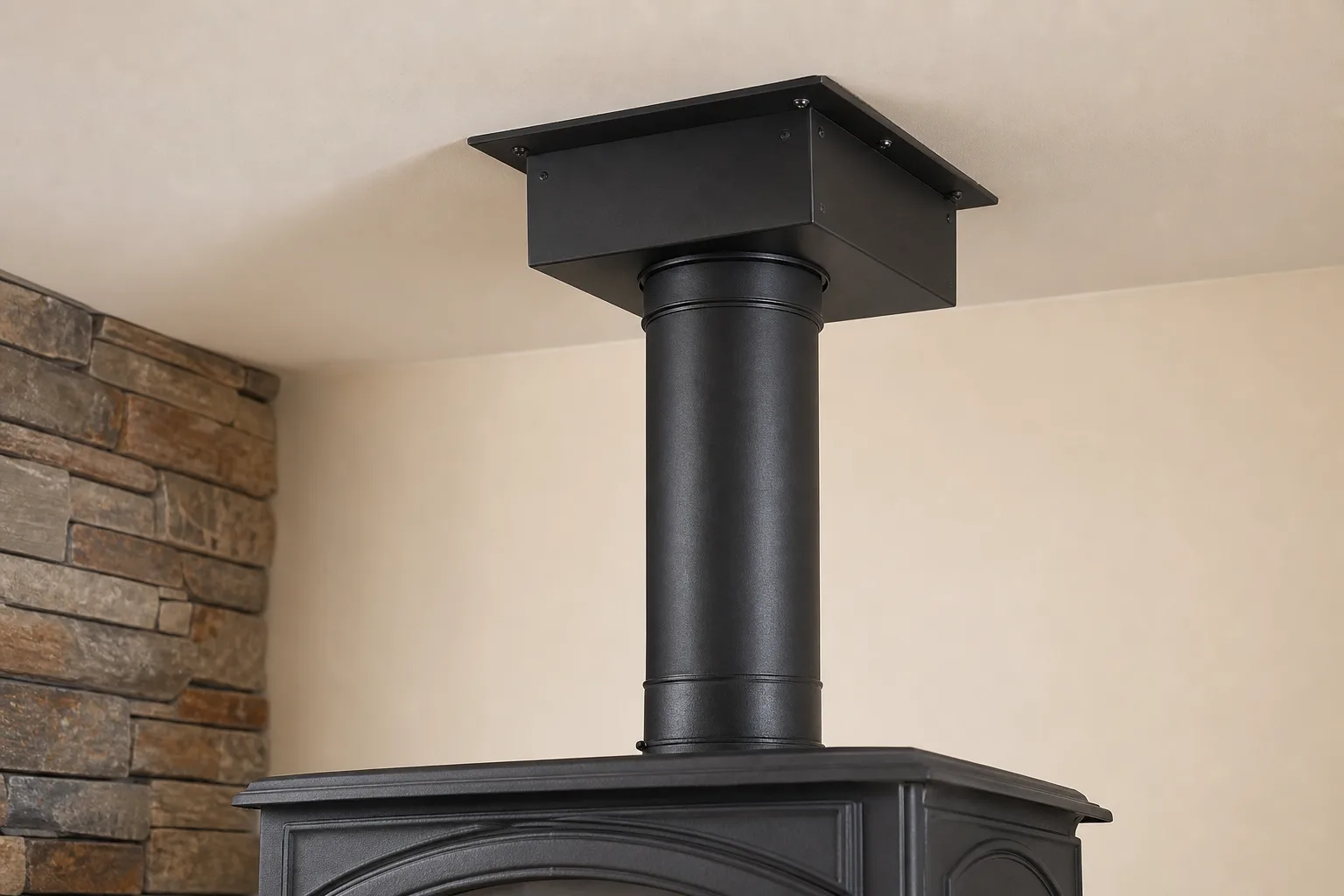
The blower has no effect on venting at all. It does not change draft, flue sizing, clearances, or hearth requirements. It is a room air device on the outside of a hot box. The venting system, meanwhile, is what makes the stove legal, safe, and functional, and it is where these projects succeed or fail.
Flue sizing and the liner
A wood stove needs a flue sized to its outlet and suited to the appliance. Dropping a stove into an existing masonry chimney built for an open fireplace is a plan people arrive with often, and it frequently needs a liner, because a fireplace flue is typically far larger than what a modern stove wants. An oversized flue cools exhaust gases, which weakens draft and encourages creosote to form.
That is why chimney liner installation comes up so often here, and why the answer depends on measurements of your specific chimney rather than a rule of thumb.
Clearances and the hearth pad
Every listed stove carries required clearances to combustible materials and a required floor protection specification. These come from the appliance's own listing and the applicable code, and they are not adjustable by preference. The hearth pad has to meet a stated rating and extend a stated distance. Walls within a certain distance need separation or approved shielding, and the same listing governs the wood stove pipe that carries exhaust from the stove up to the chimney.
None of this is exotic, but it needs checking against your actual room before you buy an appliance that turns out not to fit the space you had in mind.
Why the evaluation comes before the purchase
The usual sequence is: pick the stove, buy the stove, then find out what the chimney needs. The reverse works better.
A chimney inspection tells you what your flue is, its condition, and what it will accept, which in turn tells you which stoves are realistic for your house. Far easier than falling in love with one and discovering the venting will not accommodate it.
Safety note: NFPA 211 calls for a Level 2 inspection when an appliance or the venting system is changed, at the sale or transfer of a property, and after an event likely to have caused damage, such as a chimney fire or a significant weather event. Installing a wood stove into an existing chimney is exactly the sort of system change that triggers it. A Level 2 inspection includes the accessible portions plus a video scan of the flue interior, which is how anyone actually learns what condition the liner is in.
Find out what your chimney will take before you pick the stove.
Flue sizing and liner condition decide whether the stove you like is installable at all. A chimney evaluation answers that before you spend money, not after the appliance is sitting in your driveway. VIO connects you with local chimney companies that handle wood stove venting.
Call (513) 655-6702 or request service to get matched.
Living With It: Noise, Dust, and the First Season
Keeping the fan quiet
You will be aware of the fan for about a week and then mostly stop hearing it. If it still intrudes after that, check the speed setting first. People run variable speed blowers on high for years without realizing there was another option.
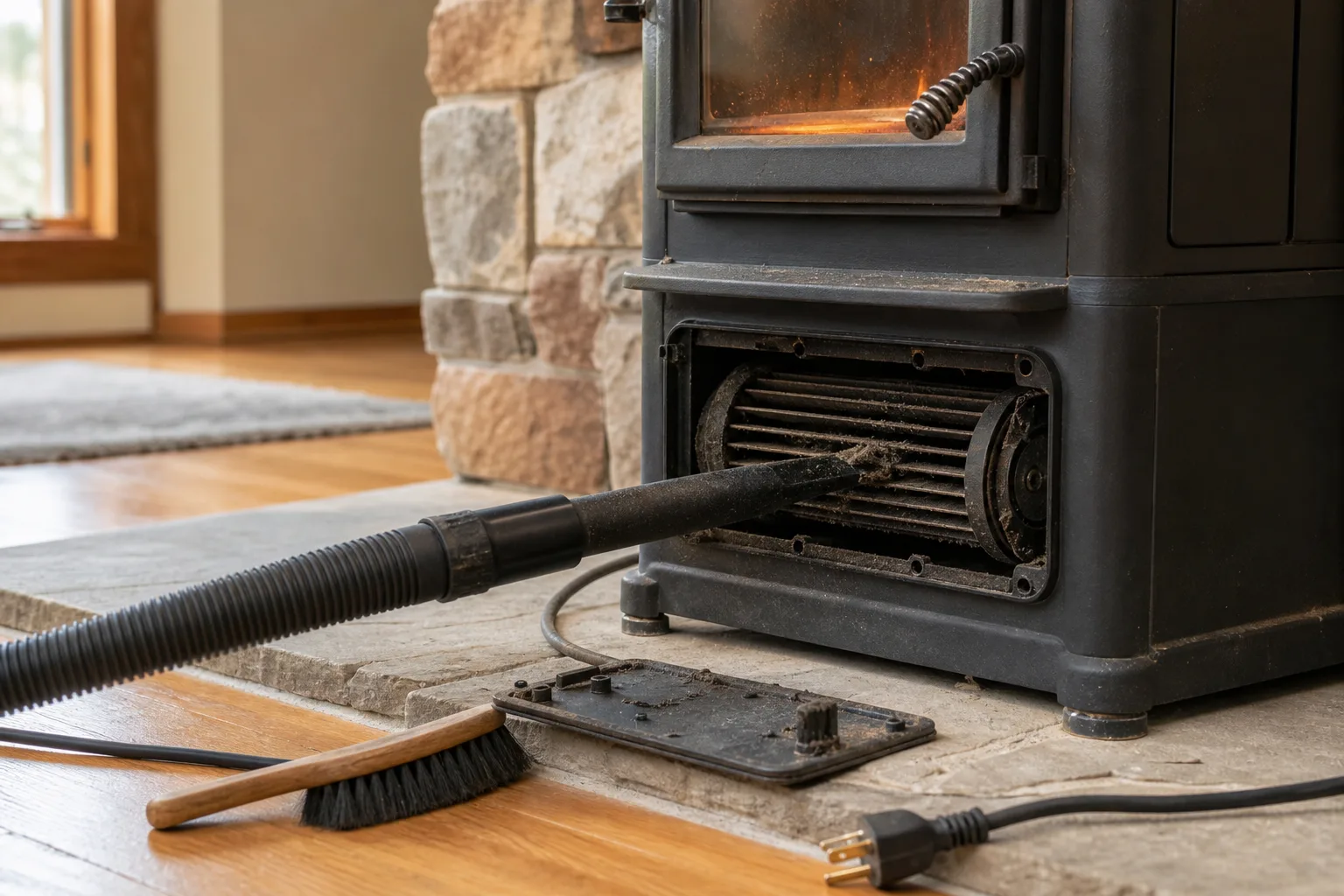
The noise that actually needs attention is the kind that appears later. Blowers pull room air, and room air carries dust. Over a season it accumulates on the squirrel cage blades, and because it never lands evenly, the cage gradually goes out of balance. Out of balance means vibration: the rattle or drone that was not there when the stove was new.
Seasonal blower maintenance checklist
- With the stove cold and the blower unplugged, vacuum the fan cage and housing
- Wipe accumulated dust from the blades themselves, not just the intake grille
- Clear the air intake path underneath and behind the stove
- Check that the power cord is intact and routed away from hot surfaces
- Confirm the thermodisc is still seated firmly against the stove body
- Listen at each speed setting for new noise, and note when it started
- Book the annual chimney inspection at the same time, with sweeping as the buildup warrants
Good to know: New rattle from a blower that used to be quiet points at dust on the fan cage throwing off its balance before it points at a failing motor. Cleaning it is a cold stove job with a vacuum. If it is still noisy afterward, start thinking about the motor or the mounting hardware.
When the blower stops working
A blower that never comes on when the stove is hot often points at the thermodisc or power supply, though motors, wiring and fuses fail too. Constant running can be a stuck switch, or simply a manual-on setting. Humming without spinning is commonly a seized cage, not always. These are appliance repairs rather than chimney work. Unplug a faulty blower and follow the stove manual's guidance before the next burn; a seized or electrically faulty fan deserves attention, not a workaround.
What stays on the calendar regardless is the annual visit from a chimney sweep, since burning wood deposits creosote in the flue no matter how well the fan works.
How VIO Helps With a Wood Stove With Blower Installation
VIO is not a chimney company. We do not employ sweeps or installers, and we will not be the ones on your roof. We are a referral service that connects homeowners with independent local chimney companies, and the work is performed by that company under its own name.
For someone shopping for a wood stove with blower, we are useful for the venting half of the project, which is the half the stove retailer does not handle.
Before you buy, you want a chimney evaluation: what your flue is, its condition, its dimensions, and what appliance it can accept. That single visit reshapes the shopping list, sometimes by ruling out a stove you were considering, sometimes by confirming the plan is simpler than you feared. After you choose the appliance, the venting work follows.
A few things we hold ourselves to, and a few you should insist on regardless of who you hire.
We ask every company in our network to put its estimate in writing before any work starts, and you should insist on exactly that, from us or from anyone else. Ask for the scope in writing too, meaning what is being installed, what size, and what is being done to the chimney. Ask the company for its license and insurance details and check them yourself rather than taking anyone's word for it, ours included. And ask whether the venting plan matches your stove's own installation manual, because that document, not general practice, is what the work has to satisfy.
If your stove is going into an existing masonry chimney, expect the conversation to include the flue's condition. Older chimneys often need chimney flue repair or a liner before they can vent a modern appliance properly, and it is better to hear that during an evaluation than during an installation.
If you are further along and already know which appliance you want, the practical next step is finding someone for the wood stove installation itself, venting included.
The honest summary: buy the blower if you want the heat spread more evenly, skip it if your rooms are open and your stove is sized right, and either way, find out what your chimney will accept before you commit to an appliance. The fan is a comfort decision. The venting is the one that has to be right.
Not sure what your chimney will accept?
Start with an evaluation. You get a clear picture of your flue's condition and dimensions, a scope in writing before anyone begins, and a local company that handles the venting side of a wood stove installation. No pressure, nothing is broken, this is just the step that comes before buying.
Call (513) 655-6702 or request service and we will match you with a chimney company in your area.
Symptom checker
What is your chimney doing?
Tap the closest match for an honest first answer.