



On this pageWhat Chimney Insulation Actually Is7 sections+6
- What Chimney Insulation Actually Is
- The Two Jobs People Mean by Chimney Insulation
- Blanket Wrap or Pour-In: The Two Ways to Insulate a Liner
- Do You Actually Need Chimney Insulation?
- Air Sealing and Insulating Around the Chimney in the Attic
- What Bad Chimney Insulation Looks Like, and How to Check Good Work
- How VIO Helps With Chimney Insulation
Quick answer
Chimney insulation is a layer of heat-resistant material between a chimney liner and the surrounding masonry, added to keep flue gases hot so the chimney drafts better and forms less creosote. It is installed two ways: a foil-faced ceramic blanket wrapped on the liner, or a pour-in vermiculite mix. Solid-fuel appliances generally require it, while gas, oil and pellet appliances usually do not. The liner manufacturer's listing decides.
Somebody told you your chimney needs insulation. Maybe it was a sweep with a flashlight and a camera on a pole, maybe it was a line item on a quote, and now you are reading about chimney insulation with a decision to make and no way to judge it.
Here is the first thing worth knowing, and the search results will not tell you: those two words name two completely different jobs.
One of them happens inside the flue, wrapped around a stainless steel liner. The other happens in your attic, around the outside of the chimney, and has nothing to do with liners at all. Search the phrase and you get store after store selling blanket kits, which is fine if you needed a blanket and useless if what you actually have is a cold wall.
So we are going to sort out which job is yours, then answer the question you came with. Sometimes the answer is no. Nobody selling insulation is going to write that sentence, so we will.
What Chimney Insulation Actually Is
Strip away the catalog language and chimney insulation is a layer of heat-resistant material sitting between a chimney liner and the masonry around it.
That is the whole idea. Keep the heat in the pipe.
The blanket, the mesh, and what is in the box
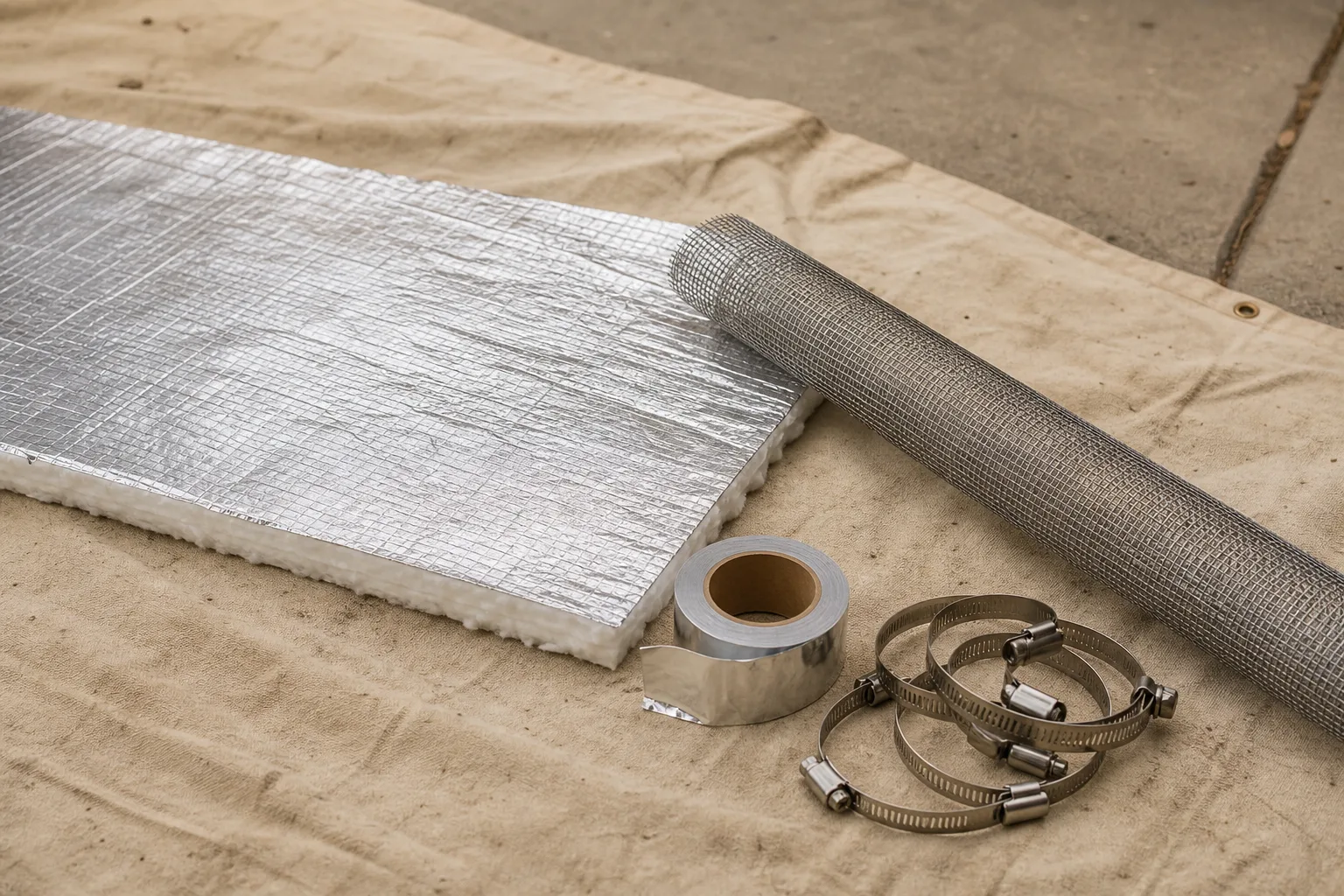
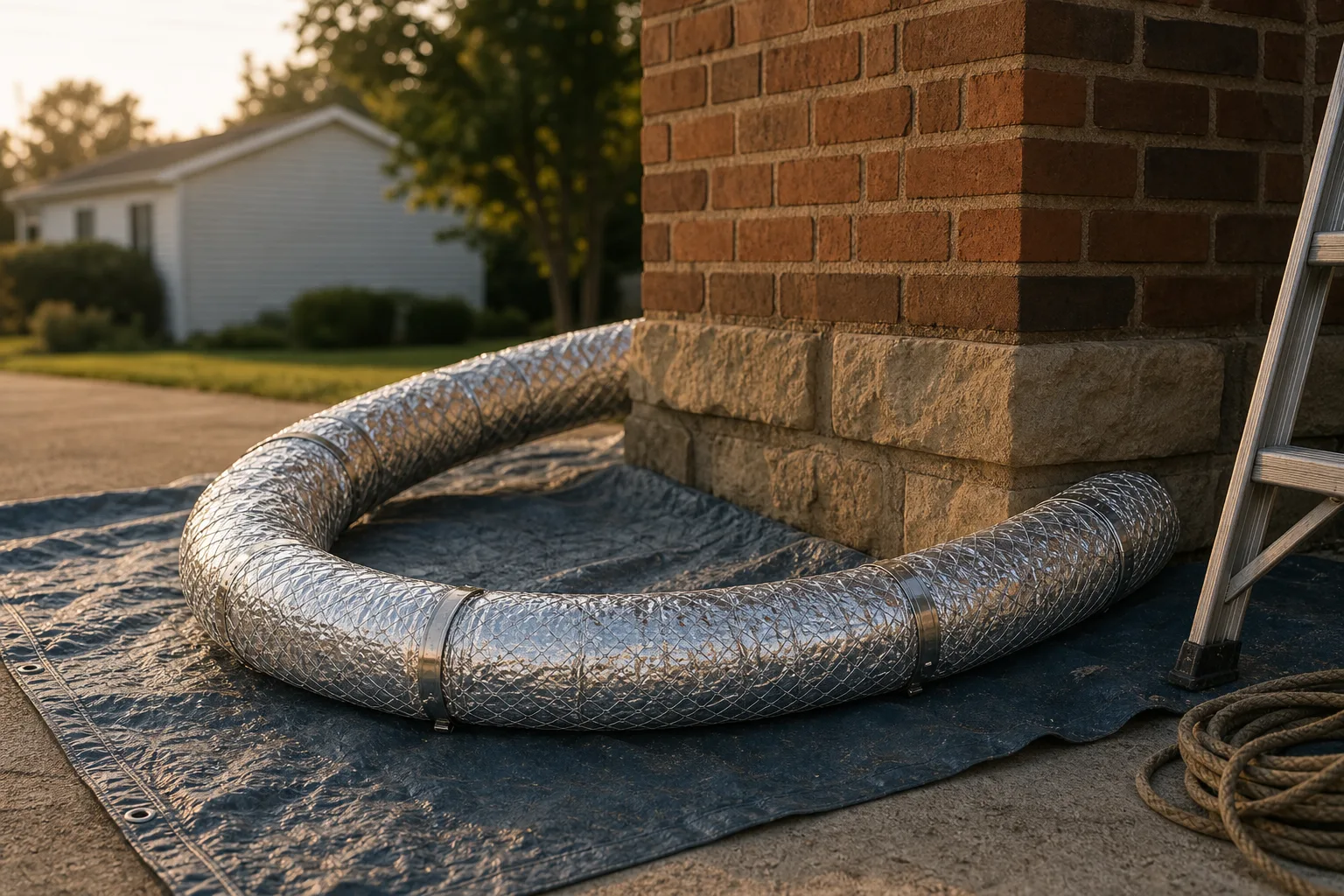
Liner insulation is sold as a kit, and the kits are more alike than different. You get a pre-sized insulating blanket in half-inch or quarter-inch thickness, faced on one side with aluminum foil. You get a stainless steel mesh sleeve. You get spray adhesive, wide foil tape, and clamps.
The blanket itself is a high-density ceramic fiber, alkaline earth silicate, which is a mouthful nobody uses on a job site. Suppliers publish a temperature rating up to 2,100°F for the material, which is a product spec from the people who sell it rather than a number written into any code.
Everything in the box exists to solve one problem: getting a soft, tearable blanket down a rough masonry flue without shredding it.
Good to know: The foil faces outward, toward the brick. The mesh sleeve goes over the blanket like a stocking and holds it against the liner, and the tape and clamps are what keep the whole assembly together on the trip down. A wrap that arrives at the bottom in pieces was not insulation, it was confetti.
What the layer is doing in there
Smoke leaves your appliance hot and gives up heat the whole way up the chimney. When it cools enough, the tars and moisture in it condense on the flue wall. That condensate is creosote, and creosote is what burns in a chimney fire, which is why how often you clean the chimney matters as much as what it is lined with.
Insulation slows the cooling. The flue comes up to temperature faster and holds it, the draft pulls better because warm gas rises harder than lukewarm gas, and less material condenses on the way out.
That is the mechanism, and it is real. What we are not going to do is attach a percentage to it, because your chimney's height, your flue's size, the fuel you burn and how you burn it all move that number, and anyone quoting you a clean figure for your house made it up.
There is a second effect that matters more than people expect on big old chimneys. A large flue serving a small appliance is a lot of cold masonry to warm up, and insulation shrinks the volume of stone the exhaust has to fight.
The Two Jobs People Mean by Chimney Insulation
This is where most people get sold the wrong thing, so it is worth two minutes.
Job one, insulating the liner inside the flue
This is the job the whole internet is selling. It happens during a reline: a stainless liner goes down the existing flue, and the question is whether it goes down bare or wrapped.
It is about combustion. Draft, creosote, code compliance, the listing on the liner. It does approximately nothing for how warm your living room feels.
Job two, sealing and insulating around the chimney
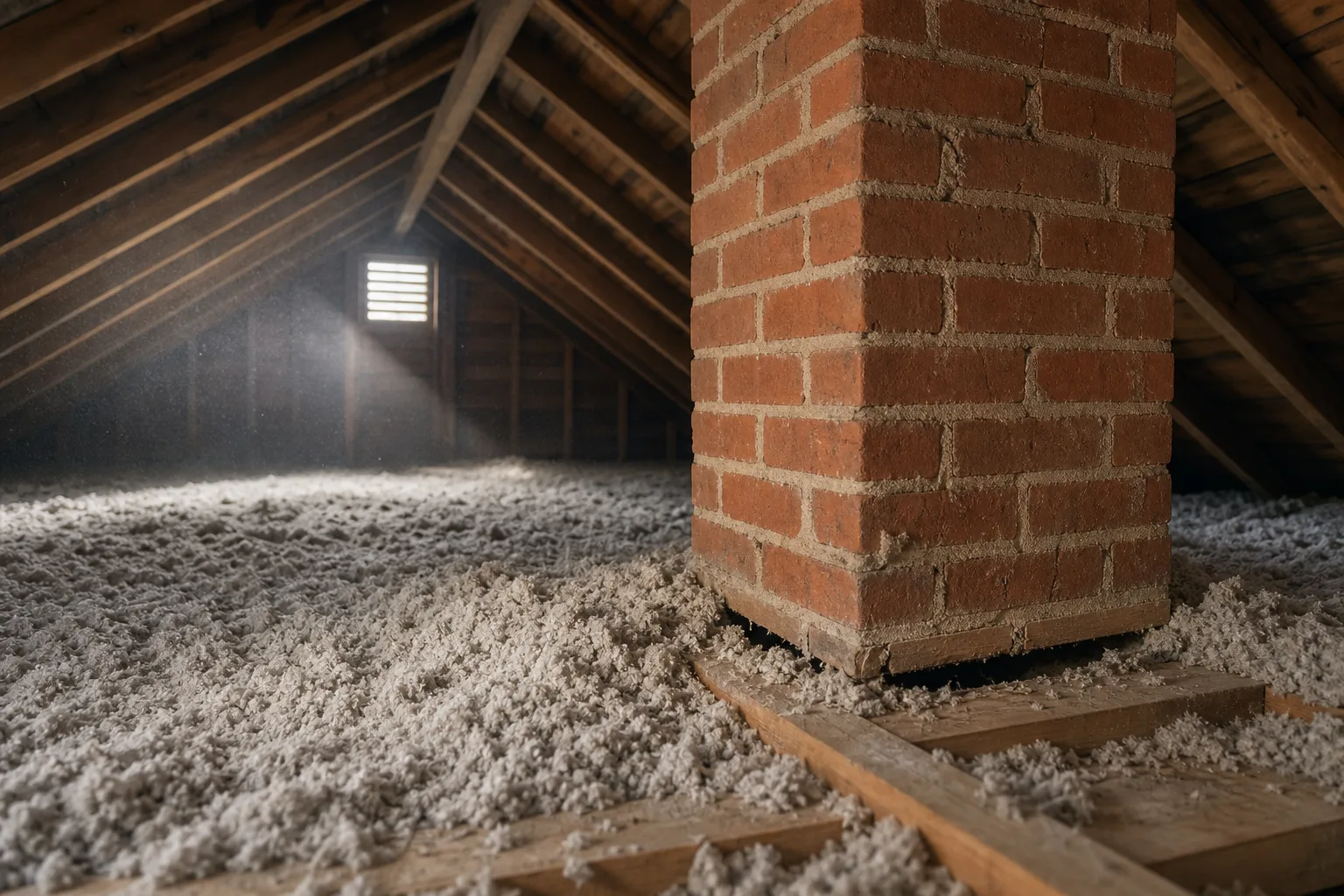
A chimney is a hole through your building envelope. It passes through the ceiling, through the attic, and out the roof, where the flashing around the chimney is what seals it, and the framing around it is deliberately held away from the masonry for fire clearance.
That gap is a chimney-shaped air leak running from your heated space straight into the attic. In winter it pulls warm air out of the house all day and all night, and it makes the wall or the room next to the chimney feel cold and drafty in a way no amount of thermostat fixes.
Fixing it is an air sealing job first and an insulation job second, and it has strict rules about what may touch what. We get into it properly further down the page.
Which chimney insulation job is yours?
Fast test. Read your own complaint back to yourself.
If your complaint has words like draft, smoke, creosote, reline, wood stove, or "the inspector said," you want job one.
If your complaint is that a room is cold, the heating bill is ugly, there is a visible gap around the chimney in the attic, or you can feel air moving near the fireplace when nothing is burning, you want job two.
If both are true, and honestly they often are on an older house, they are two separate pieces of work with two separate answers. Do not let one quote quietly cover both.
From the field: The confusion runs one direction. People who came in cold and unhappy get pointed at a liner blanket, buy it, and are still cold and unhappy afterward, because the blanket was never going to touch the problem. Ask which job you are buying before you agree to either.
Blanket Wrap or Pour-In: The Two Ways to Insulate a Liner
There are exactly two mainstream methods of chimney insulation for a liner, and choosing between them is usually less about preference than about how much room you have.
Blanket wrap
The foil-faced ceramic blanket gets wrapped around the liner on the ground, before anything goes into the chimney. Adhesive holds it, foil tape closes the seams, the mesh sleeve goes over the top, clamps hold that.
Then the wrapped liner goes down the flue as one assembly.
The advantage that matters years from now: it comes back out. If you change appliances, if the liner needs service, if a future owner wants something different, a blanket-wrapped liner can be pulled.
Pour-in vermiculite
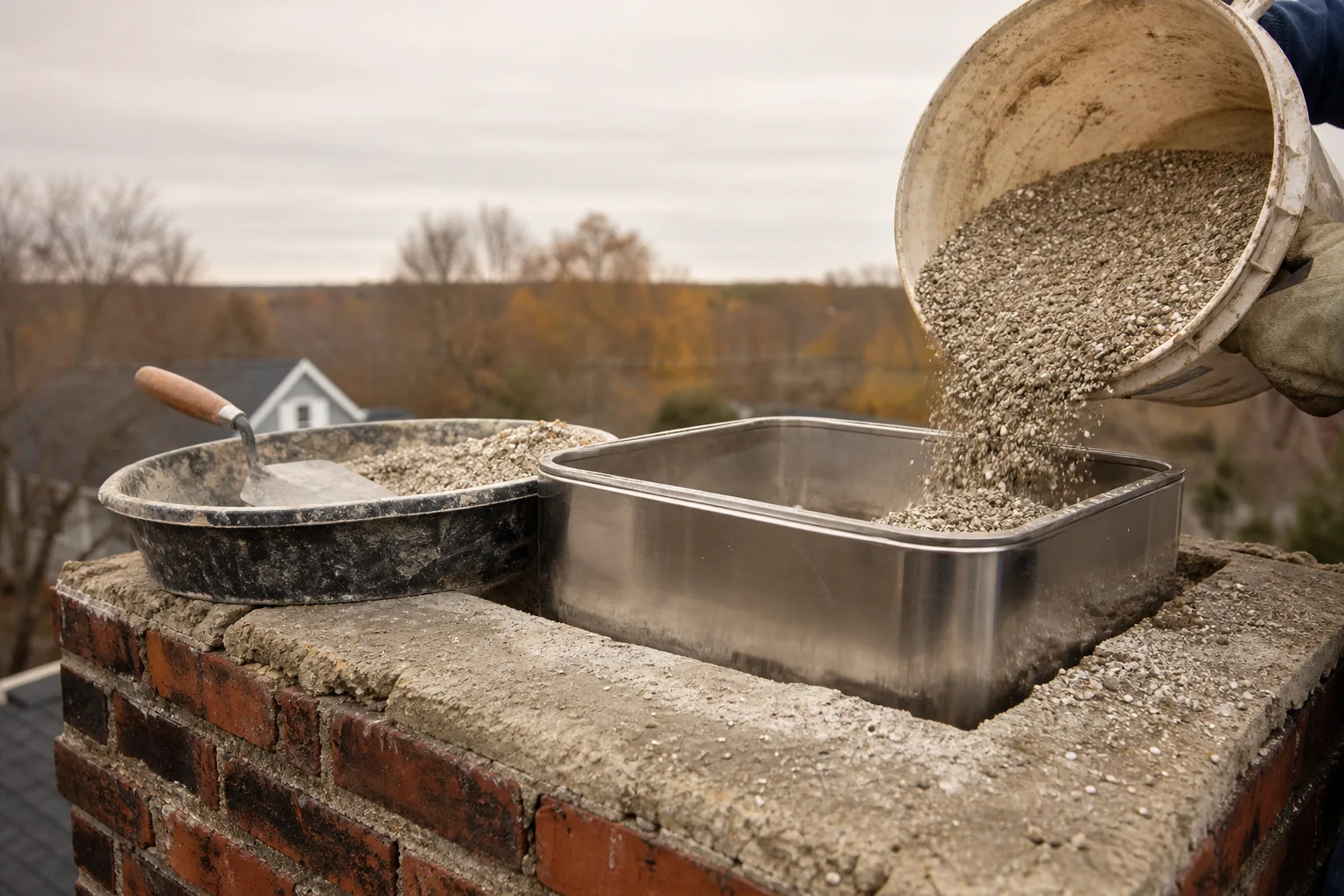
The other approach installs the bare liner first, then fills the space around it. The fill is a mix of vermiculite and Portland cement, mixed with water on site and poured in from the top of the chimney.
It flows. That is its whole reason to exist, because it will go where a blanket cannot fit and it will fill an irregular flue that a wrapped liner would never pass through.
The cost of that is permanence. Once it sets around your liner, the liner is not coming out without a fight.
When the flue decides for you
Here is the part that surprises people. A wrapped liner is measurably fatter than a bare one, so the question "do I want insulation" and the question "does insulation fit" are not the same question.
Somebody has to measure the actual clear opening of your flue, not the nominal tile size, and compare it to the outside diameter of the wrapped assembly. That measurement, more than anything on this page, decides your method.
| Blanket wrap | Pour-in vermiculite | |
|---|---|---|
| What it is | Foil-faced ceramic fiber blanket, mesh sleeve, tape, clamps | Vermiculite and Portland cement mixed with water |
| How it goes in | Wrapped on the liner first, then the assembly drops down the flue | Liner goes in bare, mix is poured around it from the top |
| Best fit for | Flues with room to spare, straightforward runs | Tight flues, irregular openings, offsets a wrapped liner will not clear |
| Removable later | Yes, the liner can be pulled | Not practically |
| Effect on liner size | Adds noticeable outside diameter | None, the liner goes in at its own size |
| Main trade-off | Needs clearance it does not always have | Permanent, commits the chimney to this liner |
An opinion, offered as an opinion: when there is room for the blanket, take the blanket. Chimneys outlive appliances, and the day you want to change something, you will be glad the liner still comes out. Pour-in is a good answer to a tight flue and a poor answer to a chimney you may want to change.
Pro tip: Measure before you choose, not after. The order of operations on a bad job is picking the method, ordering the kit, and then discovering on the roof that it does not fit. The order on a good job is measuring the flue, then ordering.
Do You Actually Need Chimney Insulation?
Finally, the question you came with.
Whether chimney insulation belongs on your job depends on one thing before all the others: what is going to be burning at the bottom of that flue?
Solid fuel versus gas, oil and pellet
Wood and coal are the demanding case. Suppliers and installers treat insulation as required to maintain a stainless liner's listing when it vents a solid-fuel appliance, and that is the general rule to work from if you are relining for a wood stove, an insert, or an open fireplace.
Gas, oil and pellet appliances are the other side of it. They burn cooler and cleaner, they typically use a small liner (four inch is the everyday example), and insulation is normally not required for them.
Notice the words "generally" and "normally." They are doing real work. The tiebreaker is never a blog post, it is the listing on the specific liner going into your specific chimney.
What UL 1777 and NFPA 211 ask of you
UL 1777 is the standard chimney liners are listed to. The part that concerns you is the zero-clearance rating, which is what lets a liner sit inside a masonry chimney that has combustible framing near it, and that rating generally depends on the liner being insulated. Most stainless liner manufacturers require insulation for their product to meet its listing.
Now the part almost nobody says plainly. Sources disagree about the thickness. Some state an inch of insulation is what earns zero clearance; others state a half-inch ceramic blanket satisfies the requirement for a compliant installation.
We are not going to pick a winner, because it is not ours to pick. The liner manufacturer's own listing and installation instructions control the thickness, and an installer who cannot show you which one they followed is guessing with your house.
NFPA 211 is the standard behind the clearances between a masonry chimney, its flue liner, and the wood framing around it. There is a number floating around the internet for that clearance. Do not treat it as a national rule, because it moves with the chimney's location, the edition your jurisdiction adopted, and local amendments. Your inspector settles it.
One more thing from NFPA 211 that catches people mid-project. A Level 2 inspection is required when the system changes, and relining a chimney is a system change. It is also required at sale or transfer of the house, after a malfunction, after a chimney fire, and after an event that could have damaged the chimney, such as a storm or an impact.
If any of those describe you, the inspection is not an upsell. It was already on the list.
The cases where the honest answer is no
Some chimneys do not need this, and you deserve to hear which.
A gas appliance vented through an appropriately sized liner, with the manufacturer's instructions not calling for insulation, is the clearest one. A short interior flue in a warm chimney serving a gas unit is another.
And there is the practical no: a flue with no room for a wrapped liner where pour-in is not appropriate for the plan. That is not a case of insulation being unnecessary, it is a case of the chimney forcing a different conversation, possibly about a different liner size or a different appliance entirely.
Work through this before you answer:
- What appliance and what fuel is at the bottom of the flue, today and after any change you are planning?
- What do the liner manufacturer's installation instructions require, in writing?
- What is the measured clear opening of the flue, compared with the outside diameter of a wrapped liner?
- Is the stack interior or exterior? An exterior chimney on a cold wall runs colder and benefits more.
- What condition is the existing clay tile in, and is the reline being driven by damage that also calls for repairs to the brickwork, or by the appliance change?
- Which code edition has your jurisdiction adopted, and what does the local inspector expect?
- Has anything on the Level 2 list already happened, which would put an inspection ahead of the insulation decision?
Myth vs. fact: "Chimney insulation is always required" is false. It depends on the appliance, the liner's listing, the flue, and your adopted code, and there are real installations that do not call for it. While we are here, you have probably read a specific count of chimney fires per year on half a dozen sites. We are leaving it out. It traces back to old aggregate data that nobody can currently verify, and a safety argument that needs a shaky statistic was not much of an argument.
Not sure whether you need chimney insulation at all?
VIO matches you with independent local chimney companies. Measuring the flue and reading the liner's listing are the two things to ask for before anyone quotes a number. We ask every company in the network to put its estimate in writing before any work starts, and you should insist on exactly that from anyone you hire.
Call (513) 655-6702, or request service online and we will connect you.
Air Sealing and Insulating Around the Chimney in the Attic
Now for the other job, the one the search results ignore.
If your real complaint is a cold room, a draft near the fireplace, or a winter heating bill that does not match the house, the fix is almost certainly up in the attic where the chimney passes through the framing.
Air seal first, with metal and a non-combustible sealant
The sequence matters more than the materials, and it goes air sealing first, insulation second. Insulating a hole that is still leaking air just hides it.
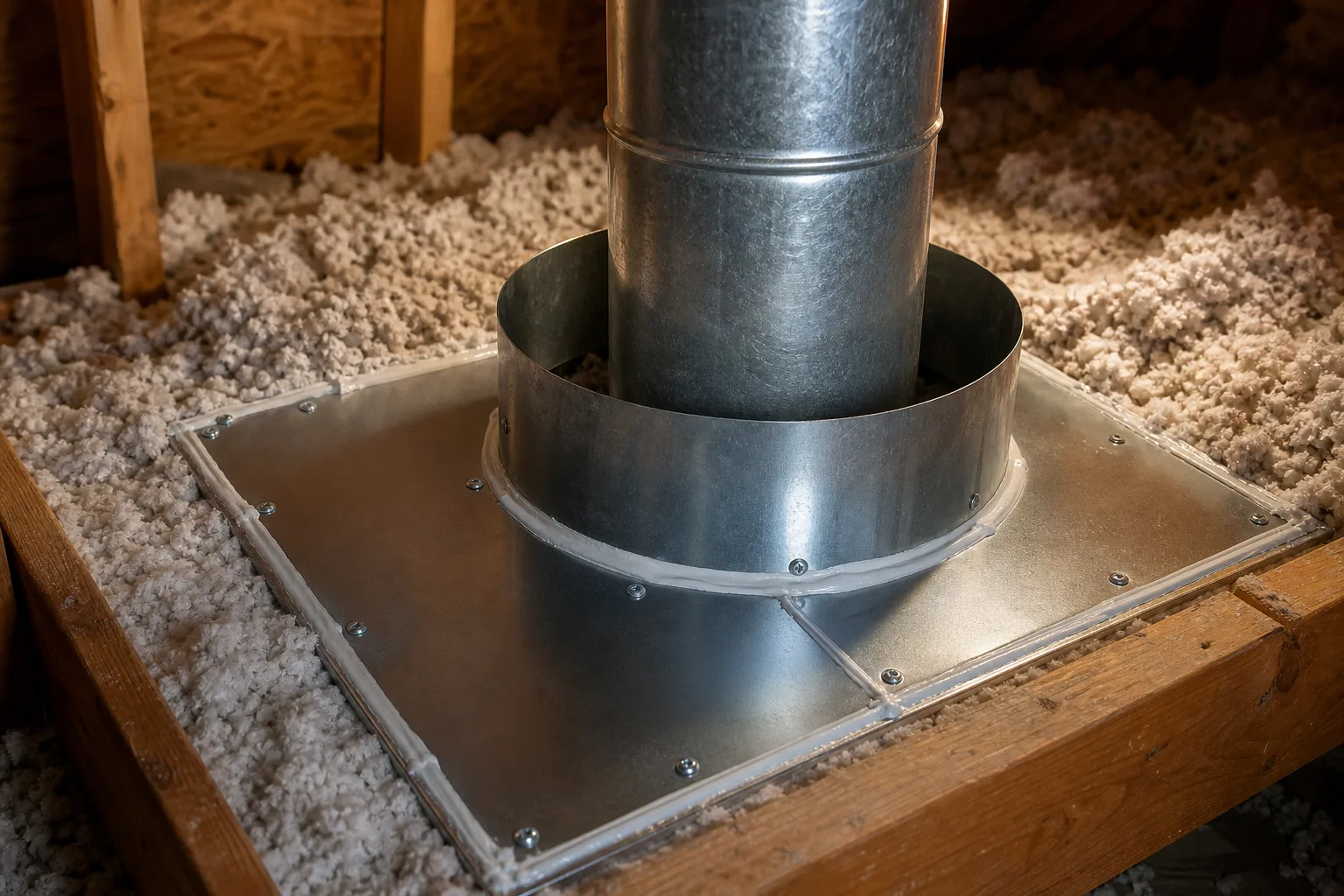
The Building America Solution Center, which is Department of Energy guidance published through Pacific Northwest National Laboratory, lays out the method. The chase opening gets covered with sheet metal cut to overlap the framing, with roughly an inch of overlap around the metal flue pipe, fastened down with screws or heavy staples.
Then every edge and every seam gets sealed with fire-rated caulk. Where metal meets the chimney or the flue, the guidance calls for a non-combustible sealant labeled to ASTM E136.
Nothing about that is exotic. It is sheet metal, screws, and the correct tube of sealant, and the reason it is worth doing right is that the opening was put there on purpose and will never close itself.
The insulation dam and the clearance you cannot close
Once the plane is sealed, attic insulation still has to be kept off the flue. The published guidance is to build a dam of heat-resistant material that holds insulation back with at least three inches of clearance around a metal flue pipe.
That clearance is not a suggestion you can trade away for a better R-value. It is the reason the framing was held off the chimney in the first place.
Safety note: Loose fill and batts must never rest against a flue. If you can see cellulose or fiberglass packed up against a metal flue pipe or drifted into the gap around a masonry chimney, that is a defect to correct, not a job well done. Pull it back, seal the plane properly, and build the dam.
Done in that order, attic work around a chimney addresses air leakage and comfort, and it is a different purchase from chimney insulation on a liner. Buy them separately, judge them separately.
What Bad Chimney Insulation Looks Like, and How to Check Good Work
You are not trying to become a chimney technician. You are trying to tell whether the one who was on your roof did the job.
On the liner
The failures are mostly failures of care during installation. A blanket that tore on the way down and was pushed the rest of the way anyway. Seams that were never taped. No mesh sleeve, so the wrap slid and bunched somewhere you will never see.
You can see some of it from the ground on a clear day and more of it from a phone photo taken at the top plate. What you cannot see is the middle of the run, which is exactly why the next subsection exists.
The other liner failure is a size failure: a wrapped liner forced into a flue that could not take it. Scraped, compressed, dented insulation is not doing the job the listing assumes it is doing.
In the attic
Easier, because you can look yourself. Get a flashlight and stand at the hatch.
You want to see a metal plate at the ceiling plane, screwed to the framing, with caulk along the seams and a visible open gap held between the insulation and the flue. You do not want to see daylight, dust streaks fanning out around the opening, or insulation crammed against the pipe.
If the only thing up there is loose insulation heaped around the chimney, the air leak was never addressed and neither was the clearance.
The paperwork that settles it
This is the part that actually protects you, and it costs nothing to ask for.
Pro tip: Ask for the liner manufacturer's installation instructions and the listing for the exact product installed, plus photos from the top plate and the appliance connection. A company that insulated to a manufacturer's spec has that paperwork sitting in the truck. A company that improvised will change the subject.
Get the scope in writing too, before anyone starts, so that "insulated liner" on the invoice means a named product installed a named way instead of a phrase. The same goes for any other chimney service bundled into the same visit.
How VIO Helps With Chimney Insulation
VIO is a referral service. We do not sweep, reline, or insulate anything ourselves. What we do is connect homeowners with independent local chimney companies and stay out of the way after that.
For this exact situation, that means being matched with an independent company you can put the right questions to: measure the flue, show me the listing for the liner you plan to install, and tell me whether chimney insulation is required for my appliance rather than for the invoice.
If the real complaint is the freezing room next to the chimney, say so when you book, so the attic penetration is part of the conversation and not just the flue.
We ask every company in the network to put its estimate in writing before any work starts, and you should insist on exactly that from anyone you hire, whether or not you found them through us.
Get a straight answer on your own chimney
An insulated liner and a cold wall next to the stack are two different problems, and telling them apart starts with someone standing at your actual chimney. VIO is a referral service that connects you with independent local companies in your area.
We ask every company in the network to put its estimate in writing before any work starts, and you should insist on exactly that.
Call (513) 655-6702.
Your next move is small. Find out what fuel the flue is serving, find out what the liner's manufacturer requires, and measure the opening. Those three answers decide the chimney insulation question for your house, and none of them can be guessed from a keyboard.
Symptom checker
What is your chimney doing?
Tap the closest match for an honest first answer.