



On this pageWhat double wall chimney pipe actually is7 sections+6
- What double wall chimney pipe actually is
- The black pipe and the silver pipe: connector vs Class A
- Double wall chimney pipe clearances, by the numbers
- What double wall pipe fixes, and what it does not
- Sizing, lengths and the parts you will actually need
- Installing double wall chimney pipe, and when a professional has to be involved
- How VIO helps with double wall chimney pipe
Quick answer
Double wall chimney pipe is sold under one name for two different products. Double wall connector pipe, the black pipe, runs from the stove to a ceiling support box or wall thimble and typically needs 6 inches of clearance to walls instead of the 18 inches single wall requires. Class A insulated chimney, the silver pipe, is what passes through the ceiling and roof. Your appliance manual and the product label govern.
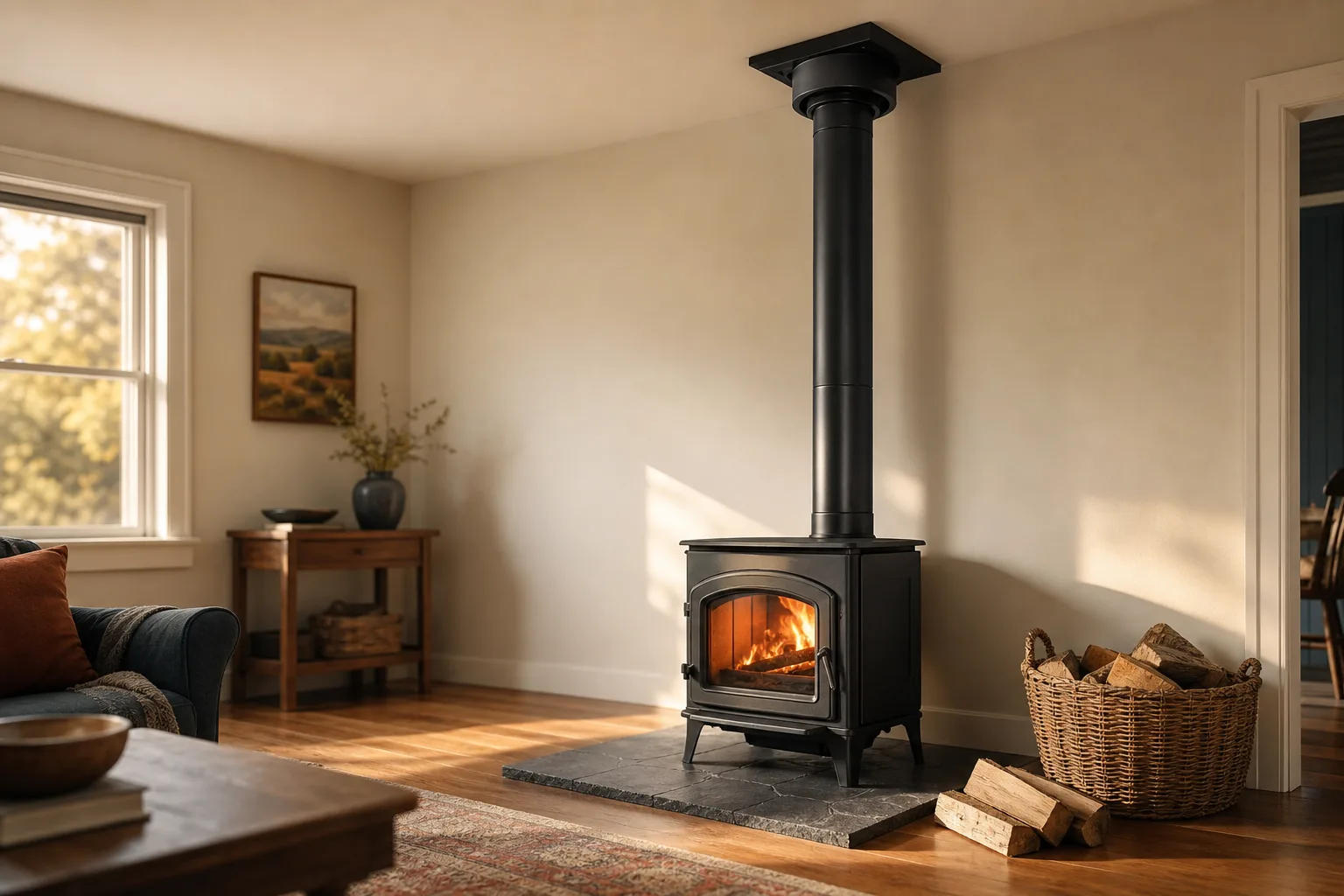
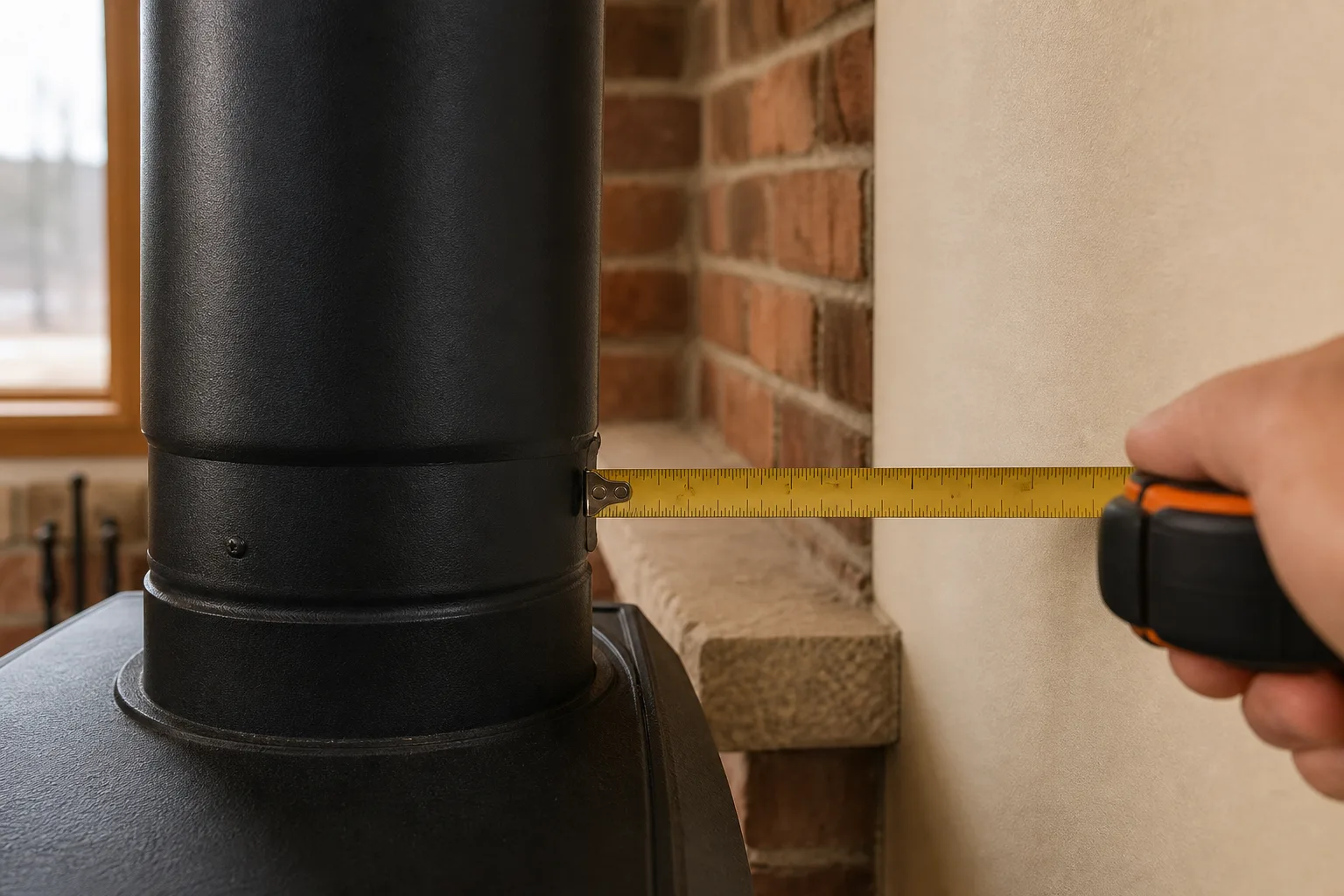
You are standing next to a wood stove with a tape measure. The hook end is on the flue collar, the tab end is against the drywall, and the number is eight inches. Then you open the manual and read that single wall pipe wants eighteen.
That gap is why most people go searching for double wall chimney pipe in the first place. It is the right instinct. It is also where a very specific mistake starts, because that phrase is sold under one name for two completely different products, and only one of them belongs in the spot you are probably about to put it.
Spend ten minutes on the shopping results and you will see the split without anyone pointing it out. One retailer's page says "double wall black stove pipe." Another says "double-wall insulated chimney pipe, Class A." Same search, same words, two parts that live in two different places in your house.
Get that boundary wrong and you have built something that can burn the building down. Get it right and the rest of this is straightforward.
So let us draw the boundary.
What double wall chimney pipe actually is
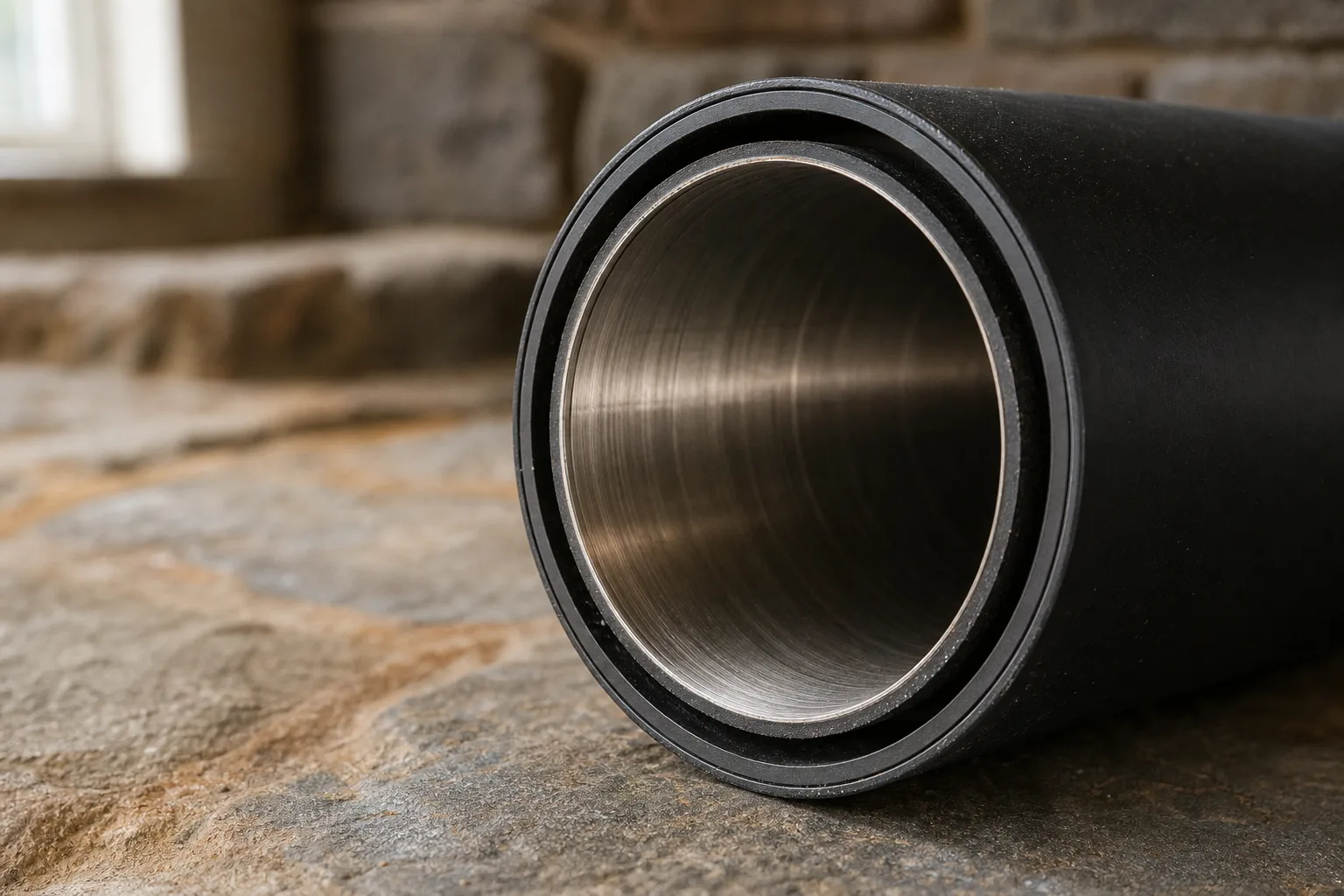
Strip away the catalog language and the idea is simple. There is a pipe inside a pipe, and something between them.
On the black connector pipe that runs from your stove, that something is a layer of still air. On Class A chimney pipe, the silver stuff that goes through the ceiling, that something is packed insulation, often a ceramic fiber blanket around an inch thick.
Both are called double wall chimney pipe by somebody selling it. They are not the same part and they are not rated for the same job.
The two walls and the air between them
The inner wall is the one taking the abuse. It carries the flue gas, so it gets built from stainless, commonly 430 on connector pipe and 304 on better product and on Class A, because stainless holds up to acidic condensate and heat cycling in a way plain steel does not.
The outer wall is doing a different job entirely. On connector pipe it is usually 24 gauge painted steel, and its whole purpose is to be the surface that faces your room.
Between them sits the gap. Air is a poor conductor, which is exactly the point.
What the outer wall is doing for you
Two things, and only one of them is the reason to buy it.
The first is clearance. Because the outer wall runs cooler than a bare single wall pipe would, the listed product is allowed to sit closer to the wood framing and drywall around it. That is the eight-inches-versus-eighteen problem, solved.
The second is flue temperature. Keeping heat inside the pipe instead of dumping it into the room means the gas arrives at the chimney warmer, and warm gas drafts better and condenses less.
Good to know: the second benefit is the one every product page leads with, and it is the softer of the two. Buy double wall for the clearance, which is a number on a label. Treat the draft improvement as a bonus that depends on the rest of your system.
The black pipe and the silver pipe: connector vs Class A
If you take one thing about double wall chimney pipe out of this page, take this sentence.
The black pipe stops at the ceiling. The silver pipe goes through it.
That is not a style preference. It is the line between a listed installation and an unlisted one, and it is the only mistake in this product category that you cannot quietly fix later.
Where the connector pipe stops
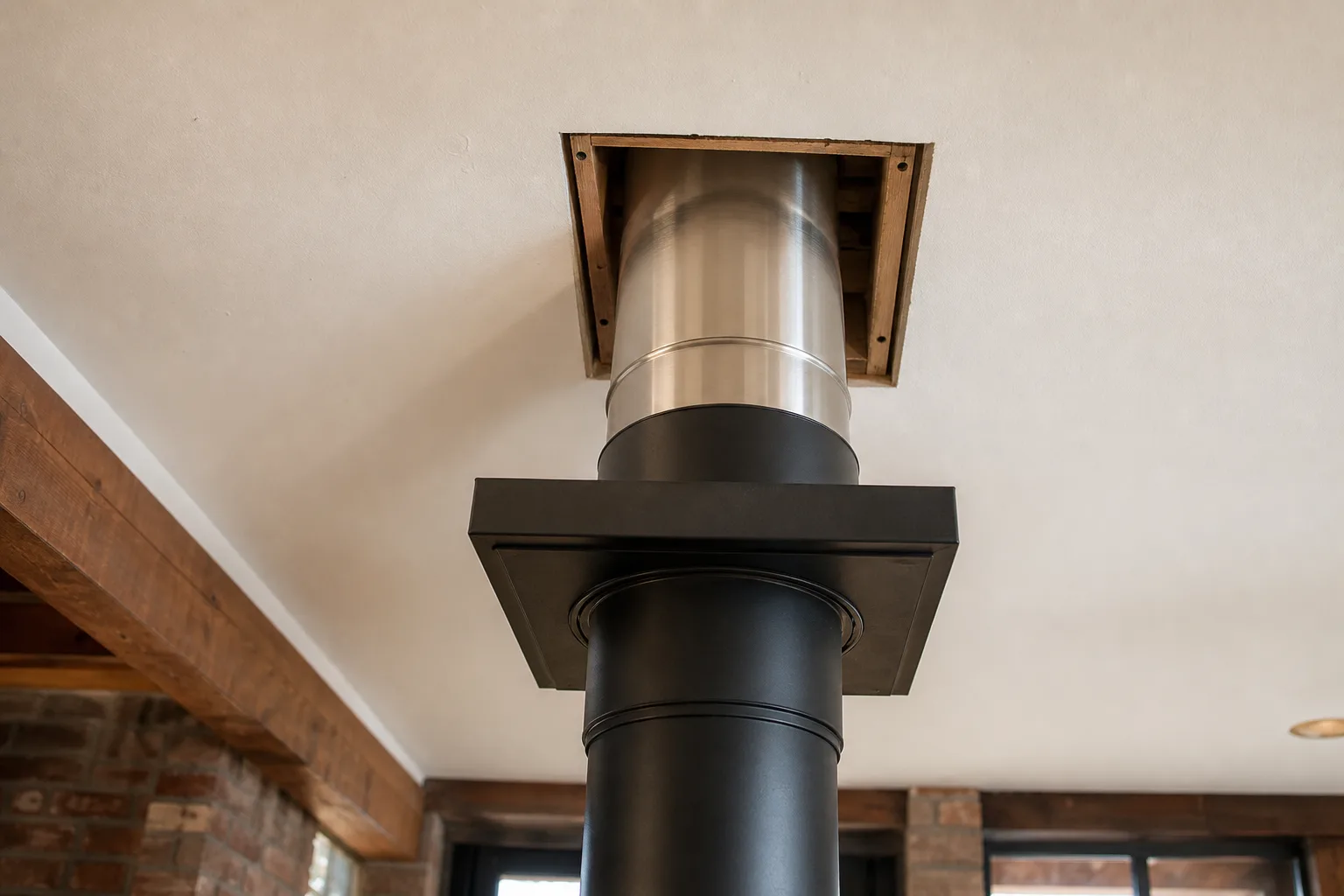
Double wall connector pipe, sometimes called stove pipe, has exactly one territory: the visible run inside the room, from the flue collar on top of or behind your stove to the point where the system enters the building structure.
That entry point is a listed component. Going up, it is a ceiling support box, a square sheet metal box framed into the joists with a trim collar showing on the room side. Going out through a wall, it is a wall thimble, a round collar set into the wall assembly.
The connector pipe terminates there. It does not continue.
Where Class A chimney pipe takes over
From that box or thimble onward, everything is Class A insulated chimney, listed to UL 103 HT. That listing exists because a chimney has to survive conditions a connector never sees.
The HT test is brutal on purpose: continuous exposure at 1,000 degrees Fahrenheit, plus three ten-minute runs at 2,100 degrees. That second number is a chimney fire, reproduced in a lab, three times.
Class A is what runs through the ceiling, across the attic, out the roof, up past the roofline, and terminates in a cap. Most Class A carries a 2-inch clearance to combustibles on its listing, which is how it gets to pass through framing at all.
One number that gets tangled in forum threads: UL 1777 is a different standard. It covers chimney liners used to reline an existing masonry chimney. If you are buying factory-built pipe for a stove, UL 103 HT is your listing, not 1777.
The four-second colour test
Stand in the room, look up, and follow the pipe with your eyes.
Black painted pipe should be everything you can see from the couch, and it should end at a collar in the ceiling or the wall. Above or beyond that collar, brushed silver stainless.
If black pipe disappears into the ceiling with no visible transition, stop and get somebody out there. Silver Class A coming down and meeting the stove directly can be a legitimate design, but only where the appliance listing and the chimney system listing expressly permit that configuration with the required listed adapter and components. Black pipe crossing into a building assembly is the one that is not fine.
Safety note: double wall connector pipe is not listed to pass through a ceiling, a wall, an attic, or any combustible assembly, and no amount of clearance around it changes that. The penetration is carried by listed components and Class A chimney pipe. If someone offers to run stove pipe through your ceiling with a homemade sleeve, you have learned something important about that someone.
Not sure where your connector pipe has to stop?
Have somebody look at the run before the parts show up. Tell us what stove you have and where it sits, and we will match you with an independent local company that works on this every week.
Call (513) 655-6702
Double wall chimney pipe clearances, by the numbers
Clearance is the reason most people are here, so let us put the numbers in one place.
Read the table carefully, because the numbers in it do not all come from the same place. The 18 inch single wall figure is the NFPA 211 default for an unlisted connector. The 6 and 8 inch double wall figures and the 2 inch Class A figure are values that appear on common listed products, not code defaults. On any listed pipe, the instructions supplied with that pipe and your appliance manual are what control.
| Single wall connector | Double wall connector | Class A insulated chimney | |
|---|---|---|---|
| Clearance to combustible walls | 18 in | 6 in | 2 in (typical) |
| Clearance to combustible ceilings | 18 in | 8 in | 2 in (typical) |
| May pass through a wall or ceiling assembly | No | No | Yes, with listed components |
| Typical construction | 22 to 24 ga black steel | 430 stainless inner, 24 ga painted outer | Stainless inner and outer, insulation between |
| Where it belongs | Room only, stove to thimble | Room only, stove to thimble | Everything past the thimble |
Two things override that table.
The first is the label on the box. Every listed product carries its own tested clearances, and those are the ones that apply to the pipe you actually bought.
The second is your appliance. The installation manual that came with your stove is a listed document, and where it is more restrictive than the code default, the manual wins. Some stoves also specify a connector diameter or restrict how many elbows you may use.
And then there is your building department. Local code and the authority having jurisdiction can be stricter than any of this, and they are the people who sign off.
Myth vs. fact: the internet will tell you double wall pipe means "6 inches from anything." That is wrong in two directions. Six inches is the wall figure on common listed products; the ceiling figure on those same listings is eight. Neither one is a universal code number. The listing for your specific pipe, your appliance manual and your local requirements are what actually apply.
Measure from the outer surface of the pipe to the nearest combustible surface, not from the center of the pipe. It sounds obvious. It is the most common way people end up short by two inches.
What double wall pipe fixes, and what it does not
The product pages sell double wall chimney pipe on two promises: better draft and less creosote. Both contain something real. Both get oversold.
Here is the version I would give a neighbor.
The draft question, answered honestly
Draft is the chimney pulling. It comes from hot, light gas inside the flue wanting to rise against cooler, heavier air outside, and the strength of that pull is mostly a function of temperature difference, flue height, and flue diameter.
Double wall connector pipe helps with exactly one of those. It keeps the gas hotter over the first few feet of the trip.
If your stove is sluggish on a cold startup and the pipe run is long, that can genuinely change the feel of the thing.
But if your chimney is too short, or oversized for the appliance, or running up an unheated exterior chase where it stays cold all winter, the connector pipe is not your problem and swapping it will not fix it. You will spend the money and still be standing there with smoke rolling out of the door.
That is a diagnosis, not a pipe purchase. Worth knowing which one you have before you order anything.
Creosote, without the marketing
Creosote forms when flue gas cools enough for its unburned volatiles to condense on the flue wall. Keep the gas hotter and you reduce the conditions that let that happen. That much is sound.
What is not sound is the leap from "reduces the conditions" to "prevents chimney fires." Nobody has established that, and the pipe is a small player next to the three things that actually drive creosote: how wet your wood is, how hard you are burning, and what shape the chimney is in.
Anyone quoting you a percentage reduction is making it up. There is no credible published figure.
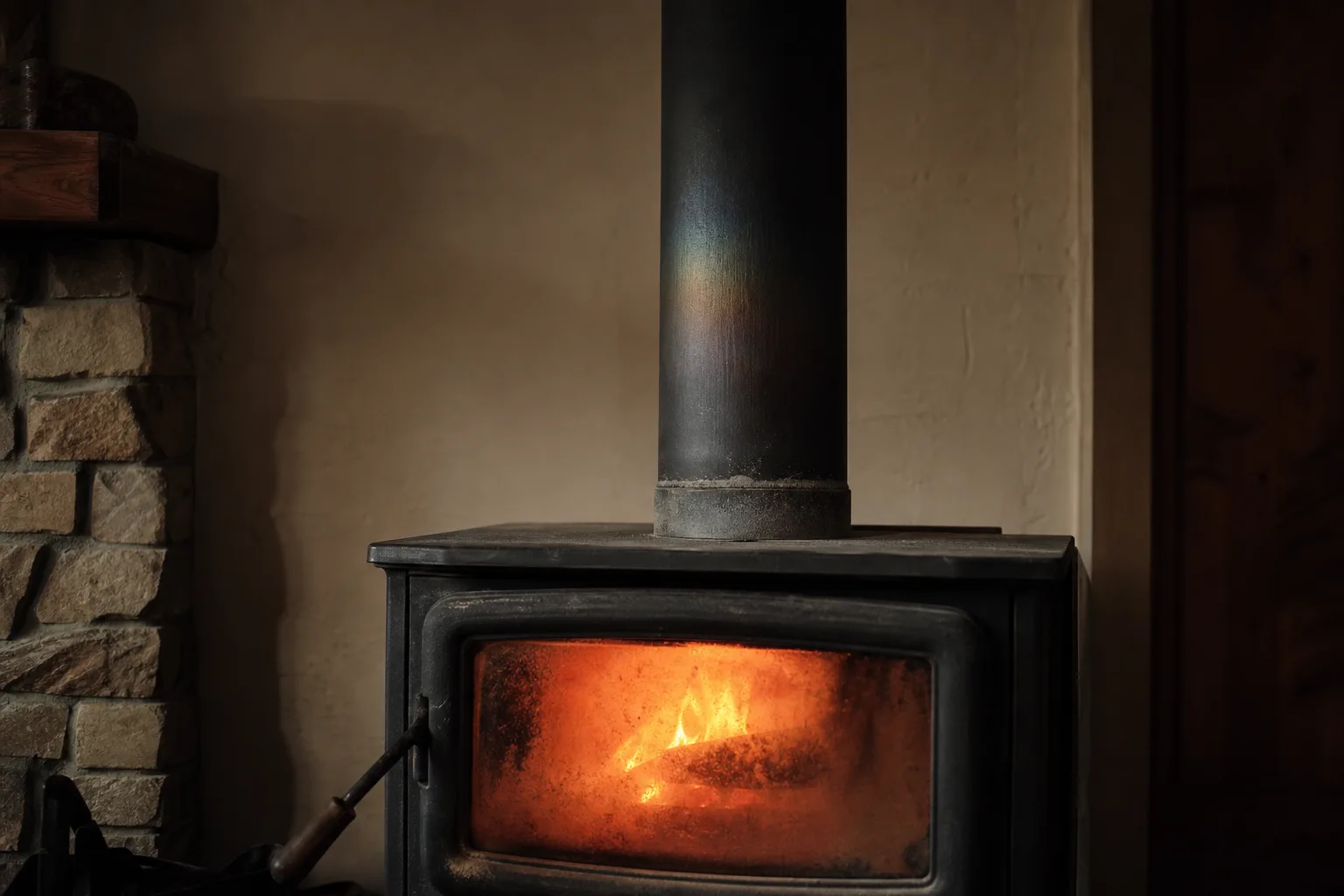
From the field: the first foot of pipe above the stove collar is worth a glance now and then. If its appearance changes from one season to the next, evaluate that against the pipe and appliance manufacturers' instructions and have the installation looked at, rather than guessing at the cause yourself.
Burn dry wood. Burn it hot enough. Get the chimney swept. Double wall chimney pipe is a good part, not a substitute for any of that.
Sizing, lengths and the parts you will actually need
Ordering double wall chimney pipe is where people fill a cart, then place a second order two days later. Annoying, and avoidable.
Diameter follows the stove, not the wall
Your connector diameter matches your stove's flue collar. Six inch and eight inch cover the overwhelming majority of residential wood stoves, and six is by far the more common.
Do not reduce the diameter to make a run fit, and do not enlarge it because you think a bigger pipe will draft better. Both hurt. The appliance was tested with a specific flue size and the manual states it.
Choosing double wall chimney pipe lengths
Fixed sections come in 12, 24, 36 and 48 inch lengths. You stack them to get most of the way there.
The last gap is what the telescoping section is for. It slides to close a variable distance and locks, which saves you from cutting and crimping a piece of double wall pipe, something you should not be doing anyway because you would be cutting through the inner liner.
Telescoping sections are commonly sold in three adjustment ranges: roughly 18 to 30 inches, 28 to 50 inches, and 40 to 68 inches.
Pro tip: measure the total run first, then plan backward from the ceiling support box down to the stove, and let the telescoping section absorb whatever is left over. Put it at the top of the connector run, right below the box, not down at the stove where it is the most visible joint in the room.
The parts list around the pipe
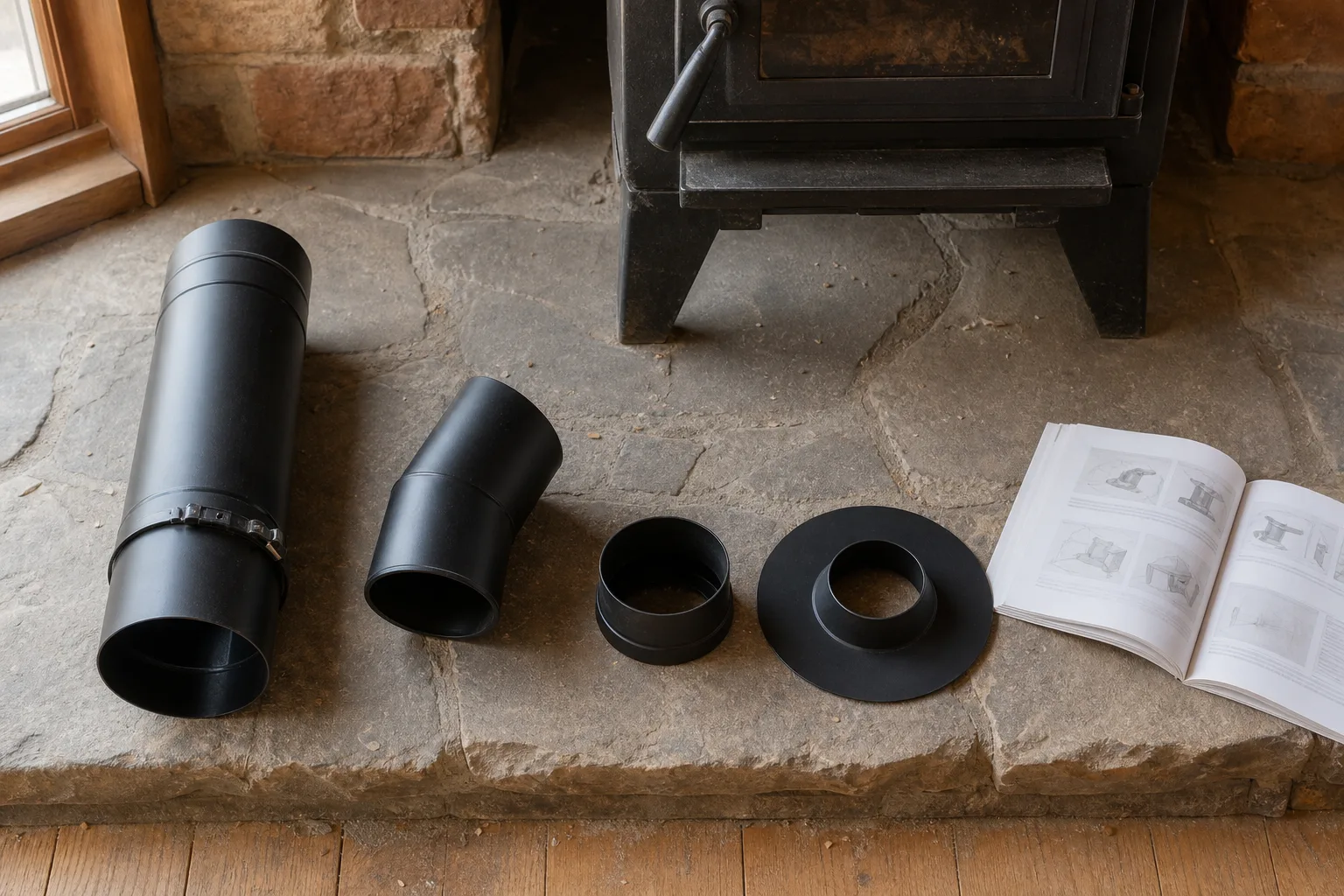
The pipe itself is maybe half of what you need, which is why so many stoves are sold alongside a complete wood stove chimney kit. Here is what to confirm before you place the order.
- Flue collar diameter, taken off the stove, not guessed from the old pipe
- Total connector run, floor to ceiling, measured in the actual location
- A stove adapter if your collar needs one to accept double wall
- Any elbows required, plus the number your stove manual allows
- Ceiling support box or wall thimble, matched to your Class A system
- Class A sections for the run through the ceiling, attic and roof
- Roof flashing sized to your roof pitch, plus a storm collar
- Chimney cap with a spark screen
- Trim collar for the room side of the ceiling penetration
- The stove manual itself, open, on the floor next to you
One more thing on that list. Stay inside one manufacturer's listed system for the whole run. Brands use different joint geometry and different tested assemblies, and a listing covers the system as it was tested, not a mix you assembled from two catalogs.
Installing double wall chimney pipe, and when a professional has to be involved
Plenty of homeowners assemble a connector run themselves and do a clean job of it. Plenty of others create a problem they cannot see, which is the dangerous kind.
A few things that separate the two.
Joint direction. On the connector run, the crimped male end points down, toward the stove. Anything that condenses inside the pipe then runs back down into the firebox instead of weeping out of a seam onto your floor and your hearth pad. People get this backward constantly because it feels wrong when you are stacking pipe upward.
Support. The connector run does not hang off the stove collar and it does not hang off the ceiling box unless the box is listed to carry it. Weight has to land somewhere intentional.
Screws. Most listed double wall chimney pipe uses a twist-lock or band connection and specifies exactly how joints are secured, including how many fasteners and where. That is a listing detail, not a preference.
The manual, again. The stove's installation manual is the controlling document for the appliance side of this. Read the venting chapter before you buy, not after.
And then there is permitting. Most jurisdictions treat a new solid fuel appliance as permitted work with an inspection at the end. That inspection is not an obstacle. It is a second set of eyes on a system that vents combustion products through your house.
Safety note: the current edition of NFPA 211 calls for a Level 2 inspection at specific trigger events, and a new pipe run is one of them. A Level 2 is required at sale or transfer of the property, on any change to the system including a new appliance or a change in fuel or flue shape, after a malfunction, after a chimney fire, and after an external event such as a storm or an earthquake. If you are reading this because you just bought the house and inherited a stove, that is a trigger.
There is one situation where I would not treat this as a weekend project at all. If your run needs offsets, crosses a floor, ties into an existing masonry chimney, or you cannot confidently identify what is already installed above your ceiling, get a professional in before you buy parts. Confirming the layout up front is a short conversation. Taking a finished run back apart is not.
How VIO helps with double wall chimney pipe
Straight about what we are: VIO CHIMNEY is a referral service. We match homeowners with independent local chimney and hearth companies. We do not send our own crews, because we do not have any. The company that shows up works for itself.
What that is worth to you on this specific problem:
Before you order. Somebody comes out, measures the actual run, identifies what is already above your ceiling, and tells you which double wall chimney pipe system and which components fit your stove and your building. That conversation prevents the second order and the wrong part.
During the install. If you would rather not be the person on the ladder securing joints in a listed assembly, the company we match you with does this work for a living.
After the fact. Already installed, and something about it is bothering you? A local company can inspect what is there against the appliance manual and the code that applies where you live, including a Level 2 when one of the trigger events applies.
On money: we ask every company in the network to put its estimate in writing before any work starts, and you should insist on exactly that. Get the scope, the parts and the number on paper, and read it before anyone touches your ceiling.
Back to where this started. You have a tape measure, a stove, and a number that came up short. Double wall chimney pipe is very likely the right answer for the run inside your room, and it is very likely the wrong answer for the part that goes through your ceiling. Knowing which is which is the whole job.
Measuring, installing, or second-guessing a run that is already in?
One call gets you matched with an independent local chimney company for a measurement, a code check, an install, or an inspection.
Call (513) 655-6702
Symptom checker
What is your chimney doing?
Tap the closest match for an honest first answer.