



On this pageStart With the Symptom, Not the Service Menu7 sections+6
- Start With the Symptom, Not the Service Menu
- Why Connecticut Chimneys Fail Faster Than They Should
- The Six Chimney Repair CT Jobs Homeowners Actually Pay For
- Inspection Levels: What NFPA 211 Actually Requires
- How to Vet a Chimney Repair CT Contractor Before Anyone Gets on Your Roof
- Timing: What Can Wait Until Spring and What Cannot
- How VIO Helps With Chimney Repair CT
Quick answer
Chimney repair CT work falls into six jobs: crown repair, repointing, flashing, a new cap, relining, and rebuilding, and which one you need depends on where water got in. Connecticut requires anyone performing chimney repair to be registered as a Home Improvement Contractor with the Department of Consumer Protection, which you can verify at elicense.ct.gov. Sweeping alone does not require that registration. NFPA 211 requires a Level 2 inspection on the sale or transfer of a property.
You are probably reading this because something already went wrong. A sweep handed you a report with words like spalling and crown on it. Or there is a brown ring on the ceiling next to the fireplace that was not there in June. Or you are selling and an inspector wrote one line about the chimney that is now holding up your closing. Almost nobody searches for chimney repair CT out of curiosity.
So this guide does not start with a service menu. It starts with your symptom, because you do not yet know the name of your problem, and every page trying to sell you something assumes you do.
Here is the thing worth waiting for: one of the most useful facts on this whole subject is published by the State of Connecticut, and it is not something a contractor is obliged to walk you through. It is in the vetting section below, and it may change how you read the estimate sitting on your counter.
Start With the Symptom, Not the Service Menu
Go outside. Stand back about forty feet, on the side of the house where the weather comes from, and look up at the stack. Then find the row below that matches what you actually see.
| What you see | What it usually means | The repair it points to | How fast |
|---|---|---|---|
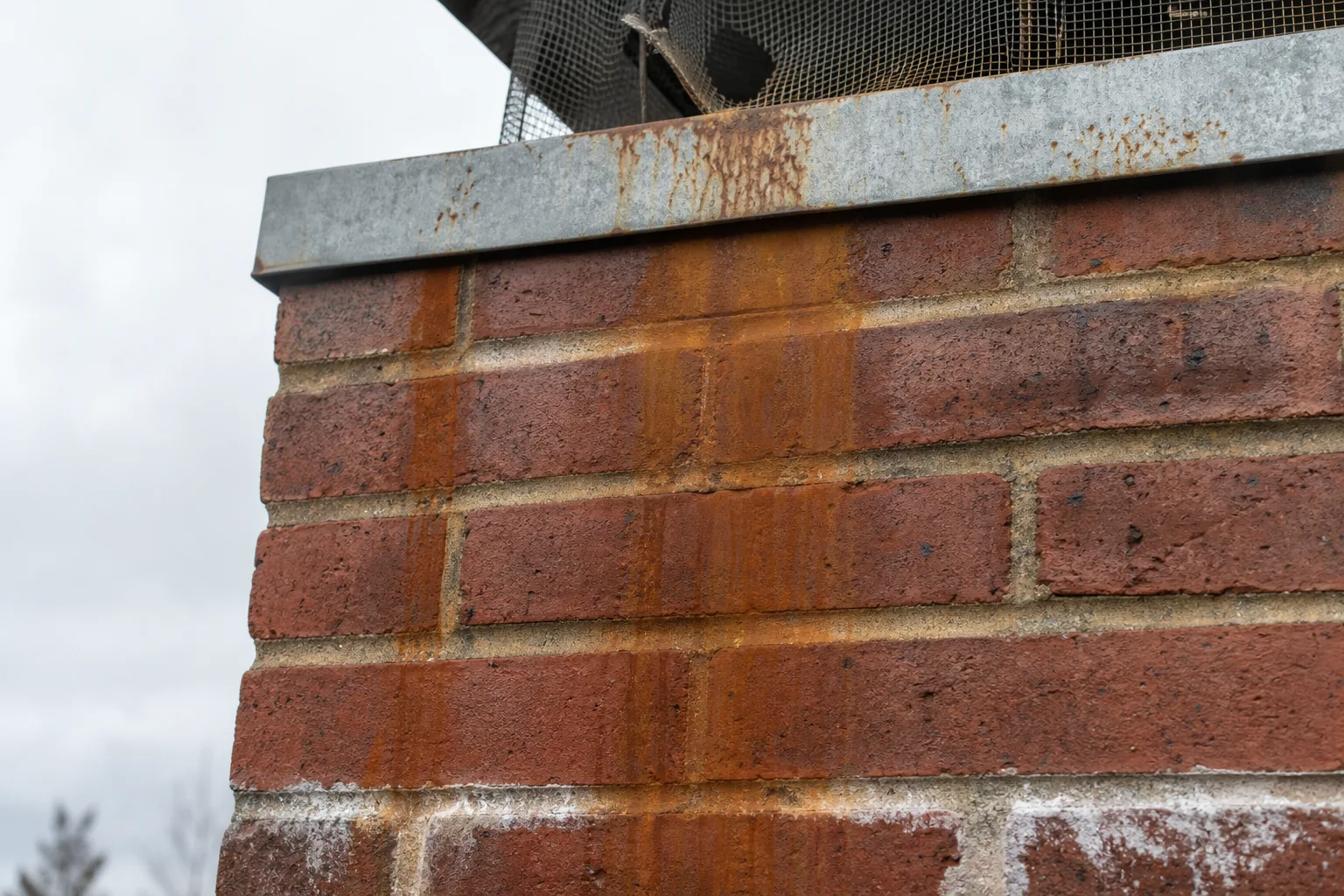
| Orange-brown streaks running down the brick from the top | The cap, or its mesh, is rusting through and water is getting in | New chimney cap, plus checking what the water already did | This season |
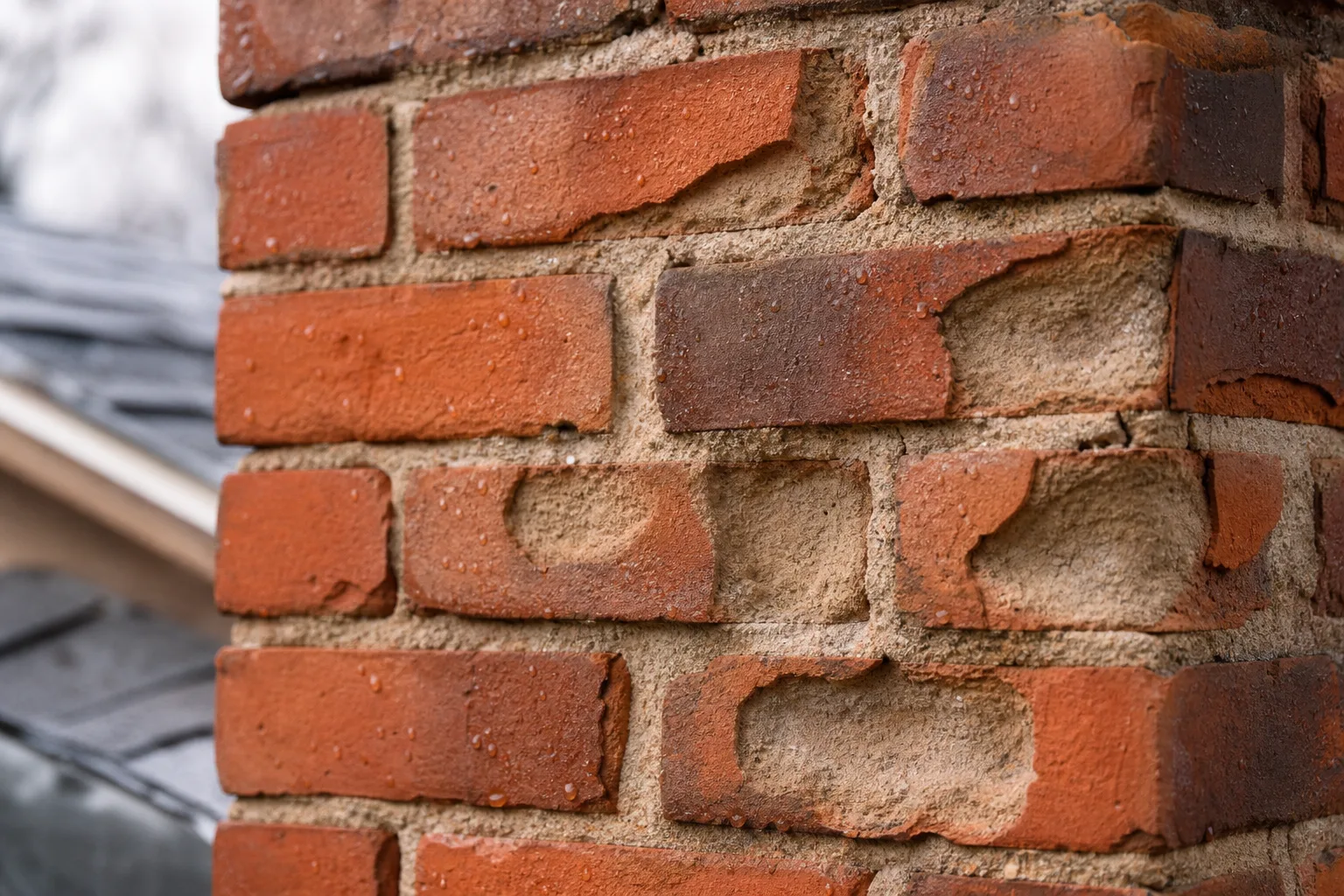
| Brick faces flaking or popped off, pale sandy material showing | Spalling. Water got into the brick and froze inside it | Brick replacement, then waterproofing | This season, before hard freeze |
| Mortar joints recessed, sandy, crumbling when you rub them | The joints have lost their bond and are now the water's front door | Repointing, also called tuckpointing | This season |
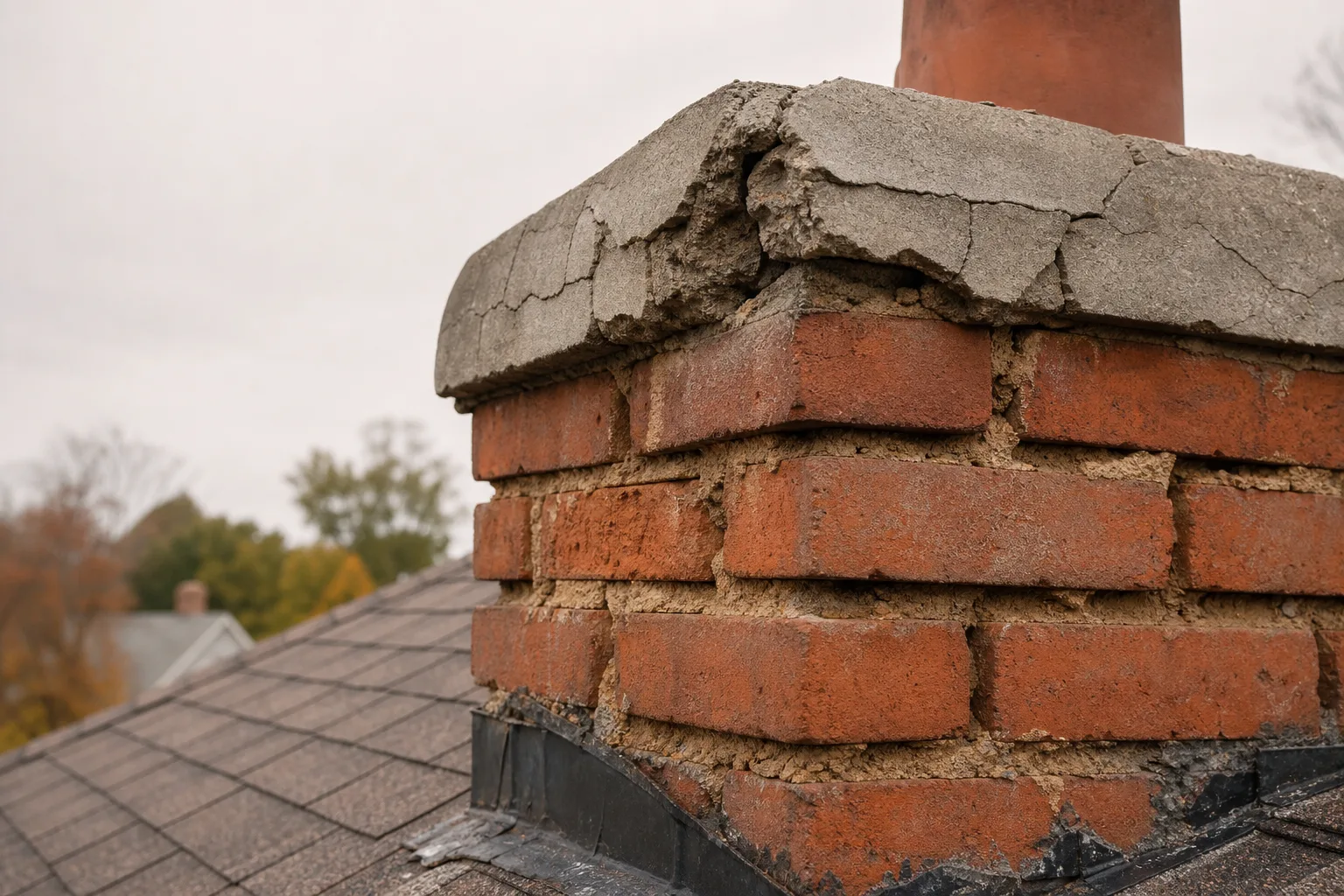
| A cracked, spidered slab on the very top | Crown failure, the most common water entry point there is | Crown repair or a new poured crown | Urgent before freeze |
| White chalky patches on the brick face | Efflorescence. Salt left behind by water moving through the masonry | Find the leak first, then repair, then waterproof | Diagnose now |
| Black roofing tar smeared where the chimney meets the roof | Someone already tried to fix a leak here, cheaply | Proper step flashing and counterflashing | This season |
| Brown stain or bubbling paint on the wall beside the fireplace | Water is already inside the house | Full leak diagnosis, likely crown or flashing | Now |
| Cap dented, mesh torn, or simply missing | Open flue. Rain, snow, and animals go straight down it | New cap | Now |
Good to know: That rust streak is easy to walk past, because it looks like ordinary staining. It is not. It means a steel component up there has been shedding itself into the rain for a while, and rain that can carry rust down the brick can also go into the brick.
If two or three rows describe your chimney at once, that is normal and it usually means one thing. Water is getting in somewhere above, and everything below it is the symptom rather than the cause.
A good inspection finds the entry point. A bad one sells you the symptom. It helps to understand how a chimney actually moves air and gas up and out before anyone starts telling you what yours needs.
You named it. Now get real eyes on it.
Describe what you are seeing and we will match you with independent chimney companies working in your part of Connecticut. You can check any company's Home Improvement Contractor registration yourself at elicense.ct.gov before anyone starts.
Call (513) 655-6702
Why Connecticut Chimneys Fail Faster Than They Should
Read ten chimney pages from ten different states and you will notice they are interchangeable. Swap the state name and nothing else has to change.
That is a tell, because the reason chimneys fail here is specifically about here, and it is why chimney repair CT quotes for the same defect look different from quotes written in Georgia.
Freeze-Thaw, and the Nine Percent Problem
Water expands by roughly nine percent when it freezes. That is not a chimney fact, it is a physics fact, and it is the entire story.
Brick and mortar are porous. They drink. When a Connecticut chimney takes on water in November and the temperature drops overnight, the water inside the masonry turns to ice and pushes outward from within. Then it thaws and does it again.
One cycle does nothing you would notice. A winter of cycles turns a hairline crack into a gap. Several winters turn a gap into a missing joint, and a missing joint into a brick you can pull out with your hand.
This is why the same defect is a different animal in October than in May. It is not that autumn damage is worse. It is that autumn damage is about to be put through the machine.
Salt Air Along the Shoreline
Coastal Fairfield County and the Long Island Sound shoreline get salt-laden air that inland Litchfield does not. Salt is aggressive toward mortar and toward the steel components sitting on top of the stack.
If your house is close enough to the water to taste it on a windy day, your cap and your flashing are living a harder life than the same parts twenty miles north.
Old Brick, Soft Mortar, and Brownstone
Connecticut has a lot of old houses. That is part of why people love living here, and it is exactly why chimney work here is not generic.
Masonry built before the middle of the last century often used softer brick and lime-based mortar. Those materials were designed to flex and to let moisture pass through slowly. They behave nothing like modern hard brick and Portland cement.
And in the Hartford and Portland corridor you get brownstone, the dark reddish sandstone the local quarries supplied for generations. Brownstone is handsome, and it delaminates in sheets when water gets behind it.
Historic masonry is also easy to damage with the wrong approach, which is why cleaning old brick and stone is its own skill rather than a pressure washer and an afternoon.
Pro tip: Ask any mason what mortar mix they plan to use on an older chimney, and why. Mortar harder than the surrounding brick does not protect the brick. It transfers stress into the brick face, and the brick loses. On a soft historic stack, the wrong mix is worse than no repointing at all.
All of it funnels down to one part almost no homeowner has ever looked at, because you cannot see it from the ground. The slab on top.
The Six Chimney Repair CT Jobs Homeowners Actually Pay For
Residential chimney repair CT work sorts into six buckets. Knowing which bucket you are in is most of the battle, because it tells you whether you are looking at an afternoon of work or a week of staging.
Crown Repair or a New Crown
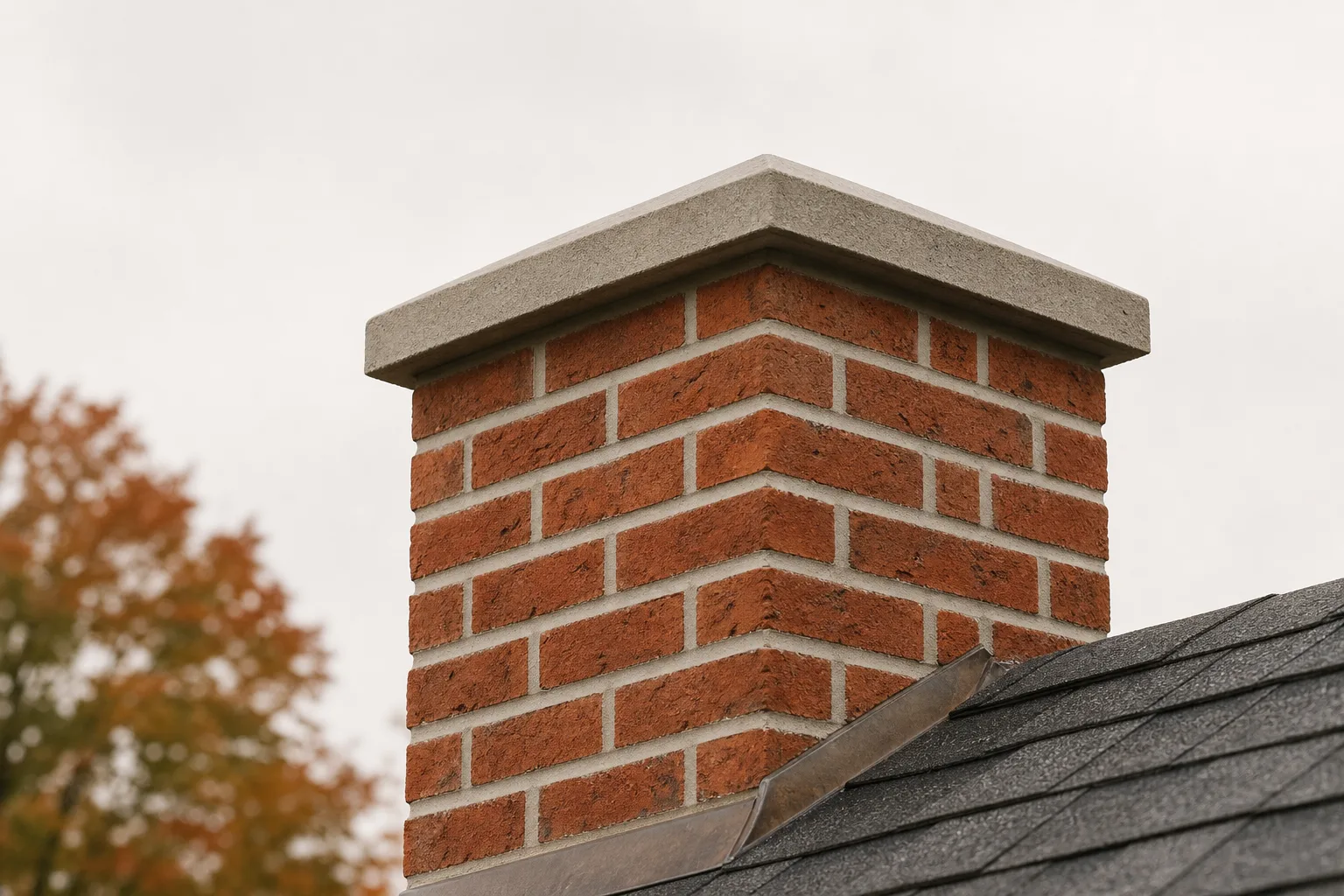
The crown is the concrete slab on the very top of the stack, a few inches thick, sloped away from the flue tiles and overhanging the brick a little so rain drips clear.
It is the roof of your chimney. It is usually the first thing to go, and when it cracks, water runs straight down into the masonry. Every problem below it starts there.
A hairline crack can be sealed. A crown that has gone to map-cracking, with chunks missing at the corners and a gritty crumbled edge, gets removed and poured again.
Repointing, Also Called Tuckpointing
Repointing means grinding out the deteriorated mortar from the joints and packing in fresh mortar. It is slow, skilled, unglamorous work, and on an old chimney it is the highest-value repair there is.
You can tell fresh repointing at a glance. Crisp light gray lines against older brick, obviously newer, cut to a consistent depth.
Partial repointing is legitimate. A stack often fails on the weather side first, and grinding out sound joints for no reason is a waste of your money.
Flashing, and the Tar Tell
Flashing is the metal where the chimney meets the roof. Done right it is two parts: step flashing that follows the shingle courses up the sides, and counterflashing tucked into a cut mortar joint and sealed.
Done wrong, it is a bucket of black roofing tar.
From the field: Tar at the flashing is the clearest signal of a previous cheap repair anywhere on a chimney. It is not a fix, it is a delay, and it fails in a way that hides the water while it is happening. When you see it, assume the underlying flashing detail was never done properly, and assume water has been tracking somewhere out of sight.
A New Chimney Cap
The cap is the steel box with mesh sides and a lid that sits over the flue opening. It keeps out rain, snow, birds, squirrels, and embers on the way up.
It is the cheapest part on the chimney and the one whose absence does the most damage per week. A missing cap is an open pipe into your house.
Stainless costs more than galvanized and lasts considerably longer, which matters more near the shoreline than it does inland.
Relining the Flue
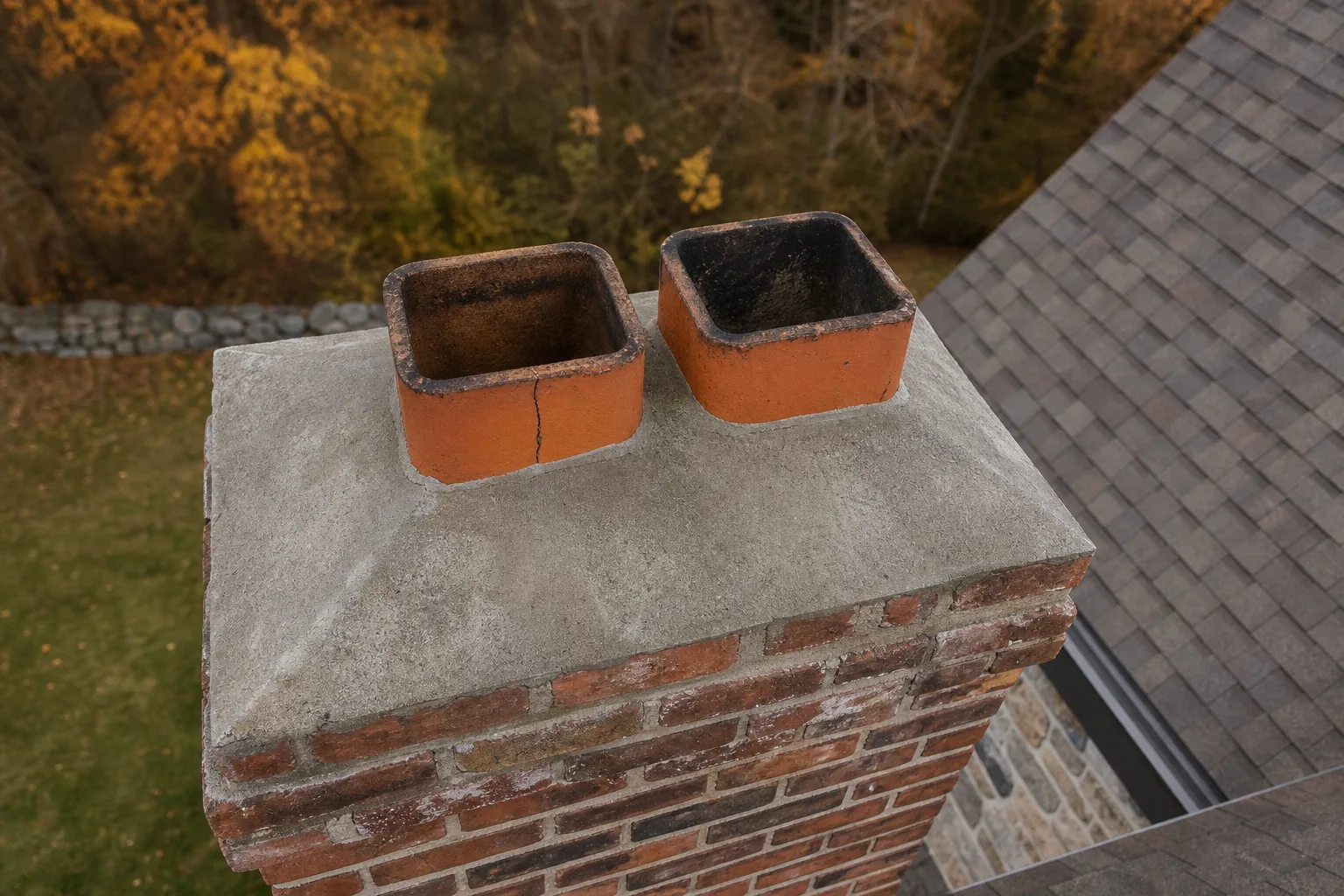
Inside the masonry shell is the flue, and what a chimney liner actually is surprises most homeowners: usually terracotta clay tiles stacked on each other. You can see their orange tops poking above the crown.
Clay cracks. Heat, a chimney fire, settling, or water freezing inside the flue will split tiles, and a cracked flue lets combustion gases reach the wood framing around the chimney. That is the scenario the whole standard exists to prevent.
Relining usually means running a stainless steel liner down the flue and sealing it top and bottom, sized to the appliance it serves. If a company proposes relining, the honest version of that conversation includes showing you the video from inside the flue.
Partial or Full Rebuild
Above the roofline, where the stack takes weather on all sides, masonry gives out first. A rebuild of the top few feet is a common and reasonable job.
A full rebuild from the foundation up is a different order of project. Be appropriately skeptical of it as a first suggestion on a stack that has never been repointed, because repointing is what was supposed to happen thirty years ago and never did.
When the firebox and hearth are part of the problem too, the conversation shifts toward restoring the fireplace as a system rather than patching the stack alone.
Inspection Levels: What NFPA 211 Actually Requires
There is a national standard for this, NFPA 211, and it defines three inspection levels. Any competent company will tell you which one they performed.
If nobody used a number, you did not get a graded inspection. You got a look.
Level 1
For a chimney in continued service under the same conditions, with no change in performance. The inspector checks the readily accessible portions for soundness, blockage, and combustible deposits.
This is the annual check. It is the right call when nothing has changed and nothing is wrong.
Level 2, and the Five Triggers
A Level 2 includes everything in a Level 1, plus accessible attics, crawl spaces, and basements, plus a video scan of the inside of the flue.
NFPA 211 requires a Level 2 in five situations:
- On the sale or transfer of a property
- When the system is changed: fuel type, appliance, flue shape, flue material, or a new liner
- After an operating malfunction
- After a chimney fire
- After an external event likely to have caused damage, including a building fire, a seismic event, or a severe weather event
That list is worth rereading, because it covers the exact moment a lot of Connecticut homeowners find themselves in. If you are selling, the standard already answers your question, and a good chimney repair CT company will produce the video rather than describe it.
Myth vs. fact: People will tell you a Level 2 inspection is "Connecticut law" at closing. It is not a Connecticut statute. It is what NFPA 211, the national standard, requires, and it is standard practice in real estate transactions. The distinction matters, because a company that is loose about what the law says tends to be loose about other things.
Level 3
Reserved for when a Level 1 or Level 2 suggests a hidden hazard that cannot be evaluated without removing or demolishing part of the chimney or the building.
Level 3 is uncommon, and it should feel uncommon. Nobody opens a wall casually.
Safety note: After a chimney fire, an operating malfunction, or a weather event likely to have caused damage, NFPA 211 calls for a Level 2 before the system goes back into service. Not after the next fire. Before.
How to Vet a Chimney Repair CT Contractor Before Anyone Gets on Your Roof
Here is the fact I promised in the opening, and it comes from the Connecticut Department of Consumer Protection rather than from anyone in this trade.
Home Improvement Contractor Registration
In Connecticut, anyone performing chimney repair must be registered as a Home Improvement Contractor with the Department of Consumer Protection. The DCP spells out what counts as covered work, and the list is broad: installing or repairing a chimney cap, replacing or repairing a liner, replacing mortar.
Which means essentially every chimney repair CT job you would actually hire for sits inside the Home Improvement Law. Chimney sweeping, on its own, does not.
Registered contractors are required to carry their Connecticut-issued home improvement registration certificate with them. You are allowed to ask to see it, and asking is not rude.
You can verify a registration yourself at elicense.ct.gov. The DCP Complaint Center is reachable at 800-842-2649 during business hours.
This is not theoretical enforcement. The state has issued stop-work orders against chimney and fireplace companies operating in Connecticut.
What Registration Does Not Mean
Now the part almost nobody tells you.
Connecticut's HIC program is a registration, not a trade license. It confirms that a business filed the required paperwork and met baseline financial qualifications. It does not certify that anyone passed a masonry exam or knows what they are doing on a hundred-year-old stack.
Good to know: Legally allowed to do the work, and good at the work, are two separate questions. Registration answers the first. Only references, photographs of finished jobs, and a written scope that shows real understanding answer the second. Ask both before you hand anyone a chimney repair CT project.
Private credentials like CSIA certification are a real signal of training, and they are not a state requirement. Treat them as a plus, never as a substitute for the registration check.
What a Chimney Repair CT Estimate Should Spell Out
We do not publish prices, and you should distrust anyone who publishes a firm number for your chimney without seeing it. What you can judge is the document.
A scope worth signing tells you:
- The company's Connecticut HIC registration number, which you then check at elicense.ct.gov
- Proof of liability insurance and workers' compensation coverage
- Which NFPA inspection level was performed, stated as a number
- Photographs or video of your actual defect, not stock images of somebody else's chimney
- The specific repair, by name, and the linear feet or square feet involved
- For repointing: the mortar mix and the joint depth
- For relining: the liner material, the diameter, and the appliance it is sized to
- What is excluded, which is where the surprises live
- The payment schedule, and what triggers each payment
- Photographs before and after, agreed in advance
An estimate that says "repair chimney" and gives a number is not an estimate. It is an invitation to argue later.
Timing: What Can Wait Until Spring and What Cannot
Masonry needs temperatures above freezing to cure properly. That is the honest reason autumn matters in Connecticut, and it is the only urgency argument worth listening to.
Before the Hard Freeze
Anything that lets water into the masonry belongs on this year's list, not next year's. Crown cracks, open joints, failed flashing, a missing cap.
The logic is simple. A defect that admits water in October gets a full winter of freeze cycles working on it, and you will pay for a larger version of the same repair in April.
Waterproofing and repointing in particular want mild, dry weather. A good company will tell you when it is too late in the season to do the work well, and a company that says any week is fine is telling you something about itself.
That is the real seasonal calculus behind chimney repair CT projects. Not scarcity, not pressure, just mortar and temperature.
What Is Genuinely a Stop-Using-It Problem
Most chimney repair CT work is not an emergency. A few things are, and they share one feature: the flue can no longer be trusted to contain what it is carrying.
- A known or suspected chimney fire, until a Level 2 clears it
- Visible cracks in the flue tiles, or a liner the inspector could not see through
- Smoke or fumes entering the room when the appliance runs
- A stack that is visibly leaning, or has loose brick above the roofline
In those cases the sequence is: stop using it, get the graded inspection, then repair. Not the other way around.
A carbon monoxide alarm is different, and it is not a repair question. If a CO alarm sounds, get everyone outside into fresh air first, then call 911 or your gas utility's emergency line from outside. Do not go back in to investigate, and do not wait for a chimney company. The inspection comes after the building has been cleared.
How VIO Helps With Chimney Repair CT
VIO is a referral service, and that is worth saying plainly rather than burying. We do not repair chimneys. Independent local companies do the work, and VIO's job is to get the right one of them to your house.
For the situation you are in, that means something specific. You have a symptom and probably one estimate, and no way to judge either. You tell us what the chimney is doing, and we match you with companies that work your part of Connecticut, from the shoreline to the northwest hills.
From there the leverage is yours. Every company we match you with can be checked at elicense.ct.gov in about a minute, and you should check. We ask every company in the network to put its estimate in writing before any work starts, and you should insist on exactly that.
If you are early in the process, the most useful thing to ask for is a graded inspection with photographs, not a quote. Chimney repair CT pricing only becomes meaningful once somebody has looked inside the flue and told you which of the six jobs above you are actually buying.
You have done the homework. Make the one call.
Tell us what your chimney is doing and we will match you with local companies that handle the chimney repair CT homeowners need, from crown work to relining. We ask every company in the network to put its estimate in writing before any work starts, and you should insist on exactly that.
Call (513) 655-6702
Symptom checker
What is your chimney doing?
Tap the closest match for an honest first answer.