



On this pageWhat a Chimney Sweep Roswell Visit Actually Includes7 sections+6
- What a Chimney Sweep Roswell Visit Actually Includes
- Sweeping and Inspection Are Not the Same Job
- How to Vet a Chimney Sweep Roswell Homeowners Can Actually Check
- Two Kinds of Roswell Chimneys, Two Very Different Visits
- What a Sweep Finds, and What It Means for Your House
- When to Book, and the Red Flags That Should End a Visit
- How VIO Helps You Book a Chimney Sweep Roswell Homeowners Can Verify
Quick answer
A chimney sweep Roswell homeowners hire should do three things: inspect the flue, clean it when buildup calls for it, and hand over a written report with photos of the flue interior. NFPA 211 calls for inspection at least once a year, with removal of deposits at 1/8 inch of creosote or any glazing. Georgia issues no chimney sweep license, so verify the individual technician's CSIA certification at search.csia.org.
The first genuinely cool night in North Fulton always ends the same way. Somebody cracks the damper open, catches a whiff of something old and damp, and starts typing.
If you are hunting for a chimney sweep Roswell homeowners can actually rely on, the useful question is not which company sits highest on a directory listing. It is what the visit includes, and what you are entitled to ask for before anyone climbs onto your roof.
Here is what the first page of results will not tell you. There is one credential you cannot check in Georgia, because the state does not issue it. That single fact should change the way you shop, and I will come back to it.
Start with the appointment, because almost nobody describes it, and the unknown is what makes people put off the call for another season.
What a Chimney Sweep Roswell Visit Actually Includes
A proper visit has three parts: a look, a cleaning if the look calls for one, and a written record of both. Skip any of the three and you did not get a chimney sweep, you got a chimney vacuuming.
Before anyone touches the firebox
Let the fire go completely cold. A full day is better than a few hours, and if you burned the night before, reschedule rather than hand someone a warm flue.
Clear a path. The gear is bulkier than people expect, and a five foot working radius around the hearth saves everyone twenty minutes of furniture shuffling.
Then get out of the way, but stay in the house. You want to be the person who sees the screen when the camera goes up.
Pro tip: Ask for the flue photos while the tech is still standing in your living room, not emailed later. Photos you look at together turn into questions you would never think to ask from a parking lot.
The arrival sequence, step by step
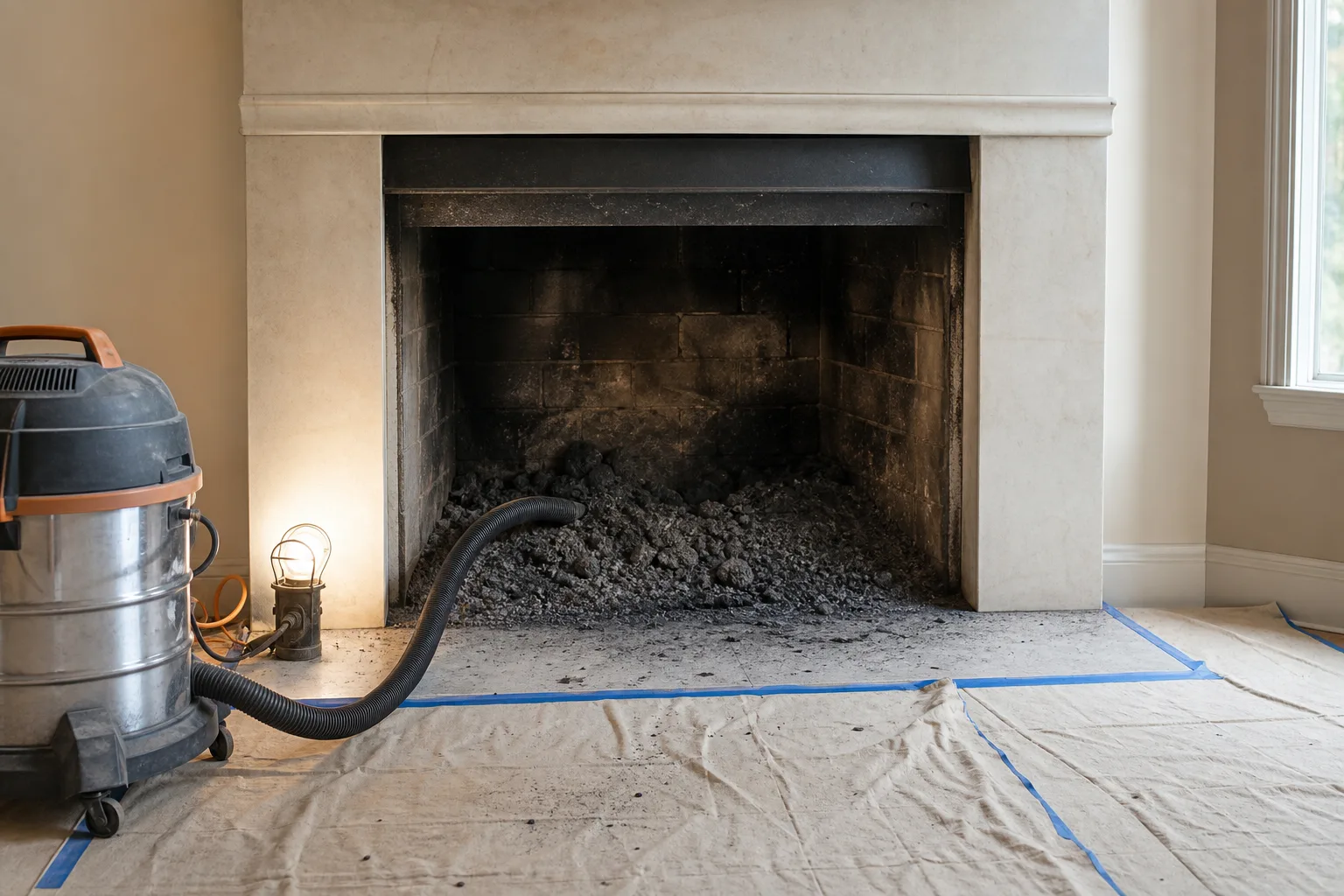
Drop cloths go down first, over the hearth and out onto the floor or carpet. Boot covers go on. If neither happens, you have learned something already.
Next comes the vacuum, a drum-sized machine with real filtration, hosed into the firebox to hold the fireplace under slight negative pressure. That vacuum is the difference between a clean job and grey film on your mantel for a month.
Then the fireplace opening gets sealed behind a barrier so nothing escapes into the room.
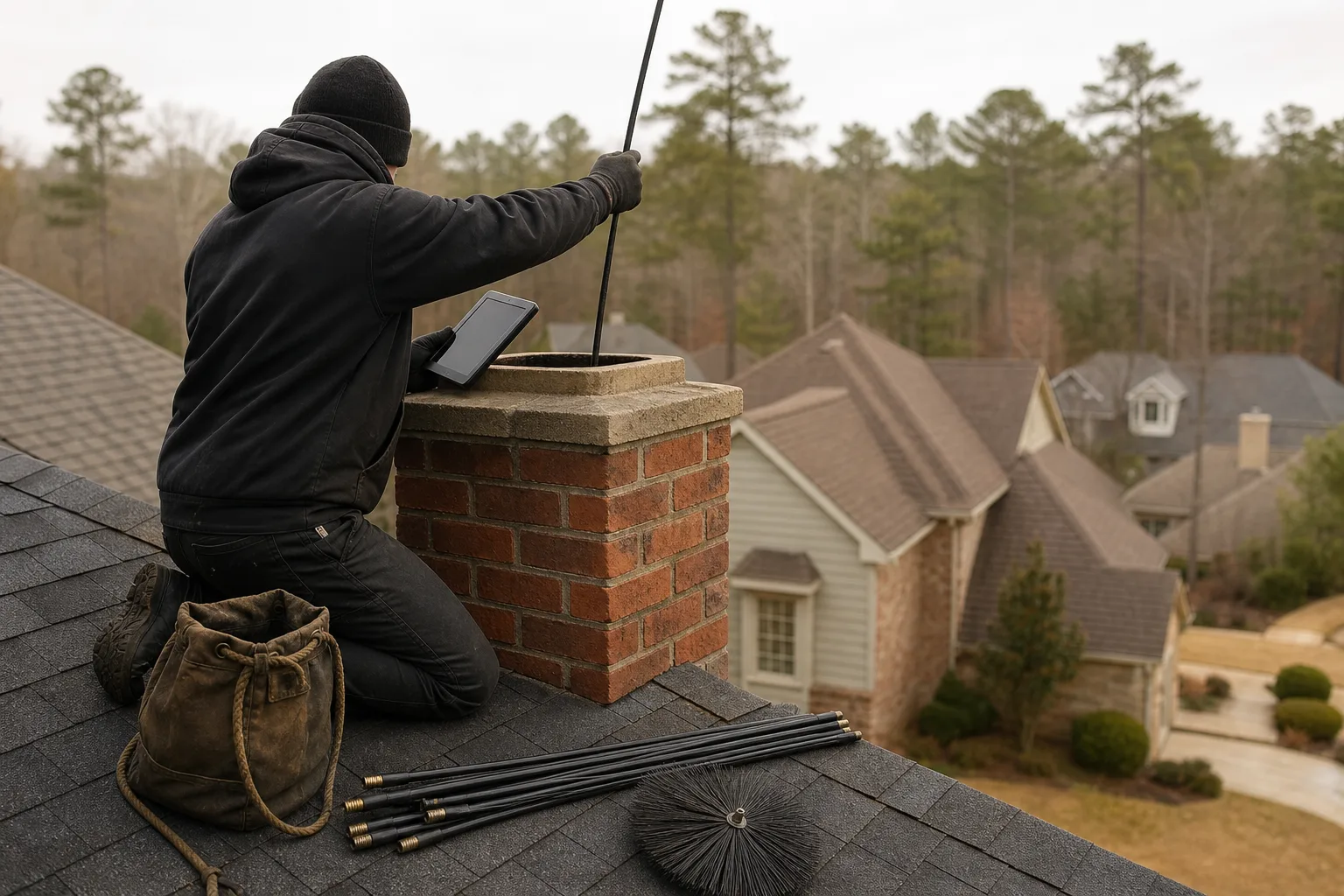
The brushing itself is unglamorous and oddly satisfying to watch. Fiberglass rods screw together one at a time, and a poly or wire brush sized to your flue gets pushed up from the firebox, or dropped down from the roof, scrubbing the walls of the flue as it travels.
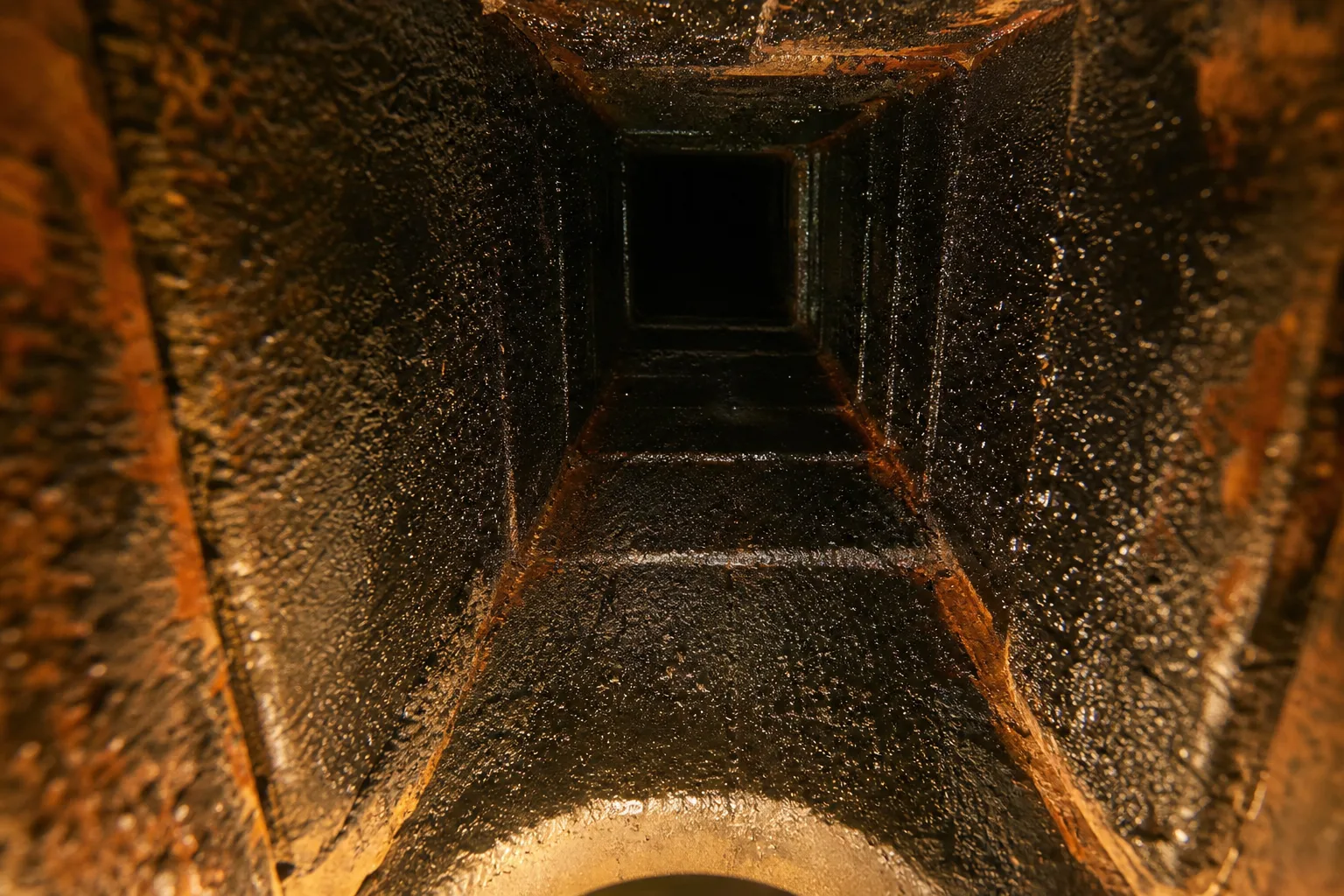
Debris falls to the smoke shelf, that hidden ledge behind the damper where decades of soot quietly collects. It gets vacuumed out, along with whatever the damper area is holding.
Here is the part homeowners find genuinely strange the first time: a lot of what comes out of a flue is not soot at all. Twigs, leaves, acorn shells, the remains of a nest. North Georgia trees do most of their chimney work in the fall.
The camera, and the report you should be handed
The cleaning is the easy half of a chimney sweep Roswell appointment. The value is in what gets looked at afterward, with a light and usually a camera on a flexible rod.
The tech is checking the flue liner for cracks and gaps, the damper for warping and rust, the firebox for failed mortar joints or cracked panels, the crown and cap up top, and the flashing where the stack meets the shingles.
By the end you should be holding paperwork, not a verbal summary in the driveway. Ask for these things in writing:
- Which flues were cleaned, and what condition each was in.
- Whether creosote had reached the removal threshold, and whether any of it was glazed.
- Photos of the flue interior, especially of anything described as a problem.
- Damper, cap, crown and flashing condition, noted individually.
- What needs attention now, what can wait a year, and what is simply worth watching.
- The name of the technician who did the work.
That last line matters more than it looks. Hold onto it.
If sorting through listings is the part you dread, you can skip it and tell us what your fireplace needs instead.
Sweeping and Inspection Are Not the Same Job
Most people believe they need an annual cleaning. What the standard actually asks for is an annual inspection, and a cleaning when the inspection says so. The difference is money in your pocket some years, and safety in others.
What NFPA 211 asks for every year
NFPA 211, the national standard for chimneys, fireplaces, vents and solid fuel burning appliances, calls for chimneys to be inspected at least once a year. Every year, regardless of how little you burned.
That annual look is the non-negotiable piece. A flue can go a season without a fire and still develop a problem, because water, animals and freeze-thaw damage do not care whether you lit anything.
Myth vs. fact: The myth is that a chimney must be swept every single year. The fact is that inspection is annual and sweeping is triggered by what the inspection finds. A sweep who tells you honestly that your flue does not need cleaning this year has just earned the next five years of your business.
The 1/8 inch rule, and glazed creosote
Creosote is what wood smoke leaves behind when it cools and condenses on flue walls. Slow, smoldering fires and unseasoned wood make far more of it than a hot fire with dry oak.
If you also run an insert or a freestanding stove, the same physics is at work, and the burning habits that keep a flue cleaner between visits are the ones covered in our guide to wood stove maintenance.
The standard sets the trigger for removal at 1/8 of an inch of accumulation. It also calls for removal when glazed deposits are present on flue surfaces, at any thickness.
Glazed creosote is the one to take seriously. It looks like hardened black tar, shiny enough that it seems wet in a flashlight beam, and it is fuel welded to the inside of your chimney. A brush alone often will not move it.
If someone tells you your flue is glazed, that is the moment to ask for a photo. Not because techs lie, but because you should see the thing you are paying to remove. The chimney sweep Roswell homeowners call back year after year hands over the photo before anybody has to ask.
Level 1, Level 2, Level 3: which one you need
The standard sorts inspections into three levels, and knowing which one applies to your situation is the fastest way to sound like someone who cannot be sold a service they do not need.
| Level | What it covers | When it applies |
|---|---|---|
| Level 1 | Readily accessible portions of the chimney exterior and interior, plus readily accessible parts of the appliance and the chimney connection | Nothing about the system has changed and you plan to keep using it the way you did last year. The routine annual visit. |
| Level 2 | Everything in Level 1, plus visual inspection of all internal surfaces including flue liners and joints, plus accessible clearances. Usually a camera scan. | Required at sale or transfer of the property, on any system change (new appliance, fuel change, relining), after a malfunction, after a chimney fire, and after an external event such as severe weather or an earthquake. |
| Level 3 | Invasive examination that can involve removing parts of the structure or building | Reserved for suspected concealed hazards that a Level 2 could not resolve. |
Buying or selling a house in Roswell puts you squarely in Level 2 territory. So does a chimney fire, even a small one you think you got away with, and so does converting a wood burning fireplace to gas or putting a new liner in the chimney, which is its own project with its own rules, walked through in our guide to chimney flue liner installation.
If a company offers you a Level 1 when your situation calls for a Level 2, that is not a bargain. It is the wrong inspection.
How to Vet a Chimney Sweep Roswell Homeowners Can Actually Check
Now the loop I opened at the top.
Georgia does not license chimney sweeps
Georgia does not license chimney sweeping as a specialty trade. Electricians and HVAC techs hold state credentials for their work. Cleaning and evaluating a flue is not one of the trades the state licenses that way.
I find that genuinely uncomfortable, and homeowners deserve to hear it plainly instead of discovering it later.
To be precise about what that does and does not mean: structural repairs, masonry work, permits and general business registration can carry their own requirements, so ask the company what applies to the specific work it is proposing. For the sweeping and inspection itself, there is no state license number to ask for.
So when you look for a chimney sweep Roswell will send to your house, "licensed" is not a useful filter. The filter is certification, insurance, and what the company is willing to put in writing.
Certification belongs to the technician, not the truck
The credential that carries weight is the CSIA Certified Chimney Sweep designation from the Chimney Safety Institute of America. CSIA describes it as recognized by industry organizations, insurance underwriters, and local, state and federal agencies as the measure of a technician's knowledge of evaluating and maintaining chimney and venting systems.
Here is the part nobody tells you. That certification belongs to a person, not to a business. A company can advertise "CSIA certified" truthfully because one employee holds the card, and send someone else entirely to your address.
CSIA runs a public directory at search.csia.org where you can look up a certified sweep. Use it on the name of the human being who is scheduled to come, not the name on the invoice.
Safety note: Ask for proof of both general liability insurance and workers' compensation before anyone goes up a ladder at your house. Who is responsible if somebody is injured there depends on coverage, employment status, contracts and the law, which is exactly why you want to see the certificates before the ladder goes up rather than afterward. A company that hesitates on this question has answered it.
The four questions to ask before you book
Say these out loud on the phone. They take ninety seconds and they change the entire tenor of the visit.
- Who is the technician coming to my house, and are they CSIA certified? A name, not a company claim. Then look it up.
- Is this a Level 1 or a Level 2 inspection, and why that one for my situation? If you are buying, selling, or you had a chimney fire, the answer had better be Level 2.
- Do I get photographs of the flue interior and a written report? Both, and before payment.
- If you find something, will the price for repairs be in writing before any work starts? Not a verbal number, and not work that begins while you are still deciding.
Any company worth your afternoon answers all four without friction. The ones that get vague on question one are the ones to thank and hang up on.
You know what to check now. One call instead of nine listings. Tell us about your fireplace and your Roswell address, and we will match you with an independent local company that works on chimneys like yours. Then put the four questions straight to them. Call (513) 655-6702
Two Kinds of Roswell Chimneys, Two Very Different Visits
There is no such thing as a standard chimney here. Roswell has two broad populations of them, and they fail in completely different ways.
Most of the city's older houses went up between the 1960s and the 1980s, and the historic district runs older still, with a median home age of roughly forty four years and genuinely old structures mixed in. Much of what was built from the 1980s onward carries a different animal entirely.
Which of the two you own decides most of what a chimney sweep Roswell visit looks like at your address, right down to which tools come off the truck.
Older masonry stacks
A brick stack with clay flue tiles inside it, a concrete crown on top, a metal cap over the opening. Solid, heavy, and vulnerable in essentially one way: water.
Water gets in through a cracked crown or a missing cap, soaks the brick, then freezes on one of those North Georgia nights that drops below thirty, and expands. Do that a few dozen times and you get spalling faces, sandy mortar joints, and eventually cracked tiles inside.
The tell you can spot from your own driveway is white chalky streaking on the brick. That is efflorescence, mineral salt carried out of the masonry by moisture, and it means water is moving through the wall.
Factory-built fireboxes and metal chases
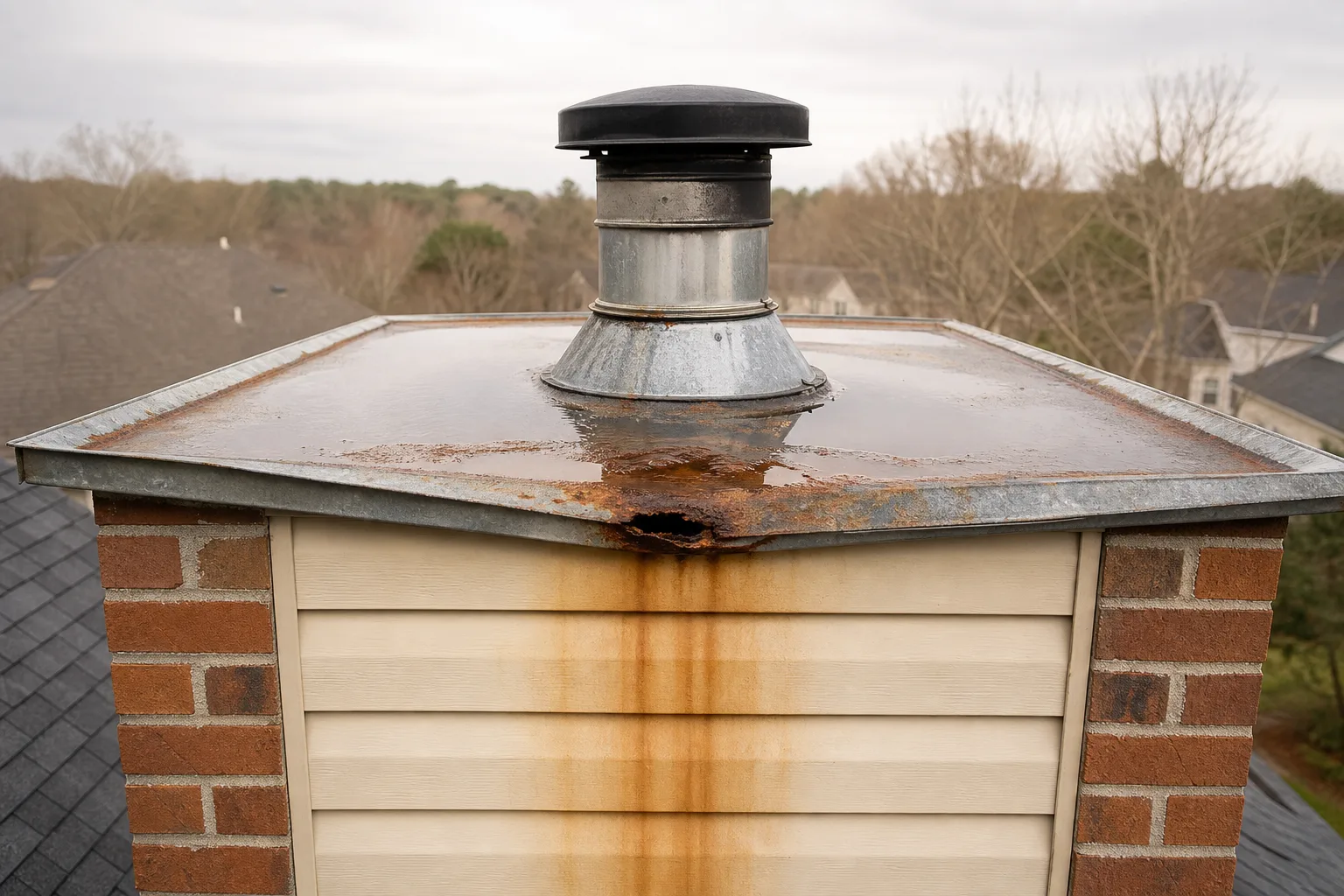
Walk a 1990s subdivision and look up. Many of those chimneys are not masonry at all. They are framed chases wrapped in siding or brick veneer, topped with a flat sheet metal pan, with a round double wall metal pipe coming through it.
That pan is called a chase cover, and it is the failure I would tell any owner of a newer Roswell home to have looked at first. Cheap ones are galvanized, they pond water instead of shedding it, and they rust from the middle outward until water runs straight down inside the chase.
Inside, the firebox is black painted steel with refractory panels stamped to look like brick. Those panels crack. When they do, the replacement has to match the listed model exactly, because a factory built fireplace is a tested system and not a pile of parts.
Good to know: Find the model number label inside your firebox opening before you call anyone. On a factory built unit, that label decides which parts are legal to install, and having it ready can save a second trip.
Gas logs vent through something too
If you converted to gas logs, you probably assumed sweeps are not your problem anymore. Half right.
You are not producing creosote. You are still venting through a flue that collects leaves and nesting material, still relying on a cap that rusts, and still depending on a damper position that a previous owner may have fixed in the wrong spot.
A blocked vent on a gas appliance is a carbon monoxide conversation, not a housekeeping one. Annual inspection applies.
From the field: The calls that sound most alarming are often the simplest to resolve, and the ones that sound like nothing at all are sometimes not. Smoke rolling into a room frequently traces back to a damper or a blockage. A faint damp smell in July, the kind people apologize for mentioning, can turn out to be water finding its way into the flue. Smell is a weaker signal than sight, and neither tells you much until somebody actually looks.
What a Sweep Finds, and What It Means for Your House
A good report is boring most years. That is the point of an annual look: to keep the list short.
What a Chimney Sweep Roswell Inspection Looks For
Here is the list a sweep works through, and what each item means if it shows up on your report:
- A cracked or deteriorated crown. The sloped concrete slab at the top. Hairline map cracks let water into the top of the stack, which is the most expensive place to let water in.
- A missing, bent or rusted cap. Without it the flue is an open pipe collecting rain, leaves and animals.
- A rusted chase cover on factory built systems, usually with a low spot that holds water after every storm.
- Creosote past the removal threshold, occasionally glazed, on flues that have been burning slow fires or unseasoned wood.
- A damper that will not seat or will not open, often rusted in position.
- Failed mortar joints or spalling brick, usually below the roof line where water has been getting in for years.
- Flashing that has been sealed rather than repaired, which is a leak waiting for its second act.
Notice how much of that list is about water rather than fire. That is why a good chimney sweep Roswell visit spends real attention on the crown, the cap and the flashing, and not only on the inside of the flue.
What can wait, and what cannot
Not every finding is urgent, and a sweep who treats all of them as emergencies is telling you something about the company rather than the chimney.
Three things I would not sit on: glazed creosote, a flue liner with visible cracks or gaps, and any evidence of a past chimney fire. All three sit between the fire and your framing.
Things that genuinely can wait a season, in most cases: cosmetic spalling above the roof line, a chase cover that is rusty but not yet perforated, minor efflorescence.
Good to know: Ask the sweep to rank the findings for you out loud. "Now, this year, or watch it" is a fair question, and the answer tells you whether you are talking to a diagnostician or a salesperson.
When to Book, and the Red Flags That Should End a Visit
The North Georgia calendar
Metro Atlanta's burning season is short and dense, roughly November through February, with a handful of cold snaps doing most of the work.
Which means the smart window is the one you are in right now. Late September and October, before the first genuinely cold week turns everybody in the neighborhood into a caller at once.
There is a practical reason beyond scheduling. If the inspection finds something that needs masonry work, repairs want dry, mild weather, and mortar does not care about your plans.
And if the inspection comes back clean, the fuel you burn all winter decides how much there is to sweep next fall. Dry hardwood, hot fires, maintained stove hardware.
Booking a chimney sweep Roswell homeowners can verify is also simply easier when you are not in a hurry. Urgency is how people skip question one, and question one is the whole ballgame.
Pick an ordinary Tuesday in October, put in the request early, and let the inspection tell you what the season looks like.
Five red flags
If any of these happen, stop the visit. You are allowed to. It is your house.
- Nobody actually inspected the flue. Brushing without looking is half a job sold as a whole one.
- A large repair recommendation with no photographs. If it is real, it can be shown to you on a screen.
- Pressure to decide today, especially paired with a discount that expires when the truck leaves.
- No written scope, no itemization, no technician name on the paperwork.
- Reluctance to show insurance, or an answer that changes when you ask twice.
None of this is exotic. It is the same script that shows up in every trade with no licensing gate, which is exactly why the four questions matter more here than they would for an electrician.
How VIO Helps You Book a Chimney Sweep Roswell Homeowners Can Verify
Plainly: VIO is a referral service, not a chimney company. We do not own ladders and we are not the ones on your roof.
What we do is the filtering step you would otherwise do yourself across nine directory listings. You tell us the address, the kind of fireplace, and what you have noticed, and we match you with an independent local company that works in Roswell and North Fulton on systems like yours.
The company that shows up is its own business, with its own technicians and its own paperwork to show you. The pro we send does the work. We stand behind the matching, and we care a great deal about who is in the network.
Ask them the four questions anyway, exactly as you would with any company you found yourself. Certification attaches to the individual technician rather than to a company name, and that stays true no matter who made the introduction.
On pricing, one commitment and one instruction. We ask every company in the network to put its estimate in writing before any work starts, and you should insist on exactly that, from us or from anybody else you call.
If a chimney sweep Roswell company will not write down what it is going to do before it does it, that tells you what you need to know, and you can end the conversation there.
Book the sweep before the cold gets here. Roswell's burning season is short, and the phones get louder the first genuinely cold week. Describe the house, the fireplace, and what you have noticed, and we will line up a local company for you. Call (513) 655-6702
Symptom checker
What is your chimney doing?
Tap the closest match for an honest first answer.