



On this pageDo Gas Fireplaces Have a Flue? The Short Answer8 sections+7
- Do Gas Fireplaces Have a Flue? The Short Answer
- The Three Ways a Gas Fireplace Can Be Vented
- How to Tell Which One You Have, Without Leaving the Room
- Gas Logs in an Old Masonry Fireplace: the Damper Question
- When a Gas Fireplace Needs a Chimney Liner
- What a Gas Fireplace Flue Actually Needs Looking At
- Do Gas Fireplaces Have a Flue That Gets Inspected When a House Changes Hands?
- How VIO CHIMNEY Helps With This Exact Question
Quick answer
Do gas fireplaces have a flue? Two of the three venting arrangements do. A direct vent appliance vents through a coaxial pipe, exhaust in the inner pipe and combustion air in the outer, terminating through an exterior wall or the roof. A B-vent appliance vents vertically through the roof. A vent-free appliance has no flue, no chimney and no vent pipe. The appliance's rating label and installation manual identify which one you have.
Some do and some do not. That is the honest answer, and it is worth a few more sentences of your time, because the three ways a gas fireplace can be vented are genuinely different objects, and the one sitting in your wall decides what is above it and what you should be asking about it.
So: do gas fireplaces have a flue? Yes, in two of the three arrangements. No, in the third, which vents nowhere at all.
What follows is built around something you can actually do, which is walk up to your own fireplace and work out which of the three you are standing in front of. It takes looking at the glass, looking at the wall outside, and then finding a small metal label that settles the question in a way no article can.
One more thing before we start, because it comes back later. Inside some of these installations there is a lever that is meant to be fixed permanently open, by design, with a piece of hardware that came in the box. If that describes your fireplace, it is worth knowing.
Do Gas Fireplaces Have a Flue? The Short Answer
A gas hearth appliance is vented in one of three ways: direct vent, B-vent (also called natural vent), or vent-free.
Two of those three carry combustion exhaust out of the building through a dedicated vent. The third carries it nowhere, because there is no vent, no chimney and no pipe.
So when someone asks do gas fireplaces have a flue, the useful response is a question back. Which of the three is it? Everything downstream of that answer changes: what sits above the appliance, what is worth having looked at, and what you should say when you pick up the phone.
Here is the part I want to plant early, because it is the spine of this whole page.
The appliance carries a rating label, and it came with an installation manual. Between them, those two documents identify what is in your wall, what it was listed to do, and how the maker says it is meant to be vented and maintained. A page like this one can narrow it down to one of three. The label and the manual are what settle it.
Everything below is written to get you to that label with your eyes open. That is what do gas fireplaces have a flue really resolves to: which of three.
The Three Ways a Gas Fireplace Can Be Vented
There is no single answer to do gas fireplaces have a flue, because there is no single gas fireplace. Here are the three arrangements, one at a time.
Direct vent: sealed combustion, a pipe inside a pipe
A direct vent appliance is a sealed combustion system. It draws the air the fire burns from outside the building, and it expels the combustion exhaust outside the building. A fixed high-temperature glass panel stands between the flames and the room, so the appliance is not pulling air out of the room you are sitting in.
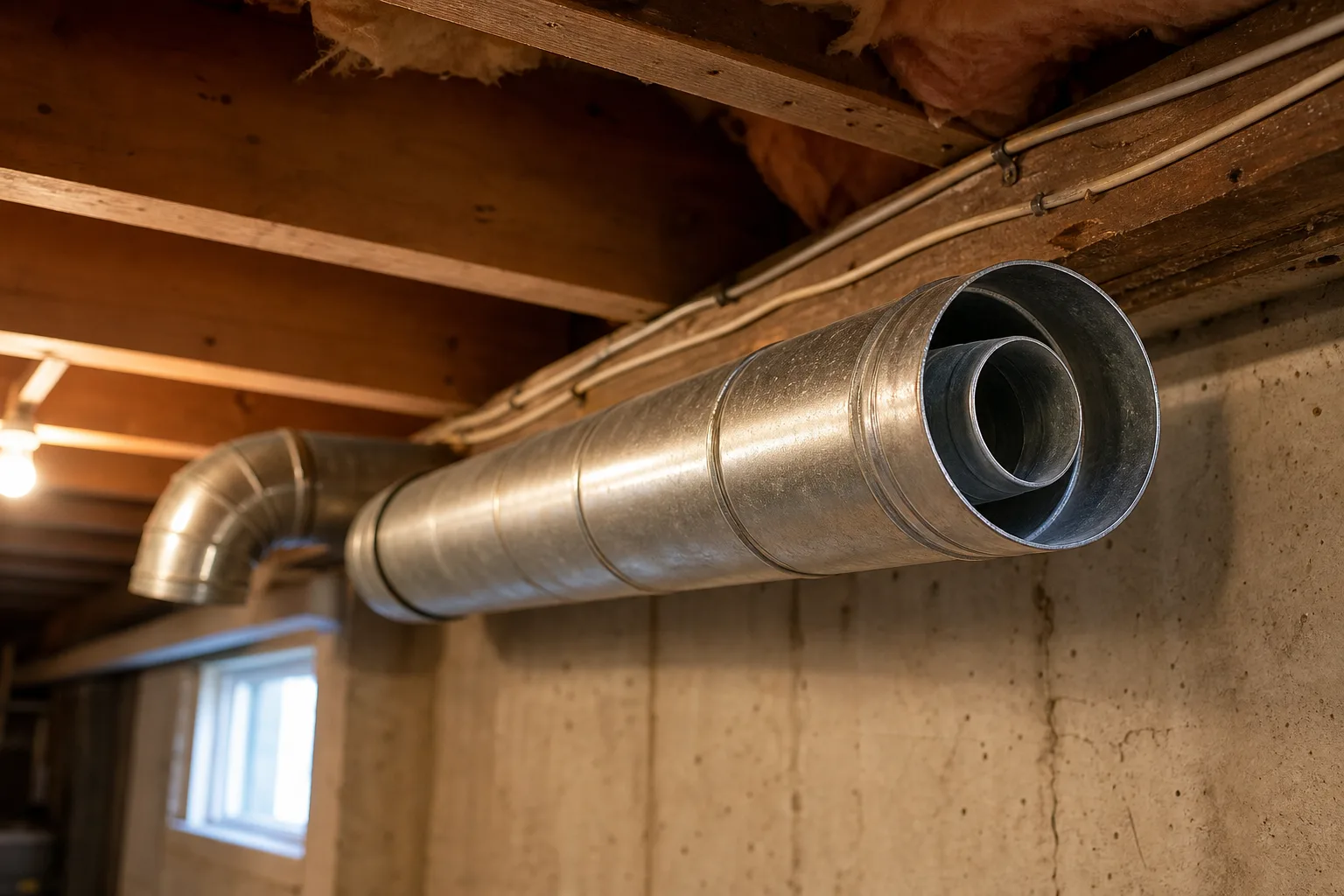
The vent itself is coaxial, which is a plain way of saying pipe inside a pipe. Exhaust travels up the inner pipe. Combustion air travels down the space around it, inside the outer pipe. One penetration in the wall or the roof, two air paths.
That vent can terminate horizontally, through an exterior wall, or vertically, through the roof. Powered venting arrangements open up routings that natural draft cannot manage.
Listed systems state a maximum number of elbows and a maximum total vent length. The figures that apply to your unit are in its manual, not on this page, and they are worth knowing before anybody starts planning a route.
A direct vent appliance can be a factory-built firebox designed to sit inside a framed opening, which is a different animal from a masonry fireplace; our guide to zero clearance gas fireplaces covers what that assembly is and what its listing controls.
B-vent, also called natural vent
A B-vent appliance is not sealed. It draws the air it burns from the room, and it sends the exhaust up a double-wall metal pipe that is routed vertically and exits through the roof.
There is no fan in that description. B-vent relies on the buoyancy of hot exhaust gas to move it, which is the same principle a masonry chimney runs on. If you want the physics of that, we walk through how a chimney works in its own guide.
Vent-free: no flue at all
A vent-free appliance has no chimney, no flue and no vent pipe. Nothing leaves the building through a dedicated path, which is the entire point of the design and the entire reason the category is regulated on its own terms.
Vent-free gas room heaters are covered by ANSI Z21.11.2, which permits them where they are certified to that standard and fitted with an oxygen depletion sensor. Under IRC 2024, that sensor shuts the gas supply off when room oxygen falls to roughly 18 percent.
Because nothing is vented outside, everything the combustion produces stays where you are.
Good to know: Vent-free appliances are banned or restricted in some states and some municipalities, and the sources that list them do not agree with each other. Do not take a roster of states from any web page, this one included. Your building department is the authority for your address, and that is a phone call worth making before you buy anything.
| Arrangement | What carries the exhaust | Where it can terminate | What to confirm |
|---|---|---|---|
| Direct vent | A coaxial vent, exhaust in the inner pipe, combustion air in the outer | Horizontally through an exterior wall, or vertically through the roof | The listed vent system for your appliance, its elbow and length limits, and its termination clearances, all in the manual |
| B-vent (natural vent) | A double-wall metal vent pipe, moved by the buoyancy of hot gas | Vertically, through the roof | That the vent is the listed type for the appliance, and the clearances the listing calls for |
| Vent-free | No vent. Nothing leaves through a dedicated path | Nothing terminates outside | Whether the appliance is permitted at your address, with the building department, and whether the unit is certified to ANSI Z21.11.2 with an oxygen depletion sensor |
| Gas logs in an existing masonry fireplace | The existing chimney flue | Above the roofline, at the top of the stack | The log set's own installation instructions, the condition and size of the existing flue, and the damper arrangement |
How to Tell Which One You Have, Without Leaving the Room
You can get a long way toward answering do gas fireplaces have a flue for your own house from where you are sitting right now. Three looks, in order.
Start at the glass
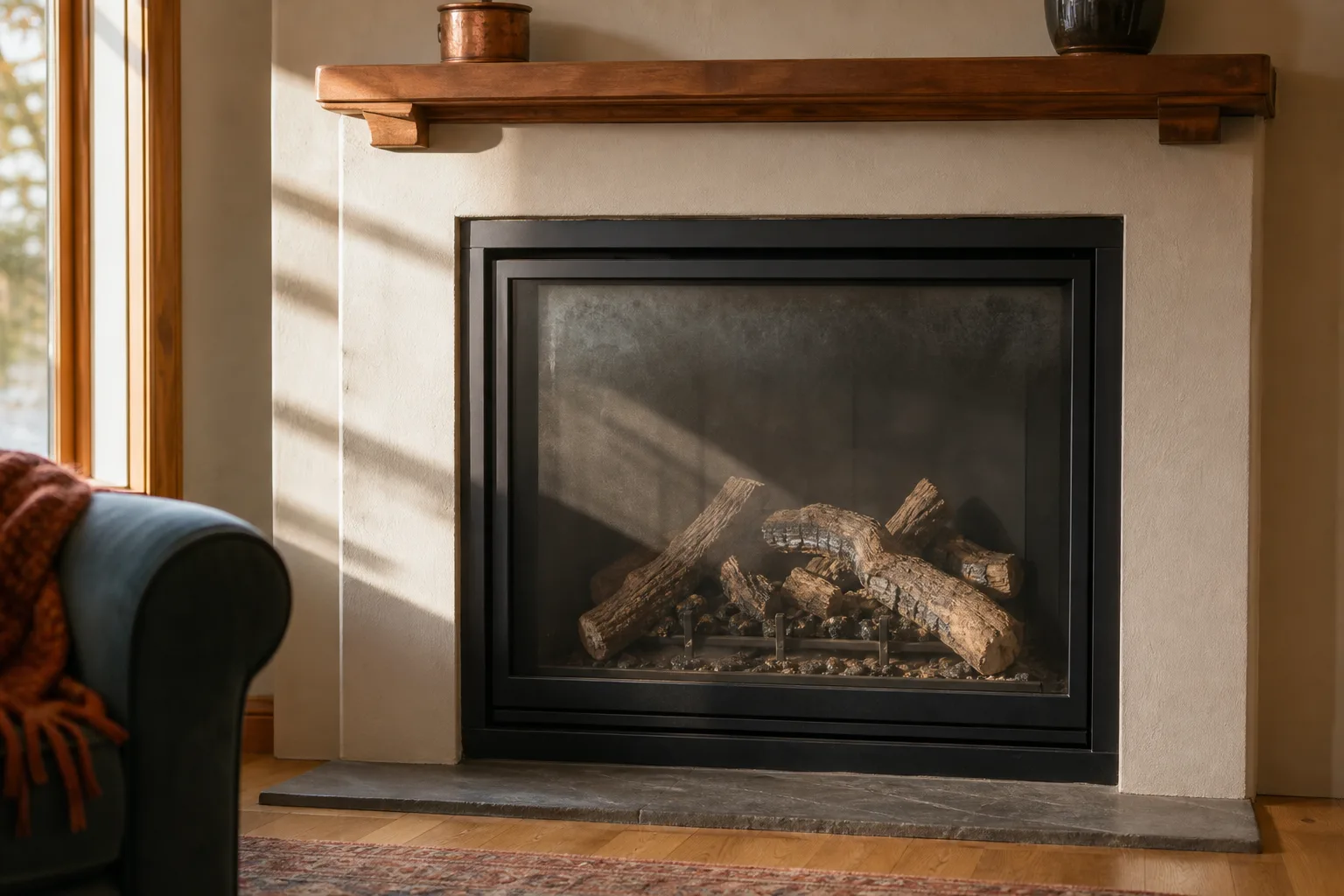
Stand in front of the fireplace. Can you put your hand into the firebox, or is there a fixed pane of glass sealed into the front of it?
A sealed, fixed glass front that does not open without tools points toward direct vent. An open firebox you could reach into, with logs sitting on a burner over a bed of sand or vermiculite, points toward a gas log set dropped into a fireplace built for wood. A unit with no glass and no chimney above it at all points toward vent-free.
These are indicators, not determinations. Designs vary, and a visual read narrows the field rather than closing it.
Do Gas Fireplaces Have a Flue You Can See From the Yard?
Walk outside and look at the wall the fireplace backs onto, then look up.
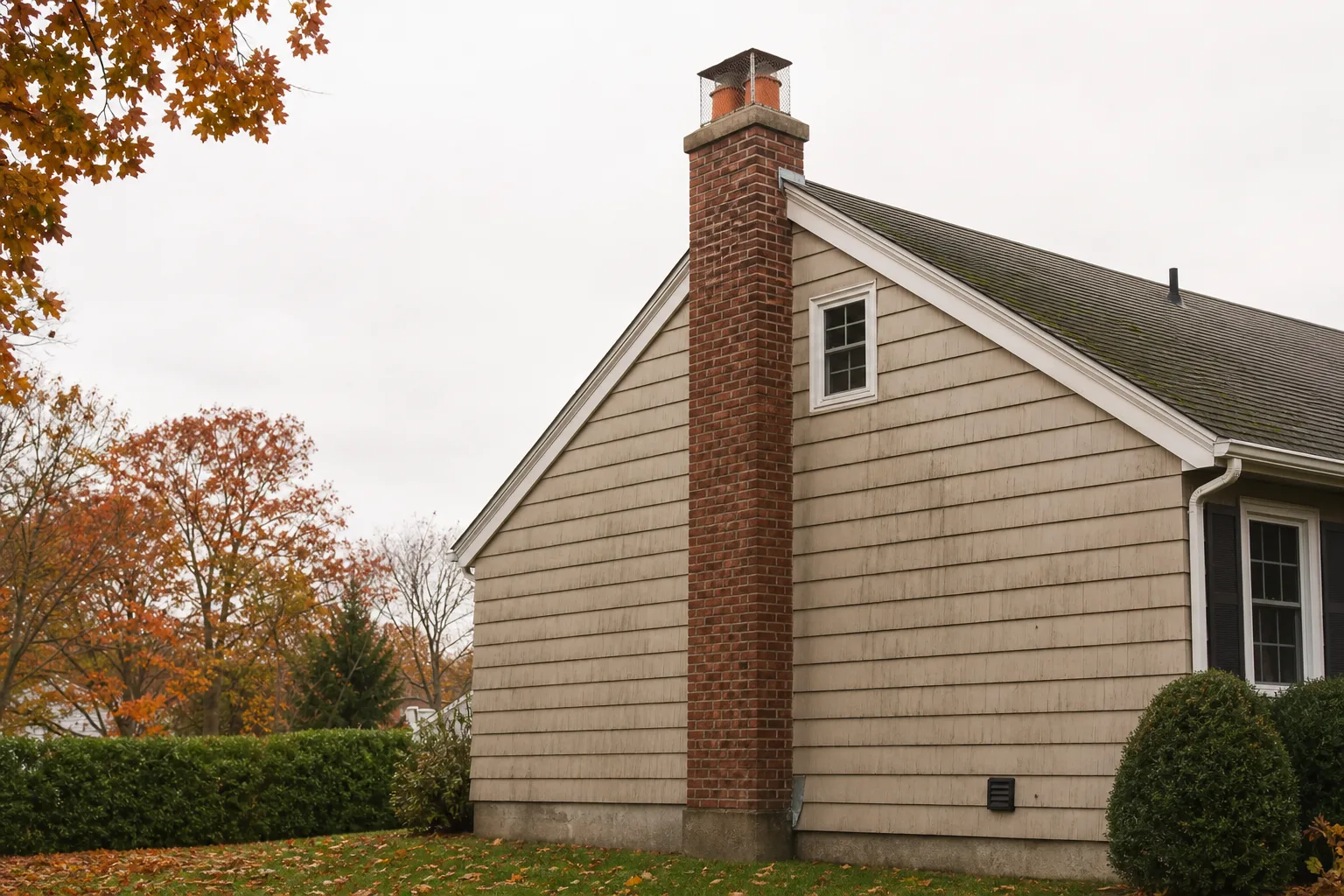
A metal cap with horizontal louvered slots on the exterior wall, somewhere near where the fireplace sits inside, is a direct vent termination. A round metal rain cap on the roof, sitting on top of bright galvanized pipe, points toward B-vent. A brick or stone stack with clay tiles poking above a concrete crown is a masonry chimney, which means the appliance inside may well be a gas log set or an insert rather than a factory-built fireplace.
Nothing above the room and nothing on the wall outside is the signature of vent-free.
The label is what settles it
Each of the reads above is an indicator. The rating label is evidence.
That label can sit behind a lower louvered panel, inside the control cavity, or elsewhere depending on the model. It carries the maker, the model number and the listing. With the model number in hand you can find the installation manual, and the manual tells you what the appliance is, how it is meant to be vented, and what its own maintenance instructions say.
Pro tip: Before you call anyone, take three photographs: the front of the fireplace, the inside of the firebox with a flashlight on it, and the exterior wall or the roofline above. Then find the label and photograph that too. You will be the rare homeowner who can answer the first four questions without going to look.
What to look at before you call
- Is the glass front fixed and sealed, or can you reach into the firebox?
- Are the logs ceramic, sitting on a steel burner, in a firebox that looks like it was built for wood?
- Is there a handle or a lever up inside the firebox opening?
- On the exterior wall behind the fireplace, is there a louvered metal cap?
- Above the room, is there a masonry stack, a metal rain cap, or nothing at all?
- Does the exterior termination have leaves, mulch, snow or a deck rail crowded against it?
- Have you found the rating label, and do you have the model number written down?
Not sure which one you have?
That is the normal answer, and it is not a failure of attention. Tell us what you can see, the front of the fireplace and what is above it outside, and we can connect you with an independent local chimney company that works on gas systems and can look at the appliance and the venting together.
Call (513) 655-6702 or request service online.
Gas Logs in an Old Masonry Fireplace: the Damper Question
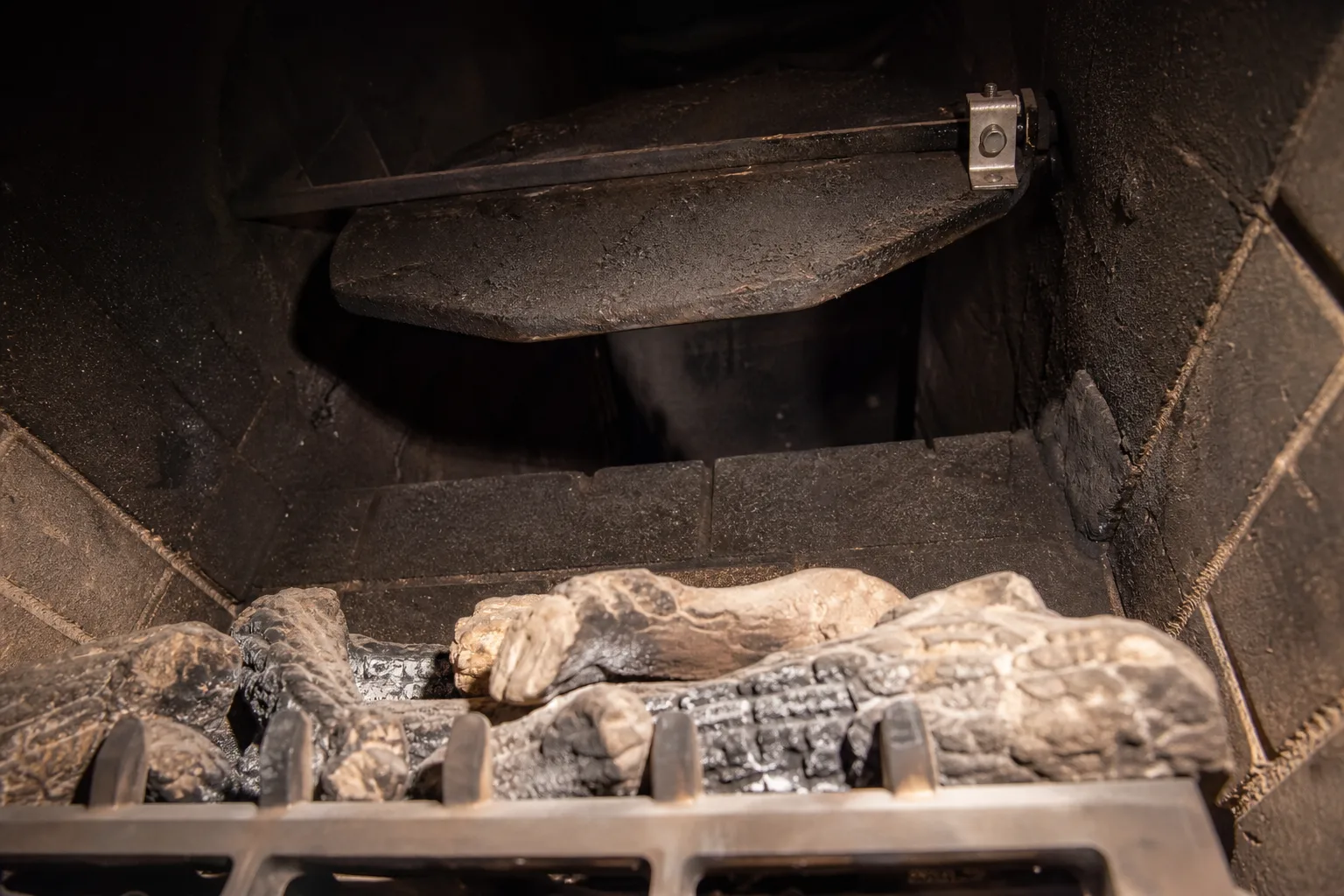
Here is an arrangement that deserves a section of its own. A set of ceramic logs sitting on a steel burner, installed into a firebox that was built for wood, with the house's original chimney standing over it.
This is where the question do gas fireplaces have a flue stops being abstract. In this case the flue is the one the house already had. It was built for a wood fire, and now it is carrying something different.
And this is the lever I mentioned at the top.
A vented gas log set is installed with the fireplace damper fixed permanently open. The instructions that came with the set call for it, and a damper clamp is supplied with the set for exactly that purpose. It is a bracket that holds a permanent opening in the damper plate so the blade cannot be swung shut while the set is in service.
Where a jurisdiction requires the clamp, it can be a condition of final inspection on the installation. Whether that applies at your address is a question for your building department rather than for this page.
If you are looking up into a masonry firebox at a sooty steel plate on a pivot rod, that is the damper. Whether it has a clamp on it, and whether the instructions for your particular set call for one, are two separate things to establish rather than to assume.
Safety note: The installation instructions that came with the log set govern the damper, full stop. Not a rule of thumb, not what the previous owner did, and not this article. If you cannot find those instructions, the model number on the set is where that search begins, and it is a reasonable thing to hand to whoever comes out to look at it.
The other thing an old masonry flue brings with it is its own condition. Clay tiles crack, mortar joints open up, and a clay flue liner that has been in service through decades of wood fires is not automatically ready for a different job.
When a Gas Fireplace Needs a Chimney Liner
Size is the part that is easy to miss.
A flue built for an open wood fire is a large opening. A gas appliance puts a much smaller volume of much cooler exhaust into it. Ask do gas fireplaces have a flue that suits them and the answer, for a gas appliance in an old wood chimney, is that the existing one may or may not.
NFPA 211 sets the area rule plainly. The liner's cross-sectional area is not to be less than the area of the appliance's flue collar, and for a roof exit it is not to exceed three times that area. The code states the multiplier. It does not explain it, and neither will I.
What that rule is guarding against has a mechanism worth understanding. An oversized vent can let stack temperature drop faster than it otherwise would, and cooler exhaust can reach the point where the moisture in it condenses on the way up. That condensation can attack the liner and work on the mortar joints from the inside, where nothing about it is visible from your driveway.
If the term itself is new to you, start with our explainer on what a chimney liner is and come back.
From the field: An oversized flue carrying gas exhaust writes its history on the inside face of the liner, not on the outside of the stack. A chimney can look sound from the ground and be telling a different story a camera's length up.
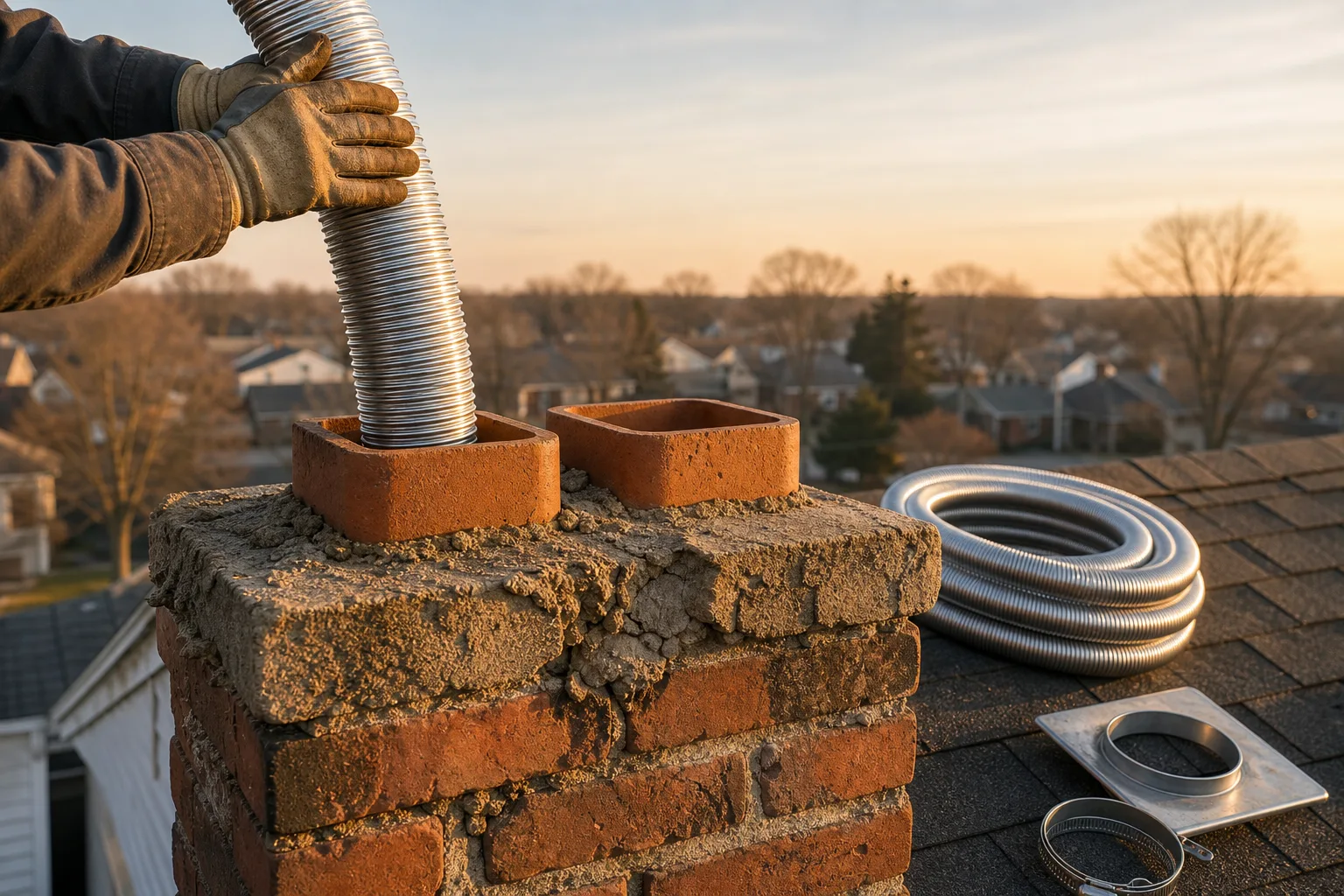
On materials, the model codes and NFPA 211 point the same way: a masonry chimney is lined with an approved clay flue lining, with a chimney lining system listed and labeled in accordance with UL 1777, or with another approved material that resists corrosion, erosion, softening and cracking from vent gases at temperatures up to 1,800°F. If relining is on the table, our walkthrough of chimney flue liner installation covers what that work involves.
Clearance is a separate duty, and it is worth saying so directly. A liner stands between the flue gas and the chimney structure. It does not make contact between a combustible assembly and a chimney acceptable. Combustible framing keeps the clearance NFPA 211 requires, or the clearance the listed product's own listing and instructions require, and that obligation stands on its own.
What a Gas Fireplace Flue Actually Needs Looking At
Do gas fireplaces have a flue that needs attention? Two of the three arrangements have a vent, and a vent is a physical thing with a condition.
I am not going to hand you a calendar for it, because the appliance's own manual carries its own maintenance instructions and that is the controlling document for your unit. What I can give you is the list of places where a gas venting arrangement has something to look at.
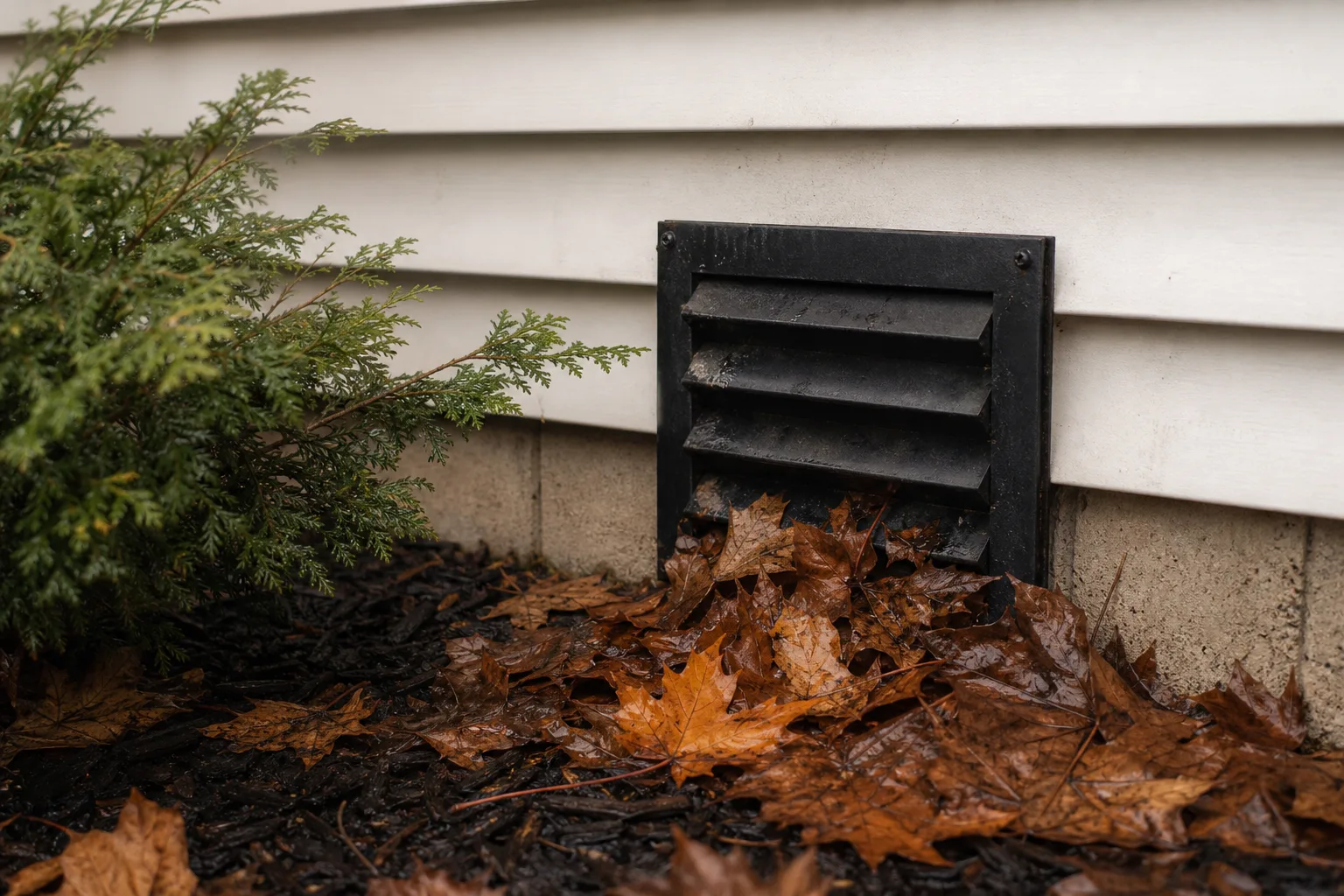
The exterior termination. On a direct vent system the cap is out on the wall, low down, where leaves pile up, where mulch gets raked, where snow drifts and where a deck rail can end up crowded against it. It needs to stay clear.
The top of a masonry stack. Crown, tiles, and the chimney cap over the flue. None of that is visible to you from inside the house, and a gas appliance below it does not change what weather does to it.
The inside face of the flue. For a gas log set in an old chimney, this is the surface that tells you something, and it is the one you cannot see.
The glass and its seal. On a sealed appliance, the glass panel and its gasket are part of what makes it a sealed appliance.
Myth vs. fact: Myth, a gas flame is clean, so whatever carries its exhaust has nothing to look at. Fact, gas combustion produces water vapor, and a vent that is oversized or running cold is a place that vapor can condense. A vent carrying gas exhaust is a vent with a condition, and condition is something to have looked at rather than assumed.
Do Gas Fireplaces Have a Flue That Gets Inspected When a House Changes Hands?
Some people arrive at this question because a home inspector, an agent or a buyer said something about a chimney, and now there is a word sitting in a report that has not been explained to them.
NFPA 211 defines inspection levels, and it sets out when the second of them applies. A Level 2 inspection is called for upon sale or transfer of the property; upon a change to the system, meaning the fuel type, the appliance, or the shape or material of the flue; upon a malfunction or an operating malfunction; after a chimney fire; and after a potentially damaging external event such as a building fire, an earthquake or a severe weather event.
Read that last trigger the way it is written. "Potentially damaging" is a lower bar than "the house looks fine to me."
Whether any of those conditions apply to your chimney is a question to raise when you book something, not something to decide from this page. What the list is useful for is the phone call. You can name the trigger you think applies and ask for the level that goes with it, instead of asking for "a chimney guy" and hoping the scopes line up.
How VIO CHIMNEY Helps With This Exact Question
Do gas fireplaces have a flue? For yours, that resolves to one specific arrangement, and part of the answer is printed on a label you may not have found yet.
Let me be plain about what we are.
VIO CHIMNEY is a referral network. We do not do the work. You tell us what you have and where you are, and we connect you with an independent local chimney company that can come and look at it.
For this particular question, that is a useful thing. Somebody who can stand in front of the appliance, read the label, look up into the firebox, and then look at the top of the stack or the termination on the wall outside is answering a question that no amount of reading settles. If you came here asking do gas fireplaces have a flue and you now know there are three possible answers, the next step is getting eyes on yours.
The company we match you with is an independent local business, and its license, its insurance and its certifications are yours to ask for and yours to verify. It sets its own crews and its own pricing.
On estimates, the move is yours: insist on a written estimate before any work starts, and do not let work begin without one in your hands.
Late September sits ahead of the heating season, which makes it a sensible stretch to have the thing looked at rather than during the months you want to be using it. You can request service online or call.
Get a real answer about your flue
VIO CHIMNEY is a referral network, not a crew. Describe what you are seeing, the front of the fireplace, the firebox, whatever is above it outside, and we can connect you with an independent local chimney company near you that can look at the appliance and the venting together.
Call (513) 655-6702 or request service online.
Symptom checker
What is your chimney doing?
Tap the closest match for an honest first answer.