



On this pageYou Were Right About the Soot. Gas Chimney Cleaning Is Not About Soot.7 sections+6
- You Were Right About the Soot. Gas Chimney Cleaning Is Not About Soot.
- Which of These Four Systems Do You Have?
- The Real Enemy Is Water, Not Dirt
- Warning Signs You Can Check Tonight
- What Gas Chimney Cleaning Actually Includes
- Four Questions to Ask Before Anyone Starts
- How VIO Helps With Gas Chimney Cleaning
Quick answer
Gas chimney cleaning covers two things: servicing the appliance, meaning the burner, logs, pilot and glass, and inspecting the vent or flue it exhausts into. The reason it matters is not soot, since gas makes very little creosote. Burning gas produces water vapor that condenses into a weak acid and attacks clay tile liners from the inside. NFPA 211 and the CSIA call for annual inspection regardless of fuel, and sweeping happens only if the inspection finds a reason for it.
Somebody told you the chimney needs attention, and your first thought was that it sounded like a pitch. So you opened the fireplace doors and looked. No black buildup. No crumbling deposits. Nothing in there that a brush would obviously improve. Which raises a fair question: what is gas chimney cleaning actually cleaning?
You are not wrong about the soot. Gas burns far cleaner than wood, and it does not lay down the thick creosote that makes a wood flue a fire hazard. That much is not in dispute.
Here is the part that changes the picture. The thing that damages a gas venting system is not dirt at all, and you will not find it by looking into the fireplace. It happens above you, inside the flue, in a place you have never seen.
This guide walks through what that actually is, which of four very different setups you have, what a technician does and does not do for the money, and how to tell whether you need the work at all.
You Were Right About the Soot. Gas Chimney Cleaning Is Not About Soot.
The skepticism is earned, because the industry has been sloppy with language. "Chimney sweeping" is a wood-burning term. It describes scraping creosote off flue walls so it cannot catch fire. A gas flue can still need clearing, of dust, debris, nesting material, rust or liner fragments, but that is a different job from the one the word describes, and homeowners can hear the mismatch.
What gets lost in the sloppiness is that a gas venting system has its own failure modes. They are slower, quieter, and considerably harder to see.
Wood chimney trouble tends to announce itself. A fire, smoke pushing into the room, or a visible black layer when you open it up. Gas venting trouble can be quieter. Corrosion works on the inside of the flue, fragments drop down the shaft, and none of that has to show up on the living room side.
Myth vs. fact: The myth is that because gas produces little creosote, the flue needs nothing. The fact is only the first half. Gas does produce very little creosote. The flue still needs an annual look, because what wears it out is chemistry, not deposits.
There is a second reason the term confuses people. "Gas chimney cleaning" gets used for two jobs that share a name and nothing else: servicing the appliance itself, and dealing with the structure it vents into. Most articles on this topic quietly pick one and never tell you which.
So before anything else, find your house.
Which of These Four Systems Do You Have?
Four common setups fall under the heading of gas chimney cleaning. They vent differently, they fail differently, and the annual visit looks different for each. Skip this part and the rest of the advice you read online will be aimed at somebody else's house.
Gas logs retrofitted into a masonry fireplace
An old wood fireplace, brick or stone, with a ceramic log set dropped into it and a gas line run to a burner. The exhaust goes up the original masonry flue, which was built for wood and is now handling something with completely different properties.
The next section describes a problem that acts on masonry flues in particular, which is why the annual look is worth keeping on the calendar for this setup.
A direct-vent gas fireplace
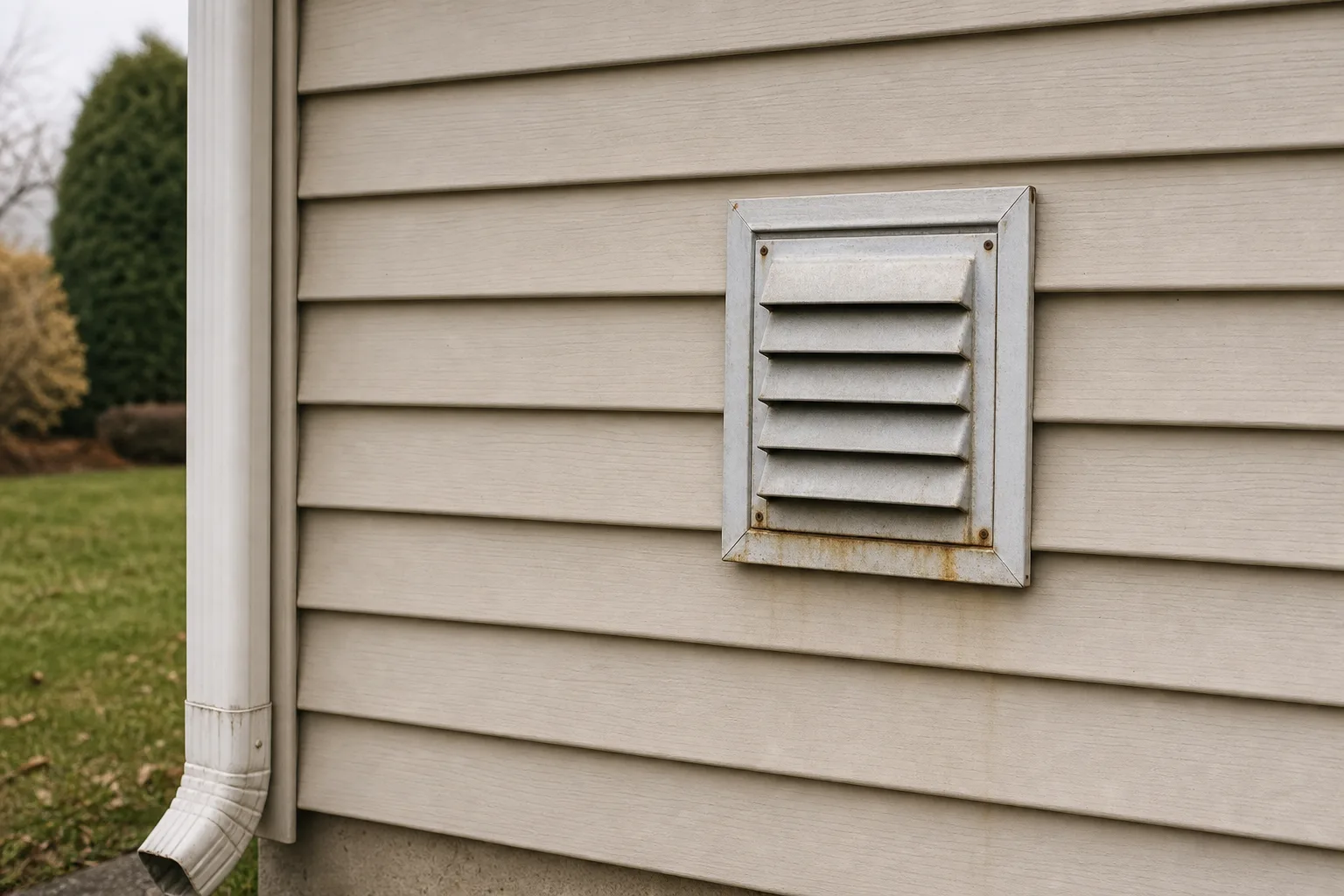
A sealed unit behind fixed glass. It pulls combustion air from outside and pushes exhaust back outside through a coaxial pipe, one tube running inside another. It usually terminates through an exterior wall rather than the roof.
There is no chimney in the traditional sense. There is a vent run and a termination cap, and both can fail.
A B-vent (natural vent) gas fireplace
A draft-fed unit that takes combustion air from the room and exhausts through round metal pipe running up through the house, terminating above the roofline and capped against rain.
It is metal rather than masonry, and open to the room rather than sealed, so the annual look centers on the pipe, the cap and the draft.
A gas furnace or water heater venting into the chimney
No fireplace involved. The appliance is in the basement or a utility closet, and its exhaust runs into the same masonry stack the house has always had. Plenty of mid-century homes are built exactly this way.
This is the one homeowners tend not to think about, because there is no fireplace sitting in the living room as a reminder. The appliance runs all winter whether or not anyone has looked at the flue.
| Your setup | How it vents | What actually accumulates | What the annual visit focuses on |
|---|---|---|---|
| Gas logs in a masonry fireplace | Original brick and clay tile flue | Condensate damage, tile fragments, nesting material | Flue condition, blockage, draft, burner and log placement |
| Direct-vent fireplace | Sealed coaxial pipe through a wall or roof | Dust on glass and logs, debris at the termination cap | Cap condition, vent run, glass gasket, pilot and burner |
| B-vent fireplace | Round metal pipe above the roofline | Rust, rain cap debris, nesting material | Cap and pipe condition, draft, burner and pilot |
| Furnace or water heater into the chimney | Shared masonry stack | Condensate damage, spalled tile at the base | Liner condition, blockage, whether relining is needed |
Good to know: Vent-free gas appliances have no chimney and no vent at all. If that is what you own, the venting half of this guide does not apply to you, though the appliance-side service still does.
The Real Enemy Is Water, Not Dirt
Now the part almost nobody explains, and the answer to the question you walked in with.
What burning gas actually produces
Combustion turns natural gas into mostly carbon dioxide and water vapor. A lot of water vapor. Burning one cubic foot of gas produces roughly two cubic feet of it, according to the venting literature the trade works from.
That vapor goes up the flue. In an efficient modern appliance it enters the flue at a temperature not far above its dew point, somewhere near 140 degrees Fahrenheit.
Which means it does not take much of a cold surface to turn it back into liquid.
Why acidic condensate destroys clay tile from the inside
Water alone would be a nuisance. The problem is what rides along with it.
Flue gas carries trace oxides of nitrogen, and sulfur compounds come along too. When the vapor condenses, those dissolve into it, and the result is a weak acid solution sitting on the inside of your flue.
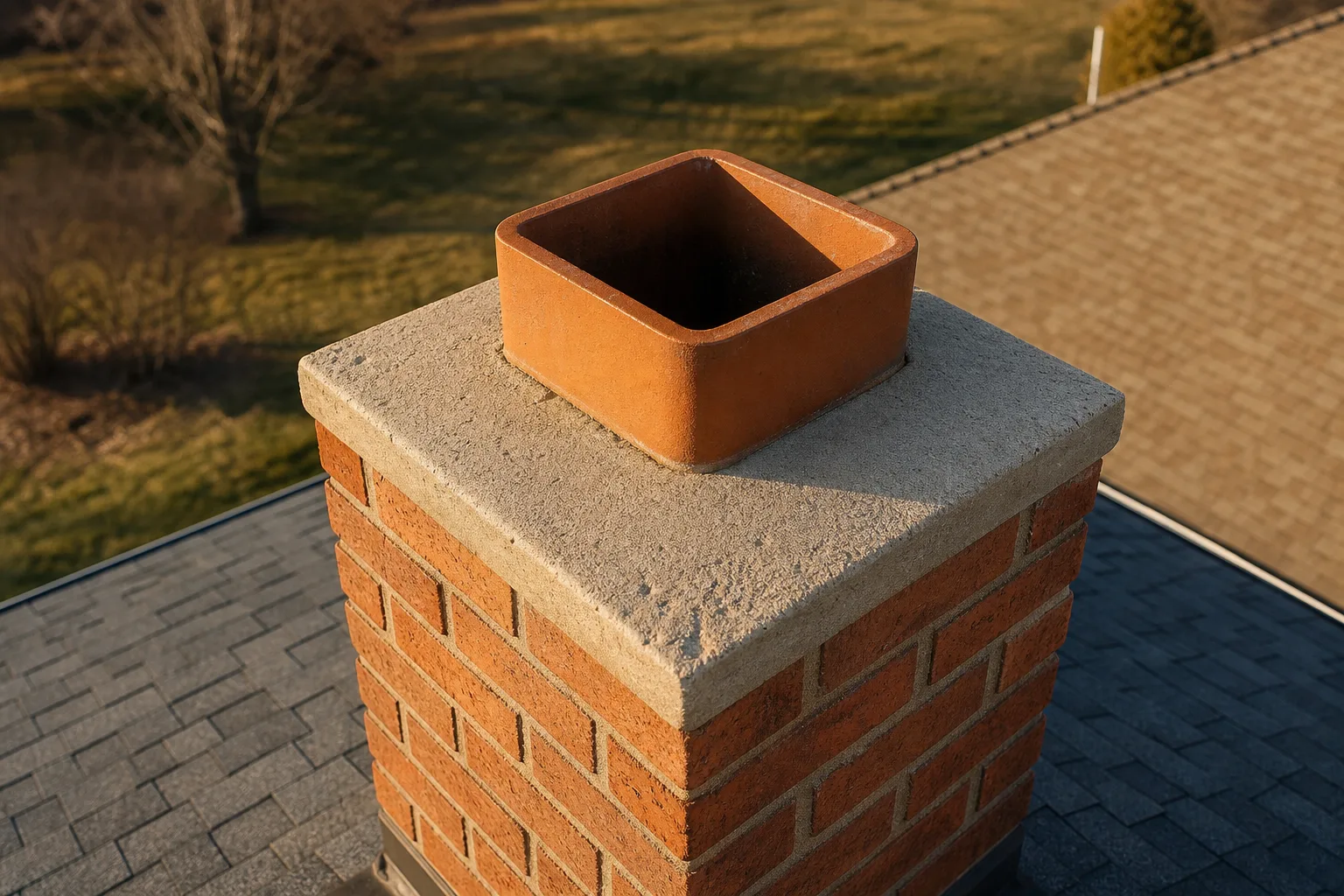
Masonry does not shrug that off. The acid attacks clay tile liners and mortar. Sulfur absorbed into the tile starts a process the trade calls flaking or spalling, where the face of the tile breaks apart in layers. Inspectors pulling cameras through chimneys that serve gas and oil heating appliances find cracked and gapped tile often enough that it is treated as an ordinary finding, not an exotic one.
Once tile starts shedding, the pieces have to go somewhere. They fall. They pile up. And a pile of broken tile at a narrow point in the flue is a blockage.
Why the firebox tells you nothing about it
Here is the frustrating part. All of that happens above the damper, inside a shaft you cannot see into from a chair.
The firebox can look immaculate while the flue above it is coming apart. That is exactly why the standards call for someone to actually look rather than for homeowners to judge by appearance.
Safety note: When liner debris blocks a flue, the combustion gases that were supposed to leave the house have a harder time doing it. Those gases include carbon monoxide. No inspection or sweeping eliminates that risk, and nobody should tell you it does. Working carbon monoxide alarms on every level of the house are the detection layer, and they are not optional.
Warning Signs You Can Check Tonight
You do not need a ladder or a camera to gather useful information. Most of what follows takes ten minutes with a flashlight, and it will tell you a great deal about whether gas chimney cleaning is urgent, routine, or not needed yet.
Inside the firebox
Open it up and look at the floor of the firebox and the tops of the logs.
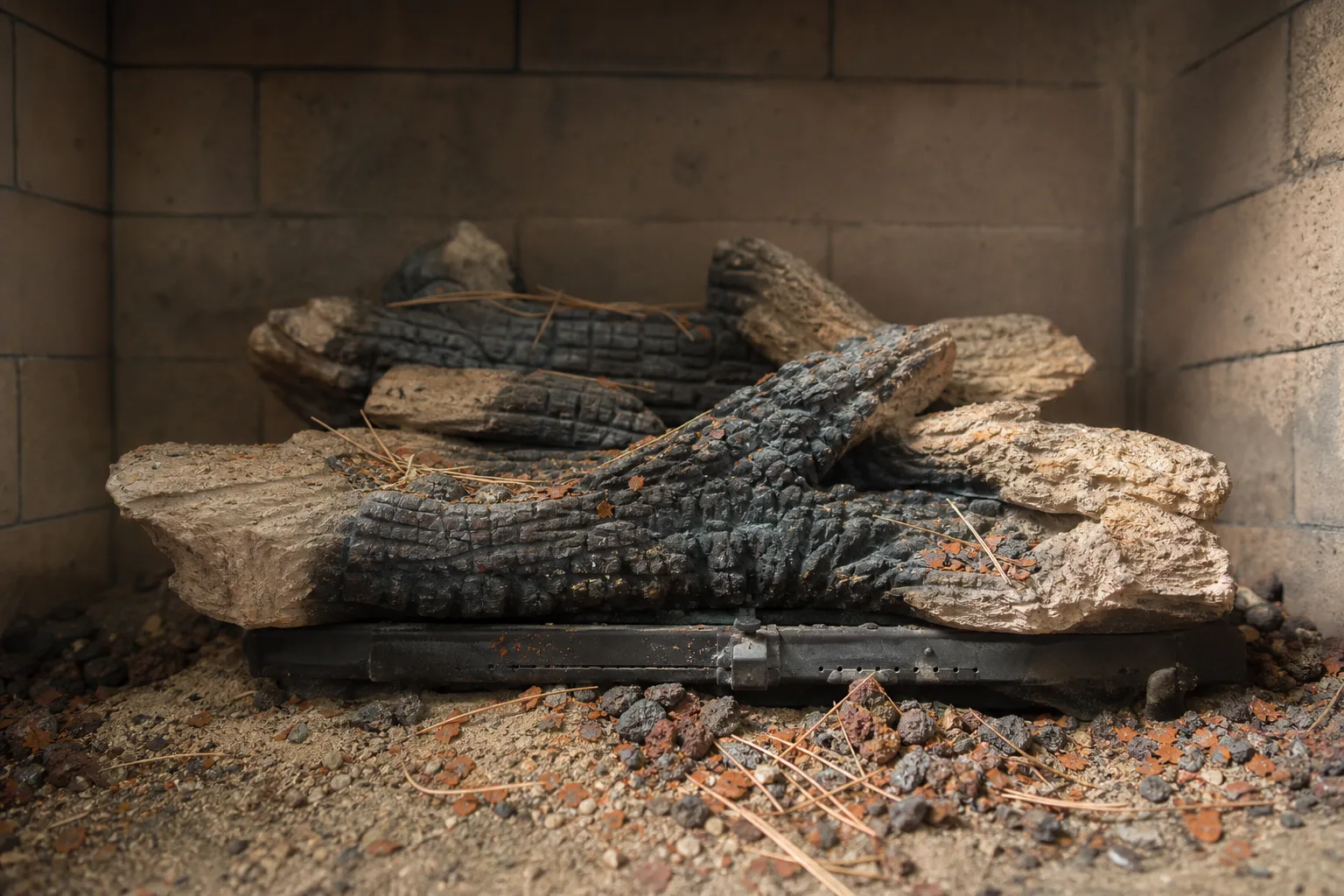
You are looking for things that did not come from the fire. Rust flakes. Twigs. Dry grass or straw. Leaves. Any of those arrived from above, which means something up top is letting them in.
At the glass and the flame
On a sealed unit, look at the inside of the glass. A hazy white film is normal residue and usually comes off with the right cleaner. A sooty black film is different information, and it points at combustion that is not burning cleanly.
Then light it and watch. A gas flame should be steady, mostly blue at the base, with yellow tips on decorative log sets. Flames that lift off the burner, roll oddly, or leave visible black smudging on the logs are worth a call.
A pilot that will not stay lit is its own signal, and it is one of the most common reasons people book the visit in the first place.
Outside, at the roofline
Step into the yard and look up at the stack, or at the vent termination on the wall.
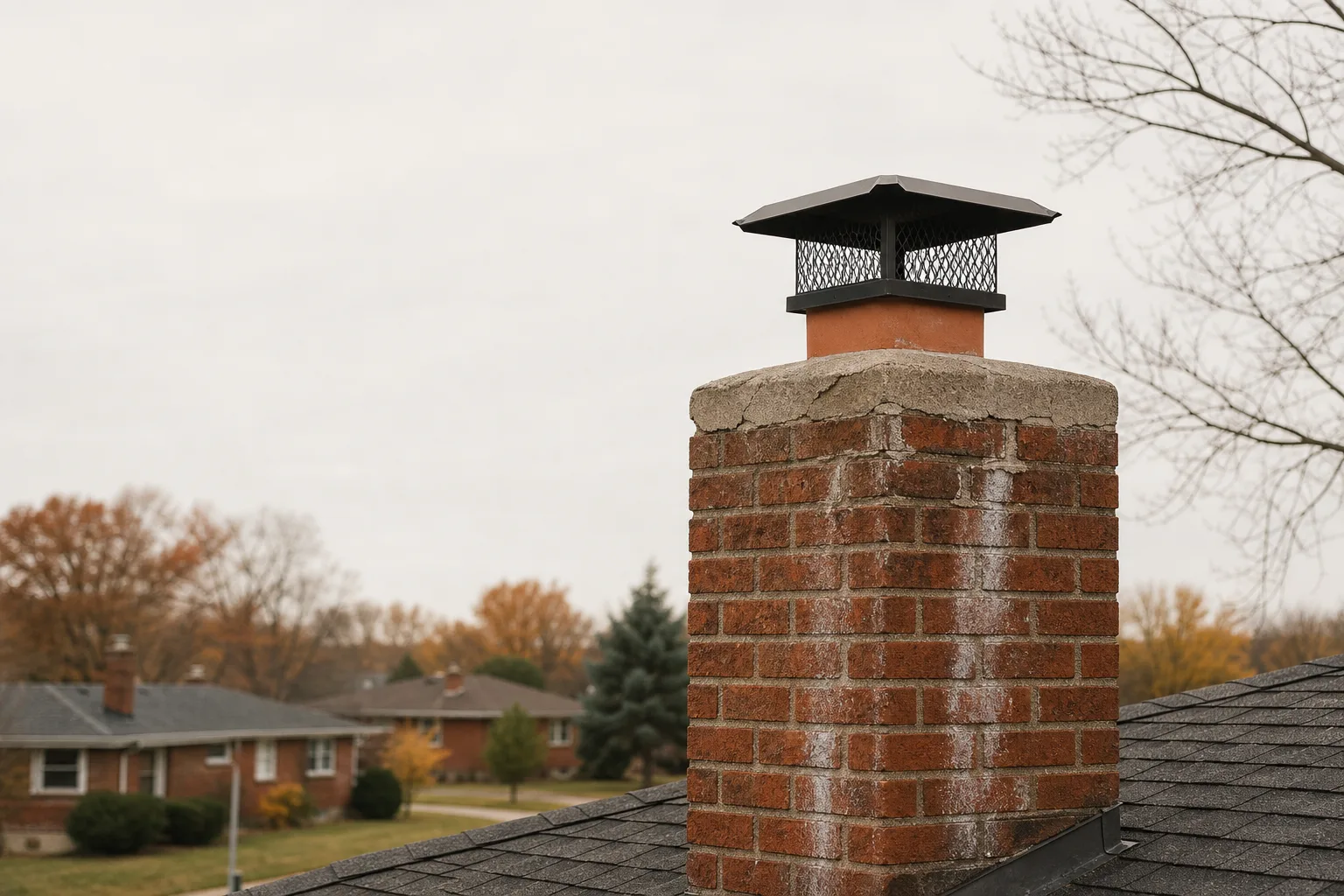
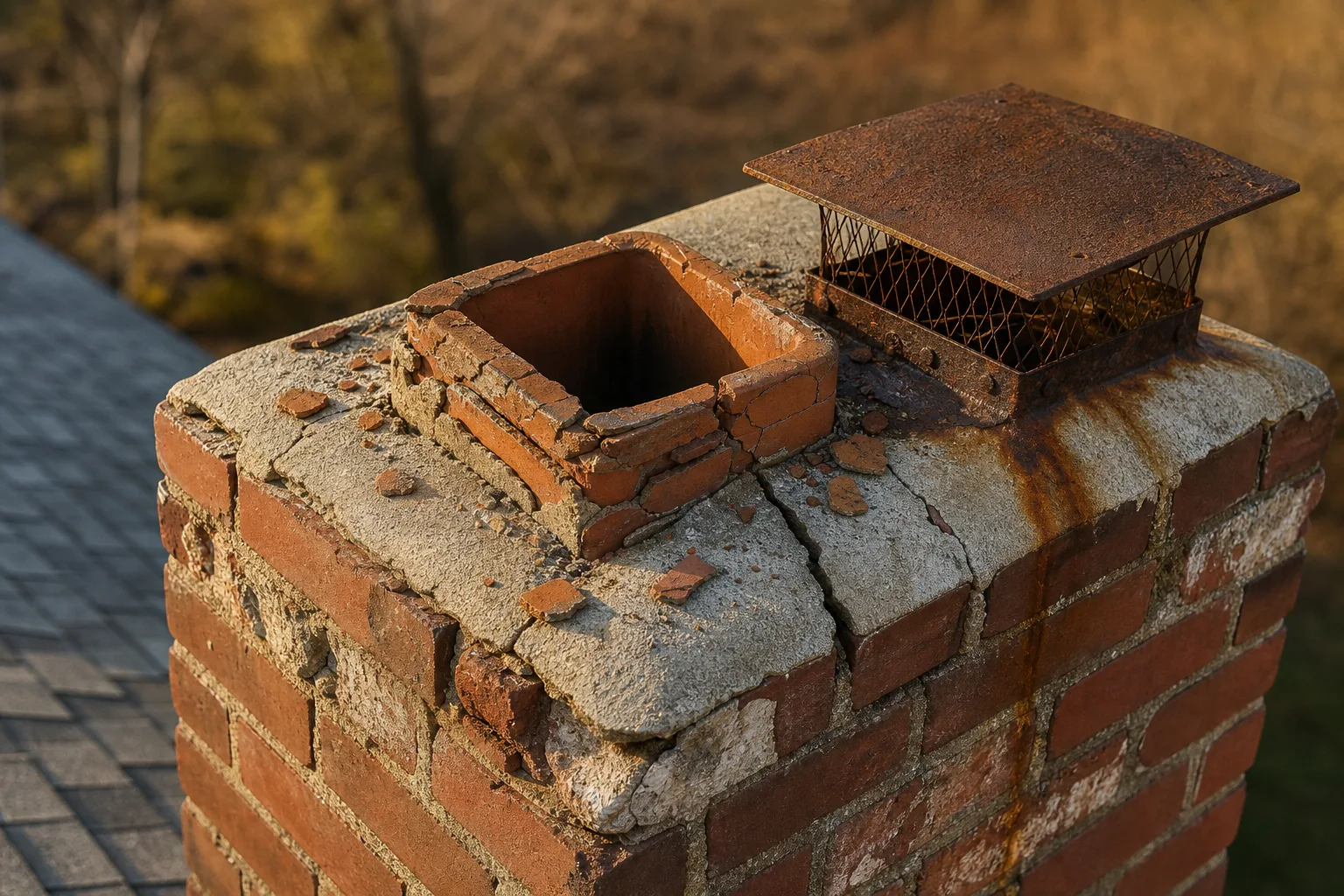
On a masonry chimney: is the chimney cap still there, is it rusted through, is the concrete crown cracked, are there white chalky streaks running down the brick, are brick faces flaking off. On a metal termination: is it rusted, dented, or packed with anything.
The ten-minute walkthrough:
- Rust flakes, twigs, or nesting material on the firebox floor or log tops
- Sooty black film on the inside of the glass
- Flames that lift, roll, or smudge the logs black
- A pilot light that will not hold
- A smell of exhaust in the room while the appliance runs
- Chimney cap missing, rusted through, or visibly damaged
- White chalky staining streaking down the exterior brick
- Brick faces flaking or popping off the stack
- Cracks in the concrete crown at the top
- Grit or orange-brown fragments behind the cleanout door at the base
- Carbon monoxide alarms present and tested on every level
From the field: Rust flakes and twigs sitting on a gas log set are almost never a fireplace problem. They are a cap problem. The fireplace is just where the evidence lands, and people spend money on the wrong end of the system because that is the end they can see.
Any single item on that list is a reason to get eyes on it. Several together, especially the ones involving the flue or the brick, move it up the priority list.
Not sure what you are looking at?
Tell us what your setup is, gas logs in an old masonry fireplace, a direct-vent unit, or a furnace venting into the chimney, and we will match you with a local company that works on that exact system.
Call (513) 655-6702 or request service online.
What Gas Chimney Cleaning Actually Includes
Part of why the service feels vague is that it happens while you are in another room. Here is what the visit consists of, so the invoice stops looking arbitrary.
The appliance side
The gas supply gets shut off and the unit is allowed to cool completely before anything is touched. That step is not a formality, and a technician who skips it is telling you something.
Then the work is patient and detailed. Burners and valves are vacuumed with HEPA-filtered equipment. The log set is dusted piece by piece, top to bottom, with a soft-bristled brush, including the decorative embers and any ceramic detail. The firebox is cleared of cobwebs, lint, and whatever has drifted in.
The pilot assembly is inspected and the ignition tested, so it lights the way it should instead of hesitating. Glass doors are cleaned and the gaskets and seals checked, because a failed seal on a sealed unit is a real problem rather than a cosmetic one.
Log placement matters more than people expect. Logs sitting slightly off position can put flame where it does not belong and start producing the soot you were told gas does not make.
The venting side
This is the half that earns the word "chimney" in gas chimney cleaning.
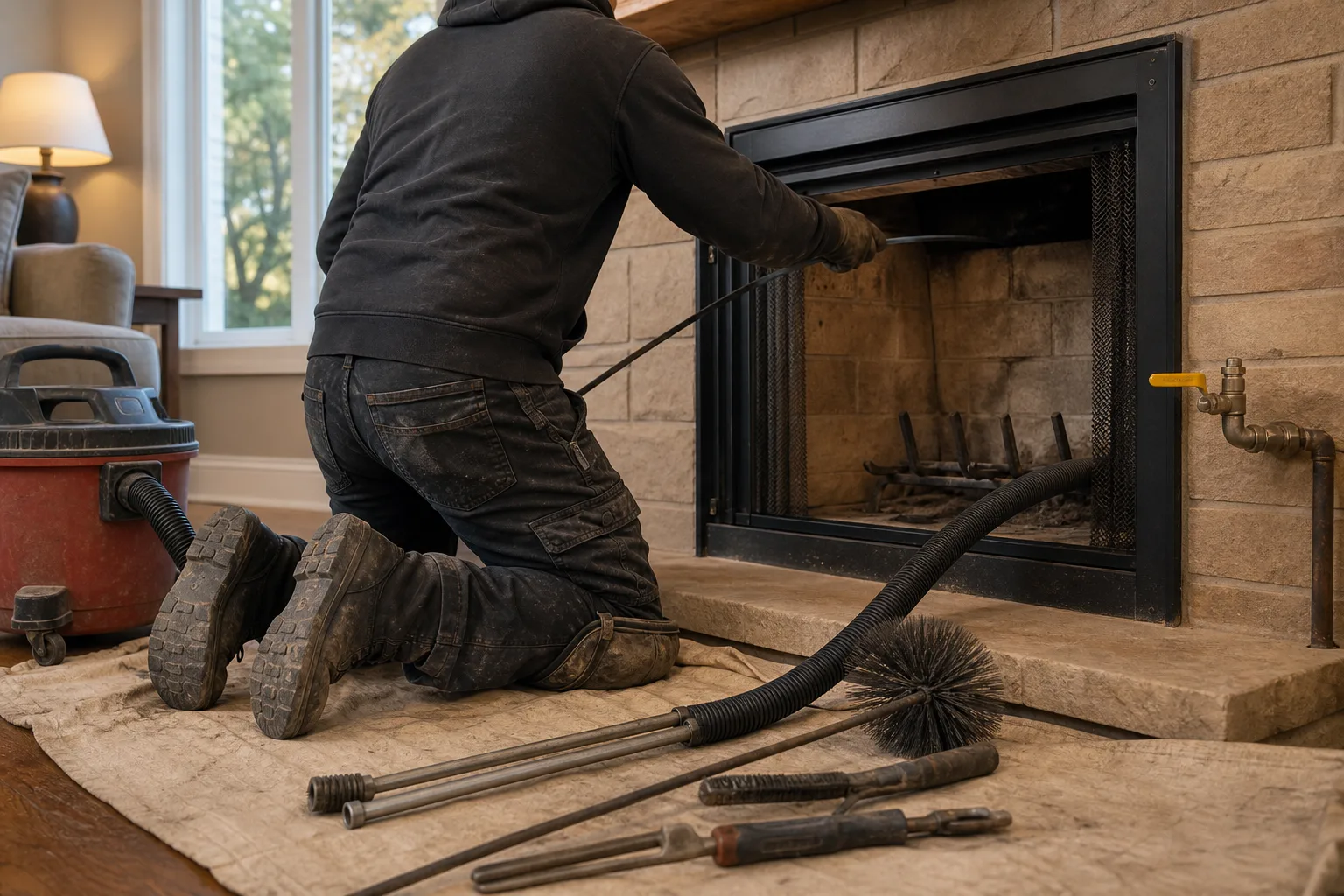
The vent or flue is inspected for soundness, for blockage, and for debris. On a masonry flue that usually means a camera on a flexible rod, fed up from the firebox or down from the top, because a flashlight and a glance up the throat does not qualify as looking.
Dust and debris get vacuumed out. Nesting material, if there is any, comes out. Cap and termination condition are checked, since that is where most of the junk in your firebox originated.
On an old masonry stack the technician is specifically hunting for what the previous section described: cracked or spalled tile, gaps at the joints, fragments collecting at the base.
Inspection and cleaning are two different purchases
This distinction gets blurred constantly, and the blur is expensive.
NFPA 211 calls for chimneys, fireplaces, and vents to be inspected at least once a year for soundness, freedom from deposits, and correct clearances, with cleaning, maintenance, and repairs done if necessary. The language is neutral about fuel, which is why it covers your gas system. The Chimney Safety Institute of America makes the same annual recommendation, and says it applies to gas and wood appliances alike.
Read that carefully. The annual requirement is the inspection. The sweeping is conditional on what the inspection finds.
Good to know: Sometimes there is nothing to sweep, and that is a legitimate result. A company that inspects your gas flue, finds it sound, tells you so, and charges you for the inspection has done its job correctly. We can say that out loud because we are not the ones holding the brush.
What Gas Chimney Cleaning Does Not Cover
Worth knowing before you book, because these arrive as separate line items and surprise people.
Relining a damaged flue is not cleaning, it is a repair, and on a masonry chimney serving a gas appliance it is the fix that condensate damage eventually points toward. Rebuilding a cracked crown, replacing a rusted cap, repairing spalled brick, and repairing or replacing appliance components are each their own job.
None of that means a quote including them is padded. It means you should know which category each line falls into before you agree to it.
Pro tip: Ask what the quote covers before the visit, not after. "Is this an inspection, a cleaning, or both, and what happens to the price if you find the flue needs work?" is a completely normal question, and any honest company answers it in one sentence.
Four Questions to Ask Before Anyone Starts
You do not need to become an expert on gas chimney cleaning to buy it well. You need four questions.
1. Which system am I, and does that change what you are doing? If the answer does not distinguish between a masonry flue and a sealed direct-vent run, keep calling.
2. Are you putting a camera in the flue? On an old masonry chimney serving a gas appliance, a visual glance is not an inspection. On a sealed unit it may genuinely not be needed. Either way the answer should arrive with a reason attached.
3. Is this an inspection, a cleaning, or both? Settle it before anyone arrives.
4. What level of inspection is this, and do I need a Level 2? Which brings us to the one piece of the standard worth memorizing.
When a Level 2 inspection is required, not optional
NFPA 211 treats certain situations as calling for a Level 2 inspection rather than the basic annual look:
- Sale or transfer of the property
- Any change to the system, including a change of fuel, a change of appliance, or a change to the flue's shape or material
- After a malfunction
- After a chimney fire
- After an external event such as severe weather or an earthquake
Swapping a wood-burning fireplace for a gas log set is a change of fuel and a change of appliance. If that happened at your house and nobody did a Level 2 afterward, raise it.
Good to know: Annual inspection is what the standard asks for. Sweeping is what the inspection may or may not call for. A company quoting an annual sweep for a gas appliance without looking first is the one to push back on.
How VIO Helps With Gas Chimney Cleaning
VIO is a referral network. We do not perform the work ourselves. Independent local chimney companies do, and our job is matching you with the ones that handle your particular system.
That matters more here than on most topics. A company that lives in direct-vent appliance service is not the company you want scoping a 1950s masonry stack that a furnace has been venting into for decades. Gas chimney cleaning is really several trades wearing one label, and sending the wrong one costs you a visit.
So we ask two things: where you are, and which of the four setups you have. If you are not sure which one you have, describe what you see when you request service and we will sort it out with you.
We ask every company in the network to put its estimate in writing before any work starts, and you should insist on exactly that, from us or from anyone else you call.
We will also tell you plainly when gas chimney cleaning is not the answer. If what you describe sounds like a cap that needs replacing, a liner that needs evaluating, or an appliance that needs a service technician rather than a sweep, we would rather point you there than book you the wrong appointment.
The best time to sort this out is before the first real cold snap, while a finding is still a repair you plan rather than a failure you react to.
Get your gas chimney cleaning scheduled before the cold sets in
Tell us your address and what you are burning. We will match you with independent chimney companies in your area, and you can compare what they say before anyone touches the chimney.
Call (513) 655-6702 or request service online.
Symptom checker
What is your chimney doing?
Tap the closest match for an honest first answer.