



On this pageWhat Wood Stove Installation Cost Actually Covers7 sections+6
- What Wood Stove Installation Cost Actually Covers
- The Three Questions That Place Your House Inside the Range
- Why the Chimney Decides Your Wood Stove Installation Cost
- The Federal Tax Credit Is Gone, and Most Cost Guides Have Not Caught Up
- What Makes a Quote Go Up After the Site Visit
- How VIO Helps With Your Wood Stove Installation Cost
- The Short Version
Quick answer
Wood stove installation cost is driven mainly by the venting, not by the stove itself. A simple ground-floor job with a short chimney run sits at the low end of the range, while a long interior run, a cathedral ceiling, or a masonry flue that needs a stainless liner pushes a total up several times over. As of September 2026 the federal 25C biomass tax credit has expired, so no federal credit applies.
Most people who look up wood stove installation cost get handed the same answer: a range so wide that the top of it is several times the bottom. That range is honest. It is also close to useless when you are sitting at the kitchen table trying to decide whether this happens before winter or waits another year.
The problem is not that the range is wrong. The problem is that nobody tells you which part of it belongs to your house.
So let's fix that. By the end of this you will be able to place your own home inside that spread with reasonable confidence, and you will know which single feature of your house is doing most of the work in that number. Hint: it is not the stove.
One more thing before we start. There is a piece of advice sitting on most wood stove installation cost guides right now that went out of date at the end of last year, and if you build your budget around it you will come up short by a meaningful amount. We will get to it, and it deserves its own section.
What Wood Stove Installation Cost Actually Covers
Here is the honest headline. The spread between a simple installation and a hard one is enormous, and nothing about the stove you picked tells you which one you have.
Where a project lands depends on five buckets. Almost every surprise you will meet lives in one of them.
| Cost component | Relative weight | What moves it |
|---|---|---|
| The stove itself | Small end to mid, and the most predictable line | Size, cast iron vs steel, catalytic vs non-catalytic, soapstone or enamel finish |
| Venting (chimney system) | Frequently the largest single line | New Class A pipe vs relining existing masonry, length of run, roof vs wall exit |
| Labor | Scales with the venting, not the appliance | Access, height, whether framing has to be opened |
| Hearth protection | Modest, unless you build in stone | Prefab UL 1618 pad vs built tile or stone hearth, floor structure |
| Permit and inspection | Usually the smallest line | Set by your jurisdiction, not by the installer |
Two of those are wide enough to swallow the others. That is not evasion, it is the actual shape of the job.
Good to know: Compare three cost databases and you will get three different national averages, and none of them is lying. They sample different project mixes. A national average is a starting point, not a quote.
The Stove Itself
This is the part people research hardest, and it is usually the most predictable line on the whole invoice.
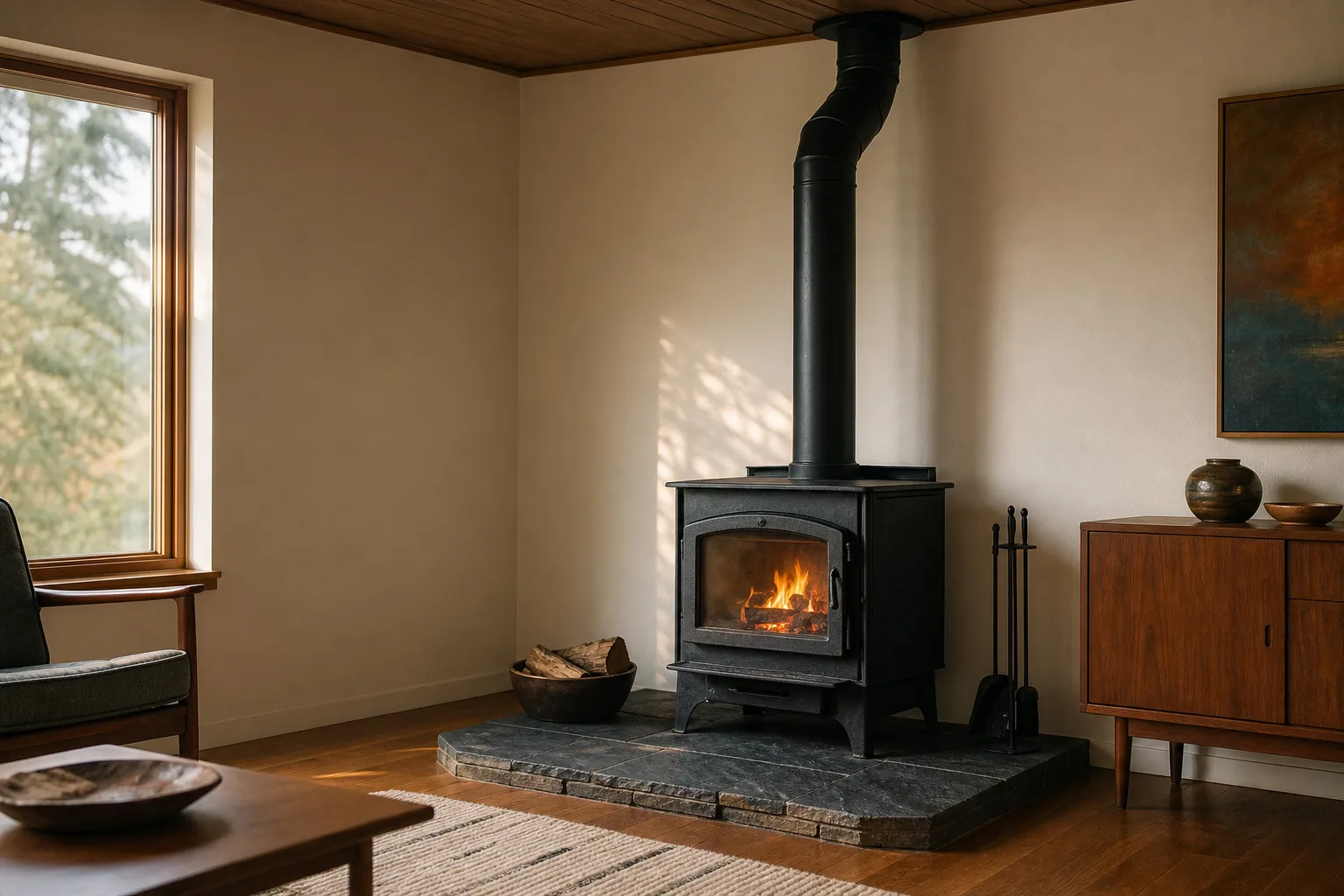
Cast iron holds heat and costs more. Steel heats faster and costs less. Soapstone and enamel finishes add money for reasons that are partly performance and partly how it looks in your living room.
Every new stove sold by a US retailer today is EPA certified to the current standard. Since May 15, 2020, EPA's New Source Performance Standards Step 2 has required certified stoves to emit under 2.0 grams per hour of particulate when crib tested, or 2.5 grams per hour under the cord wood test method. The previous limit, in force from 2015, was 4.5 grams per hour.
That matters for your budget in one specific way: clean burning is the floor of the market now, not an upgrade someone can sell you. If a salesperson prices EPA certification as a premium feature, that is a flag.
The Venting, Where the Money Actually Goes
Here is the part the cost guides underplay, and it is the reason your neighbor paid half what you were quoted for what looks like the same job.
A wood stove needs a chimney rated for solid fuel. Not the black pipe you see in the room, which is only the connector. The real chimney is either Class A insulated stainless chimney pipe running through your ceiling and roof or up an exterior wall, or a masonry flue that has been lined to suit the appliance.
Class A pipe is sold by the section, and every foot, band clamp, support box, flashing and cap is its own line. It adds up in a way a single stove purchase does not.
A full chimney system is routinely a bigger line than the appliance it serves. National cost data also holds a surprise: exterior wall runs tend to come in above runs taken up through a vaulted or cathedral ceiling, because pipe on the outside of a house needs bracketing the whole way and pipe inside does not.
Hearth Protection, Permits, and the Small Line Items
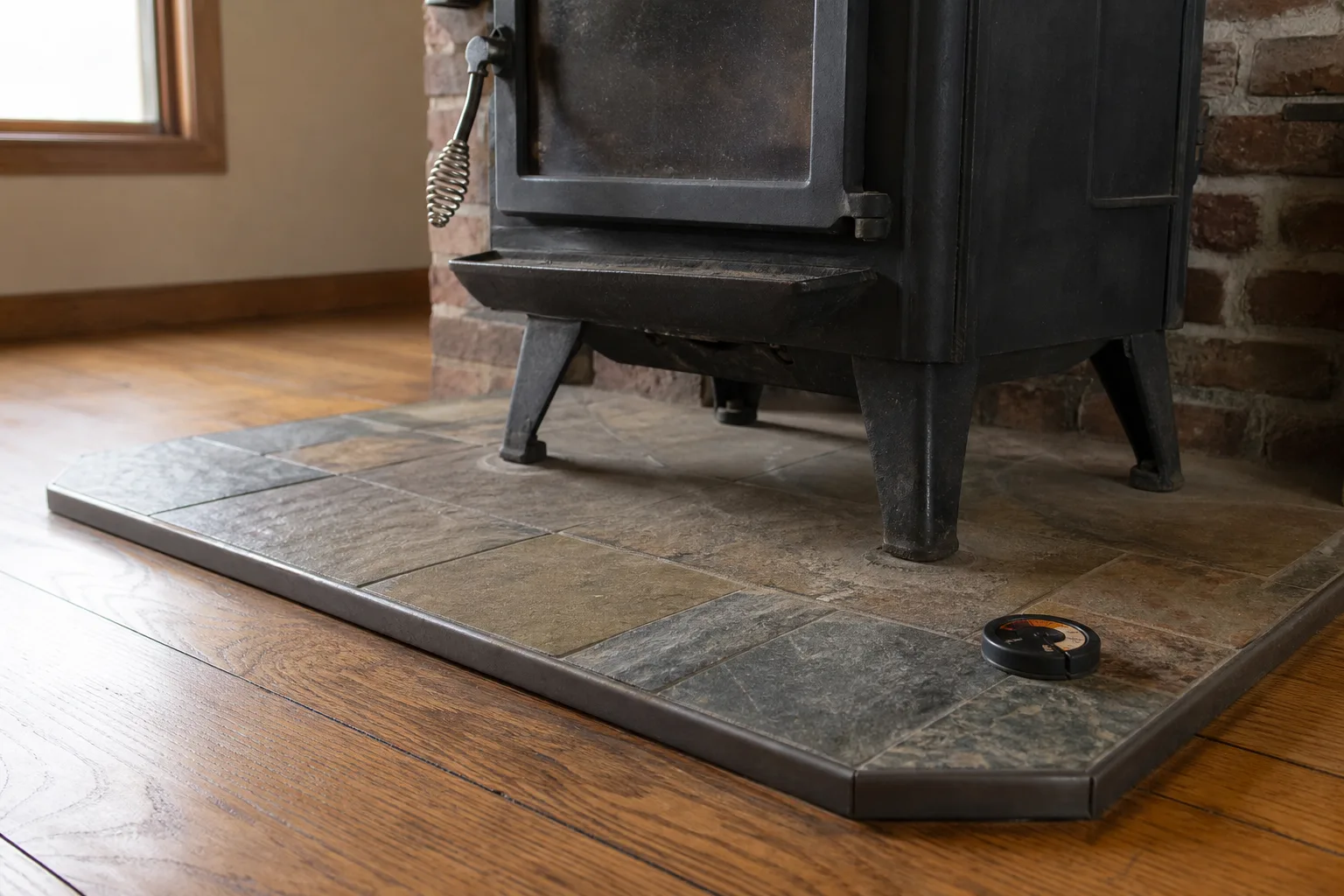
A wood stove cannot sit on a wood floor. It needs non-combustible material underneath, either masonry, brick or tile on concrete and mortared in place, or a prefabricated pad listed to UL 1618.
The required size and construction of that floor protection come from your stove's listing and manual, which is what NFPA 211 points installers to. A modest prefab pad and a built stone hearth are very different money, and that choice is yours.
Permits are local. Most jurisdictions want one for a new solid fuel appliance, and your Authority Having Jurisdiction is the office that signs off at inspection. Budget for it and confirm what it involves with your building department.
Then the small things that are easy to forget: a chimney thermometer, a hearth-side tool set, the first cord of properly seasoned wood, and if you are fitting a wood stove with a blower, the electrical outlet that fan needs.
Worth pricing in from day one, too: the annual inspection the stove needs each heating season after this one, plus sweeping whenever that inspection shows it is needed. Ongoing chimney maintenance is part of owning wood heat, not an optional extra.
Still holding a range instead of a number?
The gap between a straightforward wood stove installation and one that costs several times more is driven by the chimney, not by the appliance, and nobody can settle that from a web page. Tell us what your house has now and we will match you with a local company that comes out and prices your actual venting run. We ask every company in the network to put its estimate in writing before any work starts, and you should insist on exactly that.
Call (513) 655-6702, or request service and we will route it.
The Three Questions That Place Your House Inside the Range
Every wood stove installation cost guide gives you a list of factors. Lists are hard to use. What you actually need is a short set of questions whose answers narrow the range fast.
There are three.
Do You Have a Chimney You Can Actually Use?
This is the big one, and it is the question with the most misleading answer floating around the internet.
If you have no chimney at all, you are buying a complete Class A system. That is real money and it is unavoidable.
If you have an existing masonry chimney, the answer is: maybe, and it depends on what is inside it. A flue built for an open fireplace is usually far too large for a modern stove, and an oversized flue does not draft well for an appliance that burns as cleanly as a current stove does. Where that is the case, the chimney will need a stainless steel chimney liner sized to the stove before it can legally and safely vent one.
Where in the House Is the Stove Going?
A stove against an exterior wall on the ground floor keeps the run simple. The pipe goes up a short distance, through the wall, and continues outside on brackets.
Simple is not automatically cheapest, though, and this is where people guess wrong. Pipe on the outside of the house needs a thimble, a tee, a cleanout, and brackets the whole way up, which is why exterior runs often price above the interior runs people assume are harder.
A stove in the middle of the house is more work. The pipe travels through the ceiling, past insulation that must be held back by a shield, and out through a roof where the flashing has to stay watertight through twenty years of freeze and thaw.
Corners, offsets, and anything that makes the pipe change direction adds parts and adds labor.
How Far Does the Pipe Travel to Daylight?
Picture the same stove in two houses.
House one is a mid-century ranch. Living room, exterior wall, eight foot ceiling, single storey. The chimney run is short and straightforward, and the total lands toward the bottom of the range.
House two is a two-storey colonial with a great room and a cathedral ceiling, the stove near the middle of the room. Now the pipe climbs a long way through conditioned space, needs a support box and a shield through the framing, and exits high on a steep roof where the installer needs staging to work safely.
Same stove. Same brand, same size, same price tag on the appliance. The second job can cost multiples of the first, and every dollar of that difference is chimney.
From the field: The order of the conversation almost always flips once someone looks at the chimney. Homeowners come in with a stove picked out and a rough budget in mind, and what they learn on the site visit is that the appliance was the settled part and the venting was the open question. It is a common enough pattern that experienced installers ask about the chimney before they ask which stove you like.
Why the Chimney Decides Your Wood Stove Installation Cost
We said the stove is rarely the expensive part. Here is the payoff.
A chimney is a structural, weatherproof, fire-rated assembly that has to pass through your building envelope and then survive on your roof. The stove is a box that sits on the floor. Only one of those is a construction project.
That is why two people can buy the same appliance and get quotes thousands apart. Their wood stove installation cost was never really about the stove.
The New Chimney Path
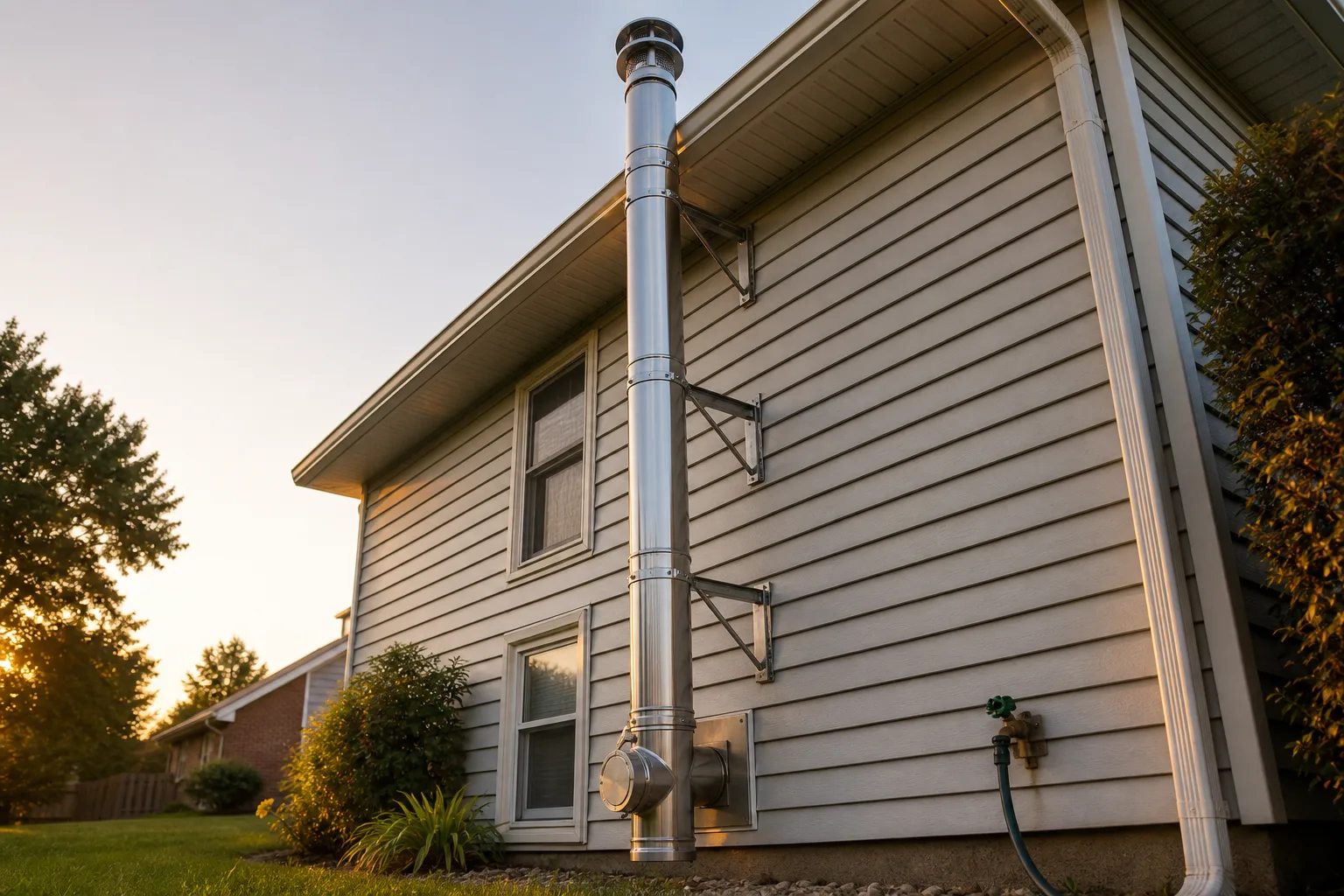
If nothing suitable exists, the installer builds a chimney. Class A insulated stainless pipe, sized to the appliance, in sections joined with band clamps.
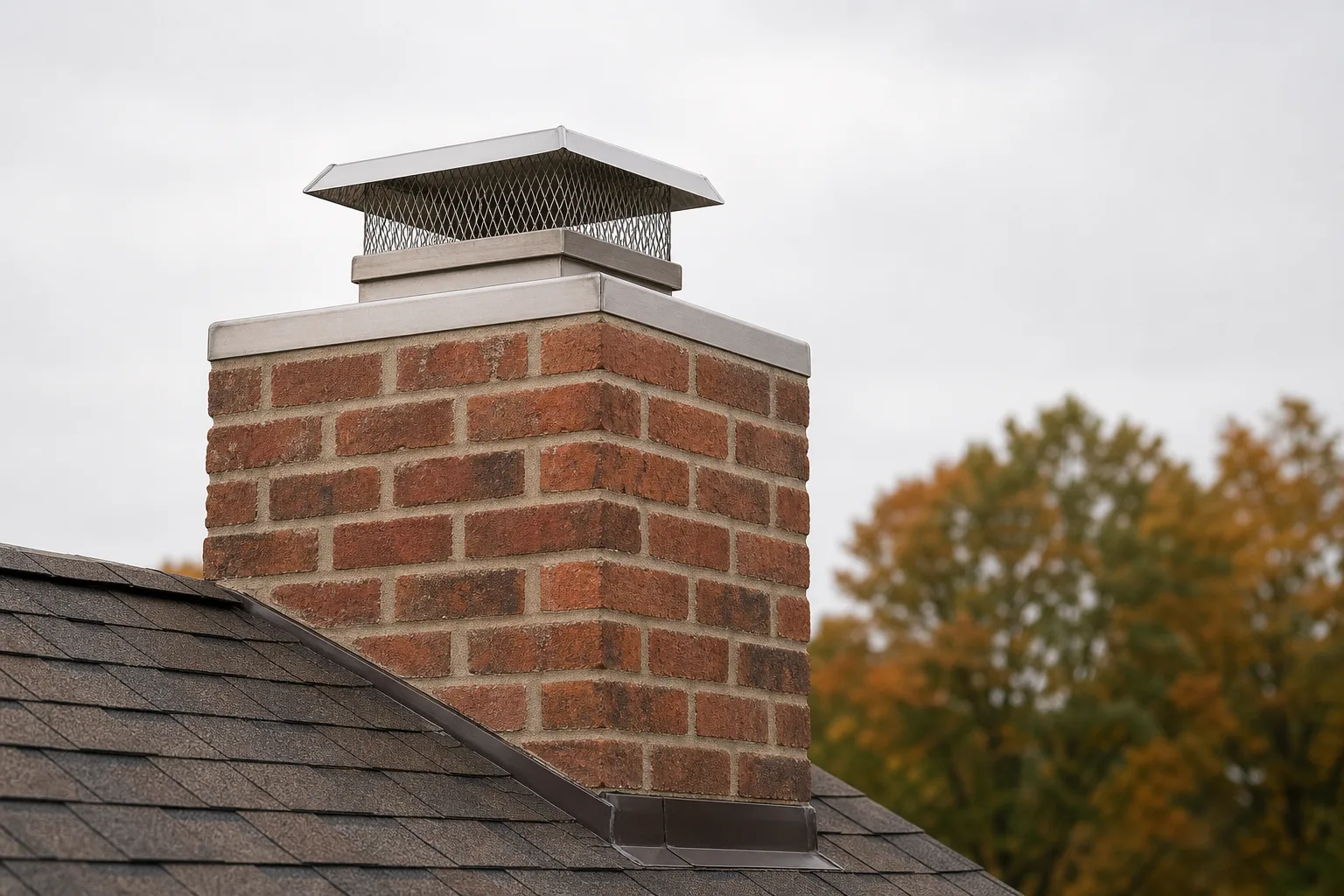
Through the ceiling it needs a support box. Through the attic it needs a shield that keeps insulation off the pipe. Through the roof it needs flashing worked into the shingles and a storm collar sealed above it. On top it needs a cap with a spark arrestor screen.
If it goes up the outside instead, it needs a wall thimble, a tee with a cleanout at the bottom, and brackets bolted into the sheathing every few feet all the way up.
Every one of those parts is a real cost, and the length of the run multiplies most of them.
The Existing Chimney Path, and What Nobody Tells You
You will read on cost pages that reusing existing ventilation can bring the job down to a small fraction of a full installation. That sentence is technically accurate and practically misleading, and it is a familiar source of quote-day disappointment.
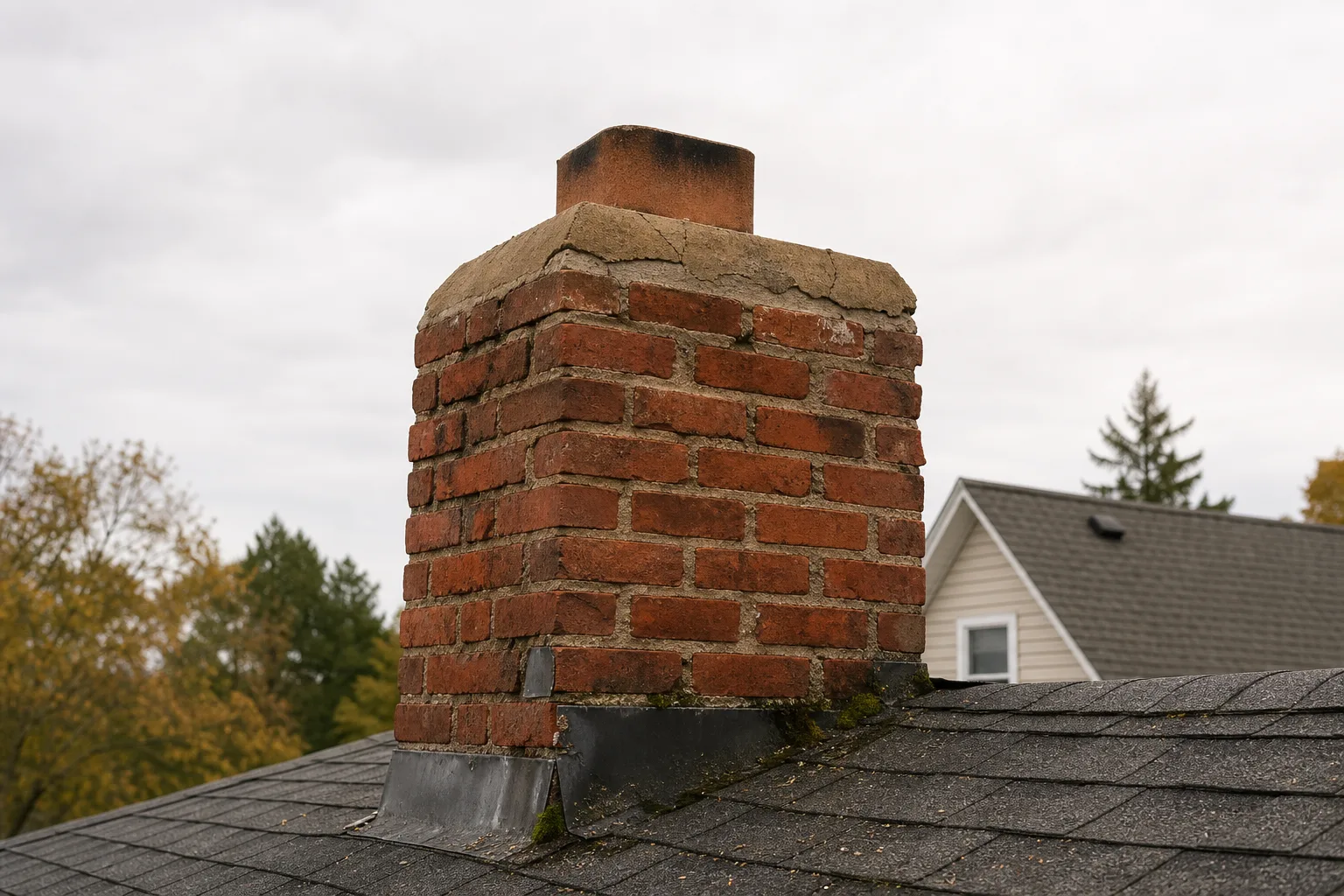
It is true when the existing flue is already correctly sized for the stove, already lined, sound, and clean. It does not describe every masonry chimney people hope to reuse, and you cannot tell which yours is from the ground.
Where the flue is a large clay tile liner built for an open fireplace, connecting a modern stove to it means running a stainless liner down the full height, insulating it, and terminating it at a new top plate and cap. That is a structural line item, not a small one, and it is the whole distance between the cheap-reuse fantasy and the actual number.
There is a code consequence too. Connecting a new appliance to an existing chimney is a system change, and under NFPA 211 a system change is one of the events that requires a Level 2 inspection. The others are sale or transfer of the property, a malfunction, a chimney fire, and external events like an earthquake, severe weather, or a building fire.
So the existing chimney does not skip the inspection. It brings one with it.
If you genuinely do not know what your flue is lined with, that is normal, and it is worth asking someone to come and look before you shop for stoves. Knowing the answer changes the whole budget.
Safety note: NFPA 211 calls for 36 inches between a wood stove and an unshielded combustible wall, and 18 inches from single-wall connector pipe. With proper wall shielding, non-combustible material such as 28-gauge sheet metal held off the wall with a 1-inch air gap, plus double-wall connector pipe, that can come down to as little as 12 inches. But the clearances printed in your specific stove's installation manual govern. A UL-listed unit tested in a particular configuration can be permitted closer than the generic figure, and it can also require more. The manual wins, every time.
Good to know: Clearance math is a cost question too. A stove that cannot meet clearances where you want it either moves, or gets a shielded wall behind it, or gets double-wall pipe. All three change the price.
The Federal Tax Credit Is Gone, and Most Cost Guides Have Not Caught Up
Now the number we promised you at the top.
For several years, homeowners installing a qualifying high-efficiency biomass stove could claim the 25C Energy Efficient Home Improvement Credit, worth a share of the total project up to an annual cap. It was genuinely good, and it is the reason so many wood stove articles still tell you to knock roughly a third off your total.
That credit expired on December 31, 2025.
The change came from H.R. 1, signed on July 4, 2025, which accelerated the expiration of the Energy Efficient Home Improvement Credit to the end of that year. As of September 2026, there is no federal tax credit available for a new wood or pellet stove installation.
If you purchased and installed a qualifying unit on or before December 31, 2025, you may still be able to claim it on the relevant return.
Myth vs. fact: Myth: "Take roughly a third off with the federal biomass credit." Fact: The 25C credit expired December 31, 2025. A 2026 installation currently gets no federal credit. Plenty of cost guides still carry the old advice, and a budget built on it comes up short by the entire value of a credit that no longer exists.
What This Does to Your Wood Stove Installation Cost
Plainly: if you would have qualified, your real out-of-pocket wood stove installation cost is now higher than it would have been for the same project in 2025, with no change to the work itself. The credit only ever covered qualifying units and eligible taxpayers, so ask your tax professional whether it would have applied to you at all.
Worth knowing before you set expectations at home. A quote that felt comfortable eighteen months ago now has to stand on its own.
There is still something to chase. Many states, and some utilities, run rebate, voucher, or discount programs for replacing an old stove with a modern EPA-certified one. Those vary enormously by location and they change on their own schedules, so we are not going to quote you a figure we cannot stand behind. Check your state energy office and your utility, and ask the local company you are talking to which programs they see homeowners using.
What Makes a Quote Go Up After the Site Visit
Here is the fear underneath this entire search: not the wood stove installation cost printed on the screen, but the number changing after someone has been to the house.
It happens. It is also usually legitimate. These are the things that genuinely move a real quote above a web estimate.
- The flue is unlined, wrong-sized, or damaged. The one that tends to move a number the furthest.
- Clearances do not work where you want the stove. Shielding, double-wall pipe, or relocating the appliance.
- The floor under the hearth needs work. A heavy stove and a stone hearth put real load on a joist bay.
- The pipe run is longer or has more offsets than assumed. Every elbow is parts plus labor.
- Roof pitch, height, or condition. Steep or high roofs need staging and more time.
- Electrical for a blower. If the model has a fan and there is no outlet nearby.
- Permit and inspection scope. Some jurisdictions want more than others.
None of that is upselling. All of it is the difference between an estimate made from a description and one made from standing in the room.
Pro tip: Before anyone comes out, take five photographs on your phone: the wall where the stove will go, the ceiling directly above it, the outside of your chimney from the ground, the top of the chimney if you can see it, and the flooring in that room. Have them ready. A company that can see the situation before it arrives gives you a far more accurate number, and it shortens the visit.
Your Pre-Quote Checklist
Run through this before you call anyone. You will not have every answer, and that is fine. Each one you do have tightens the estimate.
- Do you have an existing chimney, and do you know whether it is lined?
- Which room, and which wall, is the stove going against?
- What is directly above that spot: attic, bedroom, cathedral ceiling, open roof?
- What is the flooring in that room, and is there a basement or crawlspace below?
- Roughly how tall is the house at that point, and how steep is the roof?
- Have you picked a stove, or are you still open on the appliance?
- Is there an electrical outlet within reach if you want a blower?
- Has your building department told you what a permit involves locally?
How VIO Helps With Your Wood Stove Installation Cost
Plain version, so there is no confusion about what we are.
VIO is a referral service for chimney and stove work. We do not install stoves. We do not employ installers. What we do is take what you tell us about your house and match you with an independent local company that handles this kind of work, and then we get out of the way.
For this particular situation, that matters more than it might for other jobs. Your wood stove installation cost hinges on a venting question that cannot be answered remotely, and the fastest route to a real number is getting the right person in front of your actual chimney.
Tell us three things and that is enough to start: whether you have a chimney, roughly where in the house the stove is going, and what sits above that spot. The company we match you with takes it from there, looks at the flue, measures the run, and prices the job on your house rather than on a national average.
We ask every company in the network to put its estimate in writing before any work starts, and you should insist on exactly that. It is the single best protection you have against the number moving on you, and it costs you nothing to require it.
One more piece of advice: ask whoever comes out to walk you through the venting decision. If they can explain their reasoning in language you follow, you are dealing with someone who knows the work.
Get your wood stove installation cost priced on your own house
VIO is a referral service. We do not install stoves, we connect you with independent local companies that do, and we stay out of the way after that. Tell us whether you have a chimney, roughly where the stove is going, and what the ceiling above it looks like. That is enough to get you a real site visit. We ask every company in the network to put its estimate in writing before any work starts, and you should insist on exactly that.
Call (513) 655-6702, or request service.
The Short Version
If you want to place yourself in the range right now, here is the compressed path.
Ground floor, single storey, a short straightforward run and no structural surprises: expect the lower end of the wood stove installation cost range.
An existing masonry chimney that needs a stainless liner, or a moderate interior run through an attic and out an ordinary roof: the middle of the range.
A long interior run, a cathedral ceiling, a steep or tall roof, a heavy stove needing a built stone hearth, or a stack that needs masonry restoration work before it can carry anything: plan for the top of the range, and get that priced before you fall in love with a stove.
And subtract nothing for a federal tax credit this year. There is not one.
Your next physical move is smaller than you think. Walk into the room, stand where you want the stove, and look straight up. Whatever is above your head is most of your answer.
Symptom checker
What is your chimney doing?
Tap the closest match for an honest first answer.