



On this pageWhat It Takes to Convert Wood Fireplace to Gas7 sections+6
- What It Takes to Convert Wood Fireplace to Gas
- The Three Ways to Convert a Wood Fireplace to Gas
- What It Costs to Convert Wood Fireplace to Gas
- What the Work Actually Looks Like
- When Converting Is the Wrong Move
- Before You Call: A Pre-Conversion Checklist
- How VIO Helps When You Convert Wood Fireplace to Gas
Quick answer
You can convert wood fireplace to gas if you have an existing masonry wood-burning fireplace, a natural gas or propane supply, and a sound flue. There are three paths: vented gas logs for the look, vent-free logs where local code allows them, and a sealed gas insert for real heat. A freestanding wood stove cannot be converted. NFPA 211 calls for a Level 2 inspection, because the fuel type is changing.
There is a particular kind of fireplace sitting in a lot of American living rooms: perfectly functional, structurally fine, and stone cold since sometime around 2019. If you are reading about how to convert wood fireplace to gas, yours is probably one of them.
You got tired of hauling logs. Or of the ash bucket. Or of lighting a fire at seven and being tied to the room until midnight, because you cannot go to bed with embers behind a screen.
Here is the part the manufacturer sites skip.
Two questions decide this entire project, and neither one is about which product you like. The first is what fuel already reaches your house. The second is what shape your flue is in.
Answer those two and the rest gets simple, because they narrow you from a catalog to one or two real options. Get them wrong and you buy something your chimney cannot carry.
So that is the order this goes in. The house first, the product second, the money third, and then the section almost nobody writes: when you should not convert wood fireplace to gas at all.
What It Takes to Convert Wood Fireplace to Gas
Settle one thing immediately. An existing masonry wood-burning fireplace can generally be converted. A freestanding wood stove cannot.
Those are different appliances. A stove is a solid-fuel unit with no gas version hiding inside it. If what you have is a stove sitting on a hearth pad, this is not your article.
Everything else comes down to two prerequisites.
Fuel has to reach the house
You need a working natural gas connection or a propane supply. That is not negotiable, and it is not a detail to sort out later.
Plenty of homeowners assume they are covered because they have a gas range or a gas water heater. Good sign, but it is not the same as having a line that can reach the firebox with capacity to spare.
If there is no gas at the property, the job becomes two projects: a fuel line, then a fireplace. Better to know that on day one than on day thirty.
Safety note: Running or connecting a fuel gas line is not a weekend project. Every reputable source in this trade says the same thing, and it is the one place where a confident DIYer should hand the work to someone licensed.
The flue has to be sound
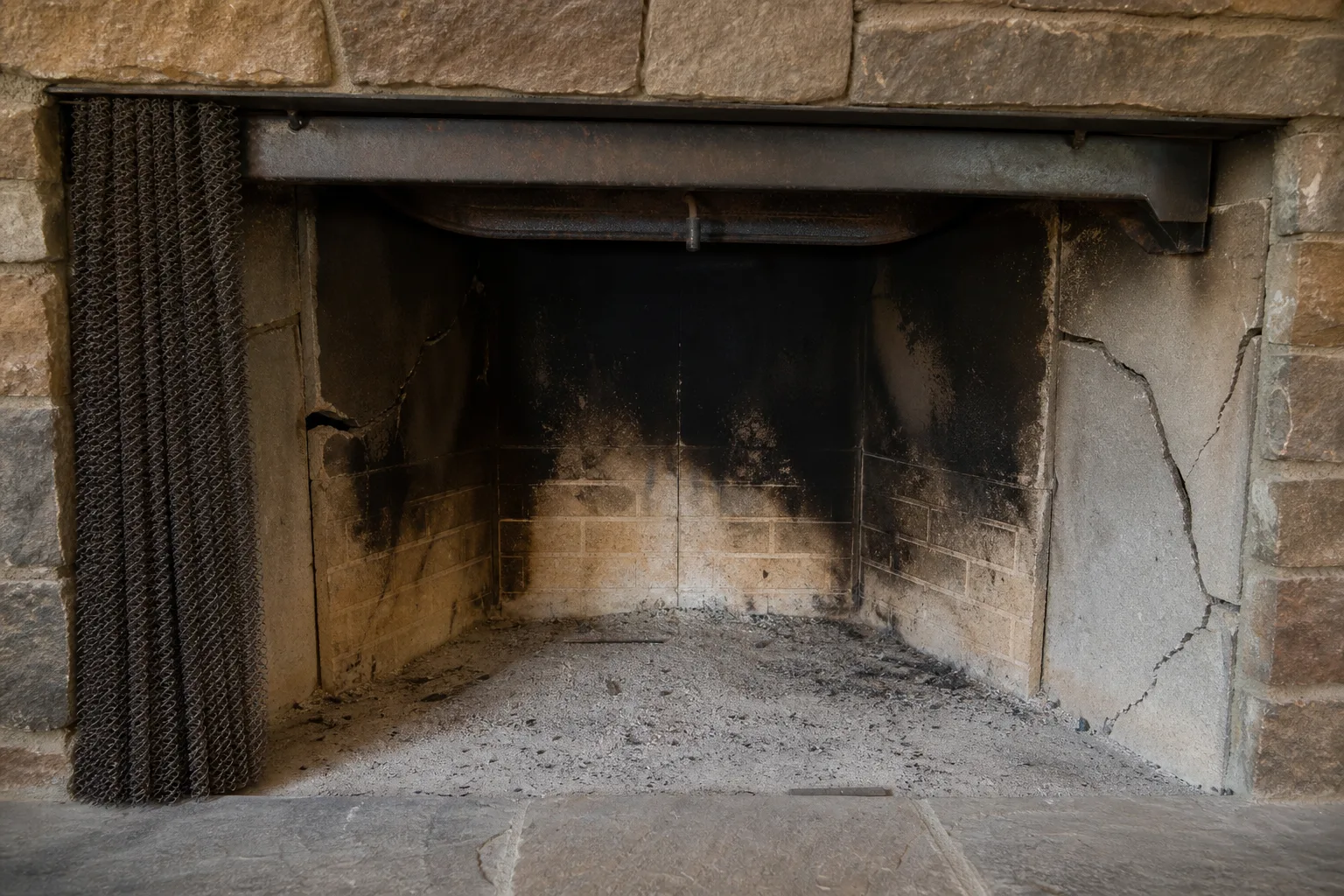
Your chimney spent years carrying wood smoke. Wood smoke leaves creosote, and creosote hides masonry problems.
Before anything gets installed, that flue needs to be cleaned and examined by a qualified chimney service: the liner, the smoke chamber, the damper, the crown, the cap, and the flashing where the stack meets the roof.
This matters most when the new appliance will use the existing flue, which two of the three conversion paths do.
The inspection a fuel change triggers
NFPA 211 calls for a Level 2 inspection when a change is made to the system, and a change of fuel is exactly that. The same standard calls for one at a property sale or transfer, after a malfunction, after a chimney fire, and after an external event such as a storm.
A Level 2 goes well past a visual once-over. It includes a video scan of the flue interior, and it covers the cap, the crown, the flashing, the masonry, the flue liner, the damper, the appliance connection, the smoke chamber, and the firebox.
Most people who set out to convert wood fireplace to gas learn the real condition of their chimney for the first time during that scan. Treat it as the first line item of the project, not as an upsell.
The Three Ways to Convert a Wood Fireplace to Gas
Most people arrive here thinking there is one thing called "a gas conversion." In fact there are three ways to convert wood fireplace to gas, and they produce genuinely different results in the same firebox.
Vented gas logs
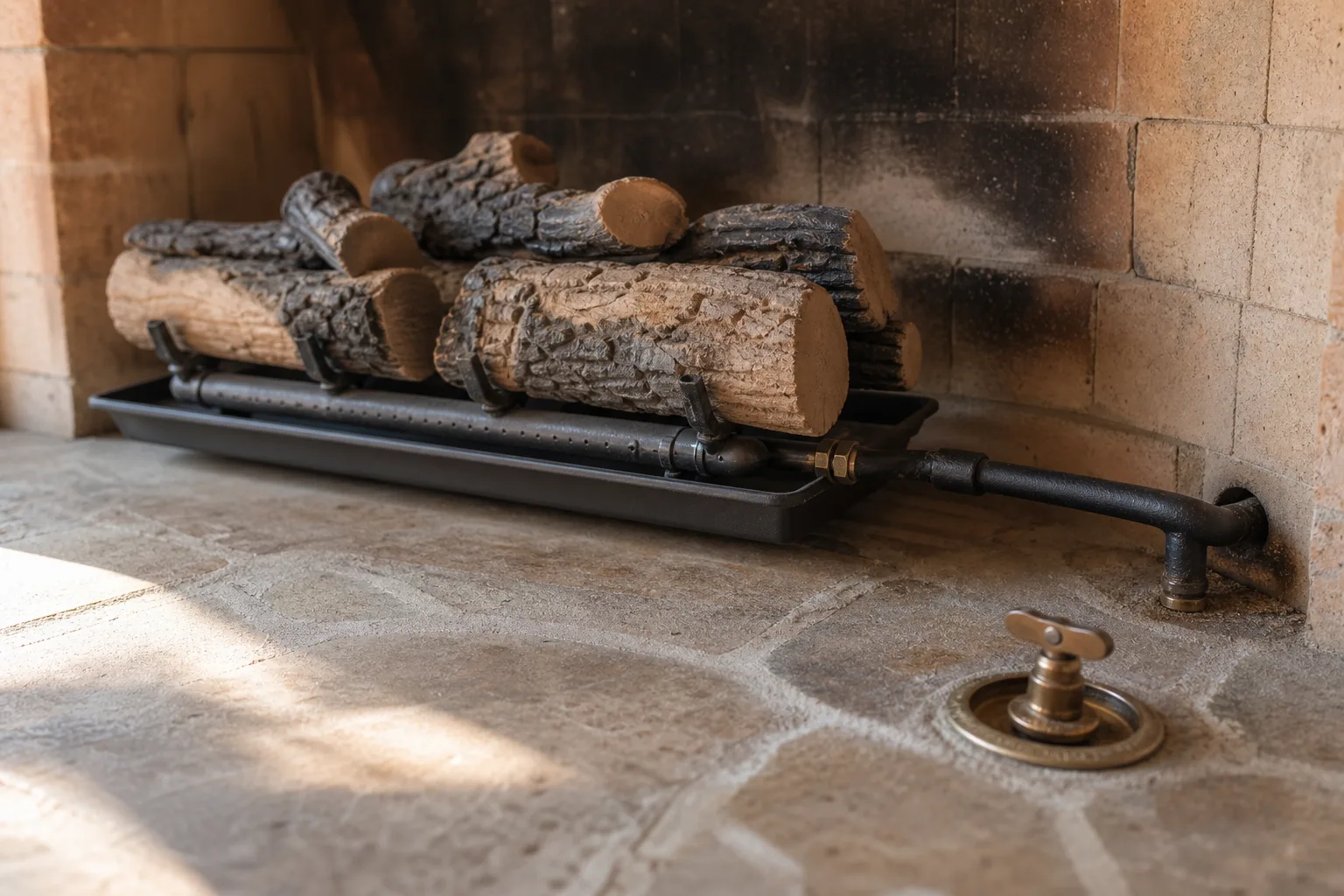
A set of ceramic logs on a burner pan, sitting inside the firebox you already have. The damper stays open while it burns, so combustion products travel up the chimney the same way wood smoke used to.
This is the look, not the heat. A vented log set is primarily decorative, and most of the warmth follows the exhaust up the flue.
It is also the lightest touch of the three. The firebox stays a firebox. You need a working chimney and a sound flue, but you are not rebuilding the venting system.
Vent-free gas logs
Also called ventless. These burn with the damper closed, which is exactly what it sounds like: the products of combustion stay in the room with you. It is the one path where the answer to whether gas fireplaces need a chimney is genuinely no.
That is why they throw heat. It is also why they are the most regulated option on this list.
Where they stand legally is an address question, not a state question. California prohibits the sale of unvented heaters designed for indoor use in a dwelling, with narrow exceptions. Massachusetts banned them at one point and now permits them with exceptions. Minnesota bans them in cities above 2,500 people. City-level prohibitions have been reported in places including Austin, Houston, Elgin, Fremont, and Manchester.
Good to know: "Are ventless logs legal in my state?" is the wrong question. The answer that governs you often comes from your city, not your statehouse, so the only reliable source is your local building department or fire marshal. Ask before you buy, not after it is sitting in your firebox.
Gas inserts
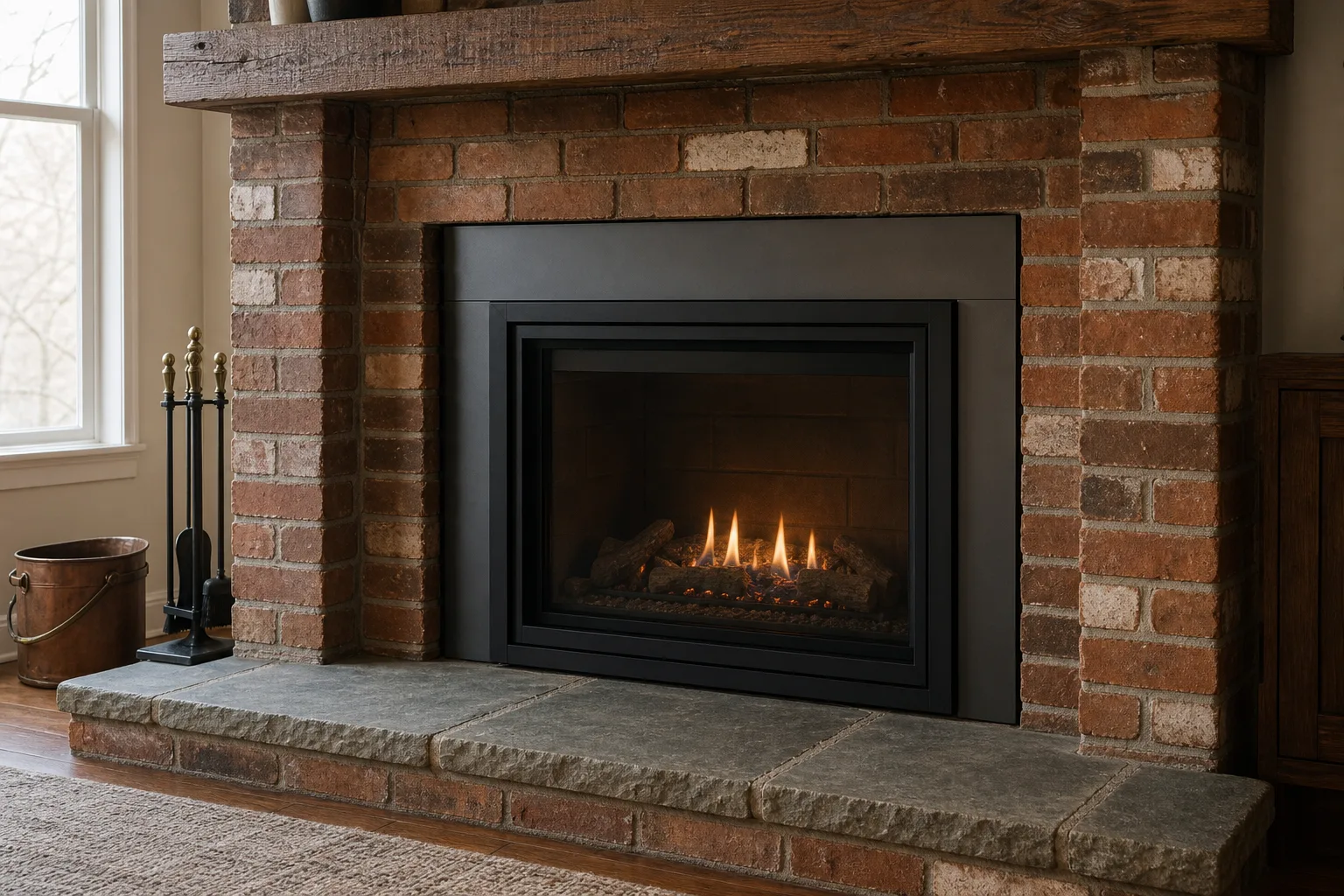
An insert is a sealed appliance built to slide into the existing opening. Glass front, its own venting, and usually a blower pushing warm air back into the room.
A direct-vent insert draws combustion air from outside and sends exhaust out through its own liner, so the air in your living room never becomes part of the fire. It delivers more usable heat than vented logs, which is the entire reason people pick it.
It is also the most involved path, because new venting gets run up the chimney to serve it.
When homeowners decide to convert wood fireplace to gas, this is the fork they did not know was coming. Here is the same decision in one view.
| Vented gas logs | Vent-free gas logs | Gas insert | |
|---|---|---|---|
| What it is | Ceramic logs on a burner in your open firebox | Ceramic logs that burn with the damper closed | Sealed appliance with a fixed glass front |
| Heat | Mostly decorative | Heats the room it sits in | The most usable heat of the three |
| Venting and damper | Damper stays open, vents up the existing flue | No venting, damper closed | Its own liner up the chimney, damper clamped off |
| Chimney work needed | Clean, sound flue | The least of the three | New liner run, top plate, termination cap |
| Where it is allowed | Broadly | Restricted in some states and cities | Broadly |
| How hard to reverse | Easiest | Easy | Hardest |
Not sure which of these three your chimney can actually carry? That question gets answered by somebody standing in front of it, not by a website. Tell us what you have and we will match you with an independent local chimney company that handles gas conversions. Call (513) 655-6702.
What It Costs to Convert Wood Fireplace to Gas
The published ranges
There is no single price to convert wood fireplace to gas, and the published ranges are wide enough that repeating one here would mislead you more than help. The width of the spread is the useful part.
A basic vented log set dropped into a sound firebox sits near the bottom. A direct-vent insert with a full liner run sits far up the range. A conversion that turns into chimney repair first can leave the range altogether.
Nobody can price your fireplace from a web page, and you should be suspicious of anyone who tries. The only number worth anything is the one written down after somebody has looked up your flue.
What actually moves your number
- Which of the three paths you choose.
- Whether a gas line already reaches the firebox, or has to be run to it.
- The condition of the flue, the liner, and the masonry above it.
- Liner length, which really means chimney height.
- Regional labor rates.
- Whether a permit and an inspection are required where you live.
Myth vs. fact: Myth: a gas conversion pays for itself within a few years. Fact: no general payback figure survives contact with a real house. It depends on your fuel prices, how often you actually run the thing, and whether it is replacing heat you were buying anyway. Anyone quoting you a universal number is guessing.
What the Work Actually Looks Like
Nobody explains the sequence, so people end up shopping before they know what they are allowed to buy.
The order of operations
- Inspection first. A Level 2 with the camera, so the flue's condition is known before any money moves.
- Confirm the fuel. Gas or propane at the property, and a line that can reach the firebox.
- Choose the path. Now, with the first two answers in hand, and not one minute before.
- Permit, where your jurisdiction requires one.
- Install.
- Final check. Gas connection tested, venting verified, appliance run and observed.
That order prevents the most common mistake in this project: falling for an insert in a showroom, then learning the chimney needs work before it can hold one.
The chimney-top half of the job
A log set is mostly interior work. An insert is not. The effort to convert wood fireplace to gas with an insert splits roughly in half between the living room and the roof.
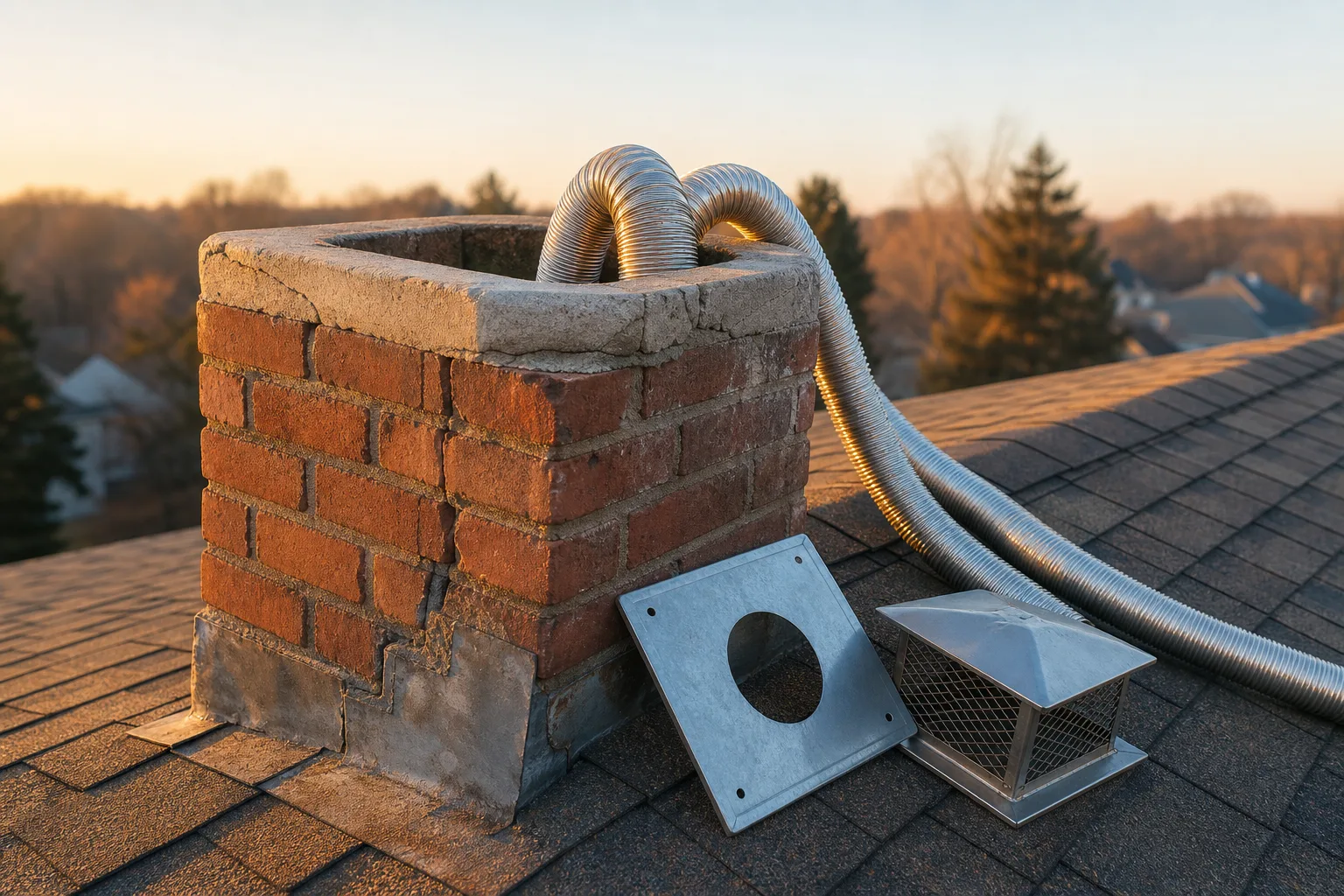
A direct-vent insert in a masonry chimney is usually vented with a co-linear system: two flexible liners running up the existing flue from the appliance to a termination cap at the top. One carries exhaust out, the other brings combustion air in. Kits commonly pair a 3 inch liner with a 3 inch, or a 3 inch with a 4 inch, and the liner is typically stainless steel.
A coaxial arrangement does the same job as a pipe inside a pipe, exhaust through the center and intake air through the space around it.
At the top of the stack, the liners land on a top plate sealed to the crown (18 by 18 inches is one common size) with a termination cap above it. High wind caps exist for exposed roofs.
One structural rule worth knowing: NFPA 211 requires a 4 inch solid masonry partition between separate liners, unless those liners are venting the same fireplace.
From the field: The firebox is rarely what complicates a conversion. It is the flue. A chimney that looked perfectly fine from the driveway is where the surprises live, and that is exactly why the camera goes in before the product gets ordered.
Can You Convert Wood Fireplace to Gas and Still Go Back to Wood?
This is the question people feel silly asking, and it deserves a straight answer.
A vented log set comes back out comparatively easily. It is an appliance sitting in your firebox, fed by a gas line. Remove it, cap the line, and you have a wood-burning fireplace again, assuming the flue is still fit for wood.
An insert is a different animal. Once a sealed liner system runs the height of the flue and the damper has been clamped off, returning to wood means undoing real work, not lifting something out.
Neither of those is an absolute rule, because chimneys differ. But the tendency is clear enough to plan around. If the option to burn wood again matters to you, say so out loud before you choose, not after.
When Converting Is the Wrong Move
A page that only ever tells you to buy is not worth much, so here is the other side.
Stay with wood if the fire itself is the point. If you like splitting and stacking your own firewood and the smell of it, gas will not give you that, and no ceramic log has ever fooled somebody who genuinely loves a wood fire.
Skip the log set if what you wanted was heat. This is the most common regret in the category. Somebody buys vented logs expecting a warm room, gets a pretty flame and a cold couch, then pays twice. If heat is the goal, the honest answer is an insert.
Fix the chimney first if the inspection says so. Spalling brick, a cracked crown, a failed liner, bad flashing: a new appliance covers none of that up. Converting on top of a compromised structure just buys you a better-looking problem.
Reconsider vent-free if the room is small, tightly sealed, or somebody sleeps next to it, and check your local code before you get attached to the idea.
The decision to convert wood fireplace to gas is far easier to unwind on paper than it is in a chimney, which is the whole argument for slowing down at this step.
Before You Call: A Pre-Conversion Checklist
Five minutes with this list and your first call to somebody who can convert wood fireplace to gas becomes twice as useful.
- Fuel: natural gas at the property, propane, or neither?
- Distance: roughly how far is the nearest gas line from the fireplace?
- The chimney: masonry stack or framed chase? Interior, or on an exterior wall?
- Last service: when was the flue last swept or inspected, if ever?
- The damper: does it still open and close, or is it seized?
- Your goal: heat, or the look? Answer honestly, because it picks the product.
- The room: size, ceiling height, and whether anyone sleeps nearby.
- Local code: what does your building department say about vent-free appliances at your address?
- Reversibility: do you want the option to burn wood again someday?
Pro tip: Book the inspection before you shop, not after. Walking into a hearth showroom with a camera report in hand changes the entire conversation, because you are choosing from what your chimney can support instead of guessing and hoping it works out.
How VIO Helps When You Convert Wood Fireplace to Gas
The plain version: VIO does not do the work. We are a referral service. We connect homeowners with independent local chimney and hearth companies, and those companies do the inspecting and the installing.
For this particular job, that distinction matters more than usual. A conversion sits across two trades, the chimney side (inspection, liner, damper, crown, cap) and the gas side (the line, the connection, the appliance itself). You want a company that handles both, or one that coordinates cleanly with whoever handles the other half.
Tell us what you are working with, masonry firebox or framed chase, interior or exterior stack, gas at the house or not, and we will match you with a company in your area that does conversions. An independent local company may want to look at the flue before anything else, for the reasons this whole article has been making.
On money: we ask every company in the network to put its estimate in writing before any work starts, and you should insist on exactly that. Ask for the scope in writing too, particularly the liner and any masonry repair, because that is where a project to convert wood fireplace to gas quietly grows.
If you are ready to find out what your own fireplace can take, start there. Give us the basics about your house and we will connect you with a local company that does this work in your area. Call (513) 655-6702.
Symptom checker
What is your chimney doing?
Tap the closest match for an honest first answer.