



On this pageWhat Firebox Repair Actually Covers9 sections+8
- What Firebox Repair Actually Covers
- Start Here: Which Firebox Do You Have?
- Why Fireboxes Crack, Crumble, and Fail
- How Bad Is It? Firebox Repair Severity Thresholds
- How Firebox Repair Is Done, by Firebox Type
- Firebox Repair Mistakes That Cost You Twice
- What Firebox Repair Costs, and What Moves the Number
- How VIO Helps With Firebox Repair
- Before You Light the First Fire
Quick answer
Firebox repair covers work on the fire chamber itself: replacing cracked firebrick and repointing joints with refractory mortar in a masonry fireplace, or replacing cracked refractory panels in a factory-built unit. A widely used CSIA rule of thumb calls for replacing a factory-built refractory panel once a crack reaches 1/16 inch wide or the surface has eroded about 1/4 inch deep. Masonry fireboxes have no equivalent published width rule and are judged by extent.
You opened the damper for the first time since March, aimed a flashlight at the back wall, and there it was.
A crack running up through the brick. Or a mortar joint gone sandy that crumbles when you press it with a thumbnail. Or a flat panel with a line across it that you're fairly sure was not that long last winter.
Then the question starts running on a loop. Is this the kind of crack that means nothing, or the kind that burns the house down?
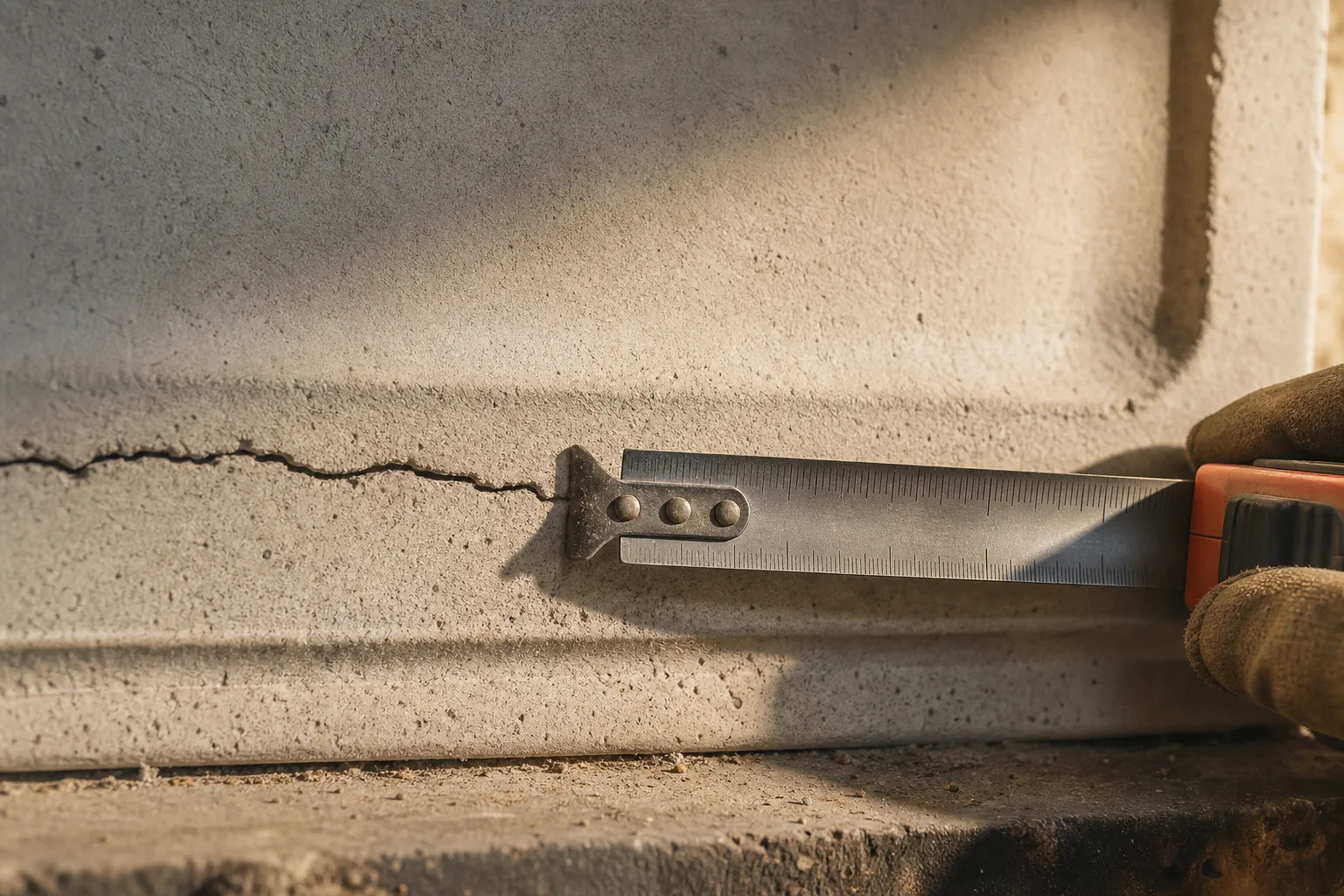
There's a better answer than guessing. The trade sorts firebox damage by what it actually looks like, and on factory-built units there are published crack-width thresholds you can check yourself with a tape measure. Masonry gets judged differently, by extent and condition. Both are further down this page, in a table.
You can't use it yet, though. Not until you know which of two completely different fireplaces you own, because the thresholds, the repair method, and the cost all fork at that one question. Most homeowners have no idea which one is in their living room.
So let's start there, and work down to the number.
What Firebox Repair Actually Covers
The firebox is the chamber where the fire burns: the walls you see looking straight in, and the floor under the grate. Above it sit the throat and the smoke chamber, which carry smoke up toward the flue and count as a separate part of the system.
Firebox repair means work on that chamber. Not the flue above it, not the stone or tile surround, not the stack on your roof.
Good to know: The firebox, the flue, and the chimney structure are three different systems stacked on top of each other. If an estimate bundles them into one number, ask for it broken out.
The Firebox Is Not the Same as the Chimney
Ask someone to point at their chimney and they'll point at the roof. Ask them to point at their firebox and most people hesitate.
The two are connected. A damaged chamber changes how the fire burns, and that changes what coats the inside of your flue, which is the short version of how does a chimney work.
Firebox work splits into two tiers. Spot repair handles localized damage: a few cracked bricks, a run of failed joints, one bad panel. Rebuild is what happens when the damage stops being localized, and which tier you're in is what you're trying to find out today.
Start Here: Which Firebox Do You Have?
American homes have two kinds of fireplaces, and they aren't variations on a theme. Different products, different trades, different repairs.
Get a flashlight. Look into the chamber.
Signs You Have a Masonry Firebox
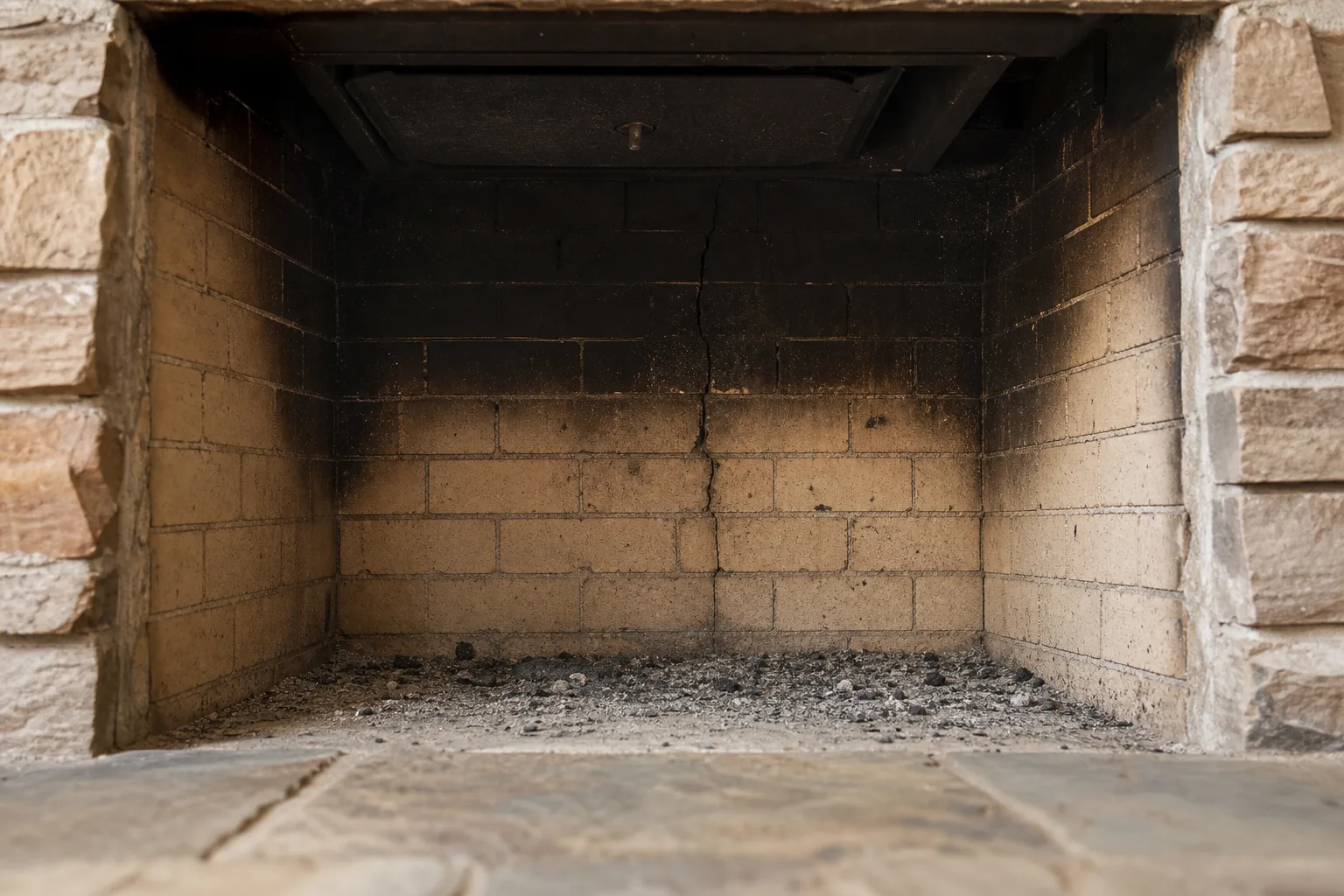
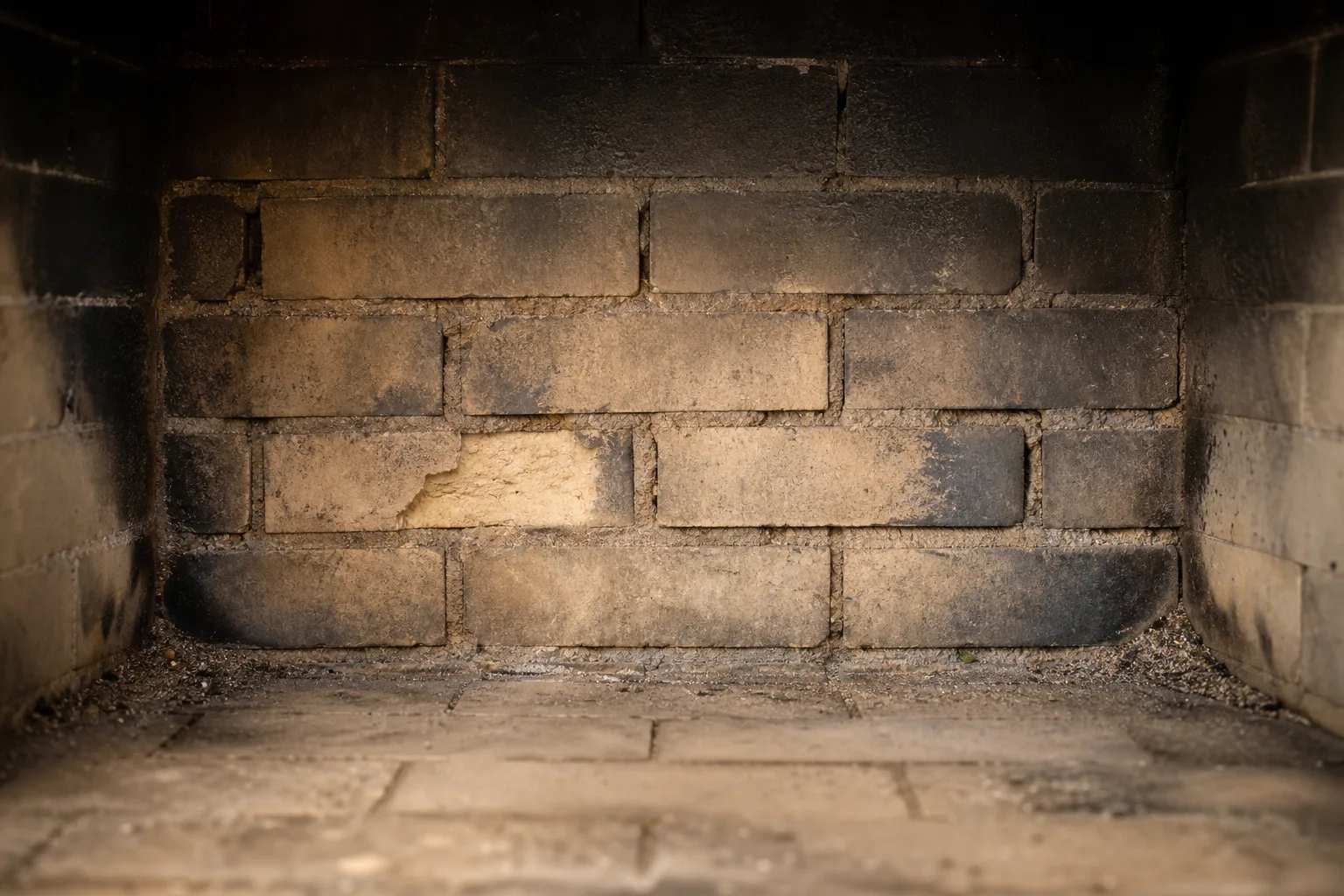
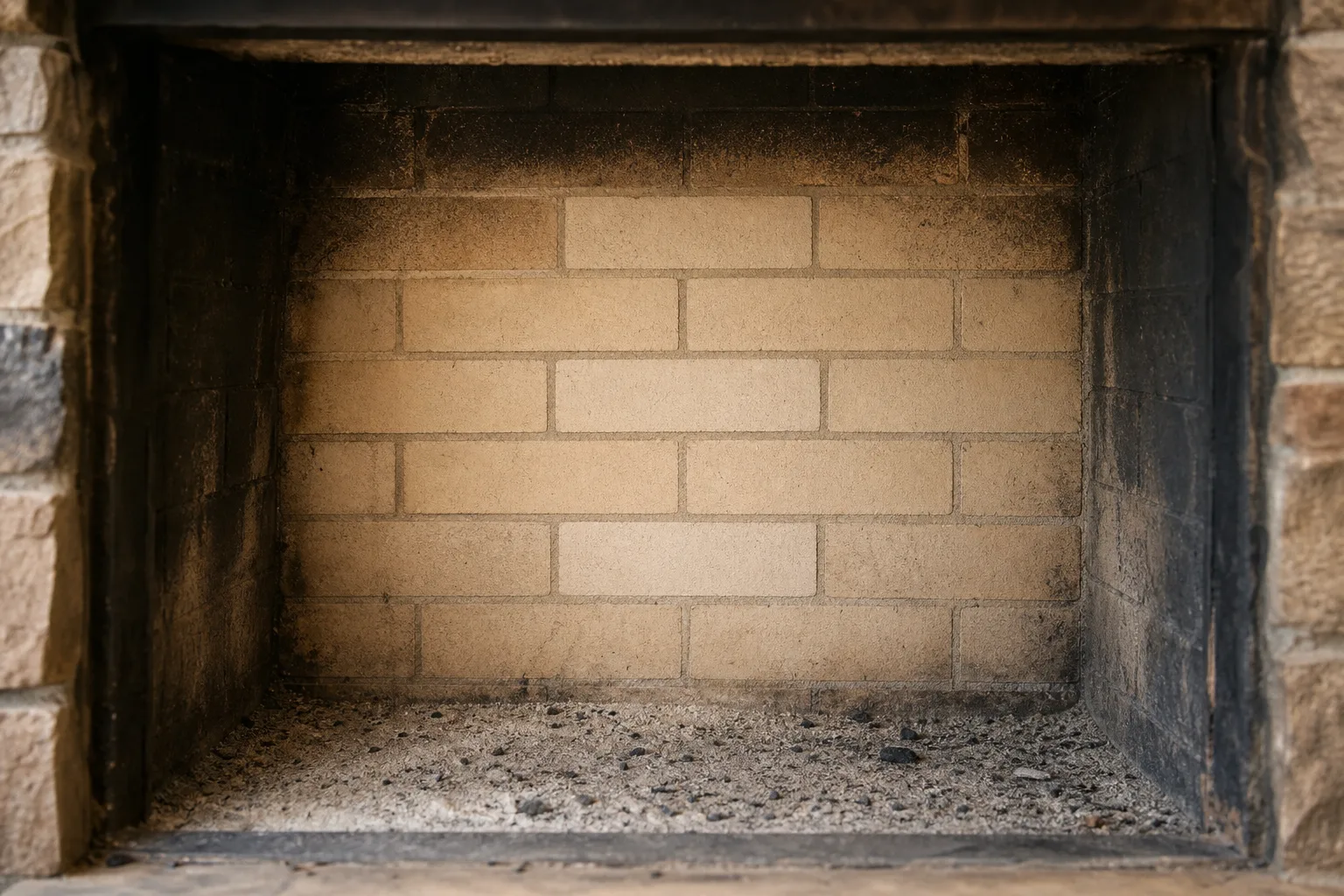
A masonry firebox was built brick by brick, on site, by a mason: real laid courses of firebrick.
Firebrick reads pale. Buff, cream, sandy tan, sometimes grey-white, and noticeably lighter than the red-orange common brick outside.
The giveaway is the joint. Firebrick is laid with very thin mortar joints, no wider than a quarter inch, and that hairline seam is unlike anything in ordinary brickwork.
Shape matters too. The side walls splay inward toward the back, and the back wall slopes forward near the top. A masonry firebox is not a plain rectangular box.
From the field: The first thing a sweep looks at is the color of the brick and the width of the joint. Pale brick with a thread-thin joint means real firebrick. Red brick with a fat half-inch joint in a fire chamber means somebody built or repaired it wrong.
Signs You Have a Factory-Built (Prefab) Firebox
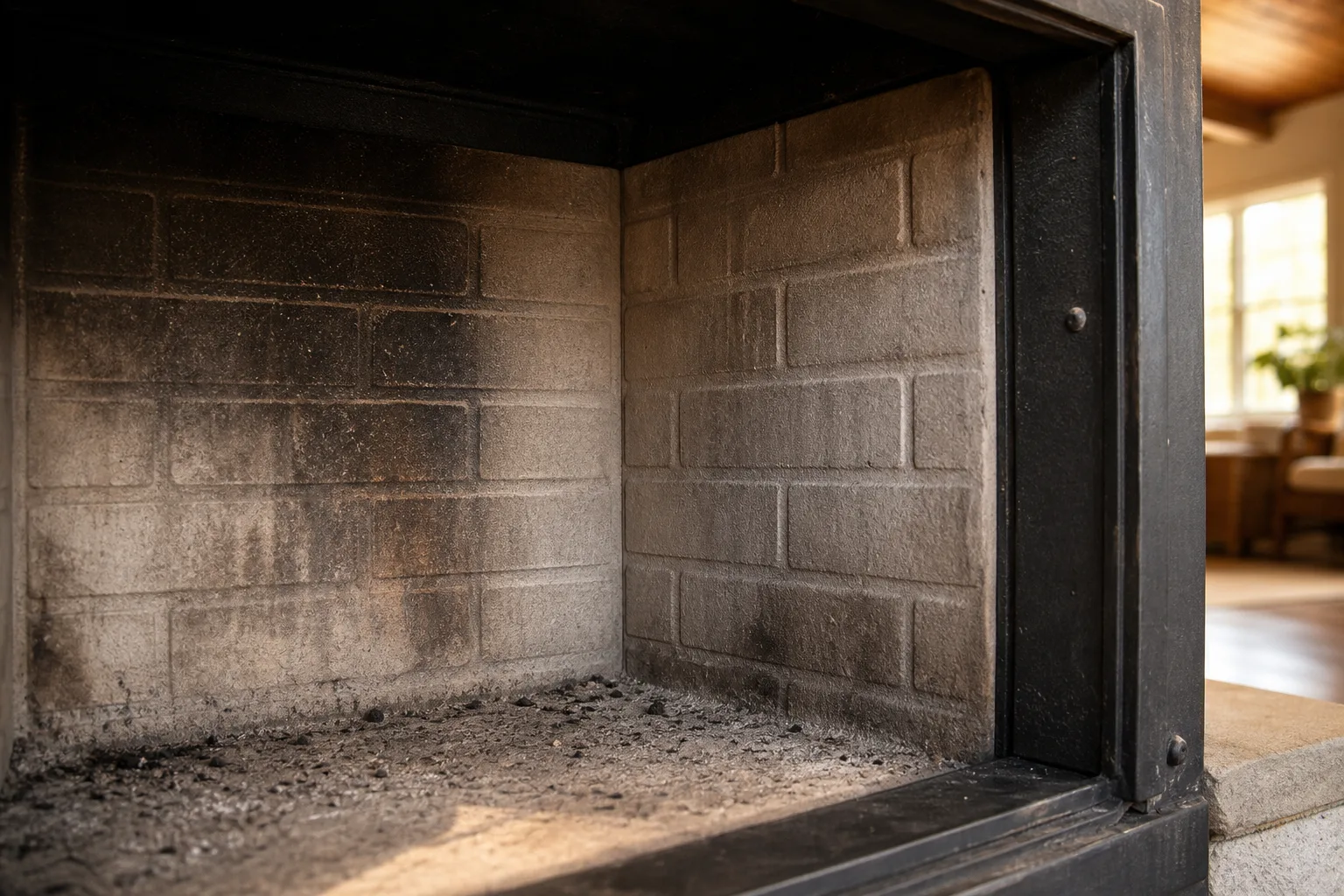
A prefab is a manufactured metal unit set into a framed chase and finished around. Inside the steel shell sit flat refractory panels, usually a back and two sides.
Those panels are smooth and light grey to off-white, and here's the tell: they're very often molded with a fake brick pattern stamped into the surface. Real laid brick has depth and irregularity; a molded panel repeats one pattern across a continuous flat face.
You'll also see straight seams where panels meet, and exposed black painted metal at the corners and around the opening.
Then look for the tag. Factory-built units carry a metal rating plate, usually riveted to the inner side wall near the opening. The manufacturer and model number on it are the most useful things you can photograph before anyone comes out.
The 60-Second Check
Run this list with a flashlight:
- Pale buff brick, or a flat light-grey panel?
- Individual bricks with thin joints, or one continuous molded face?
- Side walls splayed inward, or meeting the back squarely?
- Straight seams and black metal edges?
- A metal model tag riveted inside near the opening?
- Press a joint with your thumbnail. Does it hold, or fall as sand?
- Photograph everything: the damage close up, the tag, a wide shot.
Pale brick, thin joints, splayed walls, no tag means masonry. Flat panels, molded pattern, metal seams, a tag means factory-built.
Now the fork. These two fail differently and get repaired differently, and treating them the same is how people pay for the wrong work.
Why Fireboxes Crack, Crumble, and Fail
Damage is usually a compound of several forces rather than one villain. Anyone who tells you confidently it was definitely water, or definitely overfiring, is guessing.
Heat and Thermal Cycling
Firebrick and refractory panels handle enormous heat. What wears them out is the cycling, up to temperature and back down, hundreds of times over years.
Materials expand and contract at slightly different rates, and over enough cycles the differences show up as cracks.
Creosote, Which Is Acidic
This one surprises people. Creosote and combustion residue are highly acidic, and over time they eat into masonry.
Not a metaphor. Acidic deposits degrade mortar joints and brick faces, which is part of why a heavily used, rarely swept firebox goes downhill faster. Knowing how often to clean chimney systems matters for how long a firebox lasts.
Water Coming in From Above
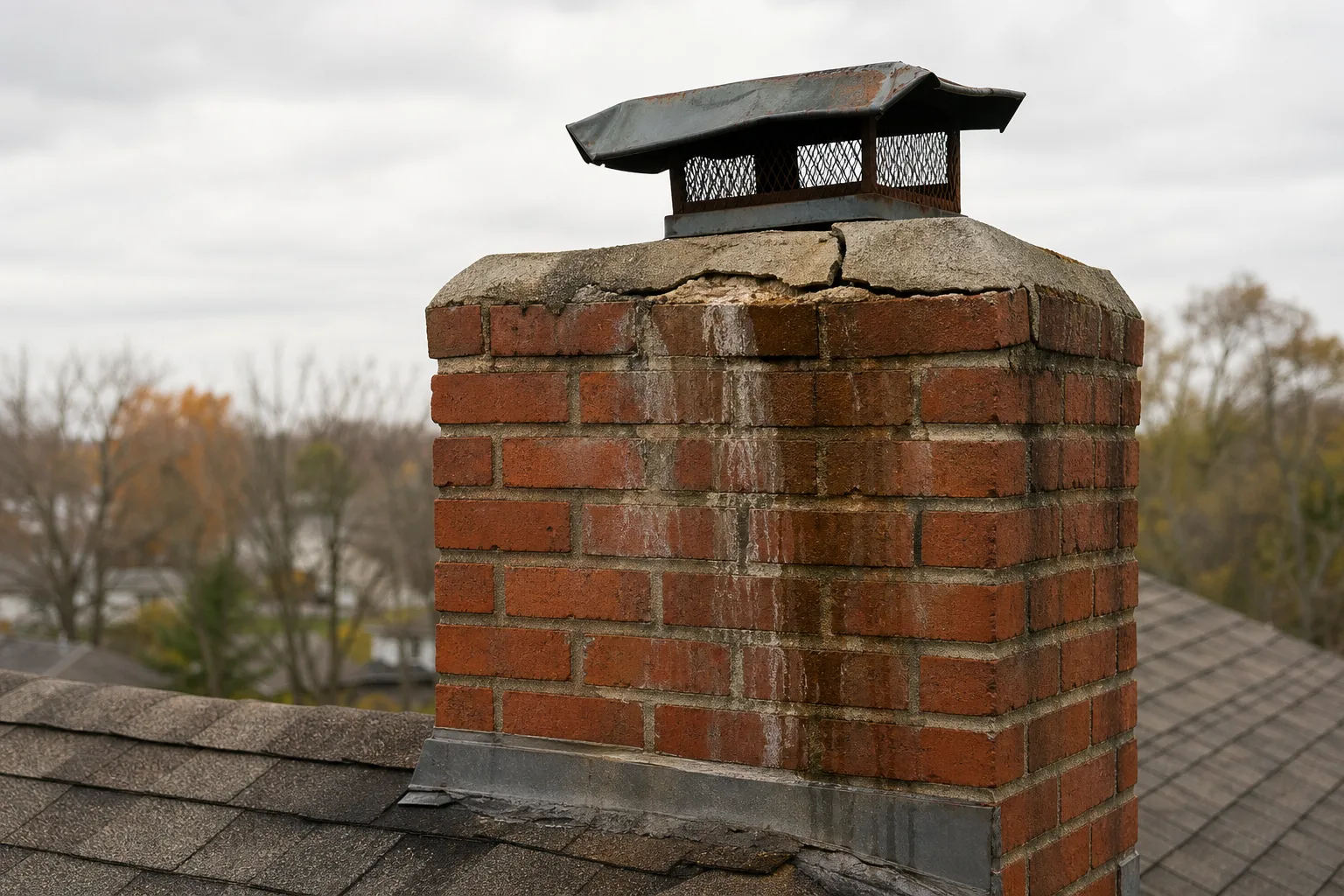
Most people never connect firebox damage to the roof, but water is a genuine cause, and it's the one that makes a repair fail twice.
It enters through a cracked crown, a missing cap, or failing mortar up the stack, soaks into masonry that was never meant to be wet, then freezes and pushes things apart.
If your firebox is deteriorating and nobody checked the top of your chimney, the diagnosis isn't finished. A sound chimney cap and an intact crown are the difference between a repair that holds and one that reopens next spring.
Movement and Settlement
Houses move. Foundations settle, framing shifts seasonally, and rigid masonry doesn't have much give.
Cracks that step diagonally through joints rather than straight through brick faces often point this direction.
Safety note: The reason this matters is specific, not vague. Cracks and failed joints can let hot combustion gases reach the framing behind the firebox. Creosote also packs into cracks, where it sits as fuel that can reignite from a spark. Those two mechanisms are the whole case for taking firebox damage seriously.
How Bad Is It? Firebox Repair Severity Thresholds
This is the part you came for.
The trade does use measurable thresholds, and the most widely cited come from the Chimney Safety Institute of America. They're generally applied to refractory panels in factory-built units, where the material is uniform and a crack width means something consistent.
Two numbers carry most of the weight, and both apply to factory-built panels. A crack reaching 1/16 inch wide is where a panel is generally considered a replacement rather than a patch. Surface erosion of about 1/4 inch deep is the other, and multiple cracks in one panel point the same way.
Masonry is a different assessment. There's no equivalent published crack width for firebrick, and a mason judges by extent instead: how many bricks are affected, how much of the joint network has failed, whether the back wall still holds its shape.
You'll see these called coin tests, the nickel or the dime. Sources disagree on which coin goes with which threshold, so measure the width and go by the measurement.
One caveat, stated plainly: this is a widely used CSIA rule of thumb, not building code and not law. An inspector's judgment on your specific unit, and the manufacturer's instructions for a listed appliance, are what actually govern.
Find your row.
| What you see | Masonry firebox | Factory-built firebox | What it generally means |
|---|---|---|---|
| Fine surface crazing | Common with age and cycling | Common on older panels | Usually cosmetic. Mention it at your next inspection |
| Crack narrower than 1/16 inch | No published width rule. Judged by extent | Often considered repairable | Monitor and get it looked at |
| Crack at or past 1/16 inch | No published width rule, but a through-crack still warrants a look | Panel replacement generally indicated | Get an inspection before the next fire |
| Several cracks in one panel or brick | Suggests broader deterioration | Replacement, not patching | Multiple cracks rarely stay isolated |
| Surface eroded roughly 1/4 inch deep | Worn brick is assessed by the mason | Replacement threshold for panels | The material has lost thickness it needs |
| Joints sandy, recessed, falling out | Repointing with refractory mortar | Not applicable | Repairable, but find out why first |
| Spalled brick, face flaked off | Replace the affected brick | Not applicable | Spot repair, if it's localized |
| Open gap at a panel seam | Not applicable | Have it assessed before use | A direct path for heat toward framing |
| The metal shell looks warped | Not applicable | Whole-unit replacement may be on the table | New panels alone may not resolve it. An inspection decides |
| Daylight, or a gap to framing behind | Stop using it | Stop using it | Do not light a fire. Get it inspected |
Myth vs. fact: The myth is that any crack in a firebox is an emergency and the fireplace is finished. The fact is that thresholds exist precisely because hairline crazing and a through-crack are different findings. The flip side holds too. Once you're past the threshold, "it's been like that for years" stops being reassuring.
Measure yours. Write the number down. That one figure changes the conversation you're about to have.
Measured your crack and not sure what it means?
Describing what you're looking at is the hard part, and you've already done it by reading this far. Tell us what you see, the light-colored brick with crumbling joints, or the flat panel with a crack across it, and we'll match you with a local chimney company that works on that kind of firebox.
Call (513) 655-6702 or request service and we'll take it from there.
How Firebox Repair Is Done, by Firebox Type
Two fireplaces, two trades, two completely different afternoons.
Masonry: Replacing Cracked or Spalled Firebrick
A damaged firebrick gets cut out and replaced. The mason chisels it free, cleans the cavity, and beds a new firebrick in refractory mortar.
The replacement isn't generic masonry. Code calls for firebrick conforming to ASTM C27 or C1261, laid with medium-duty refractory mortar conforming to ASTM C199, with joints not exceeding a quarter inch.
That last spec is worth remembering, because a fat sloppy joint in a fire chamber is the sign of someone working outside their lane.
Masonry: Repointing the Joints
When the brick is sound but the joints have gone, the fix is repointing, sometimes called tuckpointing. The same technique turns up outside the chamber in chimney mortar repair, though the material there is different.
The dead mortar gets raked out to roughly half an inch to three quarters of an inch deep, leaving clean brick faces on both sides. Scraping the loose surface off doesn't work, because new mortar needs depth to key into.
Pro tip: Mortar does not bond well to bone-dry brick. Brushing water onto the joints and faces first is a small step that separates a repair that holds from one that lets go in a season. If you watch someone repoint your firebox and they skip it, ask why.
Refractory mortar meeting ASTM C199 is tested to resist 2,550°F for at least six hours without flowing out of the joints. Ordinary masonry mortar makes no such claim, which is why the standard exists.
Factory-Built: Replacing Refractory Panels
On a prefab unit, firebox repair is mostly panel replacement.
Manufacturers produce replacement panels for most units, which is exactly why that model tag matters. Match the model, order the panel, swap it. Older units are harder, and some need custom-matched panels or generic stock cut to fit.
The important limit: a factory-built fireplace is a listed, tested assembly. The repair restores that system rather than improvising on it.
And here's what people find out too late. If the steel shell behind the panels has warped, new panels alone may not resolve it, and whole-unit replacement can come onto the table. That's a call for an inspection against the manufacturer's requirements, not something to judge from a photo.
When Firebox Repair Becomes a Rebuild
There's a point where spot work stops making sense.
Picture a homeowner with a 1920s brick stack, four cracked bricks along the back wall, joints sound everywhere else. That's spot repair.
Now picture the same fireplace where most joints crumble under a thumbnail and the back wall has lost its shape. Replacing eight bricks where the other forty are failing buys a season and wastes the money.
When most of the brick and mortar is in question, a qualified sweep or masonry contractor should assess the whole chamber. A rebuild takes the firebox back to sound structure and lays it up correctly. That's professional work.
If yours is being rebuilt, that's the moment to ask about the flue. The economics of chimney flue liner installation while the system is already open differ from a separate trip later.
Firebox Repair Mistakes That Cost You Twice
Most of these come from people trying to do the right thing. That's what makes them worth naming.
Ordinary masonry mortar in the combustion zone. The most common well-intentioned mistake there is. The bag from the hardware store isn't rated for what happens inside a fire chamber, and it will not survive.
Safety note: The combustion zone calls for medium-duty refractory mortar conforming to ASTM C199. This isn't a premium upgrade. The International Residential Code and NFPA 211 both point at that standard, and the pier test behind it exists to confirm the mortar won't flow out of the joints under sustained heat.
Coating over a cracked panel on a factory-built unit. Smearing cement across a cracked refractory panel makes the crack disappear from view. It doesn't restore a tested assembly, and whether minor patching is ever acceptable on a listed appliance is a question for the manufacturer's instructions and your inspector, not a product label.
Treating a tube of refractory cement as a permanent structural fix. These products have real uses. Carrying a firebox past a genuine threshold isn't one of them.
Curing too fast. Fire cement on firebrick is meant to come up to temperature gradually, over roughly three to four hours, rather than taking a full hot fire on day one. Rushing the first burn is how fresh firebox repair work cracks back open.
Patching without finding out why it cracked. The expensive one, because it feels like success. If water is coming down through a failed crown, the repair reopens in the same place.
What Firebox Repair Costs, and What Moves the Number
Nobody can price your firebox from a web page, and anyone offering a flat national figure is selling confidence rather than information.
Published ranges do float around online. They're wide enough to be close to useless on any specific house, which is why this page won't repeat one.
What actually moves your number:
- Which firebox you have. Masonry work is labor and materials by the hour and the brick. Panel replacement is largely a parts question.
- Whether the part exists. A current model with available panels is a different job from a discontinued unit needing cut-to-fit stock.
- Spot repair versus rebuild. The widest variable on the list.
- Whether there's an upstream problem. If water is the cause, crown or cap work is part of making the repair hold.
- Access and setup. Protecting the room and working inside a dark chamber takes time.
For more on the money side, our guide to fireplace repair cost goes deeper than this page does.
If the chamber needs more than spot work, fireplace restoration covers what a full rebuild involves.
One timing note. Under NFPA 211, a Level 2 inspection is called for at the sale or transfer of a property, when the system changes, after a malfunction, after a chimney fire, and after an external event such as an earthquake or severe weather. If you're buying or selling a home with a questionable firebox, that inspection is part of the picture.
How VIO Helps With Firebox Repair
Here's the plain version of what we are. VIO is a referral service. We match homeowners with independent local chimney companies, and those companies do the work. We don't do firebox repair ourselves.
That means you don't have to work out which contractor handles which kind of fireplace. Tell us what you found in the chamber, pale brick with failing joints or a flat panel with a crack across it, and we'll match you with a company near you that works on that type.
We ask every company in the network to put its estimate in writing before any work starts, and you should insist on exactly that. Get the scope on paper, broken out by line item, before anyone picks up a chisel.
Two questions worth asking whoever shows up. What did you measure, and what did you find. And is this spot repair or a rebuild, and what specifically pushes it from one to the other. Anyone who answers both without hedging is worth hiring.
Before You Light the First Fire
You started this page with a crack and a loop running in your head. You should be leaving with three things instead.
You know whether you own a masonry firebox or a factory-built one. You have a measurement, and you know which side of the threshold it falls on. And you know enough about the work that nobody can turn four bricks into a rebuild without explaining themselves.
That's a stronger position than most people have when they make this call.
It's late September. If you're going to need firebox repair before the first cold night, get eyes on it now rather than in January with a fire already laid. A diagnosis is easier to act on when you're not cold.
Get eyes on your firebox before you light the first fire
Tell us what you found, the measurement, the photos, the model tag if you have one, and we'll connect you with an independent chimney company near you that handles firebox repair.
Call (513) 655-6702 or request service online.
Symptom checker
What is your chimney doing?
Tap the closest match for an honest first answer.