


On this pageWhat an On Duty Chimney Service Actually Means7 sections+6
- What an On Duty Chimney Service Actually Means
- Tonight or Tuesday: A Ninety-Second Chimney Triage
- The First Ten Minutes, Before Anyone Arrives
- What an On Duty Chimney Company Can Do at 10 p.m., and What Waits for Daylight
- How to Tell Whether a 24/7 Claim Is Real
- After the Emergency: The Inspection Most People Skip
- How VIO Helps You Reach an On Duty Chimney Company
Quick answer
An on duty chimney company is one that answers after hours and dispatches for genuine emergencies: a chimney fire, a sounding carbon monoxide alarm, smoke pushing back into the room, sudden structural failure, or active water entry. Most other chimney problems, including cracked mortar, a stuck damper, or a dirty flue, can safely wait for a scheduled daytime appointment with a certified sweep.
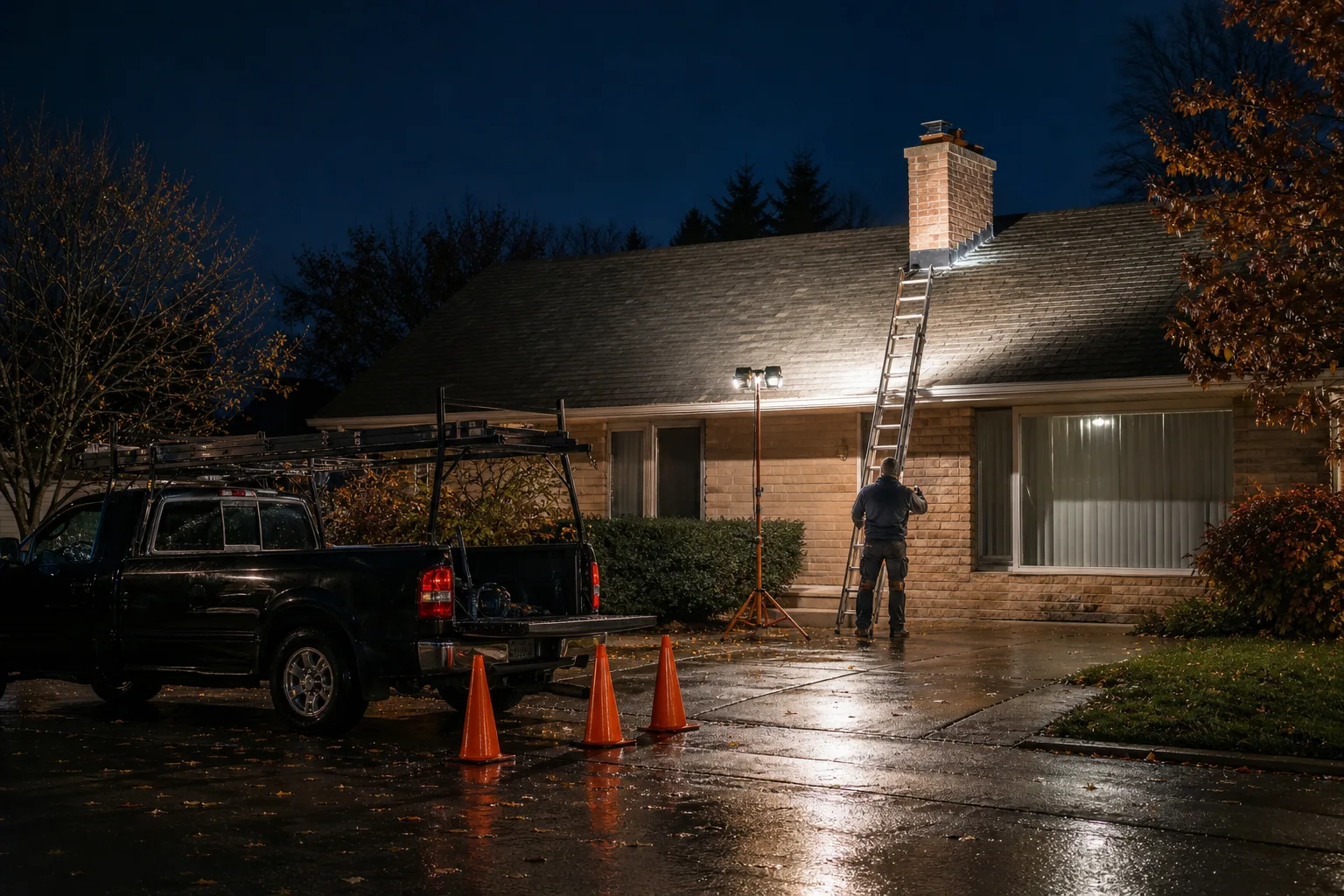
It is nine forty on a weeknight, the fire was going fine an hour ago, and now something is wrong. Smoke is drifting back into the living room instead of going up. Or the wind took something off the roof. Or the carbon monoxide alarm in the hallway is screaming and the only thing burning in the house is the fireplace. You are standing up with your phone in your hand, looking for an on duty chimney company that will answer right now.
So here you are. Three words typed into a search box at the exact moment you least wanted to be doing research.
Here is the useful thing, and it is the reason to keep reading for another two minutes: most chimney problems are not tonight problems. A handful genuinely are, and you need to know which handful you are holding. This page gives you that triage, tells you exactly what to do in the first ten minutes, and explains what an on duty chimney service can and cannot actually do for you in the dark.
If you are reading this with smoke still in the room or an alarm still sounding, stop reading. Get everyone out and call 911. The rest of this will be here in twenty minutes.
What an On Duty Chimney Service Actually Means
Two very different searches land on this phrase, so let us separate them in the first thirty seconds.
The company that owns the name
On Duty Chimney is a real business. It operates out of Leominster, Massachusetts, at 493 Lancaster Street, it is veteran owned, and it has been BBB accredited since May 23, 2022. The company lists membership in the Massachusetts Chimney Sweep Guild and covers Worcester County and roughly two dozen surrounding towns, doing sweeps, inspections, masonry repair, liner and cap work, and stove installation.
If that is who you were looking for, go find them directly.
Everyone else, the phrase itself is worth taking apart.
What "on duty" should obligate a company to do
Plenty of chimney companies advertise 24/7. Very few explain what that buys you.
At the honest end, an on duty chimney company means a person picks up the phone after hours, listens to what is happening, tells you whether it needs a truck tonight, and sends one when it does. At the thin end, it means an answering service takes a message that somebody reads at eight the next morning.
Both run the same three words in their advertising. The difference only shows up when you call.
Good to know: A directory listing that says "open 24 hours" is not verification. Those hours are self reported, and plenty of businesses whose own websites publish no hours at all show up in directories as always open. Treat every 24/7 claim as a claim until you have tested it on the phone.
Tonight or Tuesday: A Ninety-Second Chimney Triage
This is the part you came for. Find your situation in the left column.
| What you are seeing or hearing | How urgent | What to do right now |
|---|---|---|
| Roaring or crackling from inside the chimney, dense smoke, flames or sparks at the top | Call 911 first | Everyone and every pet out of the house, then call from outside |
| Carbon monoxide alarm sounding, including a low battery chirp near a fireplace or stove | Tonight | Open doors, get outside, call the fire department, then a chimney company |
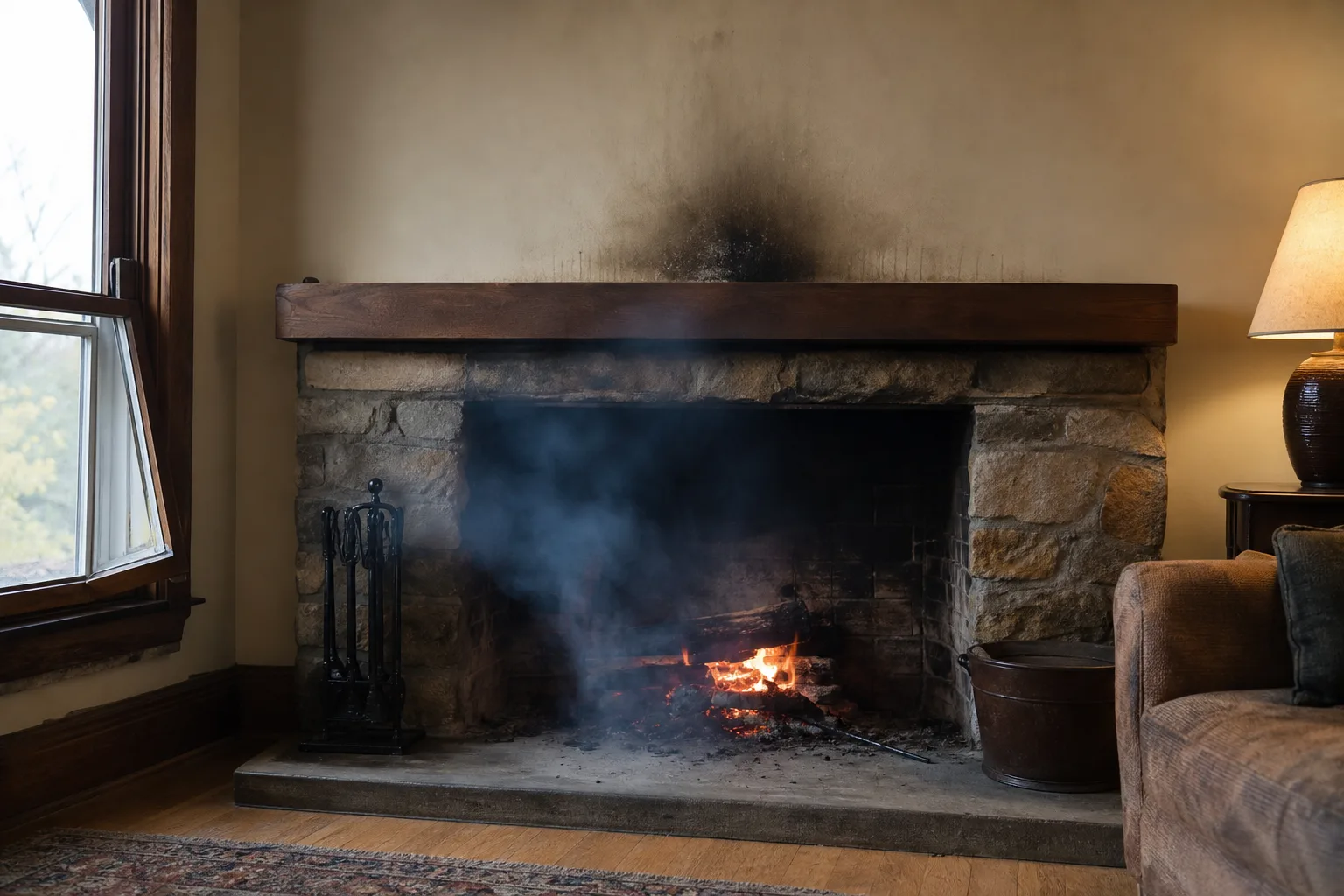
| Smoke pushing back into the room instead of drawing up | Tonight | Put the fire out, open windows, do not relight until someone has looked |
| Chimney leaning, brick or masonry chunks on the ground, a limb down on the stack | Tonight | Stay out from under it, keep people away from that side of the house |
| Water actively running into the firebox or staining the ceiling at the chimney | Tonight if it is running | Bucket it, kill any fire, call for a temporary cover |
| Cap blown off in a windstorm, tiles exposed at the top | Tonight if rain is coming, otherwise morning | Do not go up. Photograph it from the ground |
| Scratching, fluttering, or chirping inside the flue | Tonight | Do not light a fire, close the damper, call a company that handles animal removal after hours |
| Damper stuck open or shut, no fire burning | Morning or this week | Close the glass doors to cut the draft, book an appointment |
| Cracked crown, spalling brick face, washed out mortar joints | This month | Photograph it, get it looked at before heating season |
| Heavy glossy creosote found during a sweep | Before the next fire | Do not burn until it is cleaned or the liner is evaluated |
The ones that are tonight
The tonight list has one thing in common. Every item on it is either a fire, a gas, or a structure that could hurt someone in the next few hours.
A chimney fire is obvious. Carbon monoxide is not, and that is exactly why it belongs on the same line. A blocked flue stops combustion gases from leaving the house, and they come back in instead. The Consumer Product Safety Commission is blunt about this: a beeping CO alarm must never be ignored, including a low battery chirp, because either condition can mean the device is not protecting you.
Structure is the third one. If brick is on the lawn or the stack has shifted, the question is not whether the fireplace works. The question is whether something falls on somebody.
Animals belong on this list too, for a different reason. Companies that run night calls generally treat a live or dead animal in the flue as an after-hours call, because a blocked flue is a carbon monoxide problem before it is anything else.
The ones that are Tuesday
Nearly everything else. A stuck damper is annoying and it wastes heat, and it is not going to hurt you overnight if the fire is out. Spalling brick has probably been spalling for three winters, and a cracked crown will still be cracked on Tuesday.
There is a real cost to treating a Tuesday problem like a tonight problem, and it is not just the after hours rate. You make the decision in a hurry, from a list of whoever answered, instead of from a company you actually chose. Knowing which column you are in lets you call an on duty chimney company on your terms rather than theirs.
Safety note: Do not relight a fire to "see if it still smokes." If smoke came back into the room once, the flue is telling you something is in the way or the draft has failed. Lighting it again to test the theory fills the house with the same gases that pushed back the first time.
Need a chimney company on duty tonight?
Tell us what is happening and where you are, and we will match you with an independent chimney company in your area that takes after-hours calls. VIO is a referral network, not a chimney company, and we ask every company in the network to put its estimate in writing before any work starts. You should insist on exactly that.
Call (513) 655-6702
The First Ten Minutes, Before Anyone Arrives
Whatever is happening, you are going to be alone with it for a while. These are the moves that matter.
If you think the chimney is on fire
The sequence, in this order, from fire departments that publish it:
- Get every person and every pet out of the house. If the damper and the glass doors are right there on your way out, and closing them will not delay anybody, close them as you go. That starves the fire of air.
- Call 911 from outside, not from the kitchen.
- Do not go back in. Not for the damper, not for an extinguisher, not for anything.
A dry chemical extinguisher discharged from the firebox up into the chimney can help, and there are suppressant products made specifically for chimney fires. Both are options only while you are still on your way out, never a reason to re-enter the house.
And the one that gets people hurt:
Myth vs. fact: The myth is that you throw a bucket of water on it. The fact is that water hitting a chimney fire or a flare up in the grate can flash to steam and blow back into the room, and people are seriously injured that way. Never water. Air starvation and the fire department, in that order.
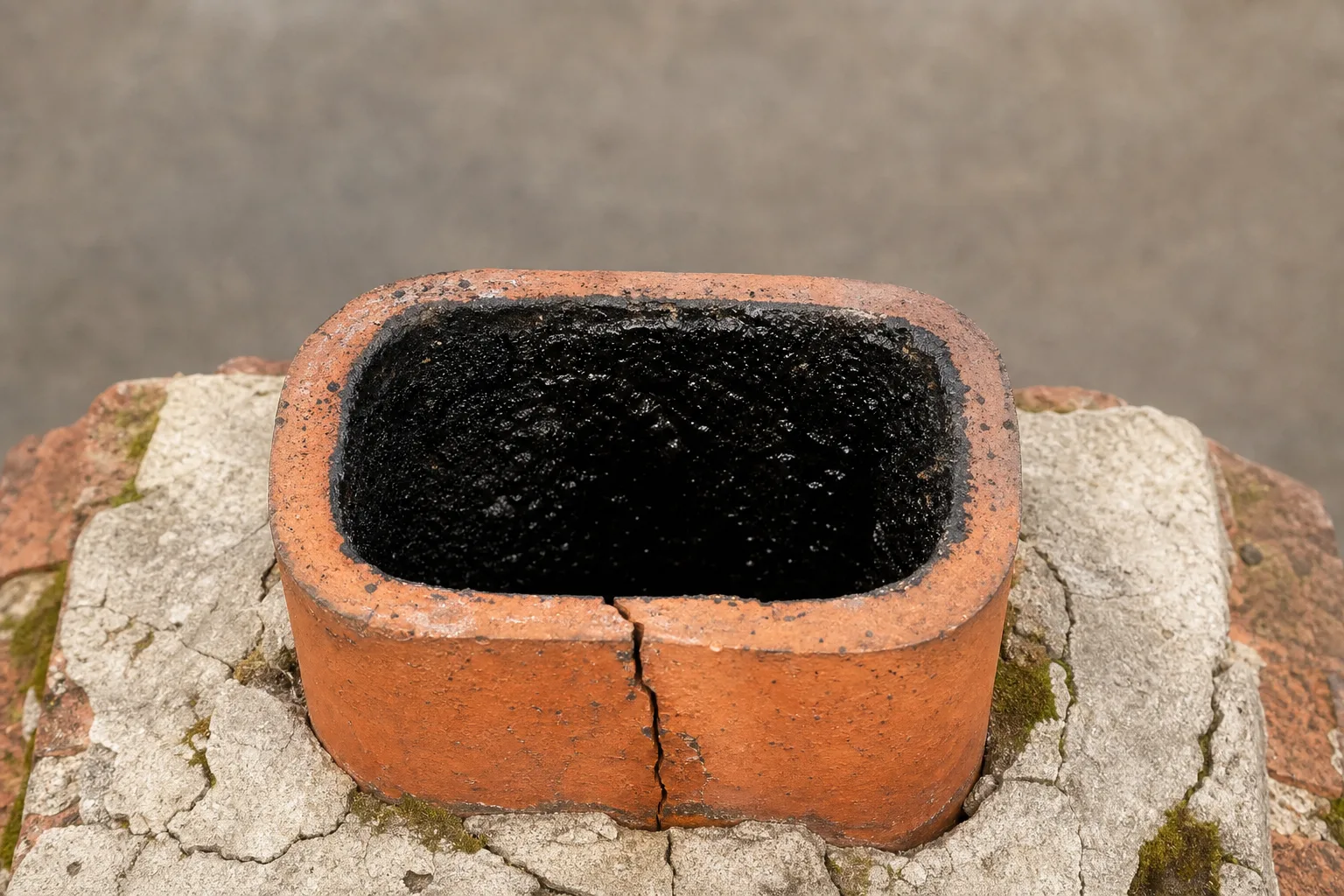
A chimney fire that appears to go out on its own is not a non event. It very often cracks clay tiles or damages the metal flue liner, and the damage is invisible from the room. That fireplace should not be used again until somebody has been inside the flue with a camera.
If the carbon monoxide alarm sounds
Doors and windows open, everyone outside, call the fire department. Do not spend ten minutes hunting for the source, and do not pull the battery to make it stop.
Once the house is clear, the chimney is a prime suspect if you have a fireplace, wood stove, or gas appliance venting through the stack. Nests built over spring and summer are among the most common blockages, and CPSC specifically calls out birds, animals, and insects as a cause.
If smoke is coming back into the room
Put the fire out. Open windows on two sides of the house to cross ventilate. Check the obvious first, which is whether the damper is actually open.
If the damper is open and it still smokes, something is restricting the flue, the draft has reversed, or the chimney is not drawing because of a blockage at the top. All three want eyes on the flue before the next fire.
If the storm took part of the chimney
Photograph everything from the ground. Not from a ladder, and absolutely not from the roof at night in the rain.
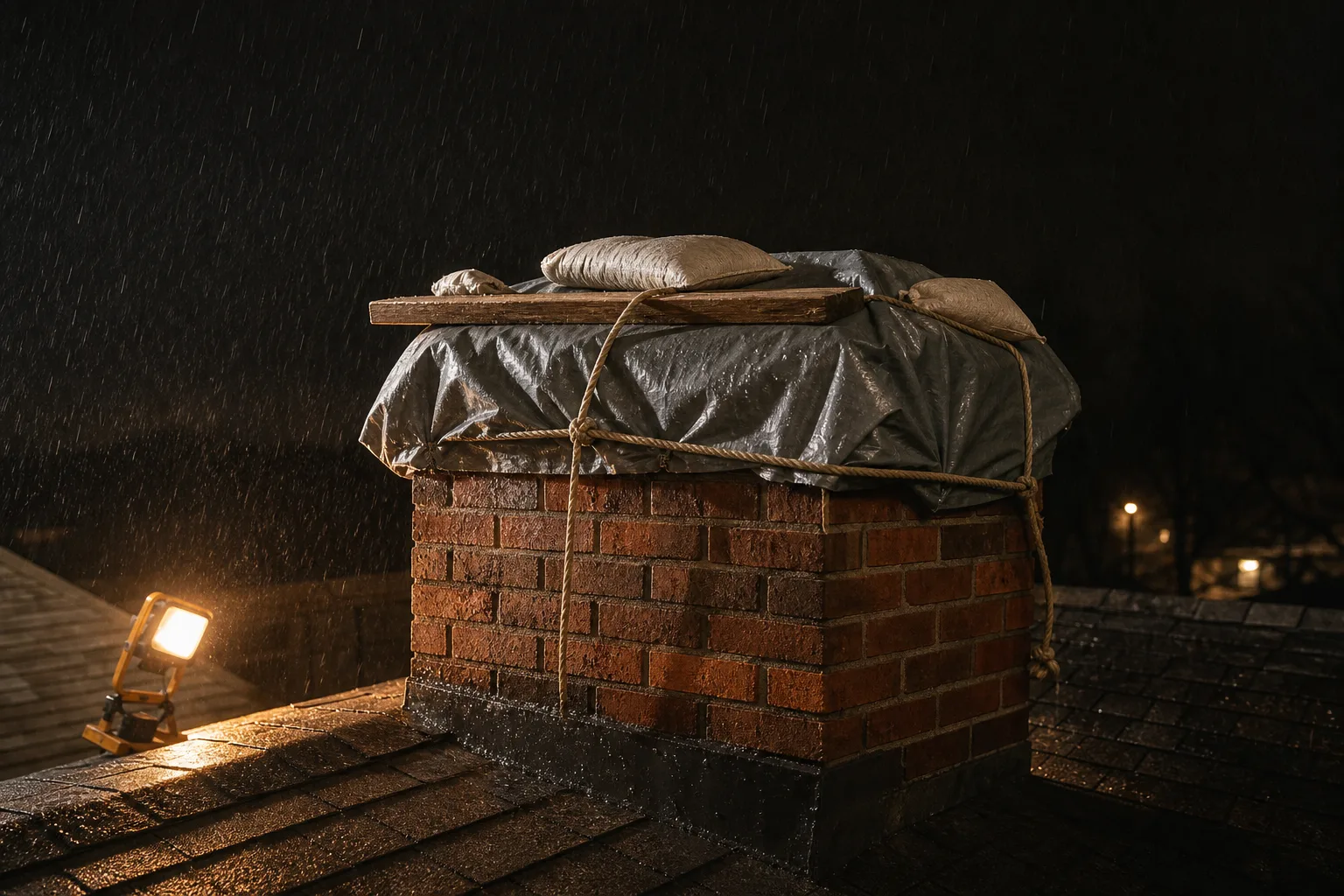
If the cap is gone and weather is coming, that opening is going to take water straight into the flue, and water in a masonry chimney is slow, expensive damage. That is a legitimate reason to want somebody tonight, and the real deliverable is a temporary cover until daylight.
What an On Duty Chimney Company Can Do at 10 p.m., and What Waits for Daylight
This is the expectation reset nobody puts in writing.
What the night visit is really for
A night call is about making the house safe, not fixing the chimney. Realistically: confirm there is no active fire, check the flue and firebox from inside with a light or a camera, stop water from coming in, clear a reachable obstruction, and tell you plainly whether the appliance can be used.
That is a real service and it is worth the call. It is just not a repair, and an on duty chimney service that is straight with you will say so before it sends anyone.
Why nobody goes up a wet roof in the dark
Because it is how people die, and because any company willing to do it is telling you something about how it makes decisions.
Masonry work needs daylight, dry conditions, and usually temperatures above freezing for mortar to cure. A company that promises to rebuild your crown at eleven at night is either not going to show up or not going to do it right.
From the field: What surprises people most on a night call is how much of it is talking. A good pro spends real time at the firebox with a flashlight, then explains what they found, what they did not find, and which parts have to wait for daylight.
How to Tell Whether a 24/7 Claim Is Real
You can sort this out on the phone before anyone gets in a truck. Here is the checklist.
Three questions to ask an on duty chimney company on the phone
- Who am I talking to right now, a technician or an answering service? Not a trick question and not rude. If it is a service, ask when a technician will call back, and get a time.
- What will you actually do tonight, and what waits for daylight? A company that answers this one specifically is a company that has done it before. Vagueness here is the tell.
- Will I get the estimate in writing before any work starts? Ask it out loud, on the first call, every time.
- Are you licensed and insured in this state, and can you send proof? A legitimate company sends a certificate of insurance without drama.
- Is anyone on the crew CSIA certified? Worth asking. It is not the only credential that counts, but it is the most portable one.
The credentials that mean something
The Chimney Safety Institute of America, based in Plainfield, Indiana, runs the Certified Chimney Sweep credential. Getting it means passing a written exam and signing on to a code of ethics, and certified sweeps are tested on the three inspection levels that NFPA 211 defines.
State licensing varies enormously, so find out what yours actually requires. Insurance does not vary. Anyone climbing on your roof should carry general liability and workers compensation, and should be able to prove it in an email.
Pro tip: Ask the estimate-in-writing question before you describe the problem in detail. You learn more from how a company answers a procedural question cold than from how it responds once it knows there is a job on the table.
After the Emergency: The Inspection Most People Skip
The fire department leaving is not the end of a chimney fire. It is the middle.
Why NFPA 211 calls for a Level 2
NFPA 211 defines three levels of chimney inspection, and the difference matters here.
Level 1 is the basic visual inspection, appropriate when nothing about the system has changed and nothing has gone wrong. This is the annual maintenance check.
Level 2 includes everything in a Level 1 and adds the accessible parts of attics, crawl spaces, and basements, and it may include a video scan of the inside of the flue. A Level 2 is required at sale or transfer of the property, when the system changes (a new appliance, a different fuel), after a malfunction, after a chimney fire, and after an external event such as a storm.
Level 3 opens up concealed areas and sometimes removes parts of the structure. It is only called for when a Level 1 or 2 finds something that cannot be evaluated any other way.
Read that Level 2 trigger list again. Three of those triggers, a malfunction, a chimney fire, and an external event such as a storm, describe the exact situations that make people search for help at night. If an on duty chimney company came out for an emergency and never mentioned a Level 2, that is a conversation to go back and have.
What should be in the report
A written report, not a verbal summary in the driveway. It should say what was inspected, what condition each part was in, photographs or video stills of anything that was called out, and a clear statement of whether the appliance is safe to use.
If the answer is not safe to use, it should say specifically what has to be repaired first. That sentence is what your insurance company will want.
Good to know: The crown, the cap, and the flashing are the three parts most often damaged by the same storm that made you call at night, and they are also the three cheapest things to fix before they let water into the masonry. A cracked crown looks like a hairline nothing from the ground. It is the reason the mortar joints twenty feet below it are failing.
The prevention version of all this is unglamorous and it works. An annual inspection before heating season, and dry seasoned firewood instead of anything green.
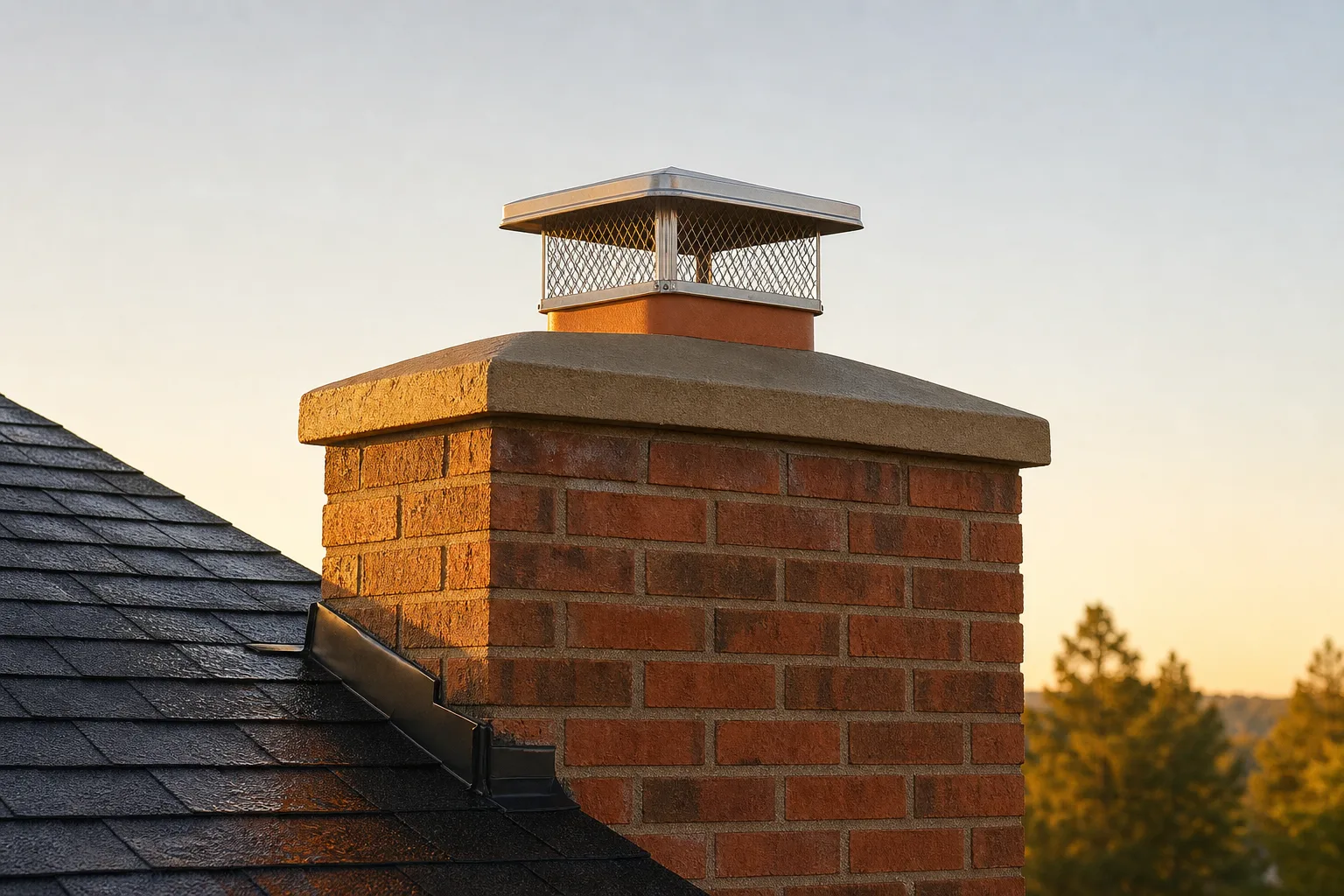
The third piece is a cap with intact mesh on top, which keeps rain and animals out of the flue and catches sparks on their way to the roof.
CPSC recommends a yearly professional check of every fuel-burning appliance that includes the chimney, flue, and vents for leakage, blockage, and loose or disconnected sections.
Most night emergencies were visible in September.
How VIO Helps You Reach an On Duty Chimney Company
Here is what we are, said plainly, because you have every reason to be skeptical of anybody answering this search.
VIO is a referral network. We are not a chimney company, we do not own trucks, and nobody on our payroll is going to show up at your house. What we do is match you with independent chimney companies that work in your area, including ones that take after-hours calls. We ask every company in the network to carry current licensing and insurance, and you should ask to see the proof yourself before anyone starts work.
You describe what is happening. We point you at a company that handles that specific thing, in your specific place, at the hour you are actually calling.
A national outfit that claims to do the work everywhere is usually subcontracting anyway, and just not saying so. We say so up front, which means you can check the company yourself before it arrives.
On the estimate: we ask every company in the network to put its estimate in writing before any work starts, and you should insist on exactly that. Not because the trade is dishonest, but because a written scope is the only thing that makes two quotes comparable, and because the worst version of a night call is the one where nobody wrote anything down.
We also tell people the unprofitable thing when it is true. If what you have described sounds like a Tuesday problem, we would rather say so and match you with a good local company for a normal daytime appointment than send someone out at midnight for a stuck damper. An on duty chimney service that talks you out of an emergency call is doing its job.
So use the triage above first. Either way, the call is the same call. Describe the problem, find out whether it needs a truck tonight, and get matched with an on duty chimney company that will actually answer when it does.
Get matched with a chimney company that answers
Whether it is tonight or Tuesday morning, describe the problem and we will point you to an independent chimney company near you. Ask for proof of license and insurance before any work begins.
Call (513) 655-6702
Symptom checker
What is your chimney doing?
Tap the closest match for an honest first answer.