


On this pageAn Outdoor Fireplace Is a Small Building, Not a Patio Accessory9 sections+8
- An Outdoor Fireplace Is a Small Building, Not a Patio Accessory
- Outdoor Fireplace Builders: The Four Trades That Will All Say Yes
- Prefab Kit, Modular Firebox, or Full Custom Masonry
- Permits, Code, and the Rules That Govern Your Stack
- How to Vet Outdoor Fireplace Builders Before You Sign Anything
- What a Real Quote Contains
- What You Own the Day the Builder Leaves
- How VIO Helps You Find Outdoor Fireplace Builders
- The Short Version
Quick answer
Outdoor fireplace builders come from four different trades: masonry contractors, landscape and hardscape companies, outdoor-living design-build firms, and fireplace retailers. All four will take the job, but they are not interchangeable. A masonry contractor builds the footing, firebox and flue itself, while the others often subcontract that part. Before hiring, confirm who builds the firebox, who pulls the permit, and whether the written quote states footing depth, firebrick and refractory mortar.
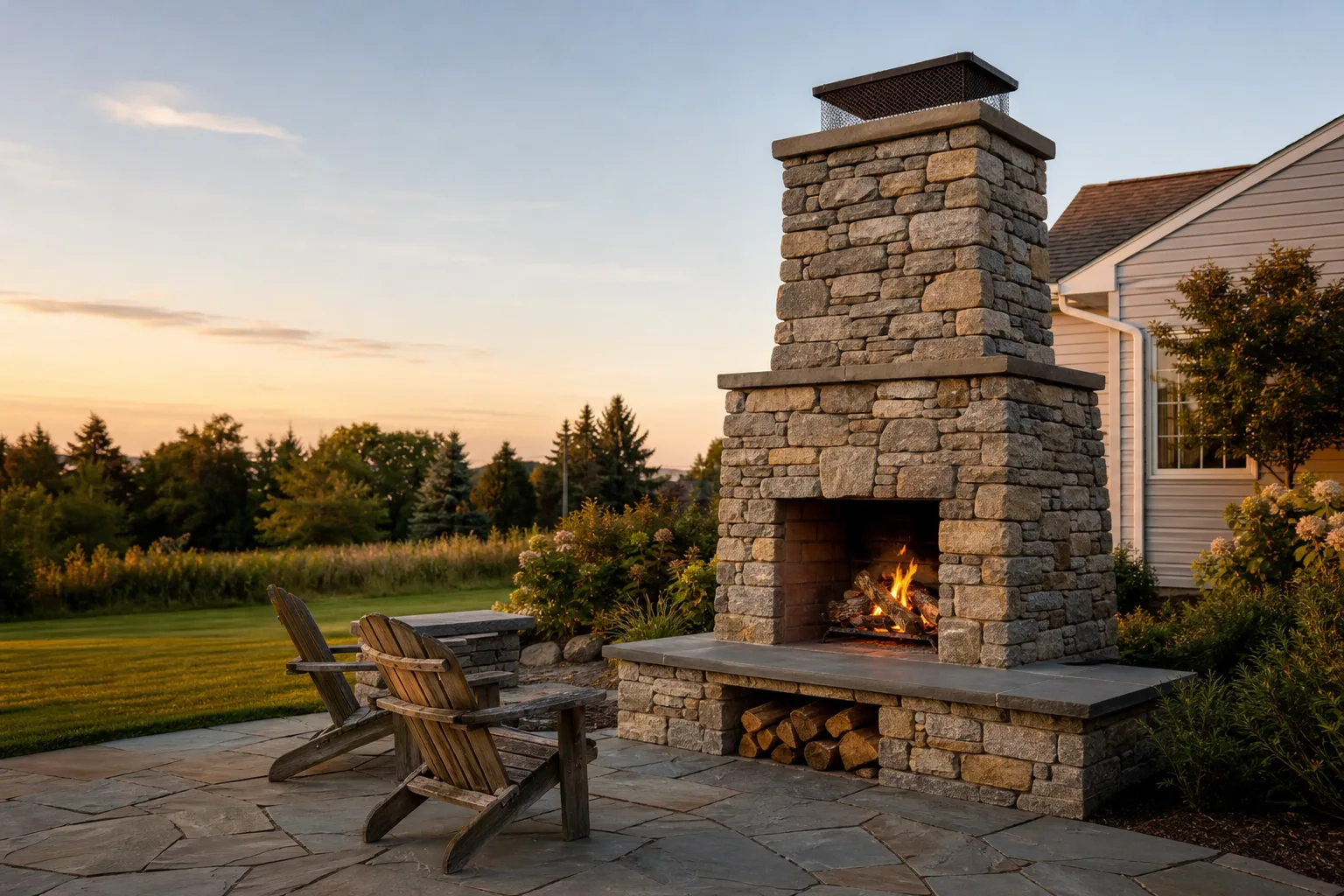
You saved the photo months ago. A stone fireplace at the edge of a backyard, fire going, two chairs pulled up close. This afternoon you finally walked out with a tape measure and held it against the corner where it would go.
And somewhere in those ten minutes it landed on you: the thing in that photo is not furniture. It is masonry, on a poured footing, with a firebox and a real chimney on top. Somebody has to build it, and you have no idea who.
So you searched for outdoor fireplace builders, and page one handed you nine contractors and an encyclopedia entry.
Every one of those nine pages argues that you should hire that company. Not one tells you the thing you need first: a mason, a landscaper, a design-build firm and a fireplace shop will all say yes to this job, and they do not produce the same result.
That is the gap this guide fills. Which trade belongs on your project, what the building department wants, how to vet outdoor fireplace builders before you hand over a deposit, and what you own the day the crew drives away.
Start with the structure, because the structure explains everything else.
An Outdoor Fireplace Is a Small Building, Not a Patio Accessory
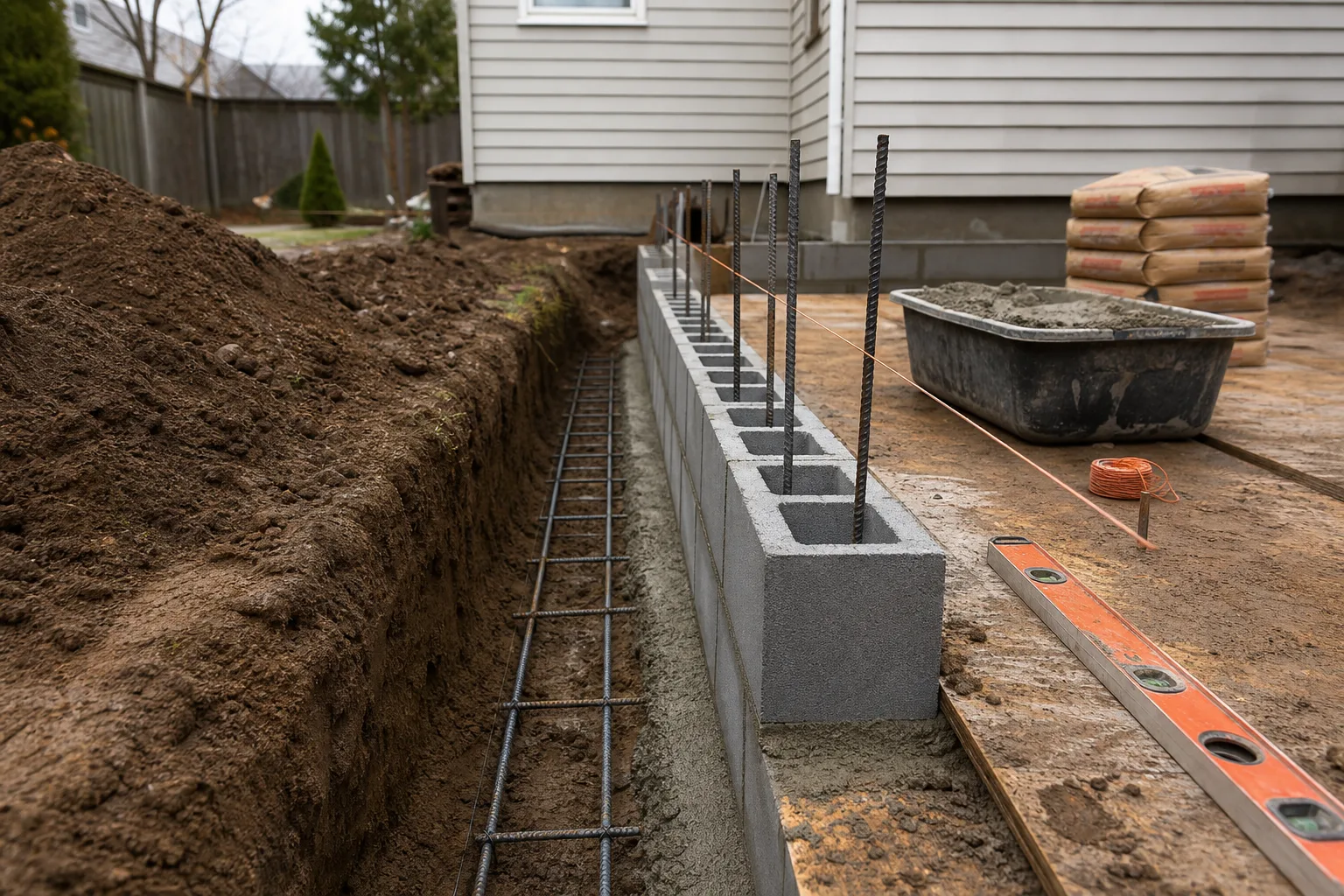
Everything you are about to decide gets easier once you understand that this is construction, not landscaping with a fire in it.
It starts underground, with a concrete footing. In climates that freeze, that footing goes below the local frost line, because ground that freezes and thaws lifts whatever sits on it. In warm zones, a reinforced slab on compacted gravel, commonly six to eight inches, does the job instead.
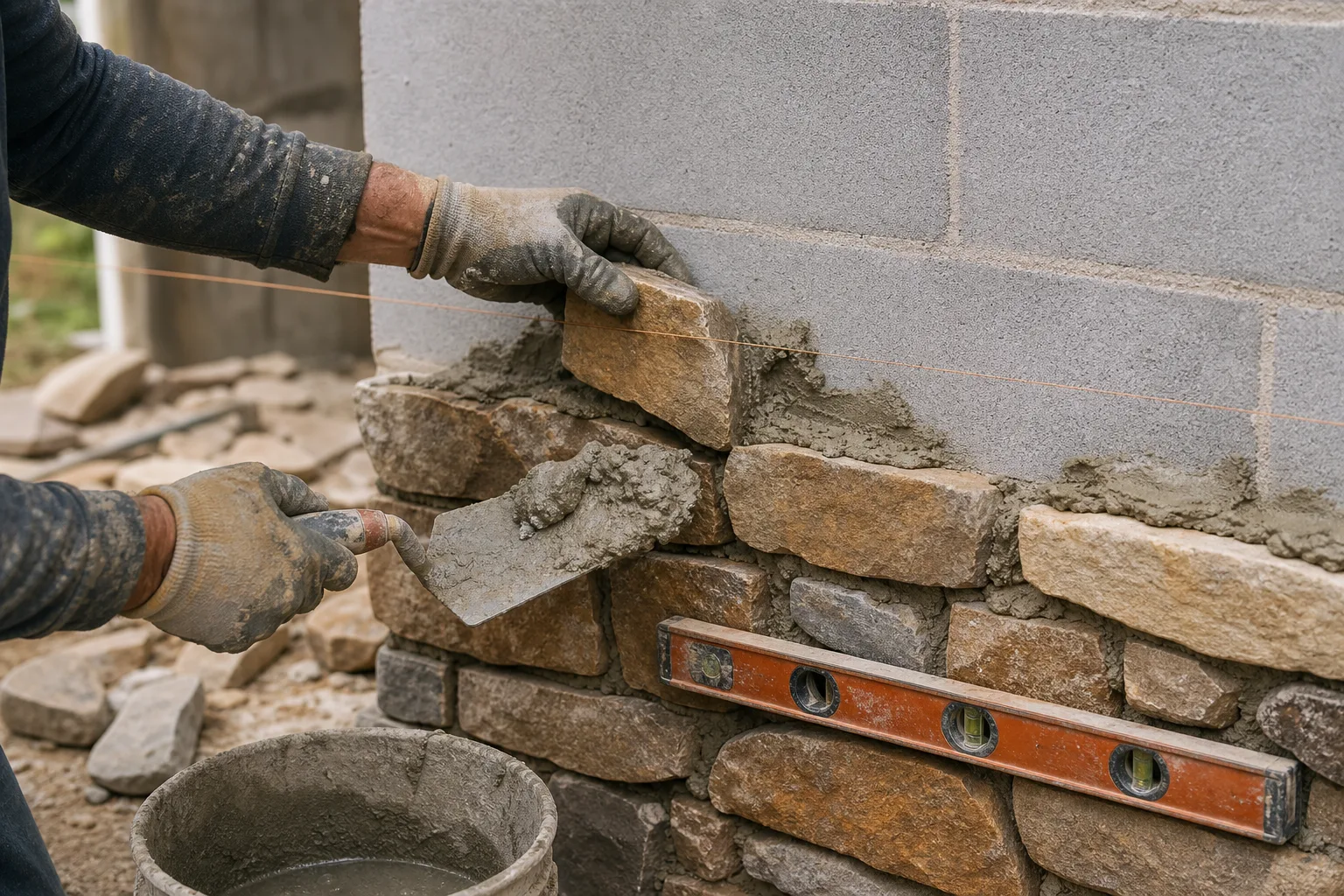
On top goes the core, usually concrete block with steel reinforcement. The crude gray skeleton nobody photographs, and what decides whether the fireplace is still standing straight in fifteen years.
Inside the core sits the firebox, and the firebox is where amateurs get found out. A proper firebox is lined with firebrick, a refractory ceramic, laid with high-temperature refractory mortar. Standard masonry mortar does not belong inside a firebox. It will not survive the heat.
Good to know: If a builder describes the firebox and never says "firebrick" or "refractory mortar," ask a follow-up question. Those two materials separate a firebox that lasts from one that starts shedding in a few seasons.
Above it sit a lintel, the throat, the smoke shelf, and the smoke chamber, a tapered space funneling the firebox down to a much smaller flue. That taper is supposed to be parged, coated smooth with refractory mortar, so smoke moves instead of tumbling. If you want the physics behind that, it is the same draft that makes a chimney work at all. Get it wrong and the fireplace smokes at you all evening.
Then the stack, the crown that sheds water off the top, and the cap. The liner inside is usually clay tile on a masonry build. Last comes the part you actually see: fieldstone, limestone, bluestone, brick or cast stone, set in polymer-modified mortar.
Most of what you are paying for is invisible in the finished photograph. That is the most useful thing to carry into a first conversation with outdoor fireplace builders, and it is why the trade you hire matters more than the stone you pick.
Outdoor Fireplace Builders: The Four Trades That Will All Say Yes
Four different kinds of company build these, and almost nobody explains the difference to homeowners before the calls start. This is the part that paralyzes people. Not "should I build one." Who do I even call.
| The trade | Best at | Usually subcontracts | Best fit for |
|---|---|---|---|
| Masonry contractor | Footing, block core, firebox, flue, stack. The parts that have to be right. | Patio work, planting, lighting, drawings. | A full custom build, especially a tall stack or an awkward site. |
| Landscape / hardscape company | Fitting the fireplace into a patio: grading, drainage, seat walls, the whole outdoor room. | The firebox and flue, often to a mason. Ask who. | A fireplace going in as part of a larger patio project. |
| Outdoor-living design-build firm | One point of responsibility. Drawings, permits, scheduling every trade. | Most of the trade work, by design. That is the model. | Kitchen, pergola, lighting and fireplace together. |
| Fireplace and hearth retailer | Appliance knowledge. Gas versus wood, prefab units, venting specifics. | The masonry surround and site work. | A prefab or modular firebox in a finished surround. |
None of these is the wrong answer. They are wrong answers for the wrong project.
The trap is the middle two rows. A landscape company or a design-build firm can be excellent and still hand your firebox to a subcontractor you never met. That is not dishonest, it is how the industry works. But you should know it is happening, and you are allowed to ask who the sub is.
Here is what nobody tells you: Run the search and look at what comes back. Masons, landscapers, design-build outfits and a hearth retailer, all on one results page. Not one of those pages mentions that the others exist, or that they are a different trade.
So when you start calling outdoor fireplace builders, the first question is not price or timeline. It is: which of those four rows are you, and who does my firebox?
Not sure which trade you need?
Tell us what you want on your patio and we will match you with outdoor fireplace builders in your area who actually do this kind of work, rather than a company that will hand it to someone else. We ask every company in the network to put its estimate in writing before any work starts, and you should insist on exactly that.
Call VIO CHIMNEY at (513) 655-6702, or request service online.
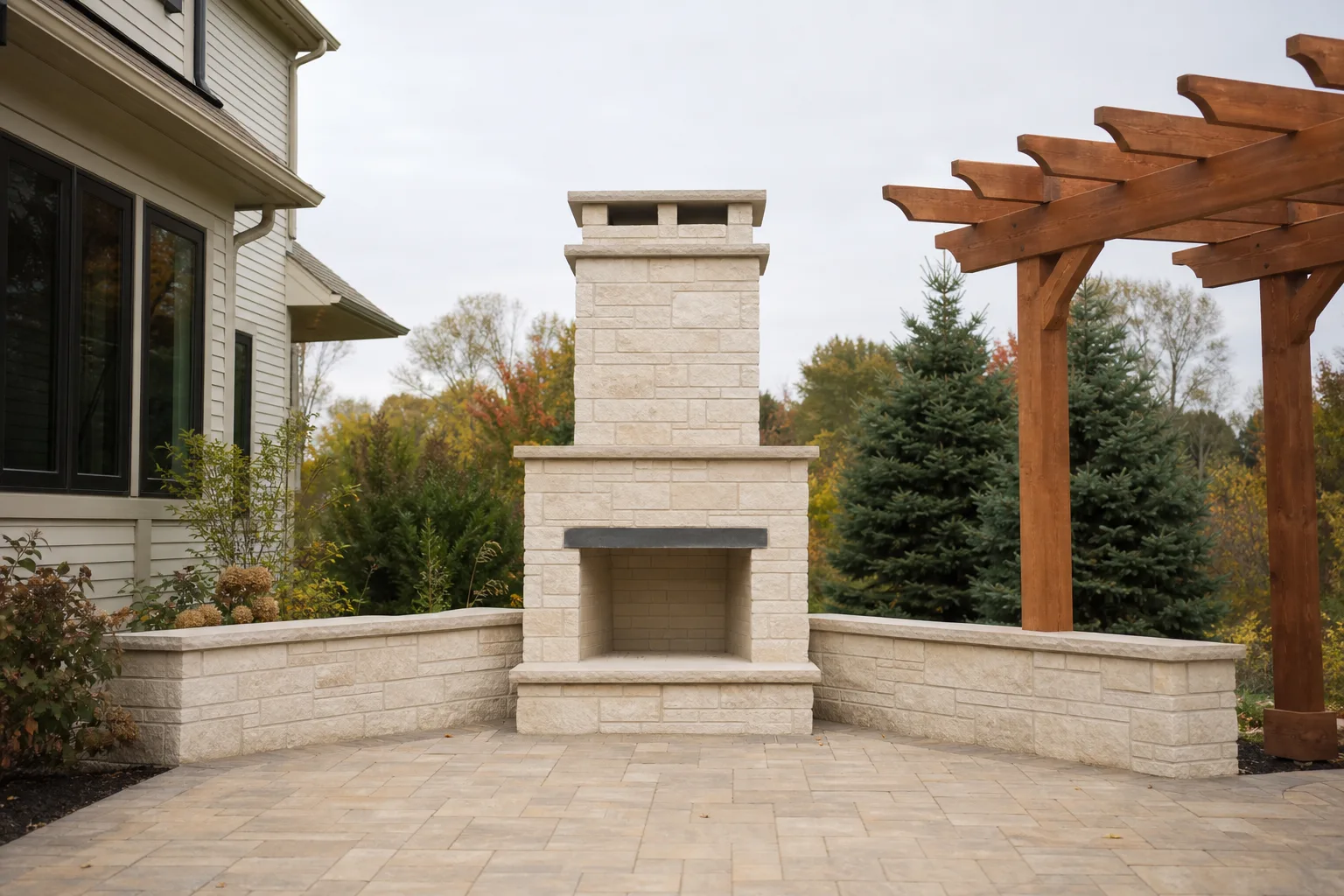
Prefab Kit, Modular Firebox, or Full Custom Masonry
Three build paths, three different projects, and the words people use for them overlap enough to cause real confusion.
The prefab kit path
A manufactured unit, often modular pieces that assemble on site. It can sit on an existing patio slab if the slab will carry the weight, which is a real question and not a formality. Fastest, simplest, least room for a builder to get it wrong. The tradeoff is that you get what the manufacturer designed, with size and firebox dimensions set.
The modular firebox with a masonry surround
A manufactured firebox and flue system, clad in stone or brick by a mason so the finished thing reads as custom. The combustion engineering comes from a manufacturer with listings and instructions, the look comes from a person with a trowel.
This one needs the two trades to talk. The mason has to build to the manufacturer's clearance specifications, not to habit.
The full custom masonry build
Everything from the footing up, on site, to a design made for your patio. It is a small construction project, with a permit, an inspection and a schedule.
Now, money, and here is where I am going to disappoint you.
These three paths are nowhere near each other in cost. A prefab unit and a full custom masonry build are different kinds of expense, and the gap between them is wide enough that choosing between them is usually a budget decision before it is a taste decision.
What I will not do is hand you a national price range. The guides that publish one contradict each other badly, and averaging contradictory numbers does not produce a fact.
Get three local quotes from outdoor fireplace builders who work in your market. That is the only number that will ever be true for your patio.
Myth vs. fact: The encyclopedia entry at the top of this search says outdoor fireplaces are "usually used for cooking." Look at what the builders on that same page sell. It is a heat-and-gather feature for a patio. Pizza ovens exist and people love them, but they are an add-on you choose, not what the category is for.
Whichever path you pick, the building department has opinions about it.
Permits, Code, and the Rules That Govern Your Stack
A wood-burning outdoor fireplace is a solid-fuel appliance with a chimney, so code applies to it. Gas units are a different animal, with their own listings and requirements, and what follows is written for the masonry, wood-burning kind. Either way, not one page ranking for this search mentions code at all.
In the United States, masonry fireplaces and chimneys fall under Chapter 10 of the International Residential Code, with chimneys and vents in Chapter 18. NFPA 211 applies as well, and factory-built high-temperature chimney pipe is listed to UL 103 HT.
The 3-2-10 rule. A chimney has to extend at least 3 feet above the point where it penetrates the roof, and at least 2 feet higher than any roof surface within 10 feet horizontally. On a patio build this often controls the stack height if it sits near the house or under an overhang.
Clearance to combustibles. A masonry chimney inside the building or within an exterior wall needs a minimum 2 inch airspace to combustibles, and one entirely outside the exterior walls needs 1 inch. Combustible framing cannot sit within 2 inches of the outside back or side of a masonry fireplace, including the smoke chamber, and no less than 6 inches from the inside surface of the nearest flue lining.
Hearth extension. For fireplaces generally, code calls for not less than 16 inches in front of the opening and 8 inches beyond each side, going to 20 and 12 where the opening is 6 square feet or larger. Whether and how that carries over to an outdoor build is decided by your local authority, so ask rather than assume.
Safety note: Those numbers are not aesthetic preferences. They are why a stack ends up the height it does, and why a pergola post cannot go where you might want it. A builder who treats clearance as negotiable has told you what kind of builder they are.
Permits and inspections are required for permanent installations, and the specifics belong to your local authority. Which edition of the code applies to your property is genuinely a local question. Different jurisdictions adopt different editions, and those editions are not identical.
Call your building department, or hire a builder who will.
A contractor working properly follows a recognizable sequence: zoning verification against your property lines, a site plan showing where utility lines run, the permit, and a final safety inspection.
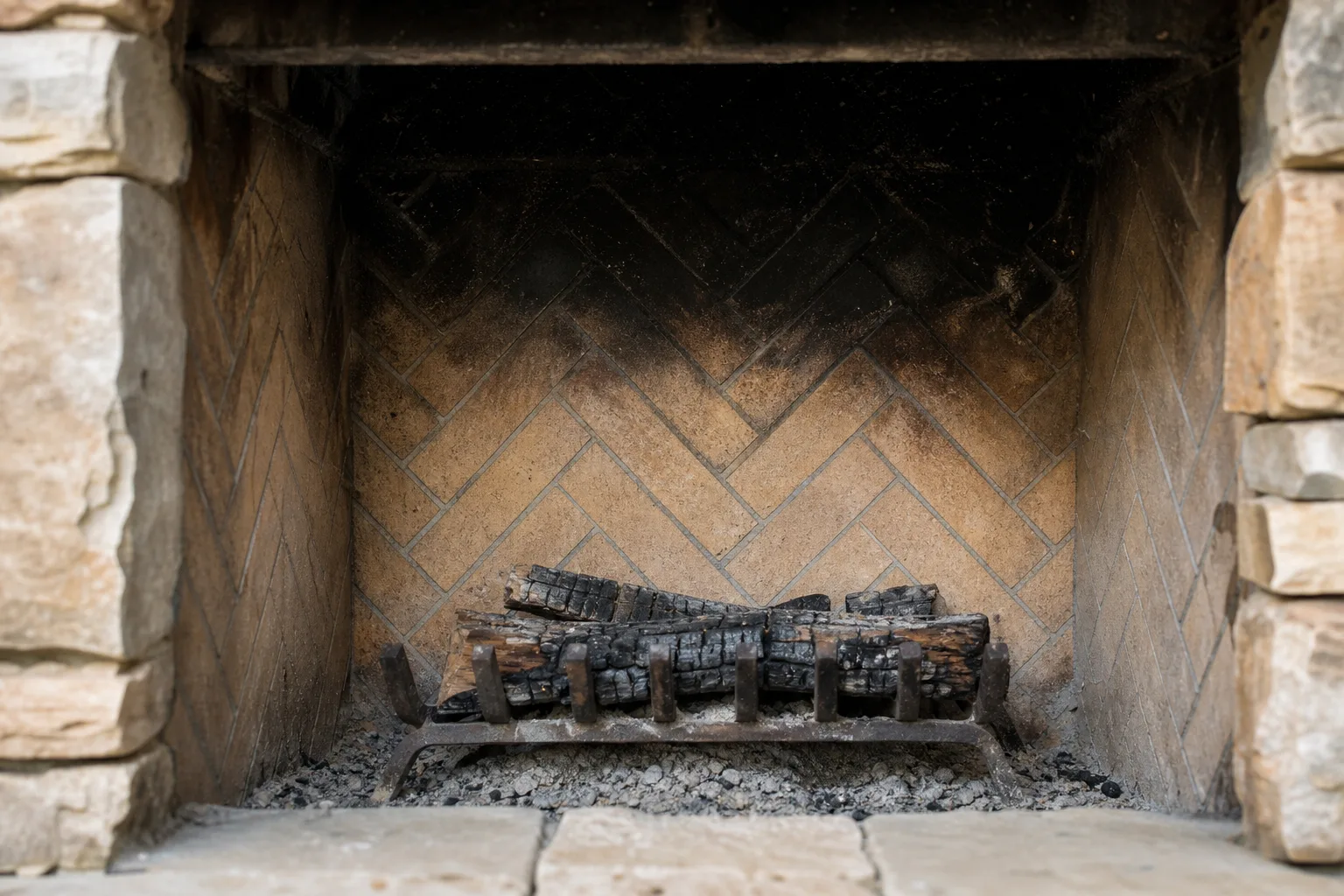
How to Vet Outdoor Fireplace Builders Before You Sign Anything
Vetting is not about finding the nicest person who returns calls. It is about confirming that whoever builds your firebox and flue has done it before, carries the paper to be there, and will still exist if something cracks next winter.
Start with what every trade source agrees on: licensed, bonded, and insured. Ask for the certificate, not the claim.
Then look for hearth-specific credentials. The most widely recognized certification in North America for this work is National Fireplace Institute certification, in three specialties: Gas, Woodburning and Pellet. Not a universal requirement for masonry, but a company that holds it has put people through testing on combustion and venting, not only on stone. It is the same credential worth looking for when you later hire chimney specialists for the maintenance side.
Questions to Ask Outdoor Fireplace Builders on the First Call
Take this list to every company you speak with. The value is in asking all of them the same thing.
- Which of the four trades are you, and how many outdoor fireplaces did your crew build last year?
- Who builds the firebox and flue, your people or a subcontractor? If a sub, who?
- How deep does the footing go on my property, and how did you arrive at that depth?
- What lines the firebox, and what mortar goes with it?
- Is the smoke chamber parged?
- Who pulls the permit?
- How do you set the stack height, and what happens if the inspector disagrees?
- Can I see two builds you finished at least three years ago?
- What goes in writing before any work starts, and what is excluded?
- Who do I call in two years if a joint opens up?
What Good Answers Sound Like
Specific, fast, and occasionally a correction of your question. A real fireplace mason names the frost depth for your county without looking it up, says firebrick and refractory mortar unprompted, and has an opinion about your proposed location that you did not ask for.
Hesitation on the firebox question is the one to watch. Everything else can be looked up. That one is either their trade or it is not.
Walk Away When You Hear This
Reluctance to name the subcontractor. "We don't usually pull permits for these." A portfolio with no build-in-progress photos. A refusal to put scope in writing until you pay something. Pressure attached to a price that expires.
Pro tip: The trade's own standard advice is to get quotes from at least three builders. The reason is not haggling, it is calibration. Three answers to the same ten questions show you quickly which company does this work, and one of the three usually tells you something the other two would rather you did not know.
What a Real Quote Contains
Three outdoor fireplace builders will price the same patio three different ways, and the cheapest number is frequently the one with the least written underneath it. Read for line items, not for the total.
- Excavation and footing, with a depth stated and a reason for it, whether that is your local frost line or an engineered slab spec.
- The core, meaning block and reinforcement, not just "masonry."
- Firebox materials, named. Firebrick, refractory mortar.
- Flue and liner, size and type, and whether the smoke chamber is parged.
- Crown and cap, with slope and drip edge called out.
- Veneer and hearth, the actual material and mortar type, and who selects it.
- Permit responsibility, inspection scheduling, and cleanup.
- Payment schedule, tied to milestones rather than dates.
- Warranty, with a duration and a definition of what it covers.
- Exclusions, written down. This is the section that prevents arguments.
From the field: The line items a quote leaves out tend to be the ones that turn into change orders later. Nobody sets out to write a sneaky estimate. The parts nobody mentioned during the friendly patio conversation are just the parts that resurface once the trench is open.
Picture a homeowner with a sloped backyard collecting two quotes. One says "fireplace, stone, one number." The other spends half a page on drainage and how the footing steps down the slope. The second is higher, and it is the only one that has looked at the yard.
Good to know: A quote that is one number and one sentence is not a quote. It is a hope with a dollar sign on it.
Then the last truck pulls out of the driveway, and the thing is yours.
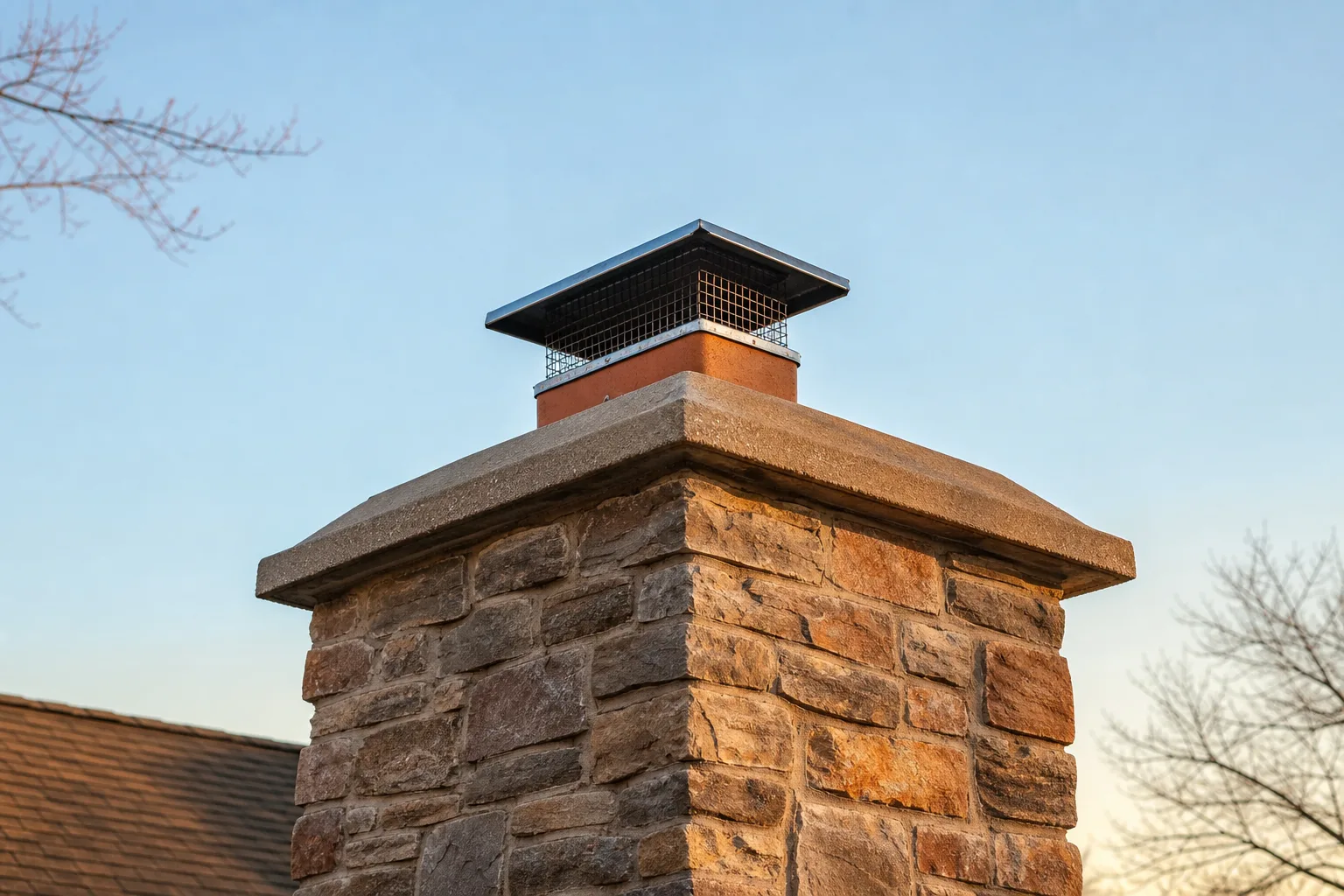
What You Own the Day the Builder Leaves
You own a chimney. That is the part nobody mentions while they are selling you the build.
An outdoor fireplace weathers harder than an indoor one, and it is not close. Indoor masonry lives in conditioned air. Yours sits out in rain, sun and freeze-thaw all year, with no roof over it.
So the mortar joints on the stack are on a clock, and chimney mortar repair comes around sooner outdoors than it does indoors. The crown takes the worst of the water and is usually first to crack.
The veneer wicks moisture and shows efflorescence, that chalky white streaking, which is one of the things masonry cleaning is for.
The cap matters more than people expect, and it is worth understanding what a chimney cap actually does before someone tells you it is optional. A drip edge and a mesh spark arrestor keep rain out of the flue and embers off the roof. A missing cap sends water straight down a masonry flue, the fastest way to ruin the inside of something you just paid to build.
A solid-fuel flue also needs sweeping on a schedule, same as the one in your living room. How often you should clean your chimney depends on how much you burn, but creosote does not care that the fire was outdoors.
Here is what nobody tells you: The companies competing for this search write beautifully about the build and say almost nothing about the decade after it. Not a conspiracy. Building and maintaining are different trades, and the builder's job ends at the final inspection. Yours does not.
On the inspection side: NFPA 211 requires a Level 2 inspection at the sale or transfer of a property, on any system change, on malfunction, after a chimney fire, and after an external event such as a storm. Adding a fireplace and flue is the kind of system change that language covers.
None of that is a reason to hesitate. It is a reason to hire someone who builds a crown correctly the first time.
Which is where we come in.
How VIO Helps You Find Outdoor Fireplace Builders
Plainly: VIO CHIMNEY does not build outdoor fireplaces. We are a referral network, connecting homeowners with independent local companies that do this work. Those companies, not us, do the building.
What that solves is the sorting problem this guide has been about. Instead of a results page where a mason, a landscaper, a design-build firm and a hearth retailer all look identical, you describe your patio and we point you toward outdoor fireplace builders in your area whose actual trade is this kind of construction.
We ask every company in the network to put its estimate in writing before any work starts, and you should insist on exactly that. Written scope, written exclusions, written payment schedule. If a builder resists, that is information.
We can also help at the other end, the part the builders do not cover: sweeping, crown and cap work, and inspections on the chimney you are about to own.
Call VIO CHIMNEY at (513) 655-6702 to get matched with outdoor fireplace builders near you.
Start with one conversation, not ten
The trade's own advice is to talk to at least three builders. Doing that cold is a lot of phone tag and voicemail. Tell VIO CHIMNEY what your patio looks like and what you have in mind, and we will point you toward local companies that build outdoor fireplaces for a living. Keep the question list above and use it on every one of them.
Call (513) 655-6702, or request service online.
The Short Version
The footing, the block core and the firebox are most of the cost and none of the photograph. Work out which of the four trades your project needs before you call anyone, because all four will say yes.
Ask about the permit, the frost depth, and what lines the firebox. Those three questions separate qualified outdoor fireplace builders from hopeful ones faster than anything else you can do in five minutes.
Get three quotes, read them for line items instead of totals, and treat the exclusions as the most important paragraph in the document.
Then plan for the chimney you will own afterward, because the fire is the easy part and the masonry is the part that has to last.
Symptom checker
What is your chimney doing?
Tap the closest match for an honest first answer.