



On this pageWhat a Smoke Chamber Is, and What Goes Wrong Up There7 sections+6
Quick answer
Smoke chamber repair restores the tapered masonry cavity above your fireplace damper, usually by parging: coating the interior smooth with refractory mortar meeting ASTM C199. Smoothing the stair-stepped corbeled brick cuts turbulence, improves draft, and removes the ledges where creosote collects. NFPA 211 calls for smoke chamber surfaces to be parge coated smooth. The work ranges from hand-troweled parging to a full rebuild, and it is a job for professionals.
Smoke Chamber Repair: What You Are Actually Being Sold, and How to Know It Is Right
A chimney sweep knelt on your hearth, aimed a flashlight up past the damper, and told you the smoke chamber needs work. Then came a number. If you went looking for information about smoke chamber repair an hour later, you are not trying to find out what a chimney is. You are trying to work out whether you are being told the truth by the only person in the room who could see the problem.
That is a reasonable thing to want, and almost nothing written on this subject helps you get it.
Most pages about this part of your fireplace stop at a definition and a phone number. The smoke chamber sits above the damper, they say, and parging fixes it. What they leave out is that "parging" covers three genuinely different jobs at three very different scales, and the gap between them is where homeowners lose money.
So here is the plan. By the time you reach the bottom of this page you will know which of those three repairs you are being quoted, what separates them, what actually drives the price, and the specific things you are entitled to ask to see before you approve anything.
What a Smoke Chamber Is, and What Goes Wrong Up There
Where the smoke chamber sits
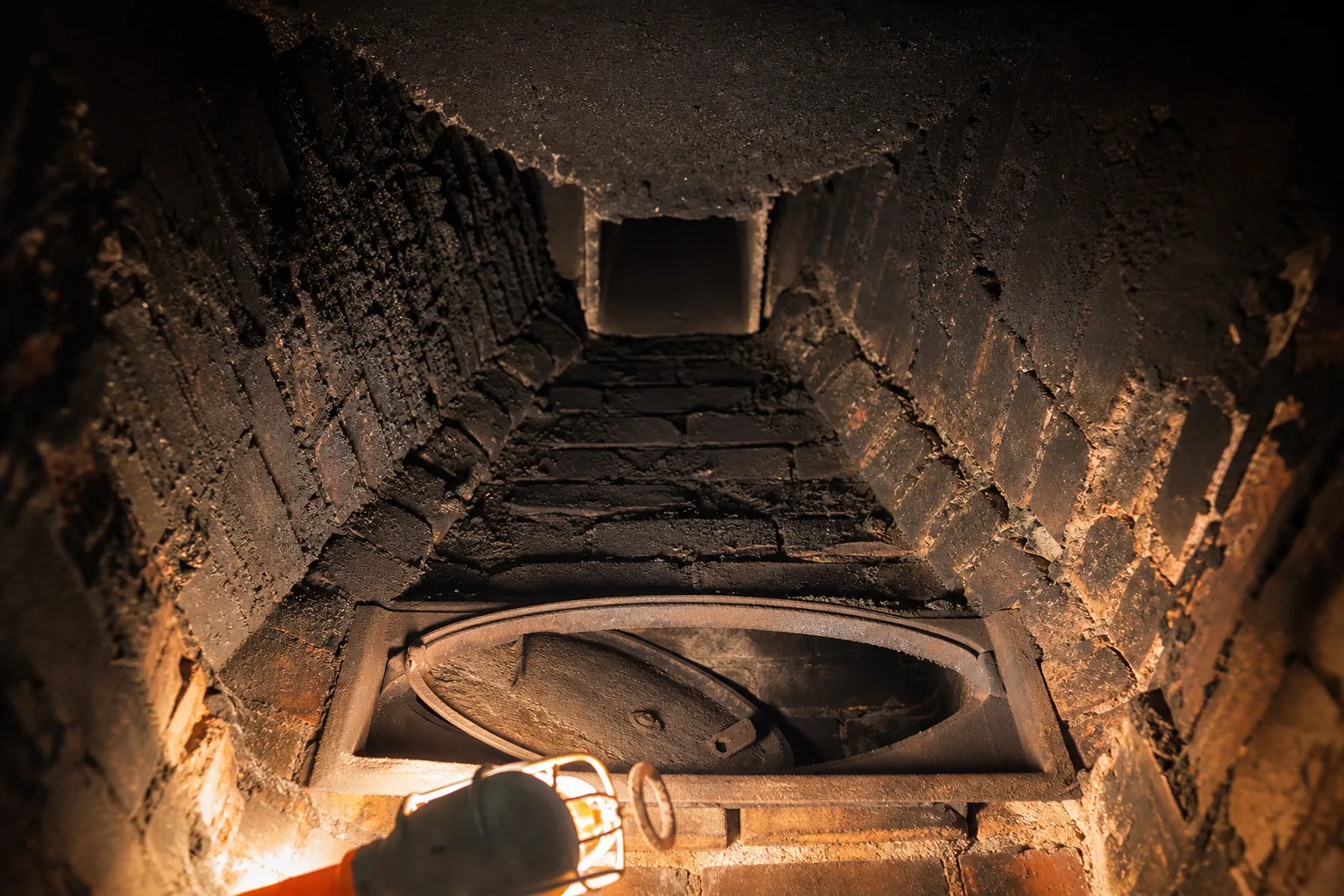
Open your damper and shine a light straight up. Past the damper plate, before the chimney narrows into its flue liner, there is a cavity shaped like an upside down funnel. Wide at the bottom where it meets the fireplace throat, tapering as it climbs, ending at the first flue tile.
That is the smoke chamber. Its whole job is compression. It takes the broad column of smoke and hot gas rising off your fire and squeezes it down to fit the much narrower flue above.
It is not the firebox, where the logs sit. It is not the flue, the vertical shaft that carries everything to the roof. It is the transition between them, and the one major part of a masonry fireplace most homeowners have never laid eyes on.
Good to know: The smoke chamber is the handoff point. Everything below it makes smoke, everything above it carries smoke away, and when the handoff is rough the whole system underperforms.
Residential building code calls for 8 inches of solid masonry in the front, back, and side walls, dropping to 6 inches including the lining only where a lining of firebrick at least 2 inches thick, or vitrified clay at least 5/8 inch thick, is present. The damper is required to sit at least 8 inches above the lintel, the steel angle spanning the top of your fireplace opening.
Why corbeled brick is the problem
Here is the part that explains everything else.
A mason building a smoke chamber by hand has to turn a wide opening into a narrow one using rectangular bricks. The way that gets done is corbeling: each course of brick is set back slightly from the course below it, stepping inward as the wall climbs, until the cavity has closed down to flue size.
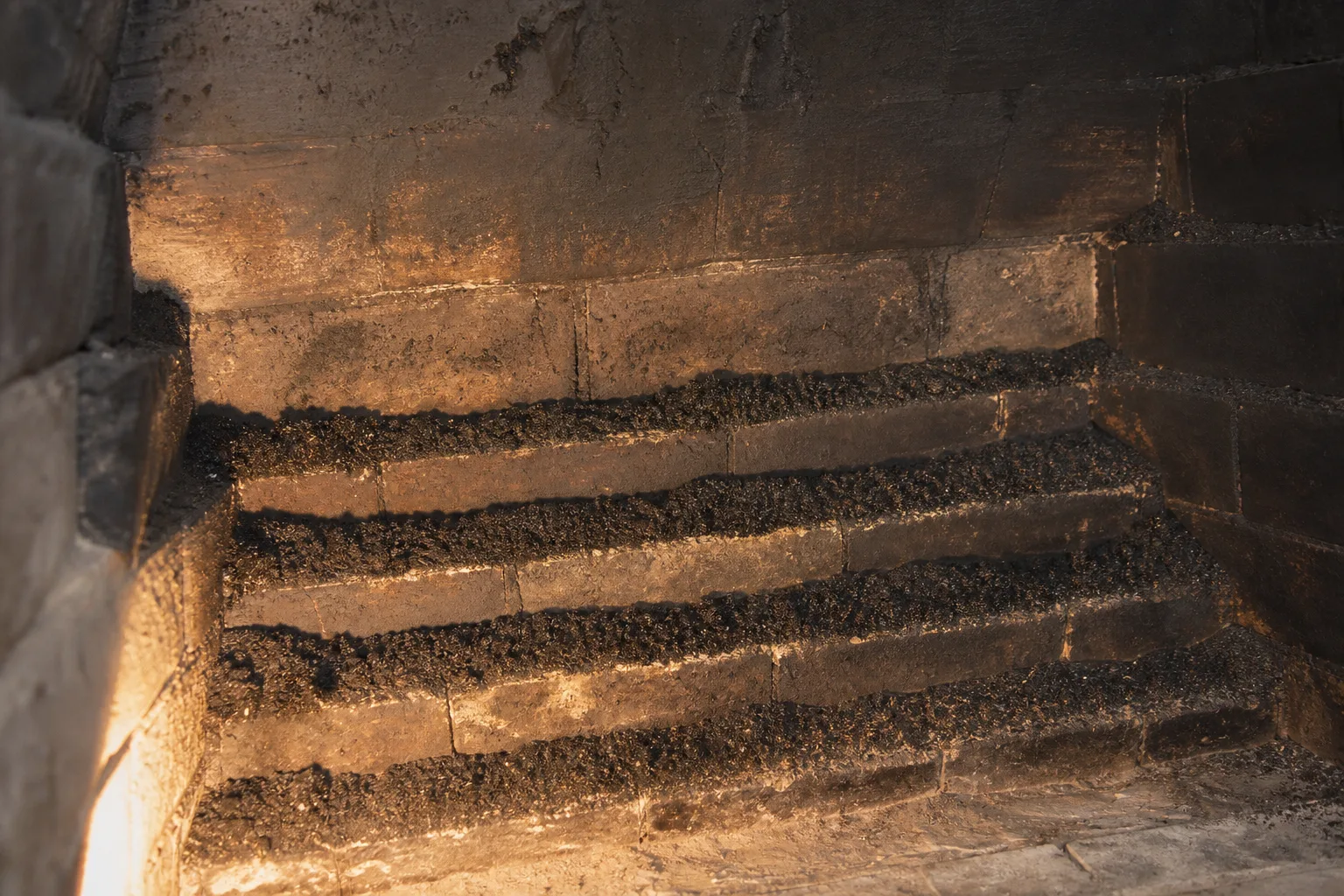
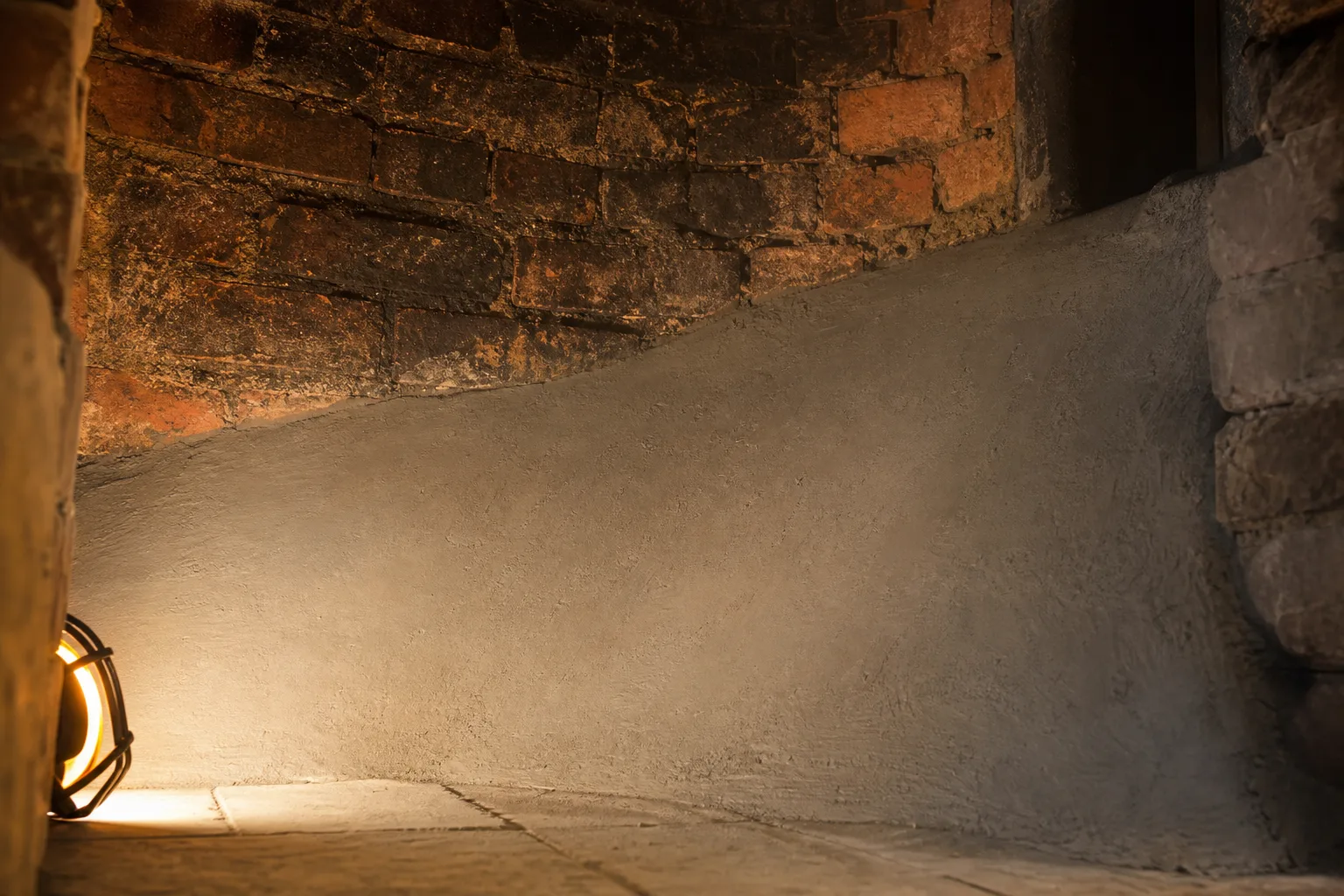
Look up into an unfinished chamber and you can see it. Stair steps, going up and inward, with a small horizontal ledge of mortar exposed on every single step.
Those ledges are the villain of this entire story, and they cause two separate problems.
The first is turbulence. Hot gas rising through a smooth tapered cavity slides. Hot gas rising through a staircase tumbles, and tumbling gas does not draft the way a chimney is supposed to. You feel this as a fireplace that is slow to get going, or one that puffs smoke into the room when the wind shifts.
The second is accumulation. Every one of those little shelves is a place for soot and creosote to land and stay, the way snow collects on a staircase rather than on a slide. Left alone in an unparged chamber, that buildup can reach what the trade calls Stage 3 creosote, a hard glazed deposit with the look of black tar. Stage 3 is both a fire hazard and a physical obstruction to draft, and it does not brush off.
From the field: The corbeled ledges are where the black stuff sits. When a camera goes up there and the operator pauses on each step, that is what they are pausing on, and it is usually the most honest picture of how a fireplace has been living.
Almost every smoke chamber repair you will ever be quoted traces back to those ledges.
The fix, then, is not mysterious. Fill the steps, smooth the slope, and give the gas a ramp instead of a staircase. That is what parging is, and it is why NFPA 211 calls for the inner surfaces of a smoke chamber to be parge coated smooth with an insulating refractory mortar rather than left as bare stepped brick.
How to Tell If You Need Smoke Chamber Repair
What you can see yourself from the hearth
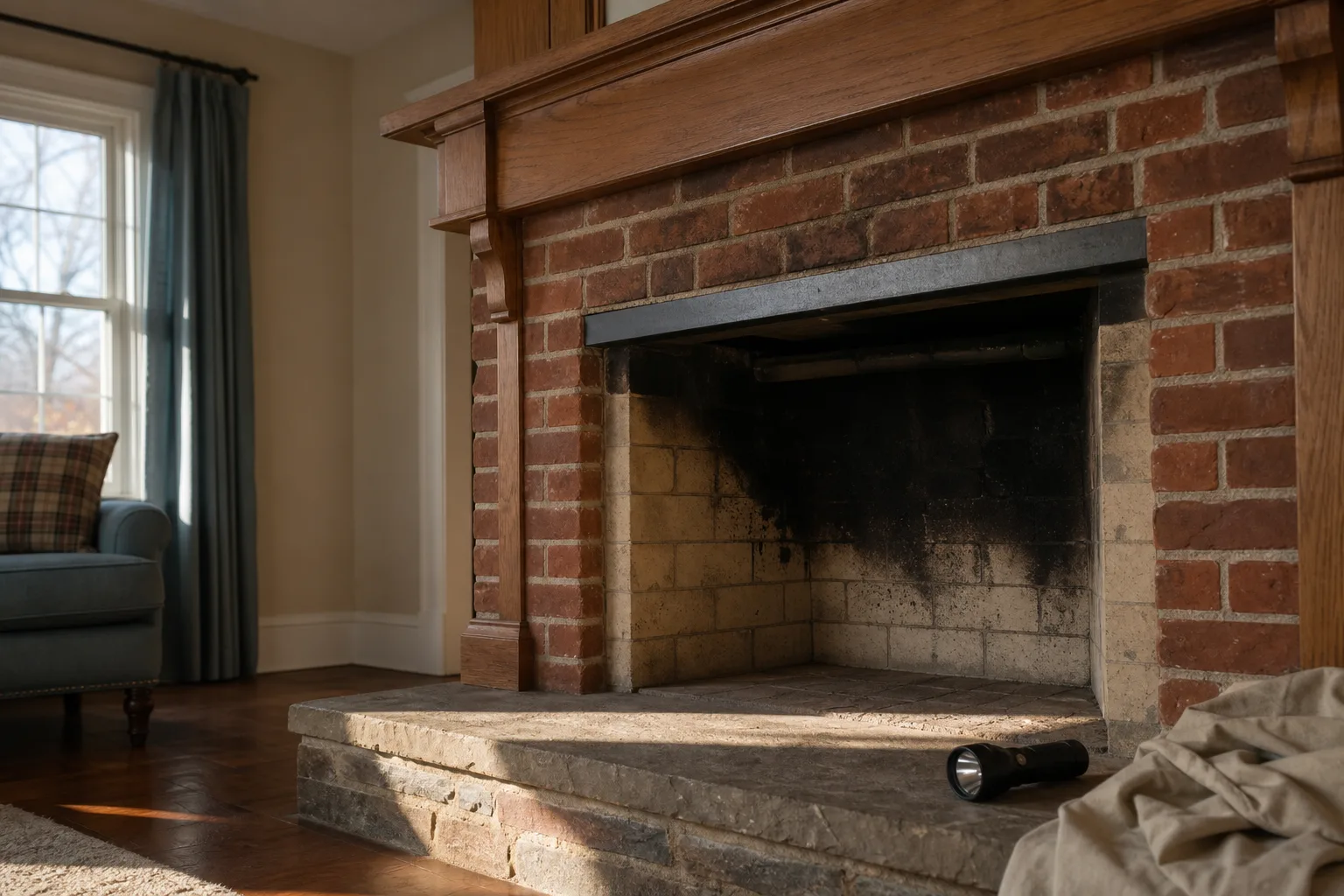
You can do a rough version of this check in about five minutes with a flashlight, and it is worth doing before anyone quotes you anything.
Open the damper fully. Get down low, lie on the hearth if you need to, and aim the light up and slightly back. You are looking for three things.
Stepped brick with no smooth coating over it. If you can clearly make out individual stair steps and the mortar ledges between them, the chamber is unparged, or whatever parging was there has come off.
Missing mortar. Gaps, voids, and crumbling joints between the bricks, especially near the top where the chamber meets the flue.
Daylight, or anything that looks like a hole through to somewhere else. That one ends the inspection. Stop and call someone.
You may also notice things that have nothing to do with the flashlight. Smoke rolling out into the room instead of up. A sour, sharp smell from the fireplace on humid days, particularly in summer when the air conditioning is running. Dark staining on the brick face above the opening.
Safety note: Smoke entering the room is a venting failure, not a quirk. If your fireplace is pushing combustion gas into your living space, stop using it until someone qualified has looked at the system. Carbon monoxide is odorless and the smoke you can see is not the part that hurts you.
What only a camera can show
Now the honest part, and this is the thing almost nobody in this business will volunteer.
Everything in that symptom list can be caused by something other than the smoke chamber.
Smoke in the room comes from a damaged smoke chamber. It also comes from a cracked or undersized flue liner, from a chimney that is too short for the roofline, from a blocked chimney cap, from negative pressure in a tightly built house, and from a damper that is not opening all the way. The symptom does not name the cause. It only tells you that the venting system is not doing its job.
Which means a quote for smoke chamber repair written by someone who never put a camera up there is a guess. It might be an experienced guess. It is still a guess, and you are the one paying for it.
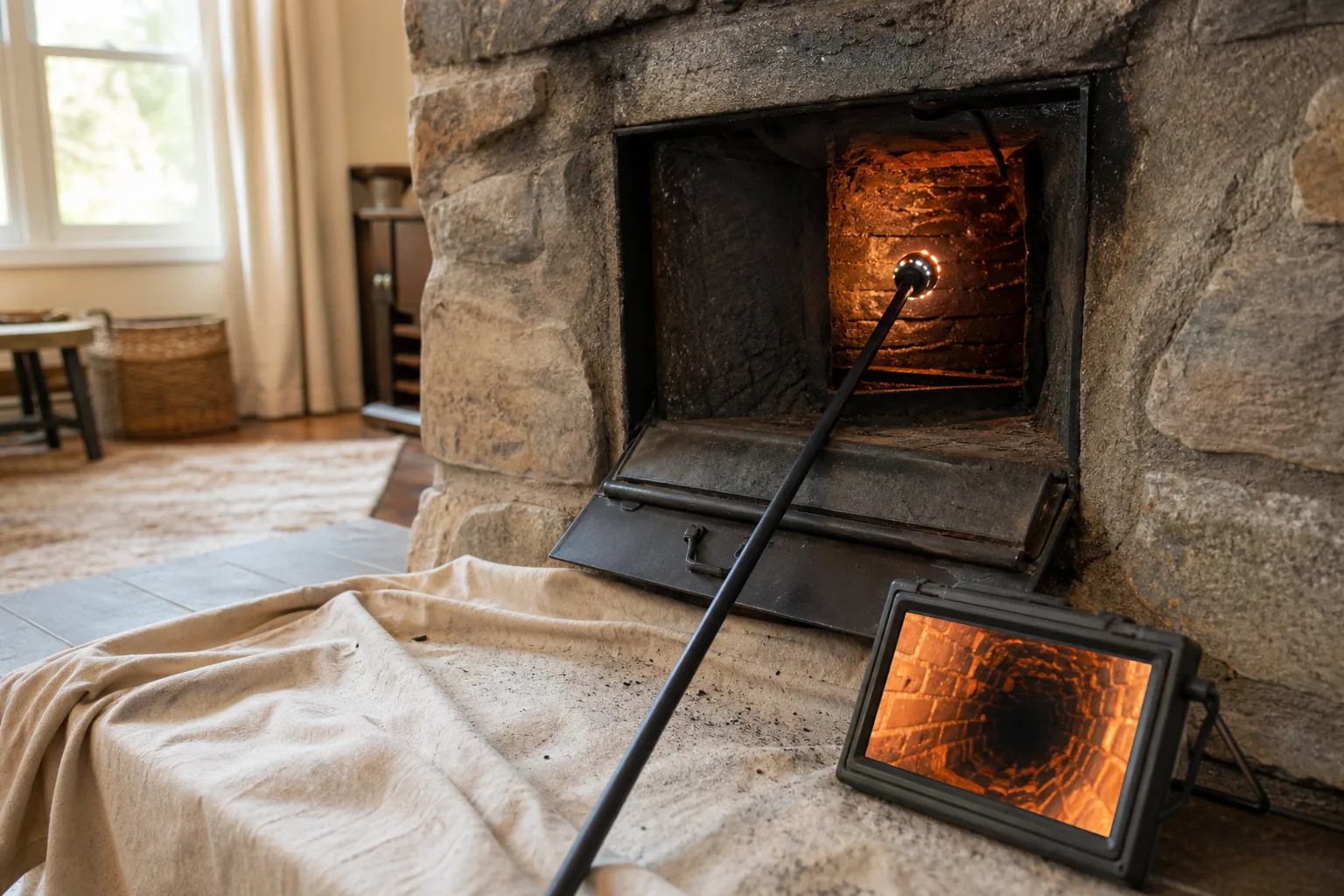
A Level 2 inspection includes video scanning of the internal surfaces. That is the tool that settles the question, and the footage exists. Somebody looked at a screen before writing your estimate, or nobody did.
Myth vs. fact: Myth, smoke coming into the room means the smoke chamber is bad. Fact, smoke coming into the room means the venting system is failing somewhere, and the smoke chamber is one of several suspects. The camera tells you which.
Ask to see it. Not aggressively, just plainly: can you show me the video of the smoke chamber? A company that scanned your chimney will be glad to pull it up, because footage of stepped brick packed with glazed creosote sells the job better than any sales pitch. A company that gets evasive has told you something important.
The Three Kinds of Smoke Chamber Repair
When a contractor says the chamber needs parging, they could mean any one of three jobs. The word covers all of them and distinguishes none of them, which is exactly why quotes for smoke chamber repair on the same fireplace can land so far apart.
Hand-parging with refractory mortar
The traditional method, and still the right one in plenty of cases.
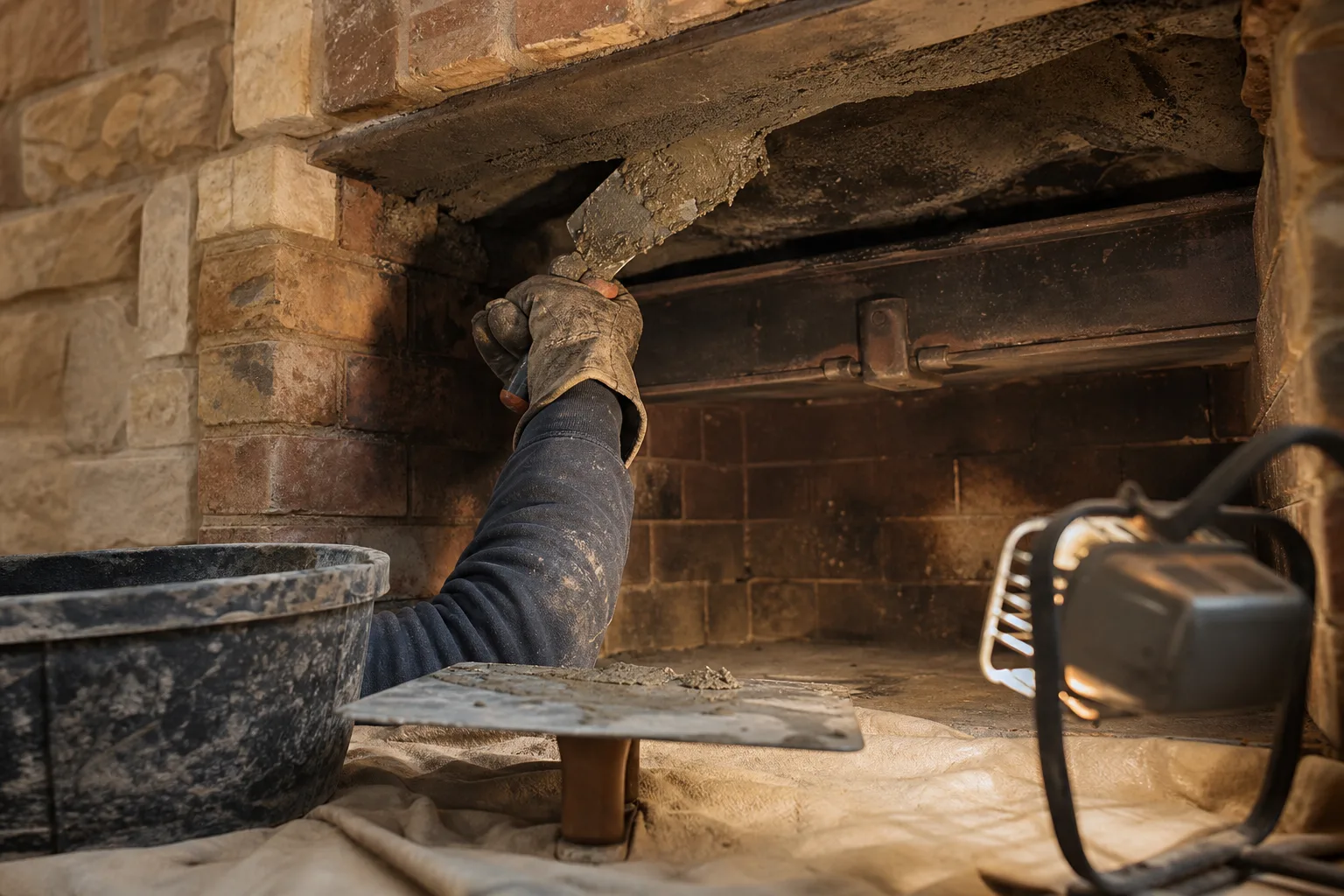
A technician works from below, reaching up through the fireplace opening with a trowel or a gloved hand, packing refractory mortar onto the stepped brick until the steps disappear and the slope runs smooth. The material matters. The standard here is ASTM C199, a refractory mortar rated to 1800°F, and it is not the mortar holding your bricks together.
It is slow, awkward work in a cramped dark space, done overhead. That is worth knowing, because it explains the labor line on your estimate.
The limitation is reach. A tall chamber, or one with an aggressive offset, has corners a human arm cannot get to properly from the hearth.
Cast and sprayed ceramic systems
The newer category. Rather than troweling by hand, the crew applies a refractory or ceramic material using equipment: a spray rig fed up through the throat, or a form or applicator plate pulled through the chamber so the material sets against it in an even layer.
The argument for these systems is coverage and consistency. They reach what an arm cannot, and they lay down a uniform thickness rather than one that varies with how well the technician could contort themselves in a given corner.
Several manufacturers make competing versions, each with its own performance claims. Treat those as marketing until someone shows you independent evidence. Judge the category on what it genuinely does well: reaching a chamber hand work cannot serve.
Rebuilding the chamber
Sometimes there is not enough sound masonry left to coat.
If bricks are missing or spalling badly, if the mortar has failed through rather than just at the surface, or if the chamber was built so far out of shape that smoothing it would not fix the draft, the answer is structural masonry work: taking the chamber apart and rebuilding it correctly, or building new walls inside the existing cavity to the right geometry.
This is the big one. It is the most disruptive, it takes the longest, and it is the quote that sends people looking for a second opinion. Sometimes it is also genuinely the only honest recommendation, which is why knowing the difference matters so much.
| Repair approach | What actually happens | Best suited to | What to watch for |
|---|---|---|---|
| Hand-parging | ASTM C199 refractory mortar troweled by hand onto the stepped brick | Sound masonry, reasonable height, reachable by arm | Thin or missed coverage in high corners and behind offsets |
| Cast or sprayed ceramic | Material applied by spray rig or against a pulled form, in a consistent layer | Tall chambers, awkward geometry, poor hand access | Vendor claims quoted as independent fact; confirm crew training on that system |
| Full rebuild | Failed masonry removed and rebuilt, or new walls built to correct geometry | Missing or spalling brick, mortar failed through, chamber badly out of shape | The jump in scope; the one to get a second opinion on |
Not sure which repair you are being quoted?
That is the right question, and it is worth asking before you approve anything. VIO CHIMNEY connects you with independent chimney companies in your area who can look at your smoke chamber and tell you what they see. We ask every company in the network to put its estimate in writing before any work starts, and you should insist on exactly that from whichever company you hire.
Call (513) 655-6702 or request service online.
Pro tip: Ask which of the three you are being quoted, by name. "Are you hand-parging, spraying a ceramic system, or rebuilding?" The answer takes five seconds and reframes the whole conversation, because now you are discussing scope instead of price.
What Actually Drives the Price
You will notice there are no dollar figures on this page. That is deliberate.
The cost ranges published around the web for smoke chamber repair are almost always one contractor's own price list, posted on their own sales page, for one regional market. Repeating those as market data would set you up to argue with a legitimate estimate over a number that never applied to your house.
What is useful is knowing what the estimate is made of.
What a Smoke Chamber Repair Quote Is Actually Pricing
Mostly labor, and mostly access.
Hand-parging is hours of overhead work in a confined space. A cast or sprayed system brings equipment, setup, masking, and cleanup into the picture. A rebuild adds demolition, debris removal, and considerably more material.
Before any of that, most companies price the inspection and camera scan that found the problem.
How bad the damage is
A chamber that simply needs its steps smoothed is a different job from one where mortar has washed out of the joints and individual bricks have started to come loose.
The first is a coating job. The second is structural, and no amount of surface material substitutes for it.
What else the inspection turns up
This is where estimates grow, and often legitimately.
A camera pointed at a smoke chamber also passes the damper, the smoke shelf, and the bottom of the flue. It is common for a scan that began as a smoke chamber question to find a cracked clay flue tile, a deteriorated liner, or a missing chimney cap that has been letting water in for years.
Water is the usual culprit behind chamber damage anyway. Mortar that has been getting wet from above for a decade fails from the top down, and repairing the chamber without addressing where the water is coming in means doing the work twice.
Good to know: Access moves the number more than most people expect. The same repair prices differently in a wide open hearth than in a low, deep firebox where a technician can barely get an arm up past the damper.
What to Ask Before You Approve Smoke Chamber Repair
This is the section worth screenshotting.
None of these are confrontational. A good company answers them happily, because good companies would rather explain their work than defend it later. Ask because smoke chamber repair happens somewhere you will never see, which makes it one of the few home repairs you cannot verify after the fact.
So verify it before.
- Can you show me the camera footage of my smoke chamber? The single most useful question on this list. Ask it first.
- Which of the three repairs are you recommending: hand-parging, a cast or sprayed system, or a rebuild? Get the answer by name, not as "we'll parge it."
- Why that one rather than the other two? The reasoning tells you more than the recommendation does.
- What material are you using, and is it rated for this? You are listening for a refractory mortar meeting ASTM C199, not general purpose masonry mortar.
- Is anything else in the system contributing to this? Especially the liner, the cap, and the crown. Water damage almost always comes from above.
- Will you photograph the finished chamber so I can see the work? Before and after images of the same view. A company that documents its work says yes without hesitating.
- Is the estimate in writing, itemized, before anything starts? Insist on this one every time, with every company.
- What happens if you open it up and find more than expected? Agree on how change orders get handled while everyone is still calm.
- Do I need to stop using the fireplace until this is done? Get a direct answer, and follow it.
If a company answers all nine of those clearly, you are probably in good hands regardless of what they charge. If a company gets impatient at question three, you learned something no price comparison would have told you.
The Standards Behind the Repair
What NFPA 211 says about parging
NFPA 211 is the standard that governs chimneys, fireplaces, vents, and solid fuel burning appliances in the United States. On this subject it is direct: the inner surfaces of a smoke chamber are to be parge coated smooth with an insulating refractory mortar.
Smooth is the operative word. Not patched, not partially coated. Smooth.
Trade sources citing the standard point to a refractory mortar conforming to ASTM C199, and the Brick Industry Association's technical guidance on residential fireplaces says the same. Two independent bodies, one requirement.
The two different degree numbers, and why both are real
You will run into two figures for how steeply a smoke chamber wall is allowed to lean, and they do not match. This confuses people, including some in the trade.
NFPA 211 and the chimney trade literature work from a slope of less than 45 degrees from vertical.
Residential building code, as adopted from the IRC by individual states, says that where the inside surface of the smoke chamber is formed by corbeled masonry, the walls shall not be corbeled more than 30 degrees from vertical.
Two documents, two slightly different things, and the tighter 30 degree figure applies specifically to the corbeled masonry case. Neither number is wrong, and they should never be merged. If someone tells you "the code says 45 degrees," they have flattened two standards into one inaccurate sentence.
What this means practically: an older chimney can be out of spec on geometry in a way no amount of parging fully corrects, and that is one of the real reasons a rebuild gets recommended.
When an inspection is required, not just suggested
NFPA 211 requires a Level 2 inspection, which includes video scanning of the internal surfaces, in these situations:
- Sale or transfer of the property
- A change to the appliance or the fuel type
- Modification or relining of the venting system
- After a chimney fire
- After an external event that could have damaged the chimney, such as severe weather or an earthquake
- A malfunction or an operating problem with the system
If your fireplace is pushing smoke into the room, that is an operating problem, and a Level 2 inspection is the appropriate response rather than an upsell. If the house is also changing hands, or the venting system has been relined or modified, the standard requires one outright.
Safety note: Those five triggers are requirements in the standard, not recommendations. If you are buying or selling a house with a fireplace, a Level 2 inspection is the one that applies, and a general home inspection is not a substitute for it.
After the repair
A smoke chamber repair done properly leaves you with a smooth sloped surface and no ledges for creosote to grab, which means the annual sweep has an easier time and the deposits that do form tend to come off rather than glazing in place.
The repair does not change how you burn, though. Seasoned wood, a chimney swept on schedule, and water kept out of the masonry from above are what keep the work intact.
How VIO Helps With Smoke Chamber Repair
Plainly: VIO CHIMNEY does not repair smoke chambers. We are a referral network. We match homeowners with independent local chimney companies who do the work themselves, and the company that shows up at your house is theirs, not ours.
For this particular problem, that arrangement is genuinely useful.
Smoke chamber repair is invisible work priced off evidence you did not personally see. The defect sits in a cavity you cannot inspect, the recommendation comes from the only person who looked, and the three possible repairs differ enormously in scope. That is a situation where a second look from a company with no stake in the first estimate is worth the phone call, whatever it ends up telling you.
When you get in touch to request service, the useful things to have ready are what the first company told you, what your fireplace is actually doing, the rough age of the house, and whether you have the inspection report or any photos. That is enough for us to match you sensibly.
We ask every company in the network to put its estimate in writing before any work starts, and you should insist on exactly that from whichever company you hire. An itemized written estimate is how you compare two recommendations honestly, and it is how you protect yourself if the scope changes mid-job.
Then you decide. Sometimes a second opinion just confirms the first, which is also a good outcome: now you can approve the work without wondering.
Get a second opinion before the first fire
If a sweep has already told you the smoke chamber needs work, a second look starts with a phone call and can change what you spend. Tell us what you were told and what your fireplace is doing, and we will match you with a local chimney company that handles smoke chamber repair. You decide from there.
Call (513) 655-6702 or request service online.
Symptom checker
What is your chimney doing?
Tap the closest match for an honest first answer.