



On this pageWhat Chimney Dampers Do, and Why Yours May Have Quit7 sections+6
- What Chimney Dampers Do, and Why Yours May Have Quit
- Start Here: Which of the Two Chimney Dampers Do You Have?
- Throat vs. Top-Sealing Chimney Dampers, Side by Side
- How to Tell If Your Damper Is Open, Closed, or Stuck
- Repair or Replace, and What a Replacement Involves
- Gas Logs Change the Rules for Chimney Dampers
- How VIO Helps With Chimney Dampers
Quick answer
Chimney dampers are movable plates that open and close the flue passage in a chimney. There are two types: throat dampers, which sit just above the firebox and seal metal against metal, and top-sealing dampers, which mount on the chimney crown and close onto a gasket for an airtight seal. A damper that no longer seals lets heated and cooled indoor air escape up the chimney.
You are crouched at a cold fireplace with your phone flashlight pointed up into the dark, and you cannot tell what you are looking at. That is the honest starting position for most people who go looking for information about chimney dampers, and almost nothing written on the subject meets you there.
Here is what nobody tells you. Nearly every guide to this part compares the types to a reader who has no idea which type is sitting in their own chimney. That is backwards.
So we are going to do it in the order that actually helps. Identify first. Compare second. Decide third.
By the end you will know which damper you own, whether it has genuinely failed or is just filthy, and whether the fix is a wire brush and twenty minutes or a phone call. There is also one thing about your damper you cannot possibly determine from inside your house, and I will come back to that.
What Chimney Dampers Do, and Why Yours May Have Quit
A damper is a movable plate that opens and closes the passage through your chimney. Chimney dampers all do this one job, whatever shape they take.
Open, it lets a fire vent, carrying smoke and combustion byproducts up and out. Closed, it seals the opening so the air you are paying to heat or cool does not drift up the flue and leave.
That is the whole job. Two positions, one plate. The trouble is that the plate lives in one of the harshest environments in your house.
Damper or Flue? They Are Not the Same Word
People use these two words interchangeably, and then nothing they read makes sense. Let us fix that in four sentences.
The flue is the passage. It is the hollow channel running up the inside of your chimney, usually lined with clay flue tiles or a metal liner.
The damper is the door in that passage. The flue is the hallway; the damper is the door across it.
If you want the longer version of how that passage moves air, how a chimney works covers the physics behind the draft.
Why Metal on Metal Stops Sealing
A traditional damper is a metal plate resting on a metal frame. Nothing soft in between.
Even brand new, that is a decent block and a poor seal. Then you run fires through it. The plate heat-cycles, and heat-cycling warps metal. The frame corrodes. Ash works into the track.
Give it enough winters and the plate no longer lies flat in its seat. You close it, it looks closed, and air moves past it anyway.
Myth vs. fact: You will read that an open damper loses as much heat as a window left open, or that some specific percentage of your heating escapes up the chimney. Those numbers get repeated constantly across the trade with no traceable source behind them. The mechanism is real and worth taking seriously. The made-up arithmetic is not, and anyone quoting it to you is selling.
Start Here: Which of the Two Chimney Dampers Do You Have?
Chimney dampers come in two families, and they live in completely different places. You almost certainly have one of them. Some houses have both.
Get a flashlight. Make sure the fireplace is stone cold, not warm from last night.
Looking Up From the Firebox: The Throat Damper
Kneel at the fireplace opening and shine the light straight up.
The firebox walls will narrow above your head into a constricted spot. That narrowing is the throat. A throat damper sits right there, spanning it.
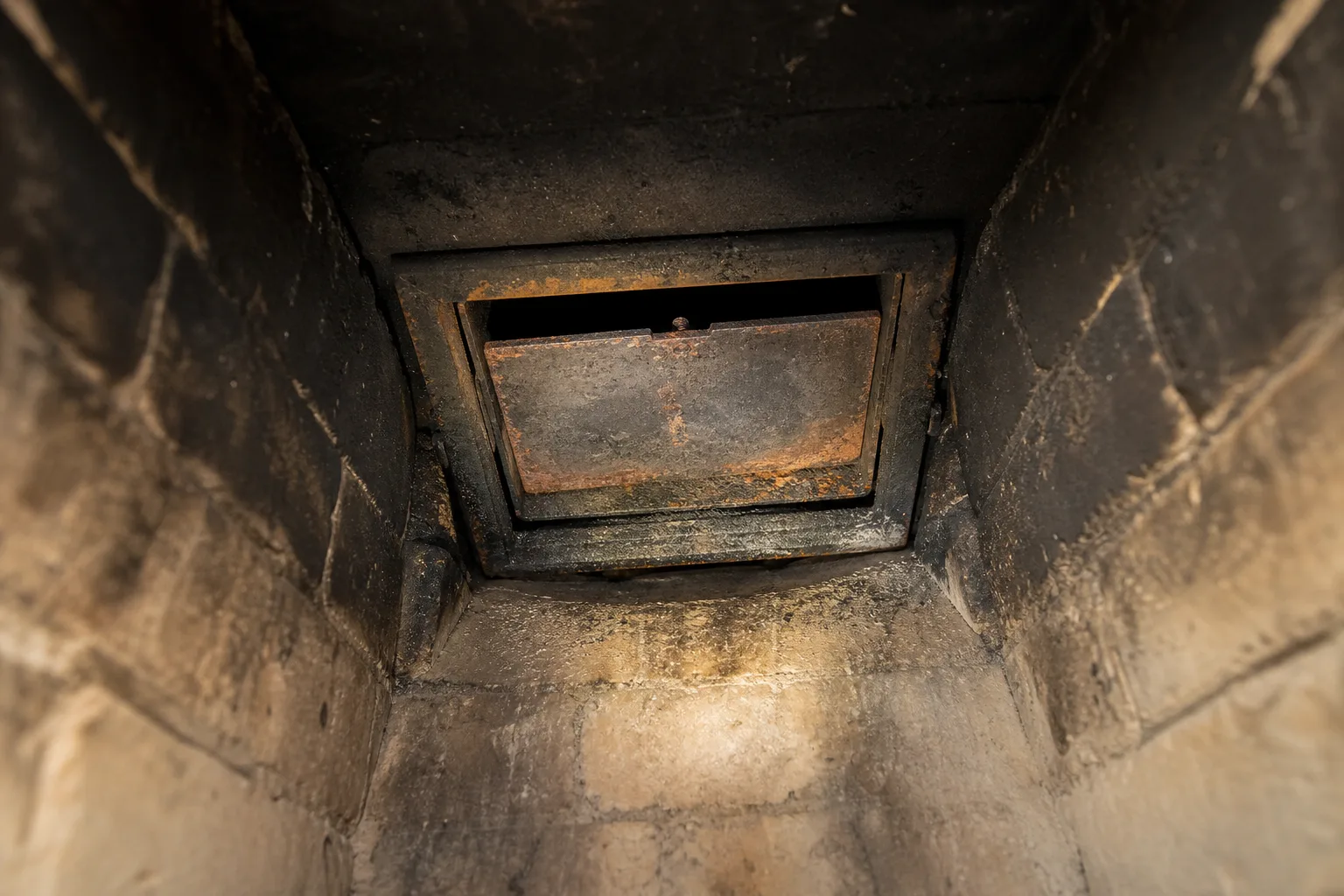
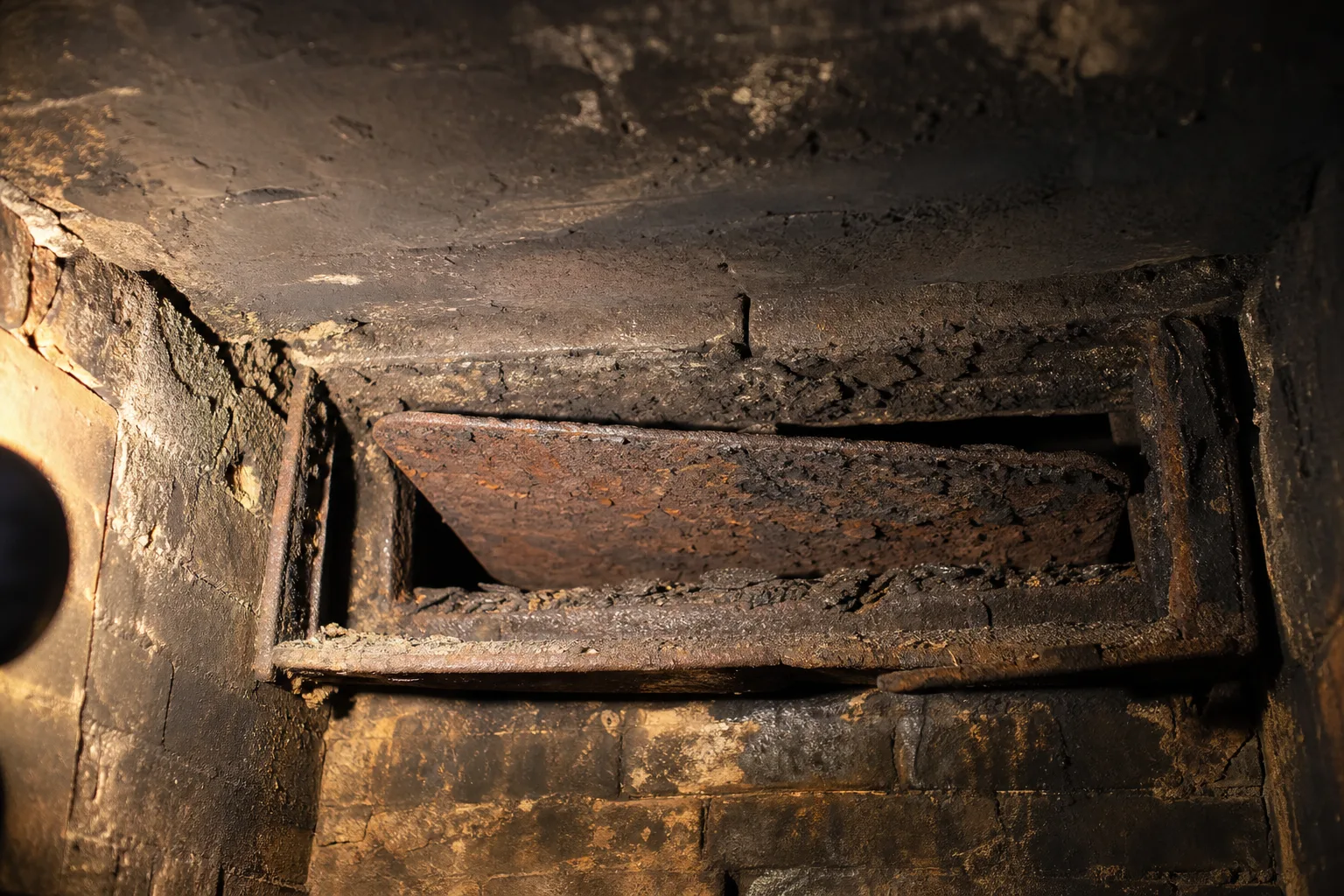
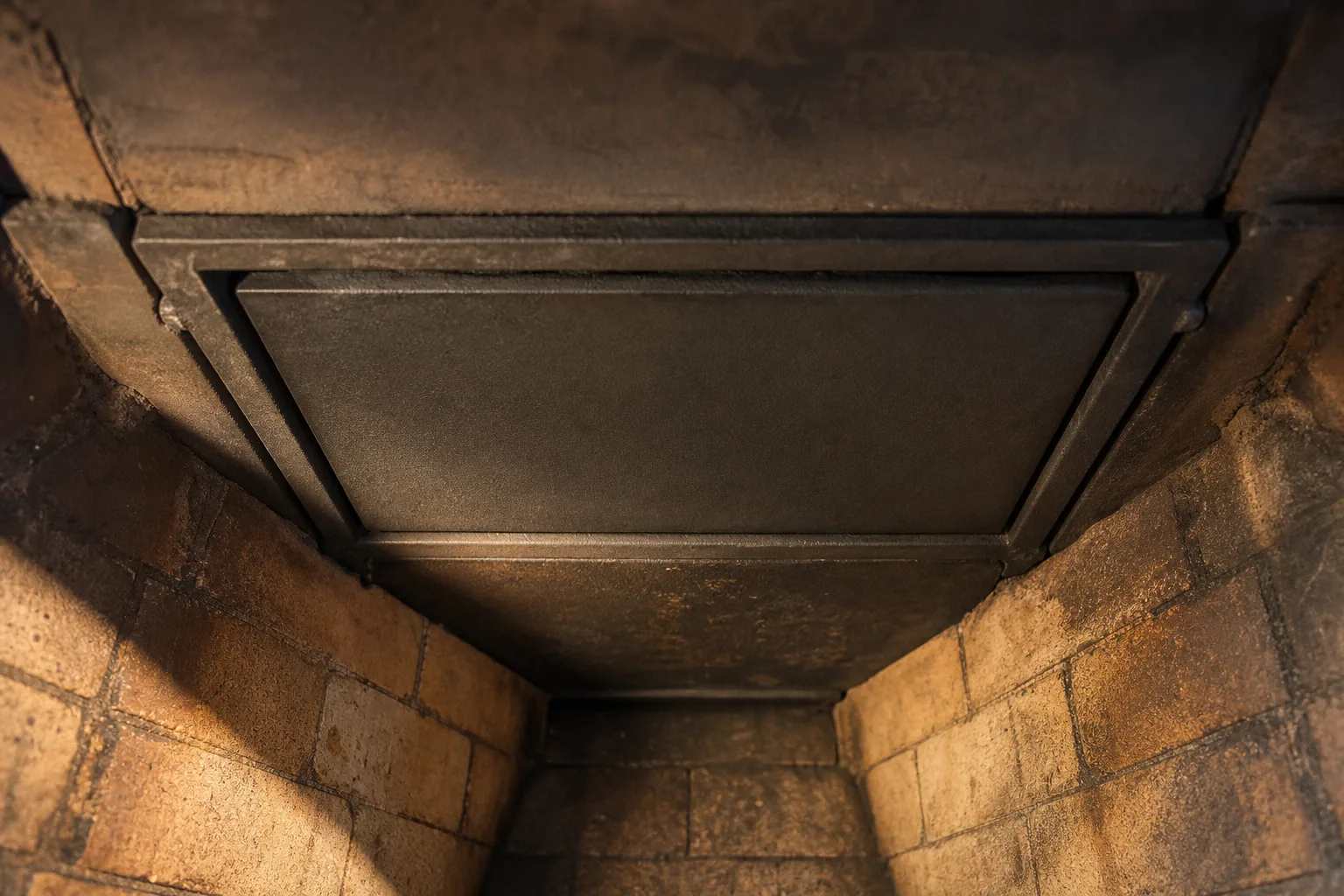
What you are looking for: a rectangular cast iron or heavy steel frame with a hinged plate lying in it, like a trap door. It will not look clean. Expect matte black, orange rust blooming at the edges, grey ash, flakes of creosote.
Then find the control. It is usually low and to one side, and it is sooted to the same black as everything around it, which is why people miss it. It might be a small cast handle, a notch you hook a poker into, or a twist knob on a threaded rod.
Work it gently and watch the plate. If the plate moves when the handle moves, you have a working throat damper and you have learned something.
Looking Up From the Ground: Signs of a Top-Sealing Damper
Now walk outside and look at the top of your chimney.
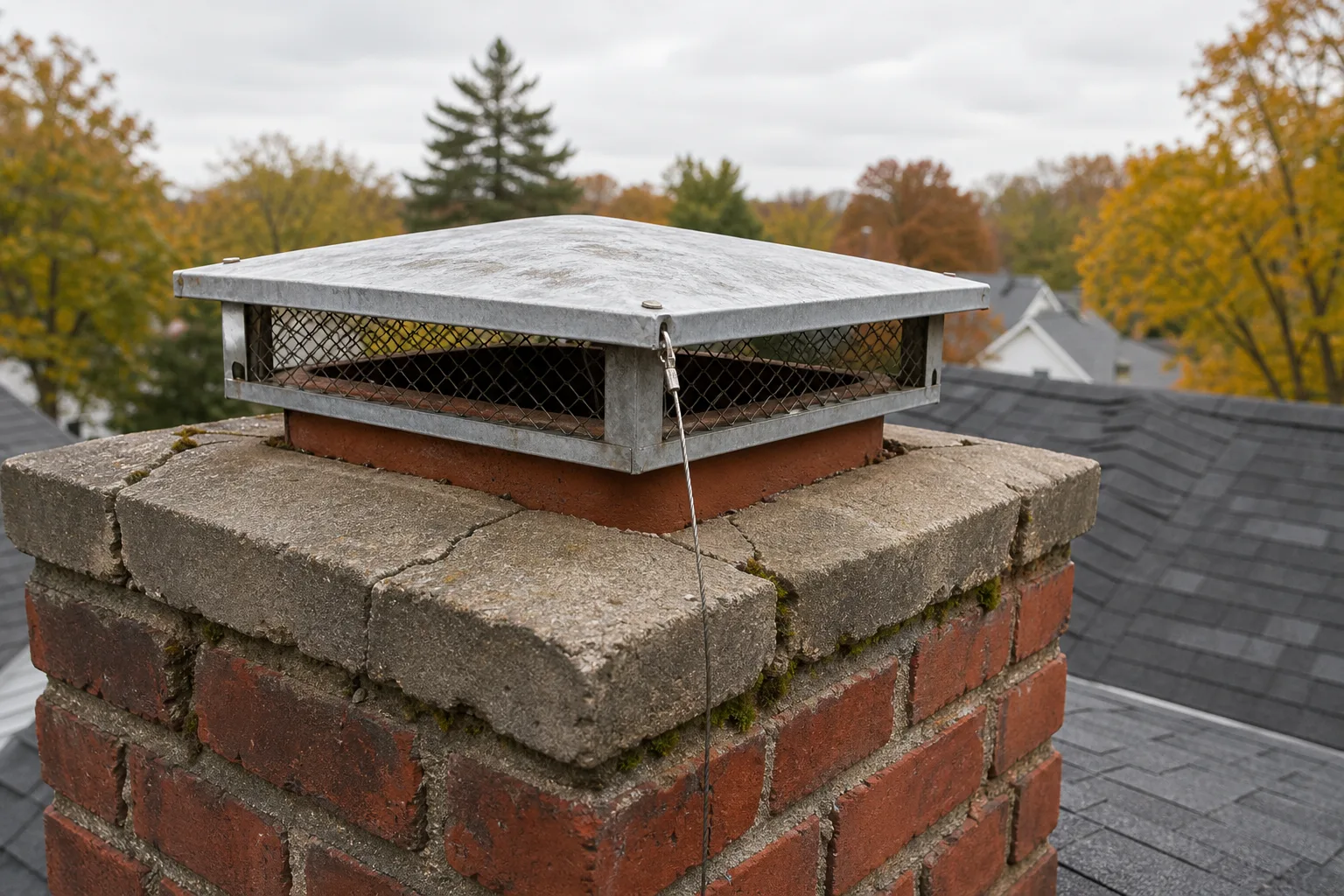
A top-sealing damper, also called a top-mount damper, sits up there on the crown. It is a cast aluminum or stainless lid sitting on a low frame, fixed to the top of the flue tile that projects above the concrete crown.
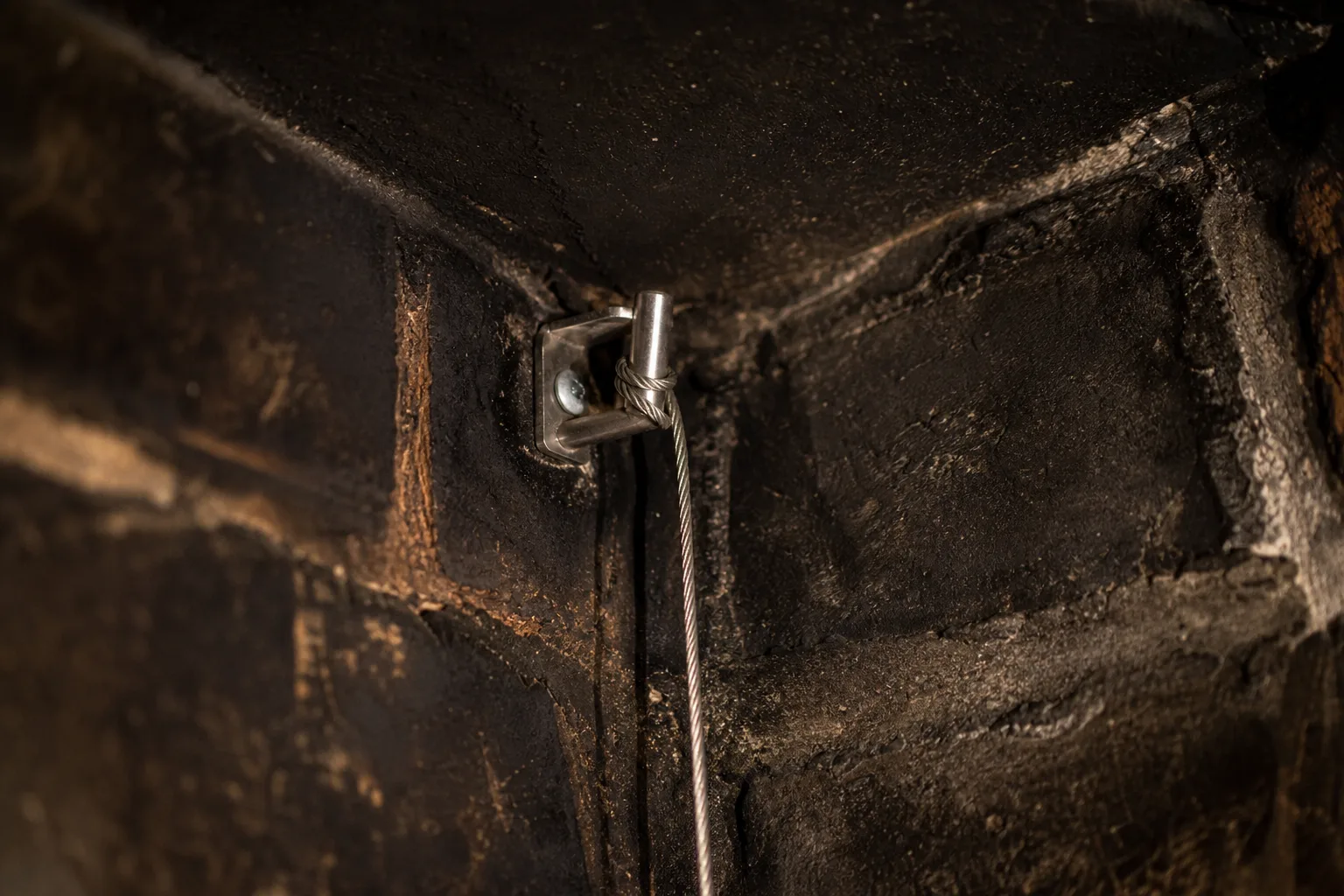
From the ground it reads as a chimney cap, because functionally it is one. The giveaway is inside: a thin stainless cable drops from the lid down through the flue and ends at a small cleat, hook, or spring handle mounted near the top of your firebox opening.
That cleat is the tell. It will be the one bright piece of metal in a box full of soot.
Good to know: A top-mount damper looks so much like a chimney cap from sixty feet below that homeowners routinely report having no damper at all while standing under one. If you are unsure what is on top of your stack, that is worth resolving before you conclude you have no damper.
The One Thing You Cannot Determine From Inside the House
Here is the payoff I promised.
You can identify your damper type from the living room floor. You cannot assess the condition of the seal, the state of the crown it sits on, or whether the flue tile under it has cracked. All three live on the roof.
A throat damper you can at least see and touch. A top-mount unit you are evaluating entirely by proxy, through a cable, from thirty feet below.
This is not a sales pitch, it is geometry. Any honest assessment of a top-sealing damper requires somebody at the top of the chimney.
Throat vs. Top-Sealing Chimney Dampers, Side by Side
Now that you know which one you have, the comparison means something.
| Throat damper | Top-sealing damper | |
|---|---|---|
| Where it sits | In the throat, just above the firebox | On the crown, at the top of the flue |
| How it seals | Metal plate on a metal frame | Lid closing onto a silicone, rubber, or rope gasket |
| Quality of seal | Blocks well, seals imperfectly, degrades as the plate warps | Airtight while the gasket is sound |
| Operation | Handle, knob, or poker notch inside the firebox | Stainless cable running down the flue to a firebox cleat |
| Keeps out rain and animals | No | Yes, it caps the flue opening |
| Where it is serviced | From inside, kneeling at the firebox | From the roof |
| Replacement access | Firebox work | Roof work |
Where Each One Wins
The two kinds of chimney dampers are not really competing for the same prize.
The throat damper wins on access. It is reachable from a kneeling position in your own living room, which makes inspection and cleaning straightforward.
The top-sealing damper wins on the thing dampers exist to do. It closes at the top of the flue column, the coldest point in the whole chimney, which is exactly where the stack effect starts pulling your conditioned air upward. Seal there and you close the leak at its source rather than partway down.
It also does a second job for free. Because the lid covers the flue opening, a closed top-mount damper keeps rain, leaves, and animals out of a chimney that would otherwise be standing open to the sky.
Good to know: Which way the cable moves is not universal. Some top-mount models are spring-loaded to sit open, with the cable pulling the lid closed. Others work the opposite way. Do not assume, and do not trust a generic instruction you read online. Confirm against your own unit or the tag on the cleat.
How to Tell If Your Damper Is Open, Closed, or Stuck
This is the question people actually type at midnight, and it has four answers. Run them in order.
They work on both kinds of chimney dampers, though the fourth one looks different depending on which you have.
Pro tip: Do all of this with the fireplace stone cold. Not "we let it die down an hour ago" cold. Masonry holds heat for a long time after the flames are gone, and embers under ash stay live longer than anyone expects.
The four-step damper check
- Look. Shine a light straight up. Open space or daylight above you means open. A metal plate filling the view means closed.
- Feel. Put your hand in the opening and check for moving air. Treat this as a hint rather than proof, because a worn throat damper can leak a noticeable draft while it is sitting closed.
- Listen. An open flue is a tube to the outdoors and it amplifies. Traffic, wind, and your own voice echoing back are all signs it is open.
- Operate. Find the handle, knob, poker notch, or cable cleat, work it slowly, and watch the plate. Movement at the control with no movement at the plate is the single clearest failure signal you can get.
That last one matters more than the first three. Plenty of chimney dampers pass a visual check and still fail, because the plate sits in the closed position without actually sealing against its seat.
What a Jammed Damper Is Usually Jammed On
Four things seize a damper, and they are boringly consistent.
Soot and creosote buildup, binding the plate to the track like glue. Rust and corrosion welding the hinge. Heat damage, where the plate has warped enough that it no longer fits its own frame. And nesting material, because a chimney without a cap is an attractive place to raise a family.
The last one is seasonal, and it is why September matters. Something moved in over the summer, and you are about to find out.
If the plate itself is sound and the problem is buildup, you may be looking at a cleaning problem rather than a damper problem. Masonry cleaning is a different job from a damper replacement, and it is worth knowing which one you need before anyone quotes you.
Repair or Replace, and What a Replacement Involves
Two paths. The retailers want you on the replacement path and the sweeps want you on the phone, so let me lay out the fork plainly.
When Chimney Dampers Are Genuinely a Homeowner Job
Some of this you can do yourself, and I would rather tell you that than pretend otherwise.
If the plate moves but grinds, and the track is packed with ash and soot, that is a cleaning job. Cold fireplace, drop cloth, gloves, eye protection, a stiff wire brush, and a shop vacuum. Work the buildup off the plate edges and out of the track, then cycle the damper a dozen times.
A stiff hinge that frees up with cleaning is fixed. That is a real outcome, and it costs you an afternoon.
If a handle has simply fallen off an otherwise functioning damper, that is also often a straightforward parts fix.
When It Is Not
Three situations where you should stop.
The plate is warped. A plate that has lost its shape cannot be brushed back into sealing, and no amount of cleaning changes the geometry.
The damper is at the top of the chimney. Roof work on a masonry stack is not a homeowner project, and the fall risk is the entire reason.
Nothing moves at all. A fully seized damper takes force to free, and force applied blindly inside a firebox is how a cast iron frame cracks or a clay flue tile gets broken. A cracked tile turns a damper visit into a chimney flue liner installation, which is a substantially larger job.
From the field: What surprises people is how often a damper question turns into a look at the crown above it. The two are physically stacked, water gets in at the top and works its way down, and by the time a top-mount unit is sitting badly there is usually a reason sitting underneath it.
Sizing, Access, and the Parts of the Job You Cannot See
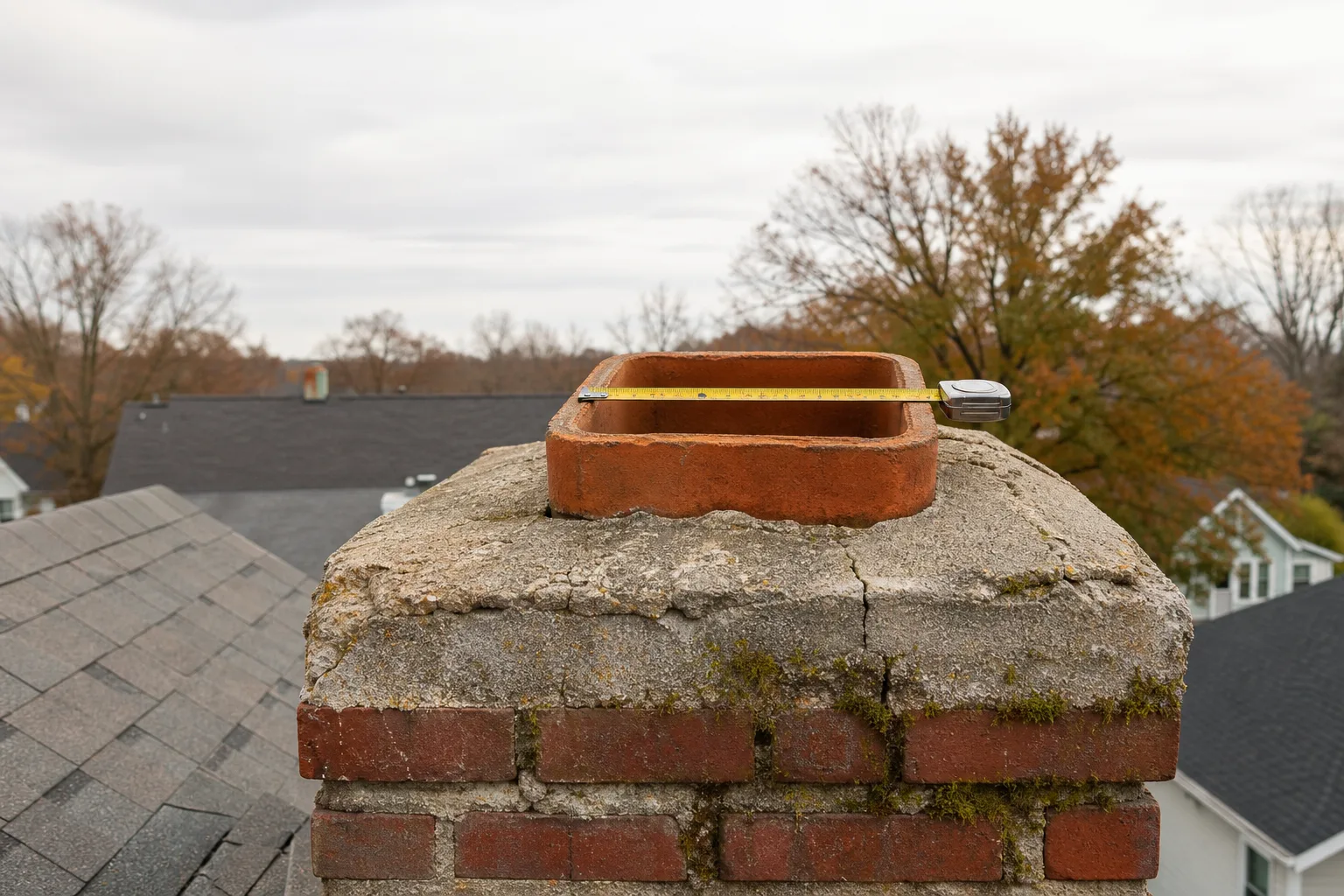
If you are replacing, size comes first. Top-mount dampers are sold by flue dimension, which is why the listings you find are titled with measurements rather than model names.
That measurement gets taken at the top of the flue tile, on the roof, with the crown in view.
The rest of the cost drivers are access, not parts. Roof pitch. Stack height. Whether the crown is sound enough to mount to. Whether the flue tile under the frame is intact.
None of those are visible from your living room, and any of them can change the scope of the work. Anyone giving you a firm number before seeing the top of your chimney is guessing.
Talk to someone who can actually get up there
You have gone as far as the floor allows. Measuring a flue, judging whether a warped plate can be saved, and checking the crown a top-mount damper bolts to all happen on the roof.
VIO matches you with independent local chimney companies that do damper work. Call (513) 655-6702 and start with a conversation, not a commitment. You can also request service and describe what you found with your flashlight.
Gas Logs Change the Rules for Chimney Dampers
Now the part that nearly every page on this topic forgets entirely.
If there is a gas log set in your masonry firebox, the rules can invert. Which way they invert depends on what kind of set it is, and that distinction matters more than anything else in this section.
A vented gas log set is built to burn with the flue open. Where a vented set or a similar decorative gas appliance is installed, codes in many places require the damper to be fixed or clamped in the open position, so the appliance cannot be run with a closed flue.
An unvented set is a different appliance under different rules, designed to operate with the damper closed, and the clamp requirement does not apply to it in the same way.
So the first question is not "is my damper open" but "which kind of set is in my firebox". Do not apply advice written for one to the other.
That is also what a damper clamp is for. If you found a small steel clamp holding your damper plate open and assumed somebody had broken it, they had not. Somebody had made it safe.
Safety note: The concern behind the clamp is carbon monoxide. It comes from incomplete combustion or from an appliance that is not venting the way it should, and a closed or blocked flue gives those combustion products nowhere to go but into the room. If you have a vented gas set and you find the damper closed or closeable, treat that as something to resolve before you light anything, not after.
Local jurisdiction governs which rules apply to you, and requirements genuinely differ between places. Confirm locally rather than trusting a national summary, including this one.
If it turns out the gas appliance is the problem and the damper is fine, gas fireplace repair cost walks through what that work involves.
One more fence. Under NFPA 211, a Level 2 inspection is required at the sale or transfer of a property, on any change to the system such as a fuel change or a new appliance or a relining, after a malfunction, after a chimney fire, and after an external event like severe weather or an earthquake. Swapping a wood-burning firebox over to gas logs is a system change, so it lands squarely in that list.
How VIO Helps With Chimney Dampers
Plainly, so there is no confusion about what we are.
VIO is a referral service. We do not do the work ourselves. We match you with independent local chimney specialists, and the pro we send works for them, not for us.
For chimney dampers specifically, the moment you need us is the one you just hit. You have identified your damper, you have run the four checks, and you have reached a question that can only be answered from the roof, or by somebody who can tell a warped plate from a dirty one.
We ask every company in the network to put its estimate in writing before any work starts, and you should insist on exactly that. If anyone gives you a number over the phone without seeing your chimney, that is worth a second opinion.
We will also tell you when the answer is that your damper is fine and your problem sits somewhere else. Sometimes it is the cap. Sometimes it is the liner. Sometimes it is a draft issue that has nothing to do with the damper at all.
Before the first fire of the season
September is the right month for this. Finding a seized damper now is an inconvenience. Finding it when the house is cold and the room is filling with smoke is a different kind of evening.
Call (513) 655-6702 and we will match you with a local company that works on chimney dampers. Tell them what you saw when you looked up.
Chimney dampers are one of the few parts of a house you can diagnose most of the way yourself, and you now have the method for it.
Go and look now, while the fireplace is cold. You already know what you are looking for.
Symptom checker
What is your chimney doing?
Tap the closest match for an honest first answer.