



On this pageWhat a Chimney Sweep Alpharetta Homeowners Hire Actually Does7 sections+6
- What a Chimney Sweep Alpharetta Homeowners Hire Actually Does
- Sweep, Inspection, or Both? The Three NFPA 211 Levels
- How to Vet a Chimney Sweep Alpharetta Homeowners Can Actually Verify
- The Upsell Question, Answered Straight
- What the Sweep Will Find on a North Fulton Roof
- Signs It Is Time to Call
- How VIO Helps You Find a Chimney Sweep Alpharetta Homeowners Can Trust
Quick answer
A chimney sweep Alpharetta homeowners hire does two different jobs: sweeping, which removes creosote deposits from the flue, and inspection, which evaluates the system's condition. NFPA 211 recommends an inspection at least once a year and defines three levels. Level 2, which requires a video scan of the flue, is the one called for when a home is sold or transferred. Verify a technician's CSIA certification at csia.org before the visit.
Finding a chimney sweep Alpharetta homeowners can actually trust should be simple. Somebody comes out, cleans the chimney, tells you whether it is safe, and you light a fire.
That is not usually how it goes.
Here is the part nobody on the first page of search results will say out loud. This trade has a reputation problem, and it earned it. The cheap special that turns into an expensive finding is a story almost everyone has heard from somebody, and if you are reading this you are probably a little braced for it already.
So the real question is not who to call. It is how you tell a working professional from someone with a ladder, a brush and a business card. There is an answer to that, it is more concrete than you would expect, and you can check most of it before anyone pulls into your driveway. I will get to it a few sections down.
It is late September in north Fulton County. The evenings just turned, the pollen season is a memory, and the fireplace that sat ignored since February is suddenly interesting again. That is the season for this. A chimney sweep Alpharetta residents book now is doing routine work. The same call in January is usually an emergency.
Before any of that, though, you need to know what you are actually buying, because two different services get sold under one word.
What a Chimney Sweep Alpharetta Homeowners Hire Actually Does
A sweep and an inspection are not the same job. They are almost always scheduled together, described together, and priced together, which is exactly why so many people end up paying for one and assuming they got the other.
The sweeping part
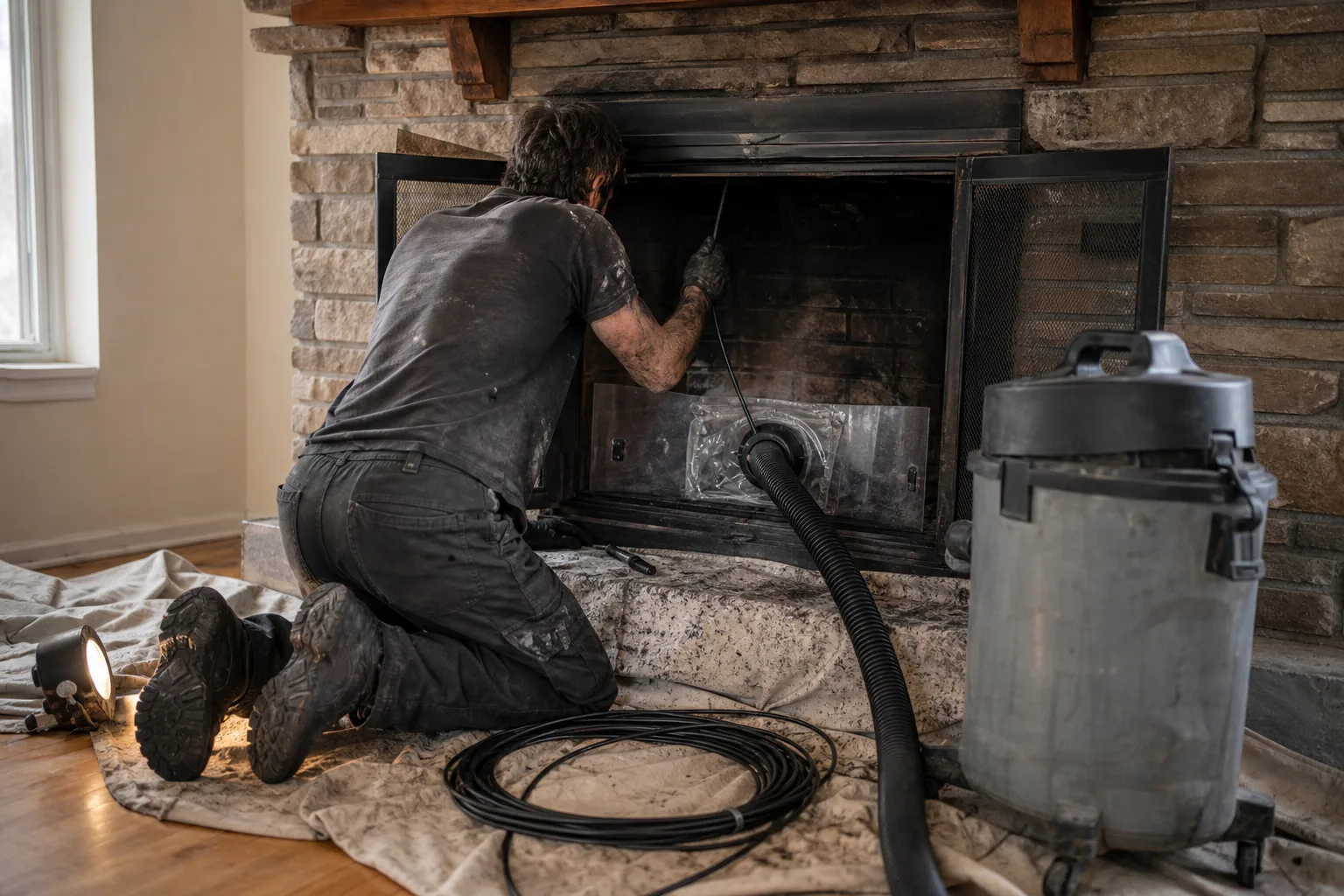
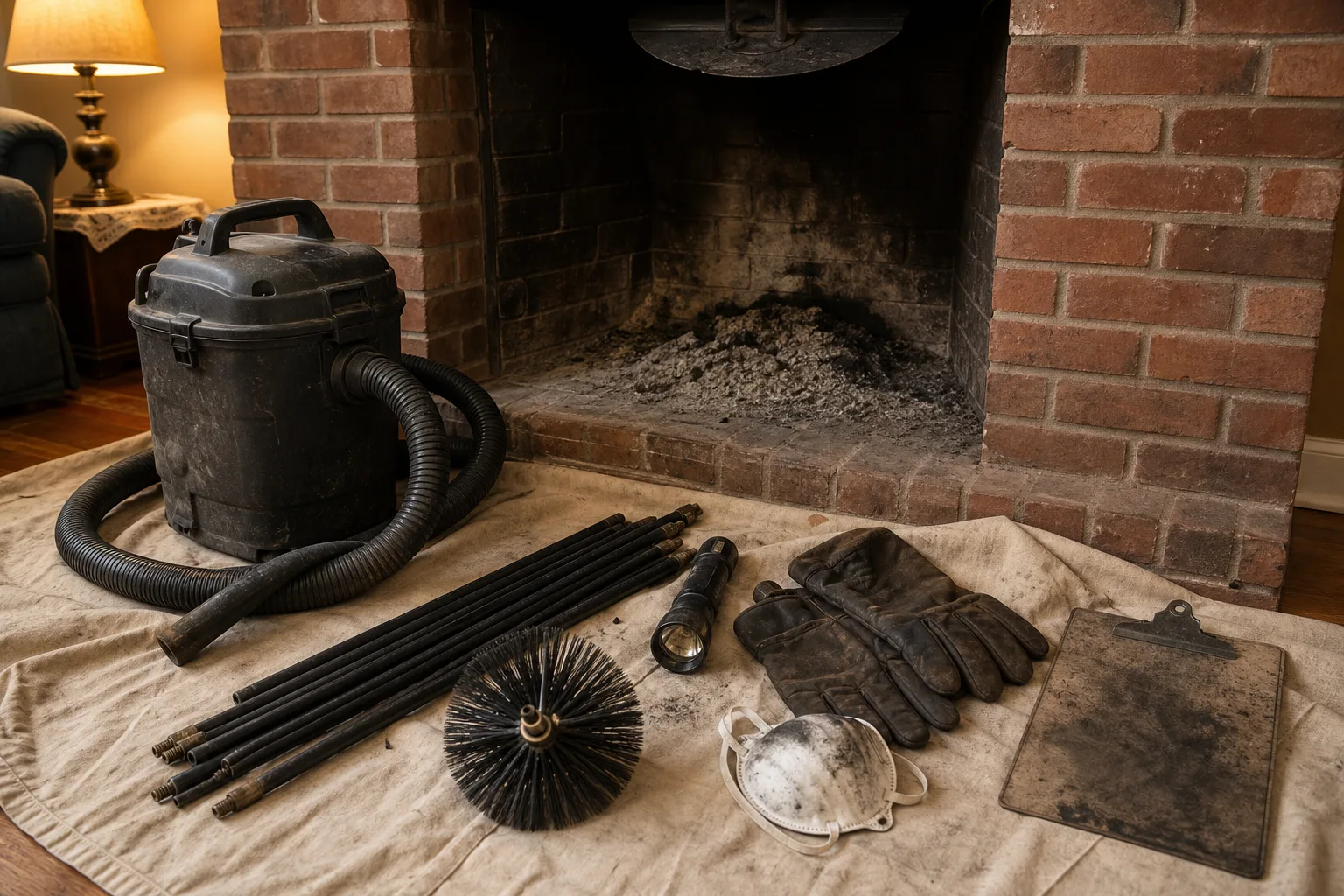
Sweeping is mechanical. A technician confirms the interior dimensions of your flue, either by measuring or from prior records, then selects a brush head sized to that flue. Wrong-sized brush, wrong result. That sizing step is most of the craft.
Drop cloths go down around the hearth. A HEPA vacuum with containment gets sealed at the firebox opening and switched on before the first rod goes in, so the soot has somewhere to go besides your sofa. Rod sections are added one at a time as the brush advances the full height of the chimney.
Done properly, it is tidy. If someone brushes a flue in your living room without a sealed vacuum running, you will know, because you will be cleaning for a week.
The inspection part, which is a different job
Before any brushing happens, a competent technician looks. Interior and exterior, for cracks, for draft problems, for animal nests, for blockages. The look comes first because the condition of the flue decides how the cleaning gets done, and occasionally decides that the cleaning should not happen at all yet.
Good to know: A routine Level 1 inspection does not include getting on your roof. Rooftop access falls outside its scope. If your concern is the crown, the cap or the flashing, say so when you book, because the standard annual visit is not automatically going to look up there.
Why a chimney sweep Alpharetta visit starts with looking, not brushing
Because the system is more than a black hole above a firebox. A technician is checking the cap on top, the crown or chase cover it sits on, the flue liner running the full height, the flashing where the chimney meets the roof, the damper at the throat, the smoke chamber above the firebox, and the firebox itself.
Any one of those can be the reason your fireplace smells, smokes or leaks. None of them are fixed by a brush.
Sweep, Inspection, or Both? The Three NFPA 211 Levels
This is the section that will save some of you real money and real arguments, so it is worth two minutes.
NFPA 211 is the standard covering chimneys, fireplaces, vents and solid fuel-burning appliances. In 2000 it defined chimney inspections in three levels, and those three levels are now the shared vocabulary of the entire trade. A CSIA certified sweep is tested on all three.
Most homeowners have never heard of any of them. Most companies will not bring them up unless you do.
| Level 1 | Level 2 | Level 3 | |
|---|---|---|---|
| When NFPA 211 calls for it | Annual service on a system in continued use, nothing changed, no known problems | Sale or transfer of the property, a change to the system or the fuel, a malfunction, a chimney fire, or an external event such as severe weather | Only when there is reason to suspect a hazard concealed inside the structure |
| What gets examined | Readily accessible portions of the chimney inside and out, plus accessible appliance connections | Everything in Level 1, plus accessible interior spaces the chimney passes through: attics, crawl spaces, basements, plus clearances to combustibles in accessible locations | Everything in Level 2, plus concealed portions of the structure and the flue |
| Video scan of the flue | Not required | Required | Included, as part of the Level 2 work it builds on |
| Roof access | Outside the scope | In scope | In scope |
| Anything taken apart | No | No | Yes. Permanently attached portions of the chimney or the building are removed as needed |
Level 1, the routine annual
Your system has not changed. You are going to use it the way you used it last year. Nothing has gone wrong. That is Level 1, and for most Alpharetta households burning a few fires a winter, that is the correct annual purchase.
Level 2, the one a real estate closing triggers
Here is the vocabulary nobody hands you.
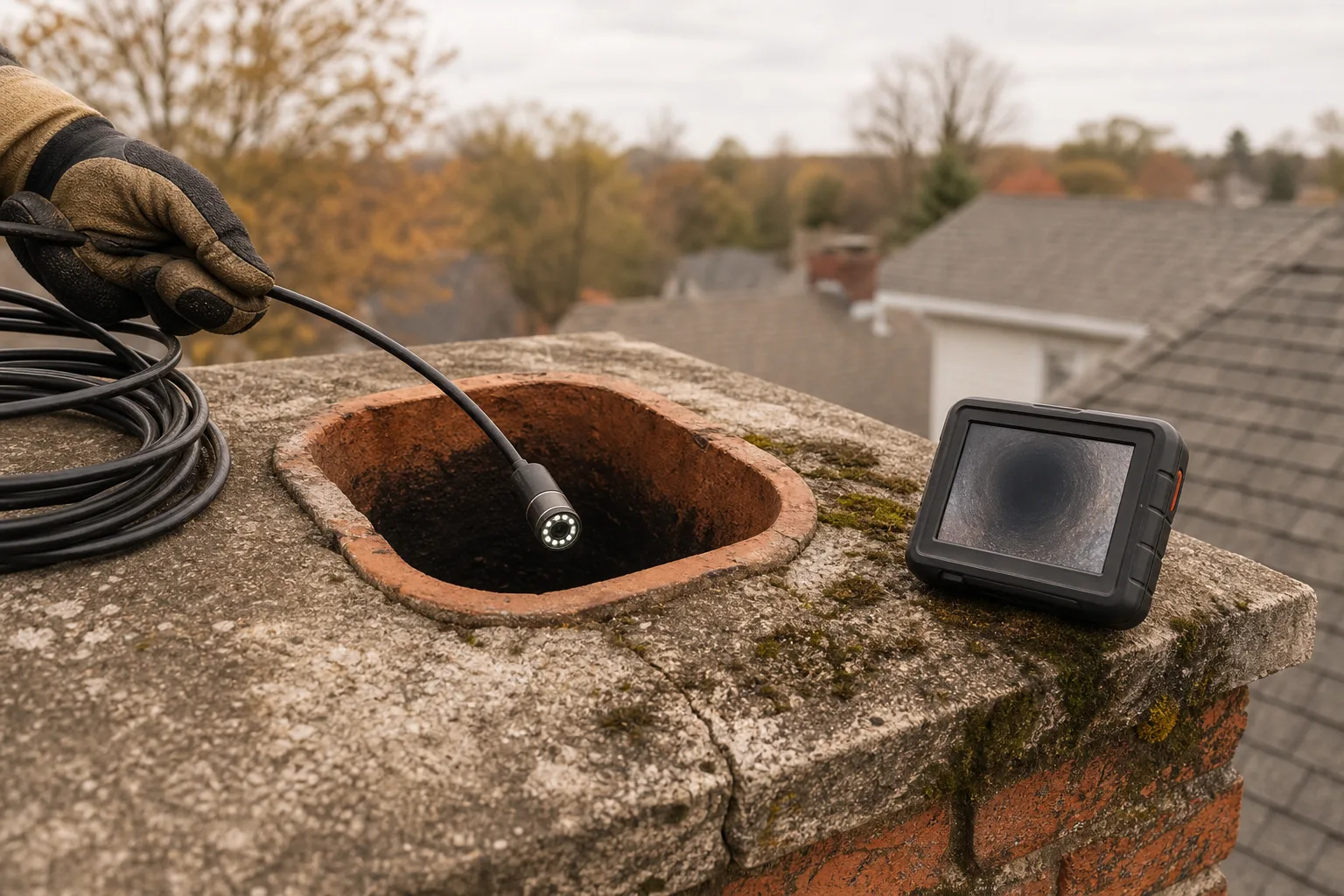
If you are selling, buying, or transferring a house, NFPA 211 calls for a Level 2 inspection. Not a cleaning. Not a Level 1. A Level 2, which requires a video camera run down the inside of the flue, and which extends into the attic and crawl space and basement wherever the chimney passes through.
The same applies after a chimney fire, after a malfunction, after you change fuel types or alter the system, and after an external event likely to have caused damage.
So when the home inspector's report says "recommend evaluation by a qualified chimney professional" and you call three companies asking for a cleaning, you are asking the wrong question. Ask for a Level 2 with video documentation. Watch how fast the conversation changes.
Myth vs. fact: Myth: booking a sweep means your chimney got inspected. Fact: sweeping is cleaning. An inspection is a defined evaluation at one of three levels, and NFPA 211 recommends one at least once a year regardless of how much you burned.
Level 3, and why you probably will not need one
Level 3 is for suspected hidden problems that cannot be evaluated any other way. It involves opening things up: removing or destroying permanently attached portions of the chimney or the building to see what is behind them.
It is rare. It is invasive. If someone leads with it on a first visit, that is a reason to pause, not a reason to sign.
Not sure whether you need a sweep or an inspection?
Tell us what your fireplace is doing, or not doing, and we will look for an independent chimney company serving Alpharetta to put you in touch with. Ask them for the estimate in writing before any work starts. We ask every company in our network to expect exactly that question.
Call (513) 655-6702, or request service online.
How to Vet a Chimney Sweep Alpharetta Homeowners Can Actually Verify
Now the promise from the top of the page. Here is how you separate a chimney sweep Alpharetta residents can rely on from the guy with the brush, and most of it happens before the appointment.
Verify the certification yourself
CSIA stands for the Chimney Safety Institute of America. The credential is the CSIA Certified Chimney Sweep, and CSIA describes it as recognized by industry organizations, insurance underwriters, and local, state and federal agencies as a measure of what a technician knows about evaluating and maintaining chimney and venting systems.
Every serious company in this market puts the CSIA logo on its website. Fine. A logo is not a certification.
CSIA maintains a public credential search at csia.org. Certification belongs to a person, not a company, so ask for the name of the technician who will be at your house, and look that name up. It takes under a minute.
Pro tip: Verify the individual, not the badge on the homepage. Ask "who is coming out, and are they CSIA certified?" A company that hesitates on that question has told you something useful for free.
The questions to ask on the phone
Write these down. Ask them in this order. The answers tell you almost everything.
- Is the technician coming to my house CSIA certified, and what is their name? You are going to verify it.
- Is this a sweep, an inspection, or both, and which NFPA 211 level? If the person on the phone cannot answer this, that is your answer.
- Does the visit include a video scan of the flue? Required at Level 2. Worth asking about at any level if something is actually wrong.
- Will I get a written report with photographs? Documentation you can keep is what lets you check a finding later, or hand it to somebody else for a second opinion.
- If you find something, will the estimate be in writing before any work starts? Not a verbal number on the spot. In writing.
Five questions. Maybe ninety seconds. They will do more to protect you than any review score.
What a legitimate visit leaves behind
A written report. Photographs, or video stills from the flue scan. A plain description of condition, and if there is a problem, where it is and what it is.
What a bad visit leaves behind is a verbal scare and an invoice. No documentation, no photos, just urgency and a number.
If you cannot see it, you cannot verify it, and you should not be paying to fix it yet.
The Upsell Question, Answered Straight
Let me address the thing you were already thinking about before you opened this page.
Yes, this industry has operators who sell fear. A chimney is close to a perfect product for that: expensive, safety-critical, and located where the homeowner physically cannot see it. You are being told about a defect in a place you will never look, by the only person in the room who can see it.
That asymmetry is real. Pretending otherwise would be insulting.
When a finding is real
Real findings come with evidence. A photograph of the cracked crown. A video still of a gap in the flue liner. A description of where it is and why it matters, in language you can follow.
Real findings also come with a timeline that makes sense. Deteriorating mortar joints are a this-year problem, not a tonight problem. A hazard that genuinely means stop using the fireplace gets explained as exactly that, clearly, without theater.
From the field: The visits that go wrong tend to share a shape. Nothing gets photographed, the explanation stays vague, the language turns urgent, and the work is proposed for the same afternoon. The visits that go right tend to be boring. Someone shows you a picture, tells you what it is, and lets you think about it.
When to slow down
If the diagnosis arrives without documentation, slow down. If the recommendation jumps straight to a Level 3 or a full rebuild on a first routine visit, slow down. If saying "I would like to think about it" produces pressure instead of a written estimate, that is all the information you need.
A second opinion on a significant repair is normal, and a confident company expects you to get one. The chimney sweep Alpharetta homeowners end up recommending to their neighbors is almost always the one who was comfortable being questioned.
What the Sweep Will Find on a North Fulton Roof
Alpharetta housing is not New England housing, and the failures are not the same ones. Two very different chimney systems dominate here, and knowing which one you own changes the entire conversation.
Masonry stacks, crowns and mortar
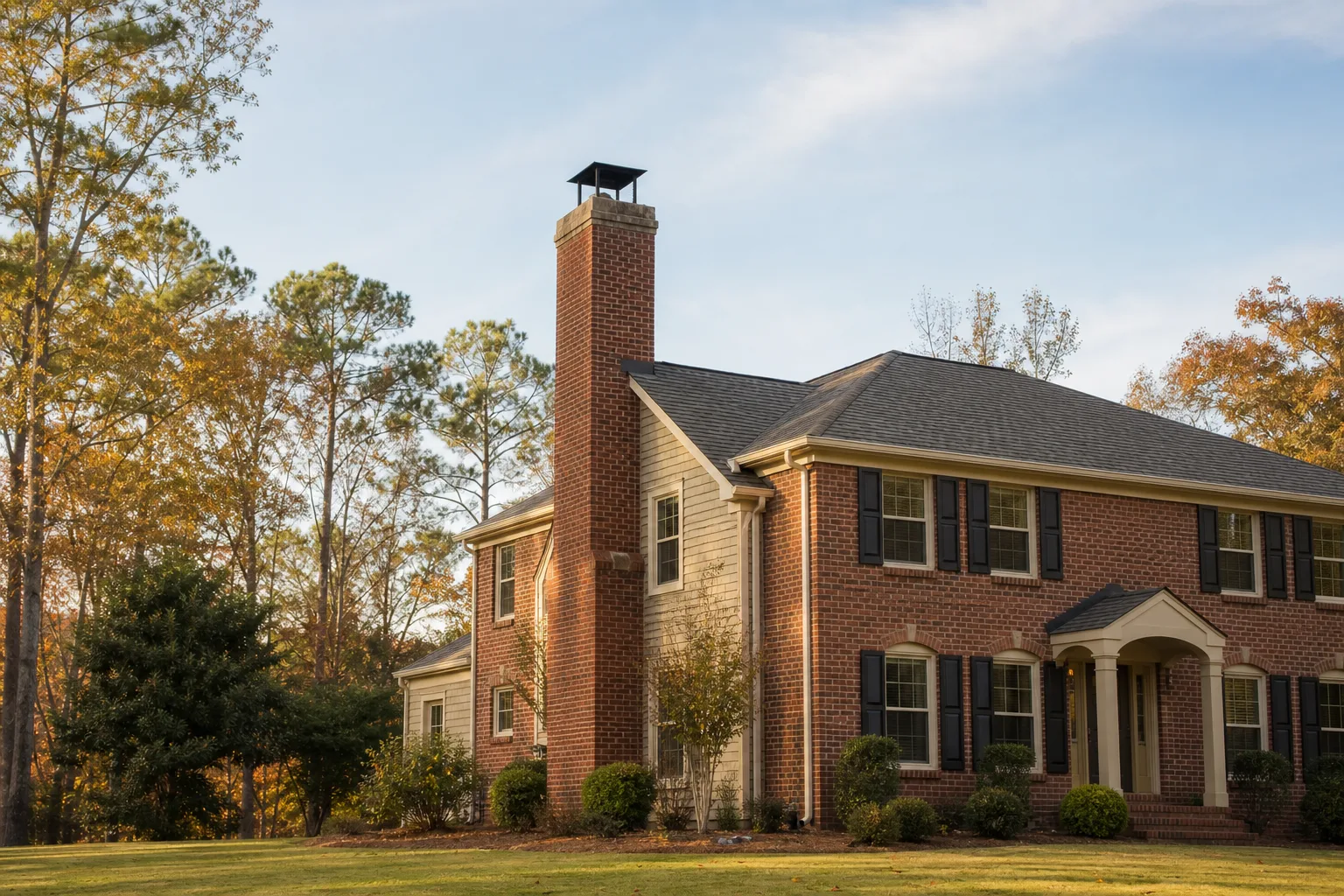
A masonry chimney is brick or stone, with a clay tile flue liner inside and a concrete crown slab across the top, sloped to shed water. The cap sits above that, over the flue opening.
Crowns crack. That is the normal failure. Water gets into the crack, then into the brickwork below it, and the cap and crown stop being decoration and start being the only thing standing between your flue and a Georgia thunderstorm.
Prefab chases and chase covers
A great deal of Alpharetta's subdivision-era housing does not have a masonry chimney at all. It has a factory-built metal firebox and a metal flue pipe inside a framed box, called a chase, clad in siding or brick veneer so it reads as a chimney from the street.
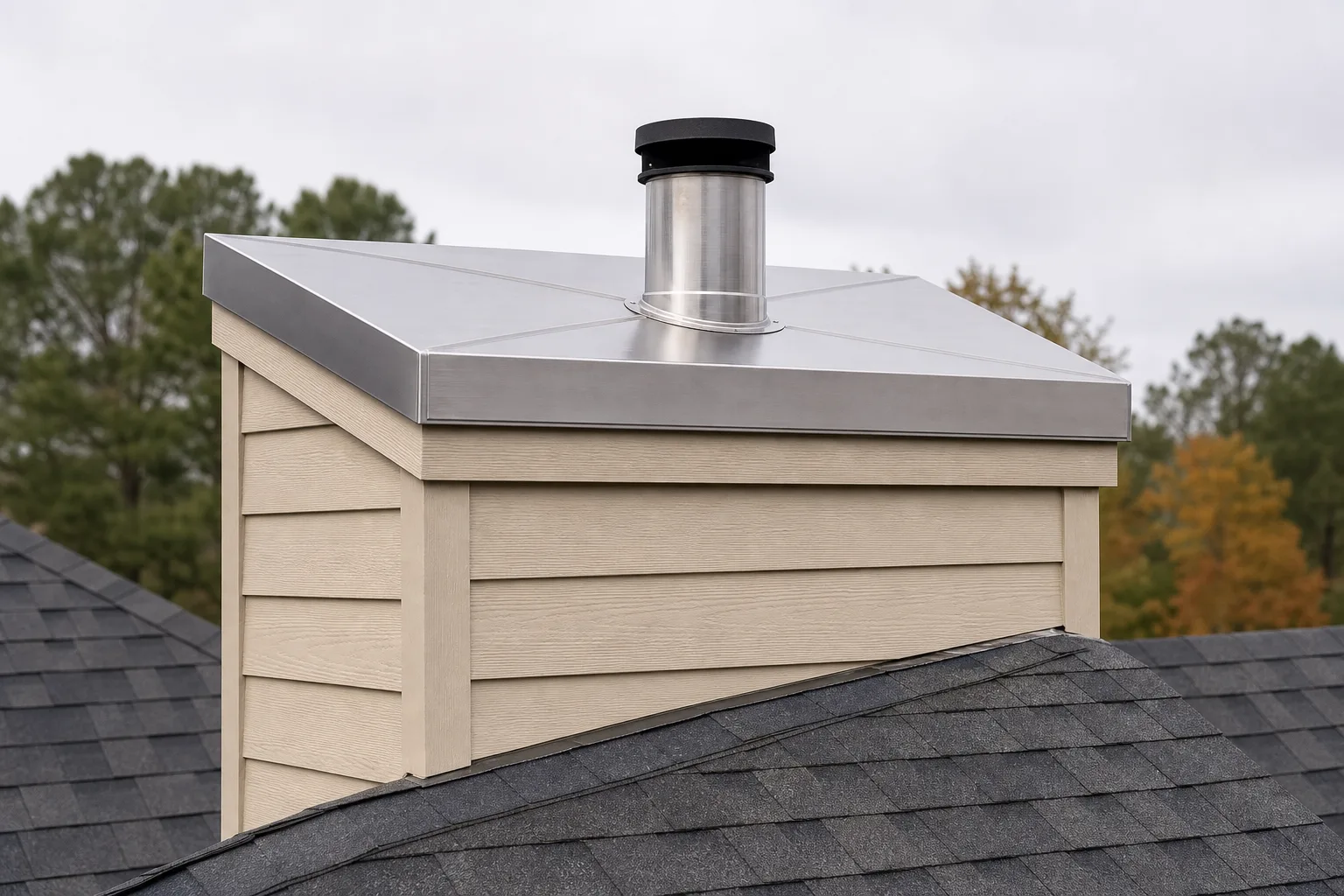
The top of that box is closed by a chase cover: a rectangular sheet-metal pan with a hole where the flue pipe comes through, sealed around the pipe with a rain collar.
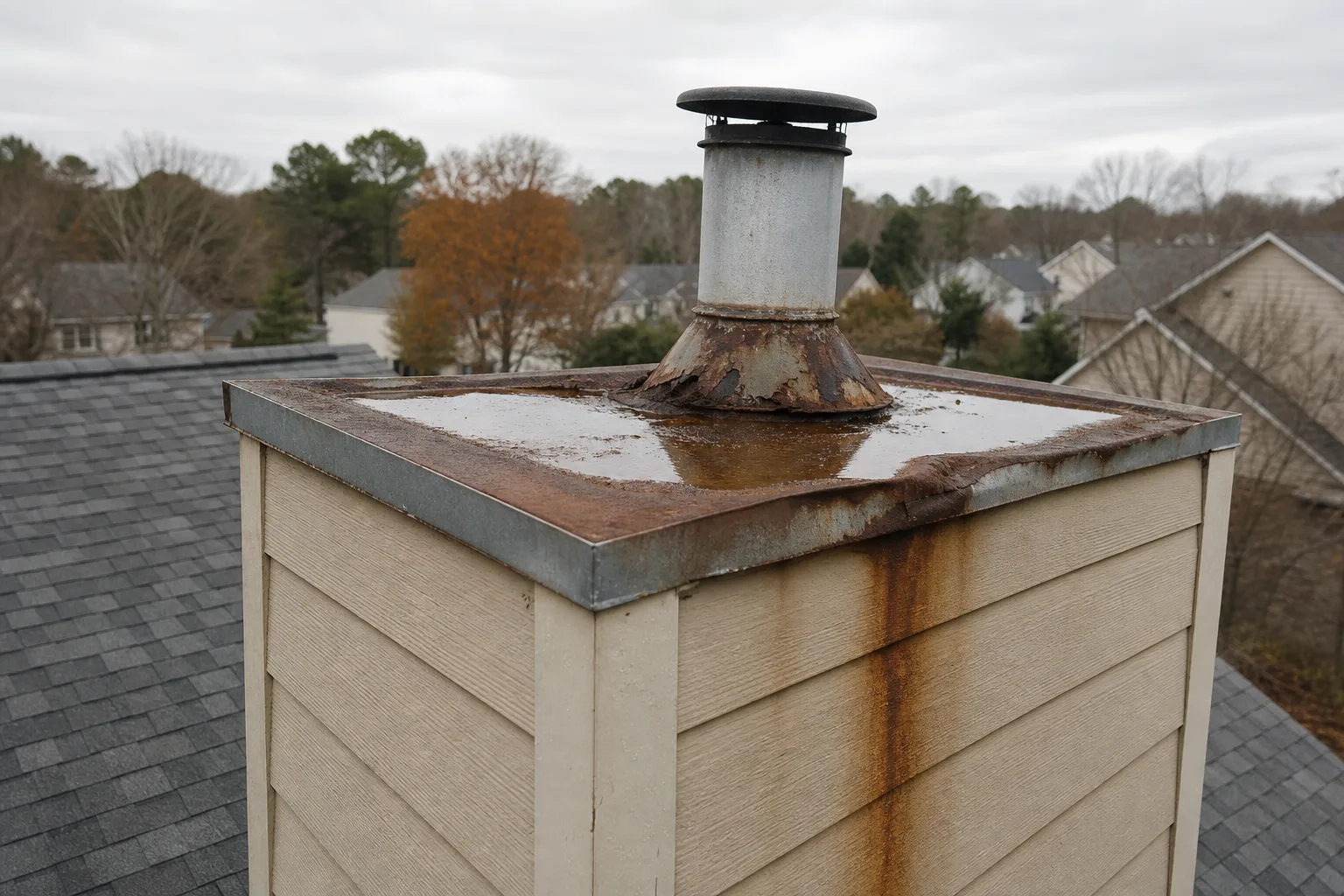
Here is something you can check in thirty seconds without a ladder. Walk outside, stand back, and look at the siding directly below the top of the chase. A dark rust streak running down it is a sign the metal chase cover up there is corroding. It does not prove the cover has failed, and you cannot diagnose that from the driveway, but it is a solid reason to have somebody get up there and look.
Stainless steel and copper covers last. Aluminum comes in colors and gives up durability for them. Galvanized steel rusts, and on plenty of these houses it already has.
Safety note: Water is the quiet destroyer of chimneys. A rusted chase cover, a cracked crown or failed flashing at the roofline lets water into a system that was never designed to get wet, and the damage accumulates invisibly for years before anyone notices a stain on a ceiling.
What Georgia weather actually does
People assume freeze-thaw damage is a northern problem. It is not. Brick and mortar absorb water, that water freezes on our cold nights, expands, then thaws by afternoon. Repeat that cycle through a north Georgia winter and masonry begins to crack, flake and crumble at the surface.
Add humid summers and the rain this region gets, and moisture becomes the most productive thing a chimney sweep Alpharetta homeowners hire is going to look for.
Signs It Is Time to Call
Scan this. If you recognize your own house in one of these, you have your answer.
- Smoke rolls back into the room when you light a fire, or the fire never quite draws.
- A sour, smoky smell on humid days, worst in summer, with nothing burning.
- A water stain on the ceiling or wall beside the chimney or the chase.
- Scratching, fluttering or chirping from inside the flue. Birds and squirrels nest in uncapped chimneys.
- The damper will not move, or will not seal.
- Brick that is flaking, spalling or crumbling, or mortar joints you can dig out with a fingertip.
- Shiny black buildup visible in the flue above the firebox.
That last one deserves its own paragraph.
Creosote gets graded in three stages. Stage 1 and Stage 2 are dry and flaky, and a normal sweeping takes them out. Stage 3 is called glazed creosote, and it is a different animal: hard, tar-black, shiny, and it looks wet even when it is bone dry, as though someone painted the inside of the flue with gloss enamel. It is highly flammable, and it does not come off with a brush. Getting rid of it is a separate job from a standard sweep, and not every chimney sweep Alpharetta offers handles it the same way, so ask.
Stop using the fireplace now if
Safety note: If a carbon monoxide alarm sounds, get everyone out of the house into fresh air first, then call 911 or your gas utility's emergency line from outside. Do not stay inside hunting for the source. Separately, stop burning and have the system evaluated by a chimney sweep Alpharetta homeowners have verified if you have had a chimney fire, including a small one you thought you got away with; if smoke spills into the room during or after a fire, whether through the fireplace opening or from anywhere else; or if you can see daylight or gaps through the flue liner. None of those are schedule-it-next-week items.
How VIO Helps You Find a Chimney Sweep Alpharetta Homeowners Can Trust
A straight answer about who we are, because it changes how you should read everything above.
VIO is not a chimney company. We do not sweep chimneys, we do not run inspections, and we do not have crews, because we do not employ technicians at all. What we do is connect homeowners with independent local chimney companies. That referral relationship is the entire business, and you should know that before you call.
For this situation, the match comes down to three things. Which system you actually have, masonry or prefab, since those are different specialties. What you actually need, a sweep, a Level 1, or the Level 2 that a closing calls for. And where you sit, because Alpharetta, Milton, Roswell, Johns Creek and Cumming are covered by overlapping but not identical sets of companies.
On the money question: we ask every company in the network to put its estimate in writing before any work starts, and you should insist on exactly that. If a conversation heads toward a verbal number and an immediate start, you already know what to do with it.
Bring the five questions to the call. A good chimney sweep Alpharetta homeowners recommend will answer all five without hesitating, and will probably be glad you asked, because those questions mark you as someone who does not need to be persuaded that documentation matters.
One conversation gets it moving. Describe the fireplace, describe what it is doing or not doing, and keep in mind that a chimney sweep Alpharetta families hire this way is hired from that company directly, not employed by us.
Get a chimney sweep Alpharetta locals trust on the calendar
One short conversation and we will go looking for a local, independent chimney company covering Alpharetta and north Fulton to put you in touch with. You describe the fireplace, they tell you what the visit includes, and you insist on the estimate in writing before anyone starts. We ask every company in our network to expect exactly that question.
Call (513) 655-6702.
Symptom checker
What is your chimney doing?
Tap the closest match for an honest first answer.