



On this pageWhat Furnace Chimney Cleaning Actually Means9 sections+8
- What Furnace Chimney Cleaning Actually Means
- Which Venting Setup Does Your House Have?
- The Orphaned Water Heater Nobody Warned You About
- What Happens During a Furnace Chimney Cleaning Visit
- What the Inspection Is Actually Looking For
- When a Level 2 Inspection Is Required, Not Optional
- What You Can Do Yourself, and Where That Stops
- How VIO Helps With Furnace Chimney Cleaning
- Where That Leaves You
Quick answer
Furnace chimney cleaning is service on the flue that carries your furnace's exhaust out of the building, which is separate from sweeping a fireplace chimney. Gas and oil exhaust leaves acidic byproducts rather than creosote. Annual inspection is the published minimum for gas-appliance flues serving furnaces, boilers and water heaters, and the appointment centers on a written condition report covering the flue liner and connector pipe.
Furnace chimney cleaning sounds like housekeeping. It is not. The service covers the flue that carries your furnace's exhaust out of the building, and the most useful thing that comes out of the appointment is a verdict: what condition that flue is in, and whether it is still doing the one job it exists to do.
That flue is not the one above your fireplace. Different pipe, sometimes a different chimney, and an entirely different set of problems.
Which is the hard part. You know the furnace is running. You do not know what it is venting into, or whether that thing needs a person with brushes and a camera.
So this guide starts where the other pages skip: working out which of three venting setups your house has.
Some readers will finish that section and discover their furnace does not use a chimney at all. That is a legitimate result, and worth a few minutes to rule out before booking anything.
What Furnace Chimney Cleaning Actually Means
Start with the thing that causes the most confusion in this whole topic.
A fireplace burns wood, and wood leaves creosote, a sticky tar-like deposit that is itself fuel. That is what a fireplace sweep is fighting. Your furnace burns gas or oil, and it does not make creosote.
What furnace exhaust makes instead is water vapor and acidic combustion byproducts. Those attack the flue from the inside. With oil-fired equipment the chemistry is documented and aggressive: sulfur, chemical residues and air pollution combined with water form a highly aggressive acid capable of causing considerable damage to flue tiles.
The published position of the trade bodies is that annual inspection is the minimum for gas-appliance chimney flues serving furnaces, boilers and water heaters. CSIA, the National Chimney Sweep Guild, NFPA and the residential code all land in the same place on that point.
The wording matters. The annual item is the inspection, and whether anything gets swept follows from what that inspection turns up.
That is why booking "a cleaning" and expecting a purely cosmetic result is the wrong mental model. You are buying a condition report on the path your furnace exhaust takes to the outdoors, with sweeping performed where that inspection calls for it.
Myth vs. fact: Homeowners have told sweeps they assumed the gas utility or the fuel delivery company handled the flue. That is not how the responsibility falls. Arranging inspection and cleaning of the flue serving your furnace sits with the property owner.
Which Venting Setup Does Your House Have?
Go stand next to the furnace. You are looking for one thing: the pipe leaving the top of the cabinet, and where it goes.
There are three answers, and they lead to three different conversations.
The older furnace venting into a masonry chimney
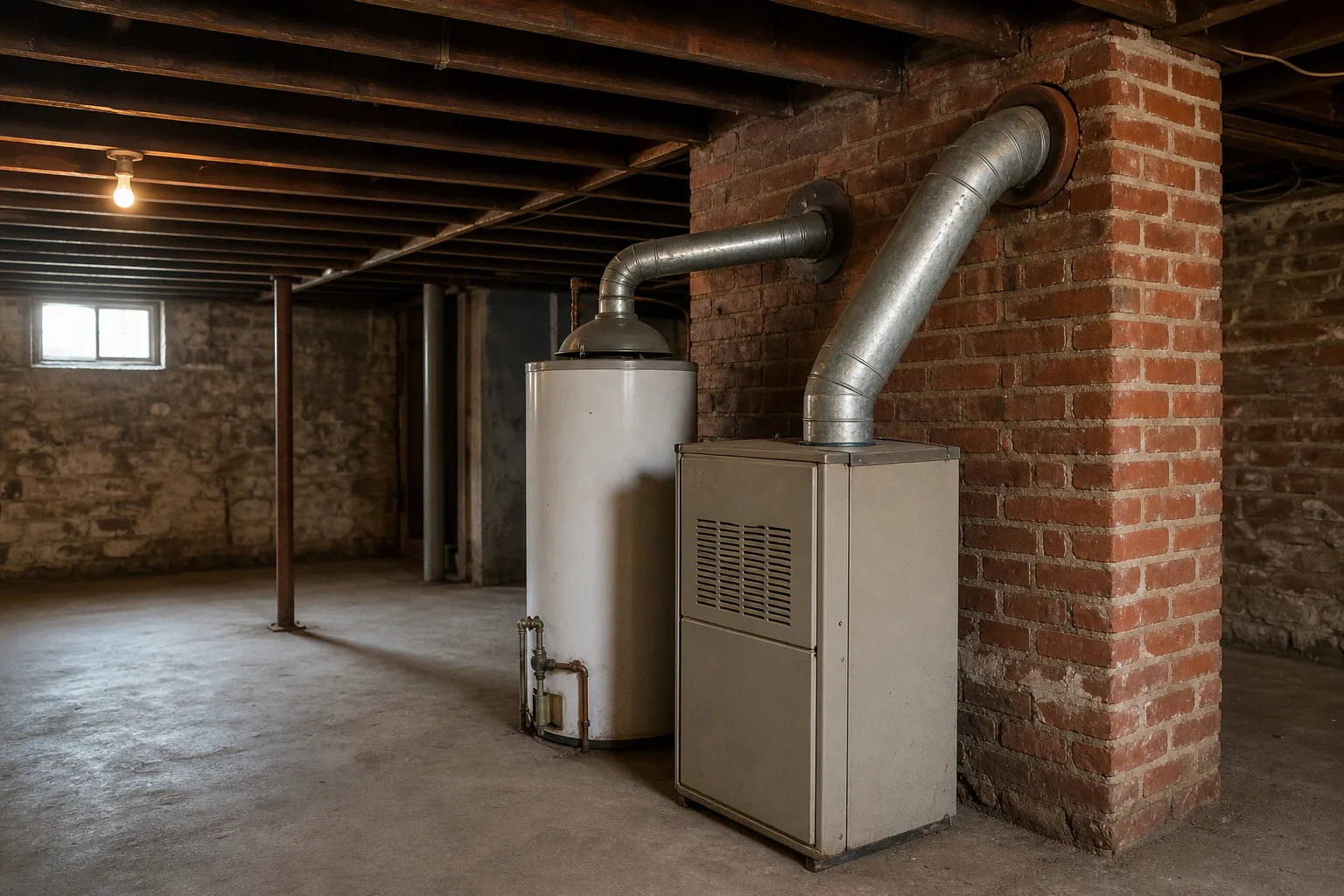
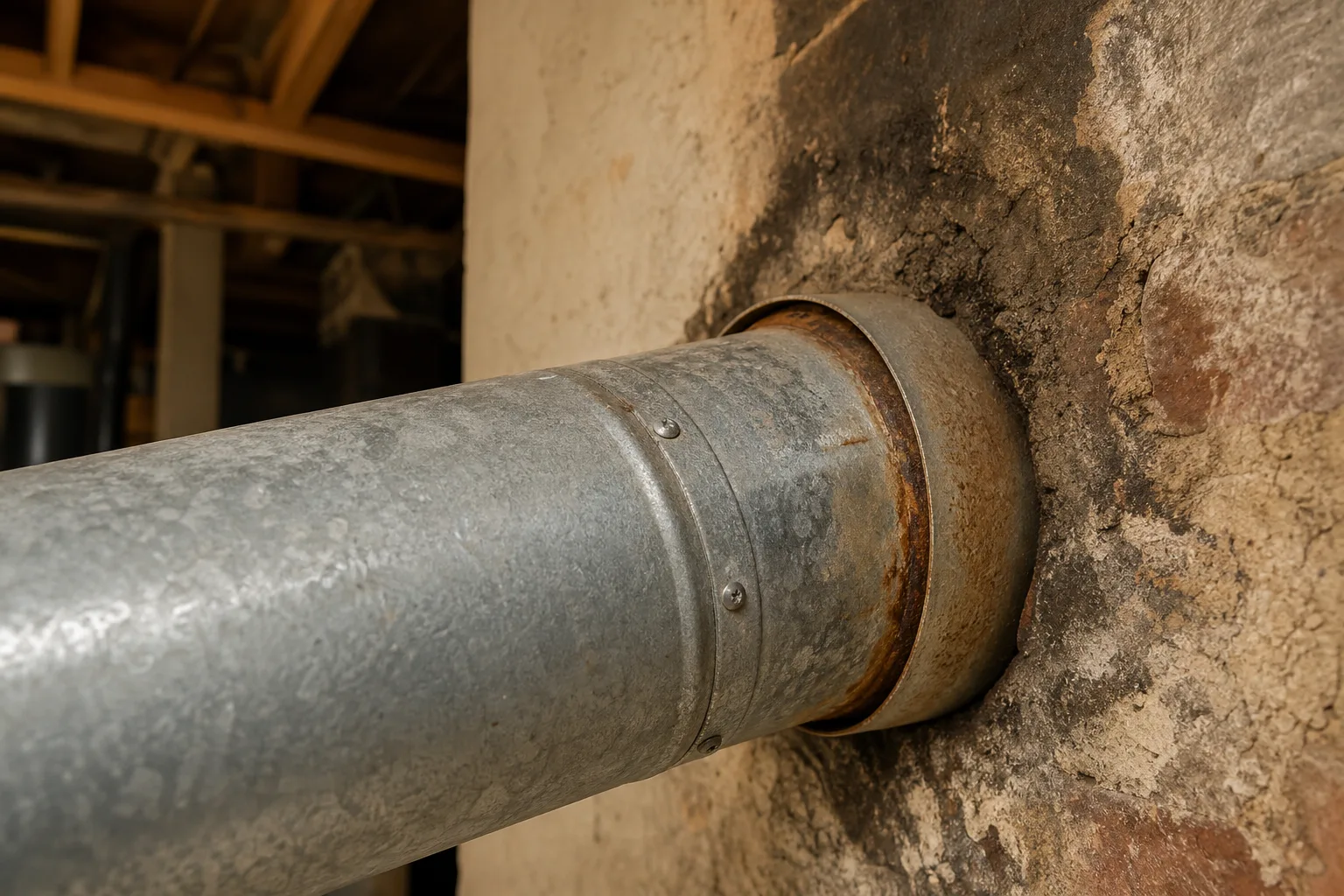
Look for a round pipe, dull silver, made of a single thickness of galvanized steel. It leaves the top of the furnace cabinet, rises at a slight angle, and disappears into a round opening in a brick or block wall.
That opening is called a thimble. The pipe is the connector, and it is held together with sheet-metal screws you can spot along the seams.
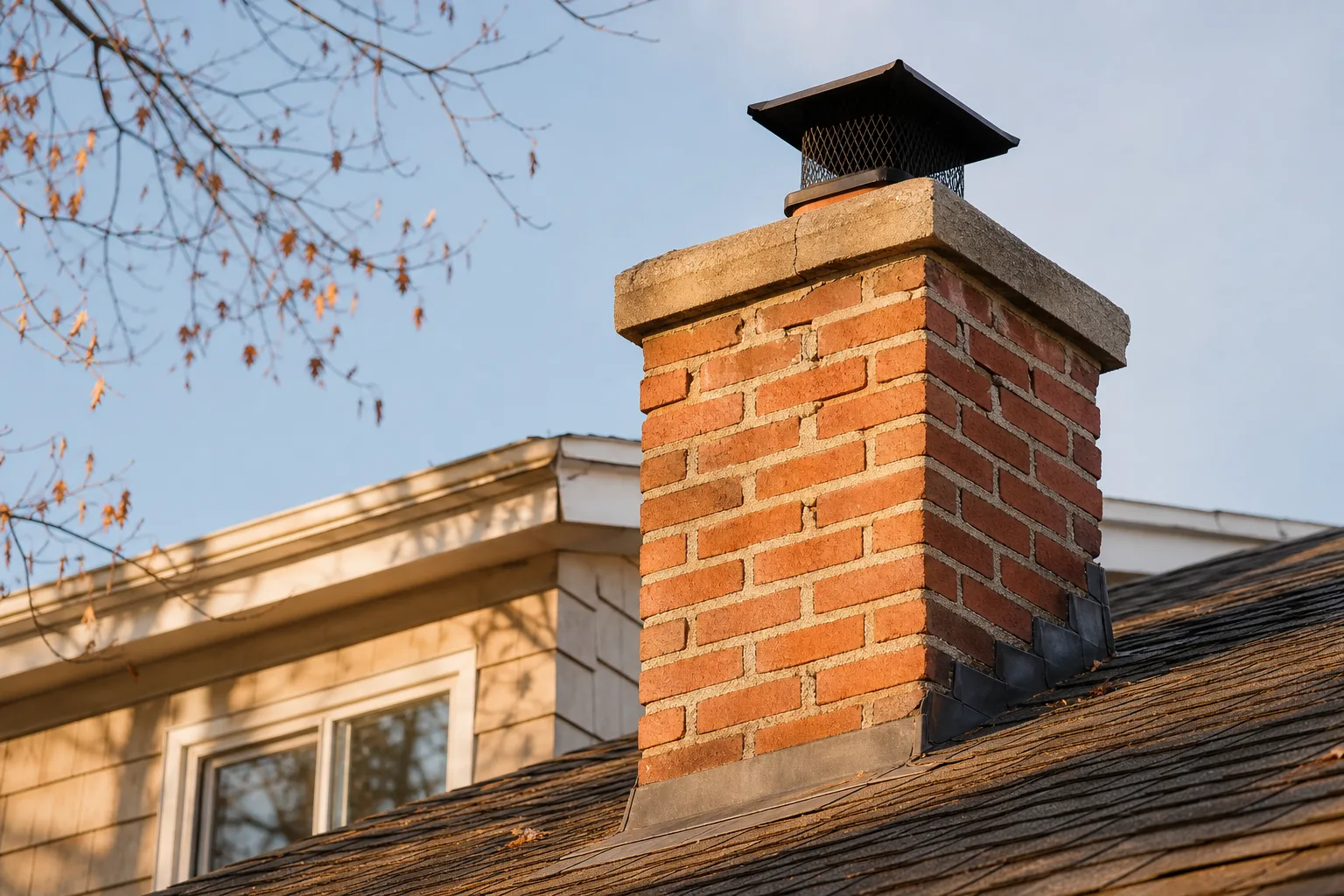
Follow the wall up. If there is a brick chimney with a concrete crown and a cap on top, your furnace is venting into masonry, and furnace chimney cleaning applies to you in the fullest sense.
One more thing to check while you are down there. Is a water heater standing nearby with its own smaller pipe running into the same chimney? Note that. It matters two sections from now.
The furnace on a metal liner or Type B vent
Same basic geometry, different pipe. Type B vent is double-walled, with a bright galvanized outer shell, visible crimped joints, and a twist-lock seam where sections meet.
It looks tidier than single-wall pipe because it is a manufactured system rather than plain sheet metal.
The code language behind this is specific rather than universal. Masonry flues serving listed gas appliances with draft hoods, Category I appliances, and other gas appliances listed for use with Type B vents are permitted to be lined with a chimney lining system listed for use only with those appliances. In other words, the liner has to be matched to the appliance class, not just present.
The high-efficiency furnace that skips the chimney entirely
Now the setup nobody warns you about before you start searching.
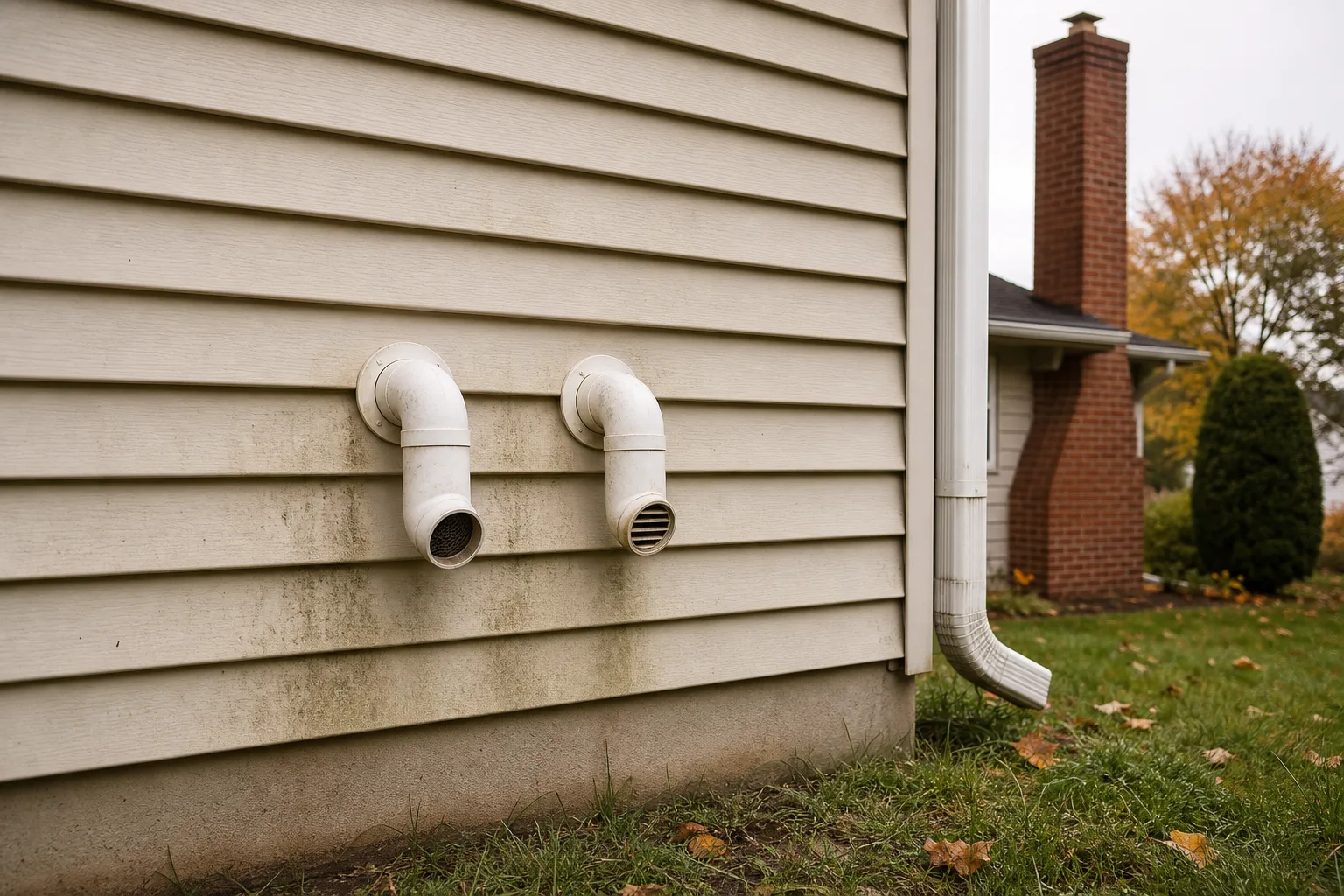
A condensing, high-efficiency furnace extracts so much heat from its exhaust that the exhaust comes out cool and wet. It cannot be sent up a masonry chimney. Instead it vents through plastic pipe, roughly two to three inches across, straight out a sidewall of the house.
Go outside and walk the exterior wall nearest the furnace, low down near grade. Two white PVC stubs with elbows, side by side, one drawing combustion air in and one pushing exhaust out, is the signature.
If that is what you find, your furnace has no chimney to sweep, and no honest company should sell you a sweep for it.
Keep reading anyway if masonry still stands on your roof. Something may still be venting into it.
| What you see at the furnace | Where the exhaust goes | What shows on the outside | What furnace chimney cleaning covers here |
|---|---|---|---|
| A round single-wall galvanized pipe sloping up into an opening in a masonry wall | Into a masonry chimney flue, which in some houses is shared with a water heater | Brick or block, a concrete crown, and a cap at the top | The full flue, plus the connector pipe and the chimney's own components |
| A double-wall pipe with a bright outer shell and twist-lock joints | Into a listed metal lining system or a Type B vent inside the chimney | A metal liner top or vent termination above the crown | The lining system's condition, and whether its listing matches the appliance class |
| Two white plastic pipes, roughly two to three inches, leaving the furnace cabinet | Out through a sidewall near grade, not up the chimney | Two PVC stubs low on an exterior wall, one intake and one exhaust | Nothing on this appliance, since it is not vented through a chimney |
Good to know: The quickest way to tell single-wall pipe from double-wall is to look at the end of a joint rather than the middle. Single-wall shows one thickness of metal. Type B shows an inner pipe set inside an outer one, with an air gap between them.
Not sure which setup you have? Describe what you can see next to your furnace, and VIO will match you with an independent chimney company in your area that works on furnace venting. Call (513) 655-6702 or request service online.
The Orphaned Water Heater Nobody Warned You About
Here is the scenario that catches people who did everything right.
You replaced an aging furnace with a high-efficiency model. The installer ran new plastic pipe out the sidewall, which is correct for that appliance. The furnace no longer touches the chimney.
The water heater, though, stayed exactly where it was, still venting into the masonry flue. It now has that flue entirely to itself.
The trade has a name for this: an orphaned water heater. The flue was sized for the combined output of two appliances, and one of them just left.
The problem is not emptiness, it is temperature. Exhaust from the water heater alone may not be sufficient to heat that mass of dense masonry, and an oversized flue liner in that condition creates a documented condensation problem.
NFPA 211 is direct on the underlying rule. Connector and flue sizing must match the appliance's BTU input and its appliance category. Removing half the load from a flue changes both sides of that equation.
There is a second consequence. Removing an appliance from a venting system is one of the conditions that calls for a Level 2 inspection, covered below. A furnace swap is not only an HVAC job, it is a change to the chimney.
Safety note: The concern with an orphaned flue is moisture, not soot. Where exhaust condenses inside masonry instead of leaving warm and dry, that moisture becomes the starting condition for the freeze-thaw damage described further down this page. A flue in that state is worth having examined on its own merits, separately from whatever the furnace is doing now.
What Happens During a Furnace Chimney Cleaning Visit
The appointment has a shape to it, and knowing the shape makes it much easier to tell whether you got what you paid for.
Before anything gets swept
The appliance gets shut down and isolated first. Nobody sweeps a flue attached to a running furnace.
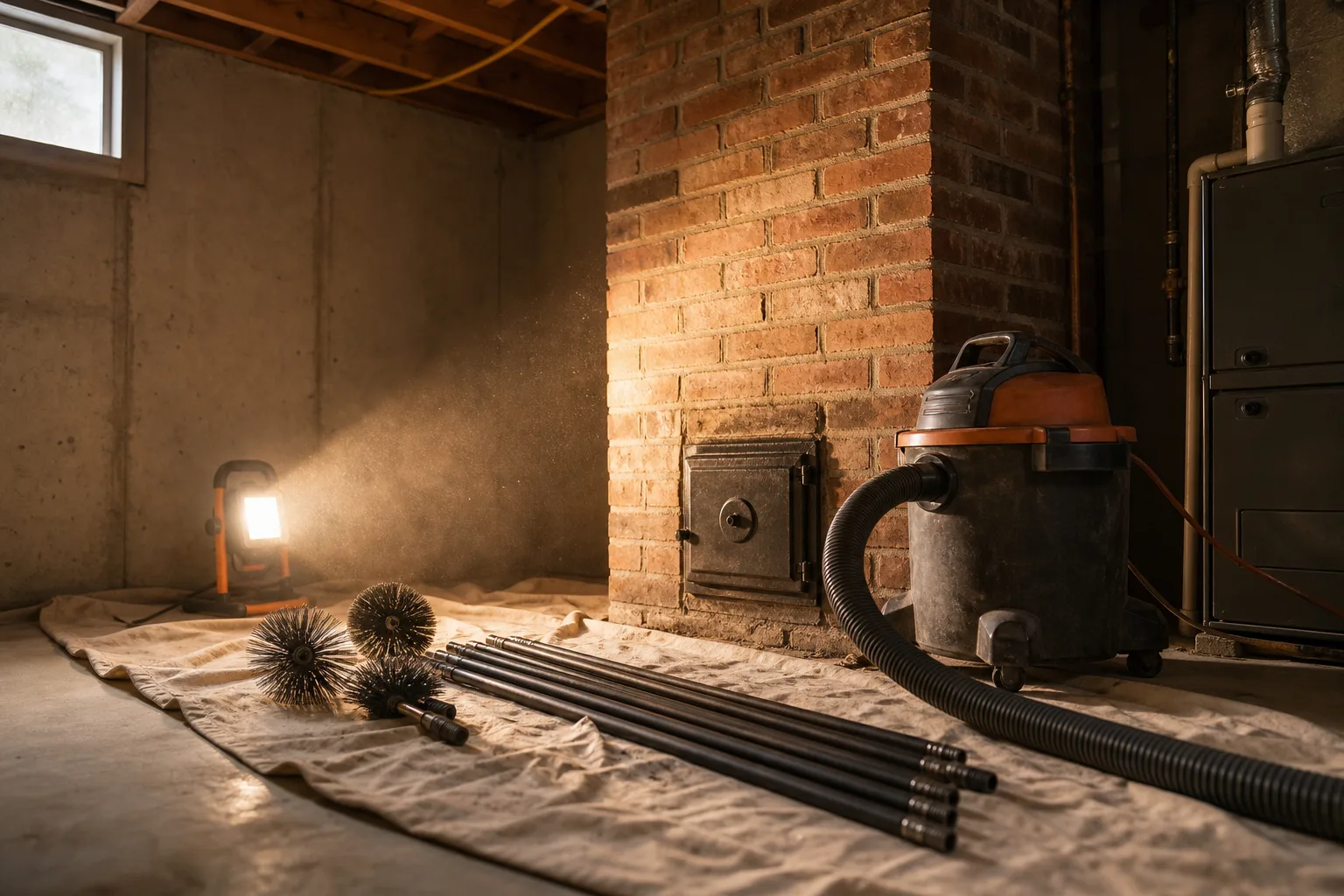
Then the dust controls: drop cloths over the floor, a vacuum with a large hose at the base of the chimney, and a work light, because unfinished basements are dark.
The sweeping itself
Brushes go on screw-together rods and travel the length of the flue, either from the top down or from the cleanout up, depending on the chimney.
What comes down matters as much as what gets removed. When rods and brushes pass through the system, loose pieces of fire clay tile, damaged tile joints or crumbling brick can fall to the bottom, and that debris is an integrity finding in its own right.
A flue that surrenders pieces of itself to a brush is telling you something about its condition, not about how dirty it was.
The report is the real deliverable of furnace chimney cleaning
A CSIA-certified sweep works visually from the top opening down, and the written report covers the condition of the flue liner, smoke chamber, smoke shelf, damper, firebox, chimney crown and chimney cap, among other components examined.
That document, not the absence of dust, is what you actually bought, and it is what you carry into any later decision about the chimney.
Pro tip: Ask for the written report before the truck leaves, and then ask what each finding means for your flue specifically. A line reading "cracked tile at the base" is a description, not a recommendation. The gap between those two is the conversation worth having while somebody knowledgeable is still standing in your basement.
What the Inspection Is Actually Looking For
Three parts of the system carry almost all of the interesting findings.
The liner
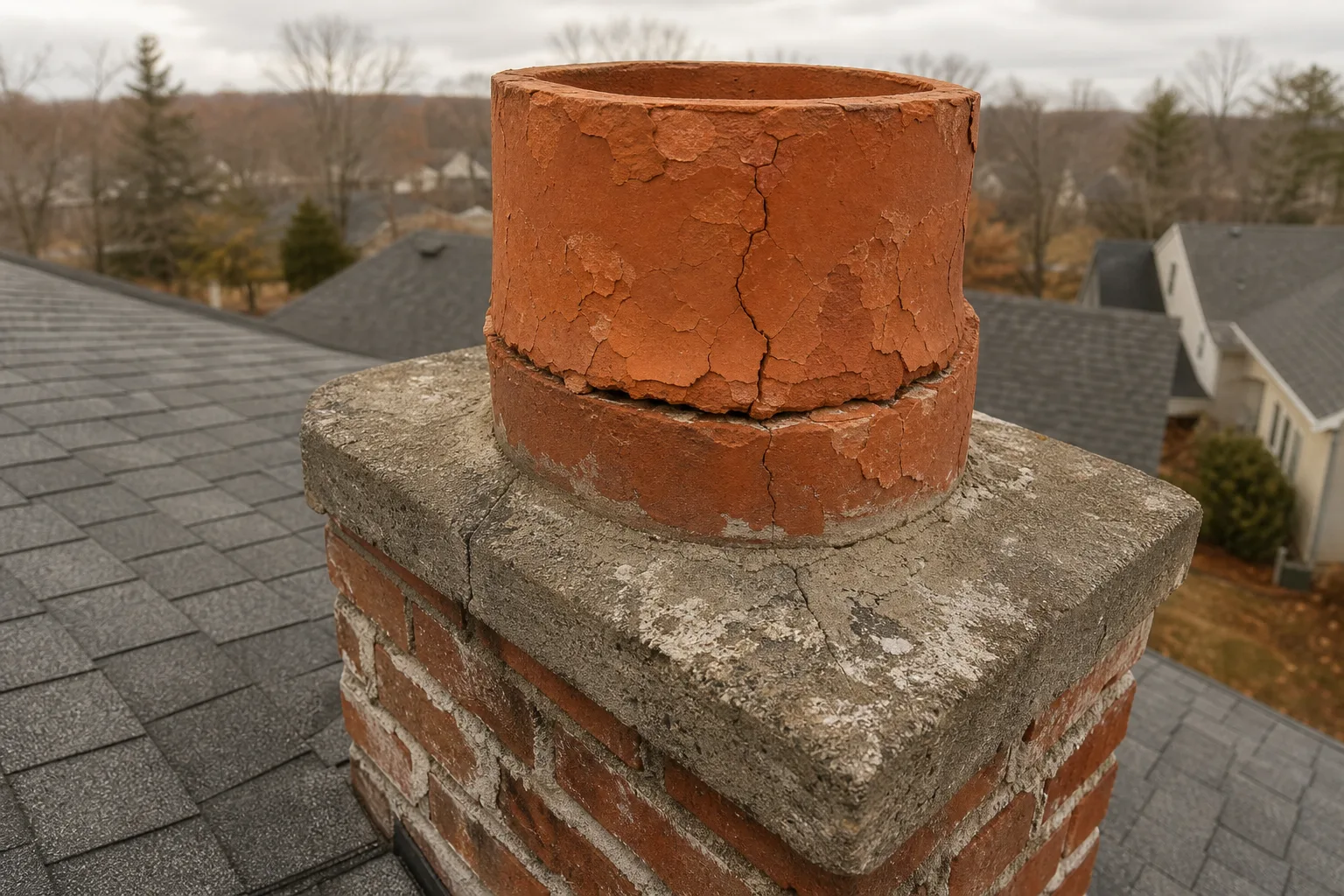
Clay tile liners are square or rectangular in section, terracotta orange-brown, and visible at the top of the chimney above the crown.
They fail in a known pattern. A wet chimney going through freeze and thaw cycles drives bricks and clay tile liners to spall, which means flaking away in layers, and to crack, while mortar joints erode and water works its way to the base.
Cracked fire clay flue tile at the base of the chimney is a standard inspection finding, and it is exactly the kind of thing that only shows up when somebody puts a camera down the flue.
On oil-fired systems there is the acid problem described earlier, working steadily on the same tiles from the inside.
The connector pipe
The run of pipe between the furnace and the chimney gets less attention than it deserves, partly because it is the one component a homeowner could actually look at.
The inspector is reading it for rust at the seams, for slope, for joints that have worked loose, and for screws that have backed out. Where a connector has pulled apart at a joint, exhaust can escape into the room rather than travel up the flue.
Blockage and what gets in
Nests, leaf litter, and pieces of the chimney's own deteriorating masonry all end up in the same place, which is the narrowest point of the flue.
The two hazards the trade names for a blocked or breached furnace flue are fire, where heat reaches a combustible assembly through a failed liner, and carbon monoxide entering the living space instead of leaving the building. That is the reason the whole system is designed the way it is, and the reason an annual look is the published floor rather than a luxury.
From the field: A flue that reads as sound from the driveway can look like a different structure on a camera. Daylight visible at a chimney top says nothing about the joints between tiles twenty feet below it, and the inside surface of a furnace flue is not something a homeowner has any practical way to see. Condition and appearance are separate questions here.
When a Level 2 Inspection Is Required, Not Optional
Inspections come in levels, and the distinction is not marketing. Level 1 is the routine annual look at readily accessible parts. Level 2 adds the flue interior by video scan, plus accessible parts of the chimney exterior and the spaces it runs through.
NFPA 211 names the situations that call for Level 2, and the wording is worth having in front of you rather than paraphrased.
A Level 2 inspection is required upon sale or transfer of the property. It is required upon addition or removal of an appliance, or a change in the fuel type, or a change in the shape or material of the flue. It is required after a malfunction or an operating malfunction of the system. It is required after a chimney fire. And it is required after a "potentially damaging external event such as" an earthquake or a weather event.
Run this against your own last two years. If any line applies, what you need is a Level 2 inspection rather than the routine annual inspection, and that distinction is worth raising when you call about furnace chimney cleaning.
- You bought, sold or inherited the property, or are about to.
- A furnace, boiler or water heater was added to the venting system, removed from it, or replaced.
- The fuel changed, for example from oil to gas.
- The flue's shape or material changed, which includes any relining work.
- The system malfunctioned, or something about how it operates changed and nobody has explained why.
- There was a chimney fire, or a potentially damaging external event such as an earthquake or a weather event.
Good to know: Code language here is scoped, not universal. Clearance rules are written about a combustible assembly specifically, and lining requirements are written about particular appliance categories. Which edition of the fuel gas code applies to your house also depends on what your jurisdiction has adopted, and adoption runs behind publication, so treat a local answer as the authoritative one.
What You Can Do Yourself, and Where That Stops
Look at the connector pipe with a flashlight. Rust blooming at a seam, a joint that has pulled apart, or a section sagging where it should rise toward the chimney are all things you can see without tools and all things worth reporting when you book.
Walk the outside of the chimney from the ground once a season. Mortar joints going pale and recessed, a cracked crown, a cap that has shifted: all visible from the yard.
Put carbon monoxide alarms on every level of the house, including the level the furnace is on. If a CO alarm activates, follow the alarm manufacturer's instructions and emergency guidance: move to fresh air and contact emergency services as directed. Investigating the furnace is not the first step.
Where it stops is the flue interior and the roof. Unless you are trained and equipped for both, the inside of a furnace chimney and the work of getting onto a roof to reach it are not a homeowner project. That is the part of furnace chimney cleaning that needs somebody who does it for a living.
Pro tip: Photograph the connector pipe and the furnace data plate before you call anyone. Two clear pictures answer most of the questions a company asks over the phone, and they make it far easier to describe a setup you do not have the vocabulary for.
How VIO Helps With Furnace Chimney Cleaning
VIO is a matching service, not a chimney company. We do not own trucks or send crews. We connect homeowners with independent local chimney companies that work on furnace venting, so you are not working down a list of names and guessing which ones know a fireplace flue from a Category I appliance vent.
For furnace chimney cleaning specifically, describing your setup up front is what makes the match useful. The three-way identification earlier in this guide is the vocabulary for that conversation: single-wall connector into masonry, listed metal liner or Type B, or plastic pipe out a sidewall.
On money, here is our own commitment and your part in it. We ask every company in the network to put its estimate in writing before any work starts, and you should insist on exactly that. Get the scope and the price on paper, read it before anyone unpacks a brush, and treat a written condition report as part of what you are arranging rather than an extra.
Where That Leaves You
You came here for furnace chimney cleaning and you leave with something more useful than a service description: a way to tell which venting setup is in your house, and therefore which of these paragraphs was ever about you.
If it is plastic pipe out a sidewall and no masonry on the roof, you can close this tab.
If it is masonry, the decision is not whether to sweep. It is whether any of the triggers listed above has happened without a Level 2 inspection following it, and a trigger that went uninspected still counts however long ago it was.
Work that out before the cold sets in properly, then book the inspection it points to. Furnace chimney cleaning follows from whatever that inspection finds.
Book the furnace chimney cleaning before the cold settles in. VIO connects homeowners with independent local chimney companies, and we ask every company in the network to put its estimate in writing before any work starts. Insist on exactly that. Call (513) 655-6702 or request service online.
Symptom checker
What is your chimney doing?
Tap the closest match for an honest first answer.