



On this pageWhat a Fireplace Sweep Actually Does Inside Your House7 sections+6
- What a Fireplace Sweep Actually Does Inside Your House
- How to Vet Fireplace Sweepers Near Me Before You Let Anyone In
- Sweeping and Inspecting Are Two Different Jobs
- The Red Flags That Should End the Visit
- Beyond the Firebox: The Parts Nobody Thinks to Ask About
- The Booking Checklist
- When to Book, and How Often
Quick answer
Four things are worth insisting on when hiring a fireplace sweep: proof of individual certification and insurance before anyone enters, a camera look at the flue rather than a guess, dust containment, and written findings with photos so you can decide what happens next. None of these is a universal legal requirement, so ask for them by name. Sweeping and inspecting are separate jobs, and no repair should be approved on evidence you were never shown.
Most people who search fireplace sweepers near me are not shopping. They are worried. Something smells wrong, or the smoke rolled into the room last winter, or a home inspector wrote a line about the flue and now there is a deadline attached to it. So here is the short version before anything else: there are four things worth insisting on when you hire one. Proof of certification and insurance before anyone crosses your threshold, a camera or at least a bright light up the flue rather than a guess, dust containment instead of a black film on your mantel, and written findings with photos rather than a verbal warning and a same-day invoice. None of those four is a universal legal requirement of the trade. They are the standard you get to set as the customer, and plenty of companies will meet it once you ask.
That is the whole shortlist. Everything below is how to apply it without needing to know a single thing about chimneys yourself.
Good to know: "Sweep" is the trade word. "Sweeper" is the word almost everybody actually types. They mean the same person; nobody in this business is going to correct your vocabulary, and if someone does, that tells you something about how the rest of the visit will go.
What a Fireplace Sweep Actually Does Inside Your House
A real sweep visit is quieter and more clinical than people expect. There is no soot-covered figure singing on your roof.
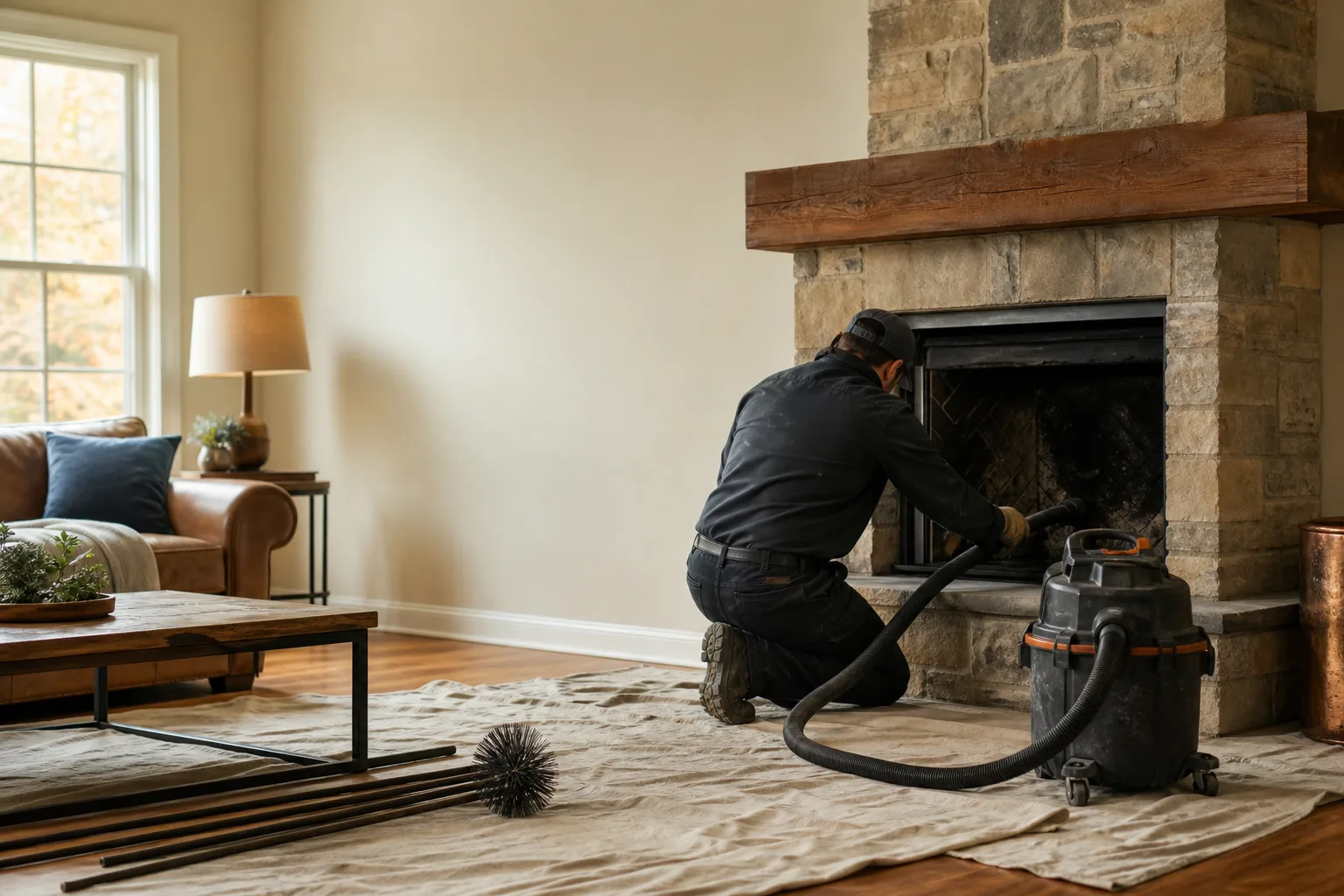
Where the brushing starts depends on the chimney and the technician's method. Top-down from the roof and bottom-up from the hearth are both accepted approaches, and some jobs use each in turn. What should not vary is that someone examines the firebox: the damper, the smoke shelf, the firebrick and mortar joints, and the condition of the surround. Before any of that, containment goes in: drop cloths, a sealed cover over the fireplace opening, and a HEPA-filtered vacuum running the entire time to hold the firebox under negative pressure. That vacuum is the difference between a clean job and a week of wiping black film off your mantel and your curtains.
The actual sweeping is done with rods and a brush sized to your flue, worked from below, from above, or both, depending on the chimney's shape. What comes down is creosote and soot and sometimes a startling amount of debris that was never supposed to be in there: leaves, twigs, mortar chunks, the occasional nest. Creosote is the part that matters most, because it is the fuel in a chimney fire. If you want the chemistry and the three stages of buildup, we wrote that up separately in what is creosote.
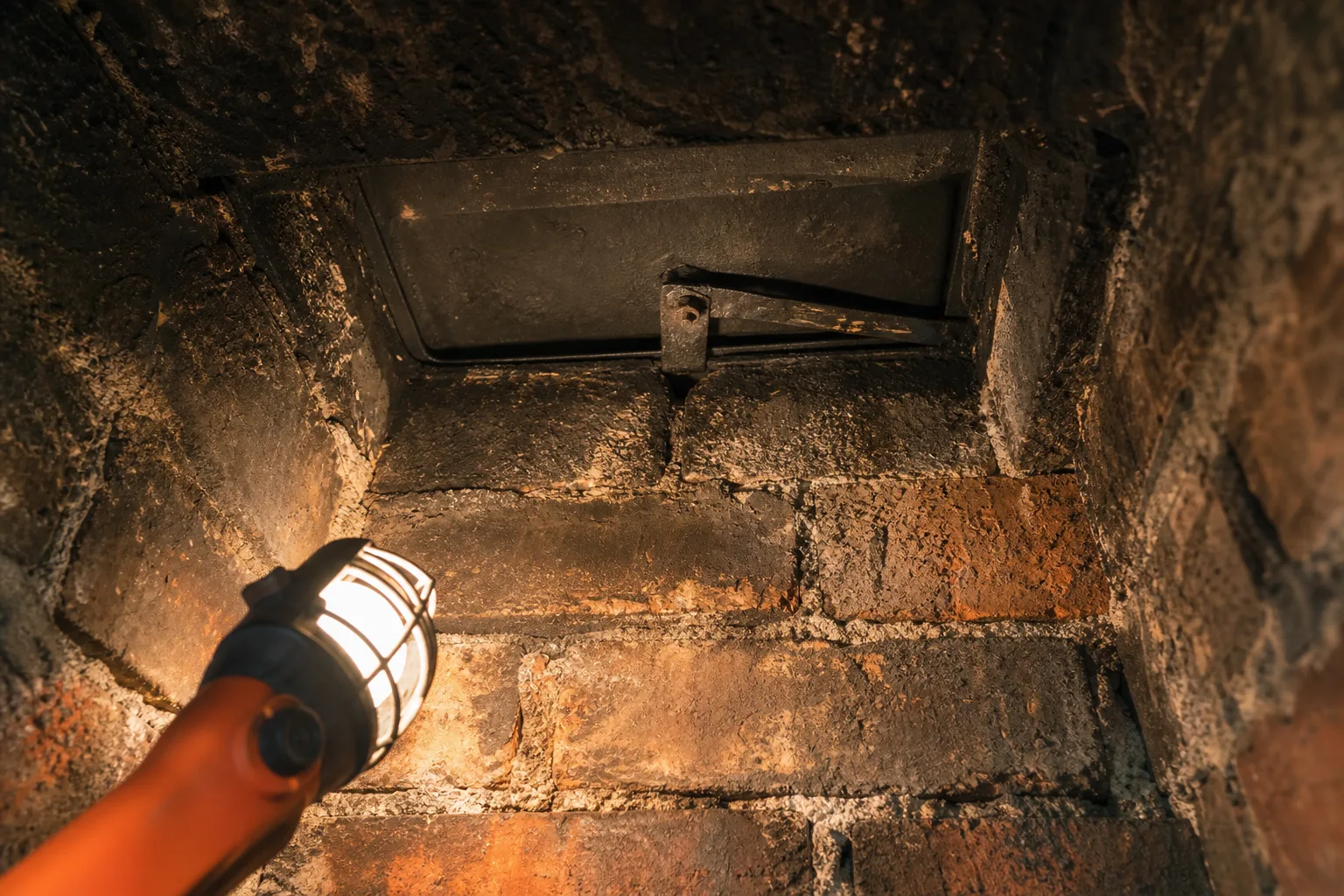
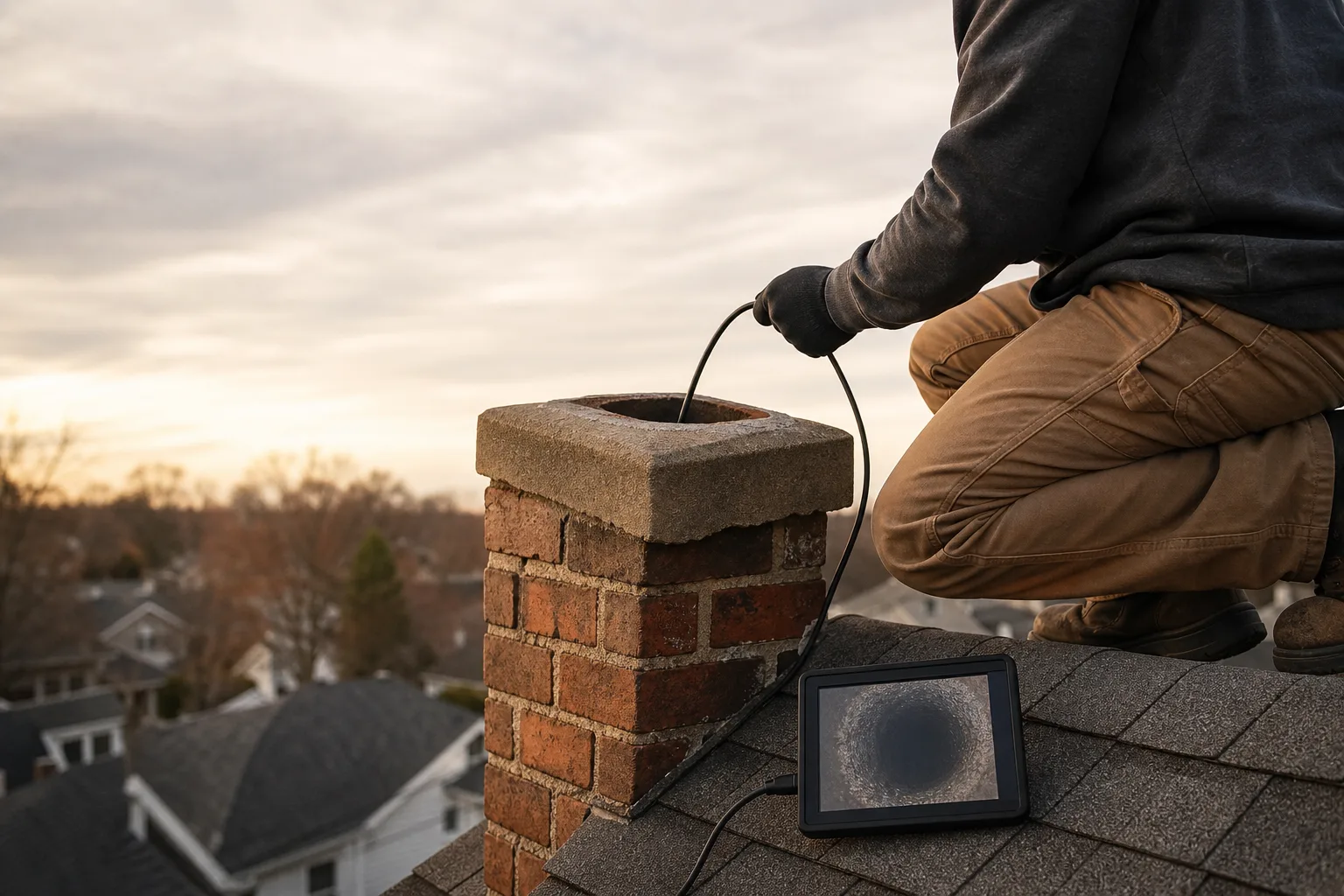
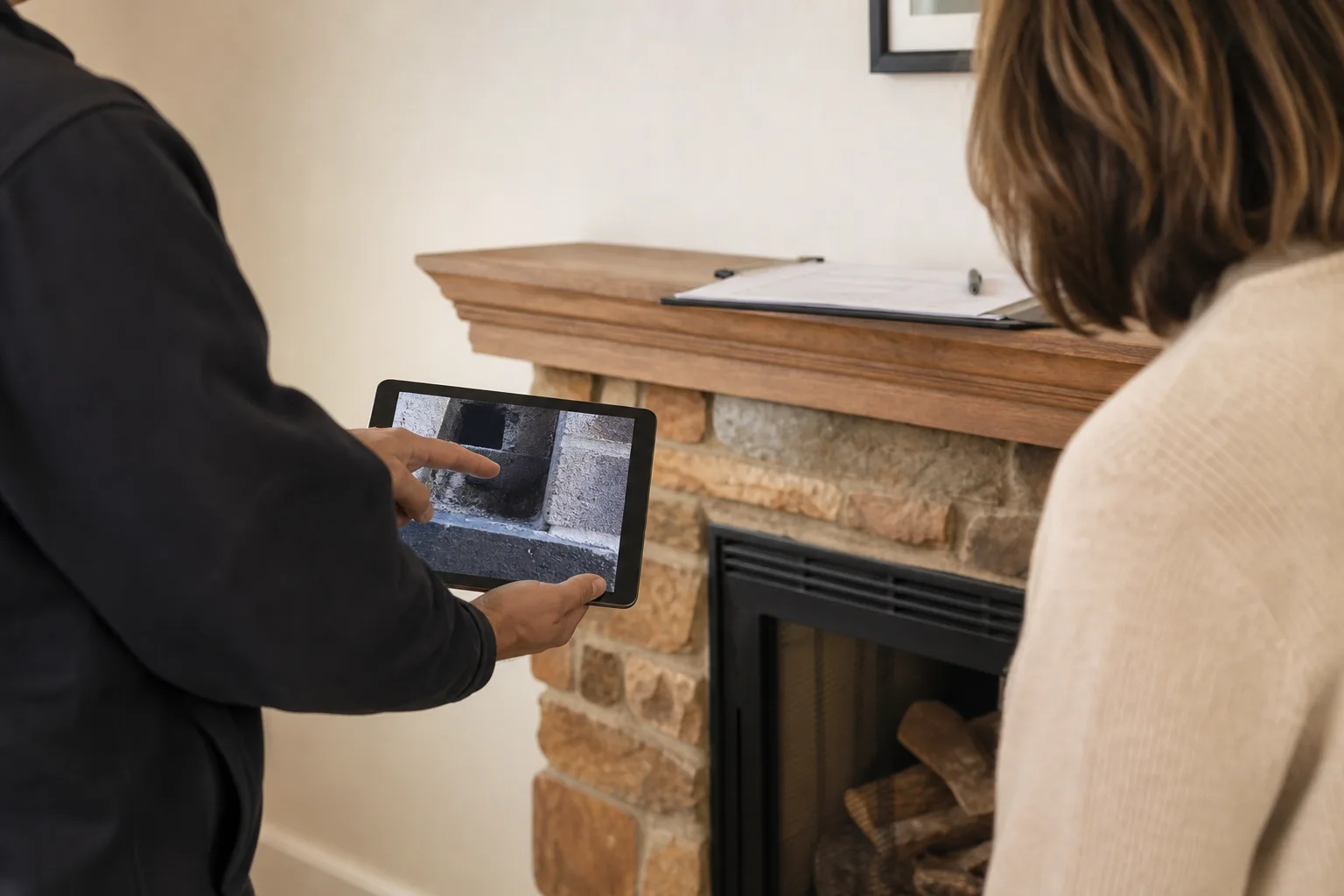
After the brushing, a good technician goes back up with a camera or a strong light and looks at what the brush revealed. Clean walls expose cracks, gaps in the liner, missing mortar between clay tiles, and rust at the connections. That second look is where the useful information lives. A sweep who packs up the moment the brush comes out is selling you a cleaning, not an assessment.
Then ask for a report. Photos of the flue interior, a note on the liner condition, the state of the cap and crown, whether the damper seals, and any recommendation with a reason attached to it. Written. Emailed or handed to you.
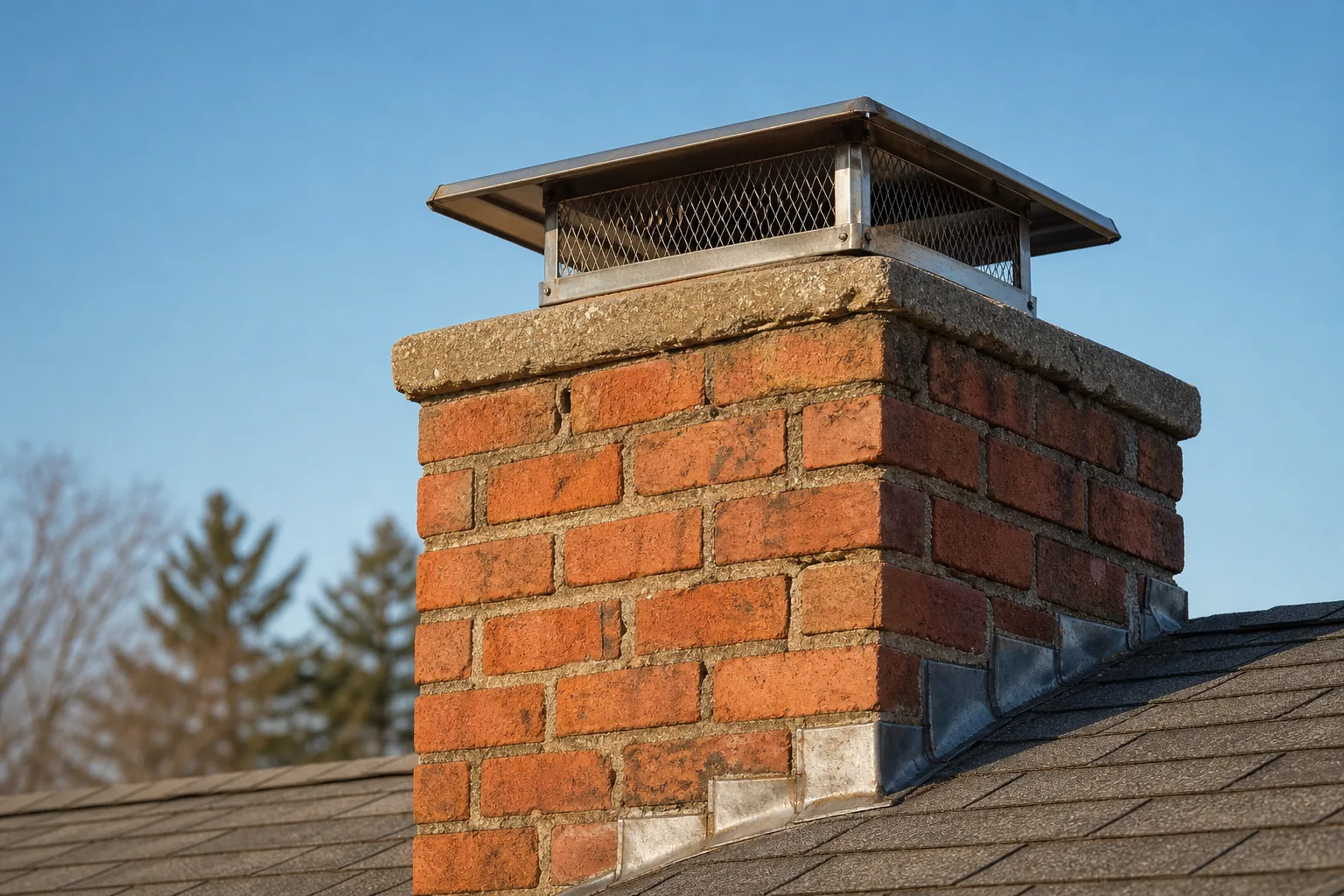
From the field: A chimney cap that has rusted through or gone missing is easy for a homeowner to overlook, because it is the one component you cannot check from the ground or from inside the house. Meanwhile rain, leaves and animals go straight down an open flue. It also sits toward the simpler end of the repair list, which is why an honest sweep tends to raise it early rather than holding it back for a bigger pitch.
How to Vet Fireplace Sweepers Near Me Before You Let Anyone In
This is the part nobody wants to do and everybody regrets skipping. It takes about four minutes on the phone.
Ask for the certification, then verify it yourself. The credential most homeowners will encounter in the US is CSIA, the Chimney Safety Institute of America, which certifies individual technicians, not companies. That distinction matters. A company can advertise "CSIA certified" because one person on staff holds a card while sending someone else to your house. So ask a sharper question: will the technician who comes to my home be certified, and what is their name? CSIA publishes a public directory you can search. Look them up while you are still on the call if you want.
Ask for a certificate of insurance. General liability, and workers' compensation if they have employees. You want it emailed to you from the insurer or the agent, not a photo of a card. This is not paranoia: someone is going to be on your roof and inside your walls.
Ask what the quoted service includes. "Cleaning" is not a defined term. Get specifics: is the flue swept, is the smoke chamber cleaned, is the firebox included, is a camera used, do you get photos, is a written report included, and is there a separate charge for the inspection.
Ask how they handle findings. The answer you want is some version of: we document it, we send you the report, you decide. The answer you do not want is a company that discovers a problem and expects a signature before the truck leaves.
Safety note: Never let anyone perform work on your chimney based on a verbal finding you cannot see. Ask for the photo or the video on the spot. Any technician with a camera can show you the screen in thirty seconds. Refusal to show you the evidence is the loudest red flag in this trade.
Local matters here for a practical reason, not a sentimental one. Chimneys fail differently in different climates: freeze-thaw cycling wrecks masonry in northern winters in ways it simply does not further south, which is why we keep a regional breakdown like cleveland chimney masonry damage separate from the national guidance. A technician who works your area every week knows which failure modes to expect on your street and which decade of housing stock hides which problem.
Sweeping and Inspecting Are Two Different Jobs
Homeowners conflate these constantly, and some companies are happy to let them, because it makes a cheap cleaning look like a clean bill of health. It is not.
Sweeping removes deposits. Inspecting evaluates the structure and whether the system is safe to operate. You can absolutely have a spotless flue that is unsafe to use, and a sooty one that is structurally fine.
NFPA 211, the national standard for chimneys, fireplaces, vents and solid fuel-burning appliances, defines three inspection levels. Here is the practical version:
| Level 1 | Level 2 | Level 3 | |
|---|---|---|---|
| When it applies | Routine annual service, no changes to the system, no known problems | Required at sale or transfer of the property, when the system is changed, after a malfunction, after a chimney fire, or after an external event | When Levels 1 or 2 suggest a hidden hazard that cannot be evaluated any other way |
| What gets examined | Readily accessible parts: firebox, accessible exterior and interior, basic appliance connections | Everything in Level 1, plus accessible attics, crawl spaces and basements, plus a video scan of the flue's full interior | Everything above, plus concealed areas |
| Access required | None beyond normal operation | No demolition; access via openings that already exist | May require removing parts of the chimney or building structure |
| Typical trigger | You booked your yearly service | You are buying, selling, adding an insert, changing fuel, or something went wrong | A serious defect is suspected behind the masonry or wall |
Read the Level 2 row again, because it is the one that catches people. Under NFPA 211, a Level 2 inspection is required at sale or transfer of the property, when there is a change to the system, after a malfunction, after a chimney fire, and after an external event that could have damaged the chimney. "A change to the system" is broader than it sounds: a new liner, a different fuel, or dropping an insert into an open fireplace all qualify. If you are putting in a stove or an insert, you are in Level 2 territory; see fireplace insert installation for what that project involves.
Myth vs. fact: Myth: "I got it swept, so it passed." Fact: a sweep is not a pass. Sweeping is maintenance. An inspection is an evaluation with a defined scope, and the two are priced and documented separately by any company doing it properly. If your paperwork does not say which level of inspection was performed, you did not get one. Our full walkthrough is at chimney inspection near me.

The Red Flags That Should End the Visit
Chimney work has an unfortunate structural weakness: the product is invisible to the customer. It is inside a masonry shaft you cannot see up, on a roof you will not climb. That asymmetry attracts a certain kind of operator.
Watch for these.
Pressure with a deadline attached. "This is unsafe, we can start today, but the price is only good today." Urgency and discount pressure in the same sentence is a sales technique, not a safety finding. Genuine hazards are documented and explained; they do not expire at 5 p.m.
Photos that could be anyone's chimney. Ask when the photo was taken and where in your flue. Ask to see the live camera feed. Vague answers are answers.
A price on the phone with no questions asked. Nobody can price your chimney sight-unseen without at least asking what you burn, how often, what the appliance is, and how tall the stack is. A firm number with no questions means either a bait figure or a job so shallow it does not vary.
Damage that appears only after they are on the roof. It happens legitimately; the roof is where a lot of the damage is. But you should be able to see it in a photo taken from the roof, in context, with your own shingles and your own crown visible in the frame.
No written scope before work starts. If they cannot put the repair in writing with a description and a price before anyone touches anything, you are signing a blank check.
A "free inspection" that is really a sales call. Free is fine. Free that ends with a same-day contract and no report is not an inspection.
Pro tip: Get a second opinion on any recommendation involving relining, rebuilding, or a number that makes you sit down. Reputable companies expect this and are not offended by it. A sweep who reacts badly to the words "I want another opinion" has told you exactly how confident they are in their own findings.
Want a sweep who shows you the footage?
VIO CHIMNEY matches you with a screened local pro who brings cameras and containment, and leaves a written report you actually get to read. Call (513) 655-6702 or request service and tell us what your fireplace has been doing lately.
Beyond the Firebox: The Parts Nobody Thinks to Ask About
The flue gets all the attention. Real failures turn up elsewhere in the system too, and a sweep who only looks up the middle of the chimney will miss those.
The cap and the crown. The cap keeps rain, snow and animals out and carries a spark screen. The crown is the sloped concrete slab at the top that sheds water off the masonry. Both live in the harshest spot on the house and both fail silently. A cracked crown wicks water into the brick, and from there into freeze-thaw damage that shows up years later as spalling and gaps. Start with chimney cap if yours is missing or rusted through.
The liner. This is the sleeve (clay tile, metal, or cast-in-place) that keeps combustion gases inside the chimney and off the surrounding framing. Cracked tiles, gaps at the joints, or a liner sized wrong for the appliance are all genuine hazards, and all invisible without a camera. If a technician tells you the liner is compromised, that is precisely the moment to ask for footage and a second opinion. The background is in chimney liner.
The flashing. Where the chimney meets the roof, metal flashing bridges the joint. When it lifts or corrodes, water runs into the attic and down the chimney chase, and the homeowner blames the roof. A ceiling stain near a chimney can also trace back to the crown, the masonry itself, the roof covering, condensation, or another penetration nearby, but flashing is worth ruling out early, and chimney flashing repair explains how the failure shows itself.
The damper. It should open fully, close fully, and seal. A damper rusted half-open bleeds conditioned air out of your house every day of the year.
The appliance itself. An open masonry fireplace, an insert, a wood stove and a gas unit are four different service jobs. Gas in particular is its own discipline: the burner, the pilot assembly, the venting and the safety controls need a technician who works on gas, which is why gas fireplace service is a separate booking rather than an add-on to a sweep. If you are weighing an insert to make an inefficient open fireplace usable, fireplace inserts near me covers the trade-offs.
While the truck is at your house, the dryer vent is worth asking about. It is the same skill set: a duct, a blockage, a fire risk, and lint accumulation is a recognized cause of house fires. Some chimney companies also handle dryer vent cleaning, so it is worth asking when you book; combining the visits saves you a second appointment.
Good to know: A chimney that smells sour in July is not a cleaning failure. It is usually creosote plus humidity plus a negative pressure problem pulling air down the flue into the house. The fix is often a cap, a damper seal, or an air-balance change rather than another sweep. We took that apart in chimney smell in summer.
The Booking Checklist
Print this, or keep it on your phone while you call. Anything you cannot get a straight answer to is itself an answer.
- Is the technician who will come to my home individually certified, and what is their name?
- Can you email me a certificate of insurance directly from your agent or carrier?
- Does the price include the flue, the smoke chamber and the firebox, or just the flue?
- Will you use a camera, and will I receive the photos or video?
- Do I get a written report, and will it state which NFPA 211 inspection level was performed?
- How do you contain dust, and do you run a HEPA vacuum during the sweep?
- If you find something, do you document it and let me decide, or do you expect a decision on the spot?
- Do you perform repairs yourselves, or subcontract them?
- How long have you worked in my area specifically?
- What do you need me to do before you arrive?
That last one is not filler. A sweep needs the fireplace cold (no fire for at least twenty-four hours), a clear path to the hearth, and pets somewhere else. Clearing the mantel and moving the rug takes you five minutes and saves the technician fifteen.
From the field: The homeowners who get the most out of a visit are the ones who describe the symptom instead of self-diagnosing. "Smoke comes into the room when I first light it, but only in cold weather" tells a technician far more than "I think it needs cleaning." Behavior points at causes. Assumptions point nowhere.
When to Book, and How Often
The industry answer is once a year, and it holds up, but the reasoning is worth understanding rather than taking on faith.
An annual inspection is about the structure: masonry, liner, cap, flashing, damper, and those degrade on a calendar, whether or not you light a fire. A chimney that went unused all winter still went through every freeze-thaw cycle and every storm.
Sweeping frequency, by contrast, depends on use. A weekend-only fireplace burning seasoned hardwood builds deposits slowly. A wood stove running as a primary heat source through a northern winter builds them fast, and burning unseasoned wood or damping the stove down for long smoldering burns accelerates it considerably. NFPA 211's guidance for solid fuel is that chimneys be cleaned when deposits warrant it, which is why the inspection drives the sweep, not the other way around. If you burn heavily, ask your technician to look mid-season rather than waiting a full year.
Book in the off-season if you can. Roof work is safer when there is no ice on the shingles, and a repair discovered in the inspection can be scheduled before you need the heat rather than during. Calling on the first cold morning of the year puts you in line behind everyone else who had the same idea that morning.
There is one timing rule that overrides all of this. If you had a chimney fire (a roaring or rumbling sound, dense smoke, a hot flue, chunks of black debris on the roof or in the yard), stop using the fireplace and get a Level 2 inspection before the next fire. Same for anything that could have shaken or struck the chimney, and same for buying or selling the house.
Safety note: A chimney fire does not always announce itself. Some burn out quickly and quietly and leave behind cracked tiles and heat-damaged mortar that only show up on camera. Puffy or honeycombed creosote, warped damper metal, and discolored cap parts are all signs one happened without your noticing. If a technician points those out, the Level 2 inspection is not an upsell — it is the standard.
If you want the wider view of how to pick a company before you call anyone, chimney sweep near me goes deeper on evaluating outfits, and chimney cleaning covers the mechanics of the job itself. And if the masonry is already coming apart (spalling brick, a crumbling crown, a leaning stack), that is a different conversation entirely, and chimney repair near me is where to start.
Book a sweep in your area
Tell us what your fireplace has been doing and we will tell you what it needs, with photos, in writing, before anything gets recommended. Call VIO CHIMNEY at (513) 655-6702, or request service online and pick a time that works.
Four minutes of questions on the phone will filter out most of the operators you do not want in your house. Ask them before you book, not after the truck is in the driveway.
Symptom checker
What is your chimney doing?
Tap the closest match for an honest first answer.